Contents
Research Article
An Analog of Nagata's Theorem for Modular LCM Domains
-
- Published online by Cambridge University Press:
- 20 November 2018, pp. 307-314
-
- Article
-
- You have access
- Export citation
On Eutactic Forms
-
- Published online by Cambridge University Press:
- 20 November 2018, pp. 1040-1054
-
- Article
-
- You have access
- Export citation
-
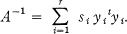
Let (aij) = A be a positive definite n × n symmetric matrix with real entries. To it corresponds a positive definite quadratic form ƒ on Rn : ƒ(x) = txAx = ∑ aijXiXj for x any column vector in Rn . The set of values ƒ(y) for y in Zn — {0} has a minimum m (A) > 0 and the number of “minimal vectors“ y1, … , yr in Zn for which ƒ(yi) = m (A) is finite. By definition, ƒ and A are called eutactic if and only if there are positive numbers s1 ,… , sr such that
On Homeomorphisms of a 3-Dimensional Handlebody
-
- Published online by Cambridge University Press:
- 20 November 2018, pp. 111-124
-
- Article
-
- You have access
- Export citation
An Operad Action on Infinite Loop Space Multiplication
-
- Published online by Cambridge University Press:
- 20 November 2018, pp. 1208-1216
-
- Article
-
- You have access
- Export citation
Cyclic Transformations of Polygons and the Generalized Inverse
-
- Published online by Cambridge University Press:
- 20 November 2018, pp. 756-770
-
- Article
-
- You have access
- Export citation
Matrices Doubly Stochastic by Blocks
-
- Published online by Cambridge University Press:
- 20 November 2018, pp. 559-577
-
- Article
-
- You have access
- Export citation
-
The present work stems from the following classical result, due to G. H. Hardy, J. E. Littlewood, G. Pólya [7], and R. Rado [10].
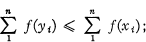
THEOREM 1. Concerning a pair of n-tuples x, y ϵ Rn, the following four statementsare equivalent:
(a) for every continuous, convex function f : R → R
On the Unitarized Adjoint Representation of a Semisimple Lie Group II
-
- Published online by Cambridge University Press:
- 20 November 2018, pp. 1217-1222
-
- Article
-
- You have access
- Export citation
-
Let G be a connected semisimple Lie group with Lie algebra
 . Lebesgue measure on
 is invariant under the adjoint action of G; and so there is a natural unitary representation TG of G on L2
 given by

 . Lebesgue measure on
 is invariant under the adjoint action of G; and so there is a natural unitary representation T
 given by

Every Hausdorff Compactification of a Locally Compact Separable Space is a Ga Compactification
-
- Published online by Cambridge University Press:
- 20 November 2018, pp. 125-131
-
- Article
-
- You have access
- Export citation
Quasi-P-Pure-Injective Groups
-
- Published online by Cambridge University Press:
- 20 November 2018, pp. 578-586
-
- Article
-
- You have access
- Export citation
The Caratheodory Metric and its Majorant Metrics
-
- Published online by Cambridge University Press:
- 20 November 2018, pp. 771-780
-
- Article
-
- You have access
- Export citation
-
One of the main purposes of the present paper is to provide a proof for the following statement:
Theorem A. Let M be a complex manifold of a complex dimension n. Let
 be a fixed point in M such that there exists a square integrable holomorphic n-form a(z) on M with
 .
 be a fixed point in M such that there exists a square integrable holomorphic n-form a(z) on M with
 .
Enlargement of σ-Algebras and Compactness of Time Changes
-
- Published online by Cambridge University Press:
- 20 November 2018, pp. 1055-1065
-
- Article
-
- You have access
- Export citation
When is a Matrix Sign Stable?
-
- Published online by Cambridge University Press:
- 20 November 2018, pp. 315-326
-
- Article
-
- You have access
- Export citation
-
An n X n real matrix A = (aij) is called stable (resp. semistable) if each of its eigenvalues has negative (resp. nonpositive) real part. These notions are important because of their close connection with the stability of motion, which can be described especially simply for a system


Formulas for the Nehari Coefficients of Bounded Univalent Functions
-
- Published online by Cambridge University Press:
- 20 November 2018, pp. 587-605
-
- Article
-
- You have access
- Export citation
Torsion Elements and the Classification of Vector Bundles
-
- Published online by Cambridge University Press:
- 20 November 2018, pp. 327-332
-
- Article
-
- You have access
- Export citation
Best Trigonometric Approximation, Fractional Order Derivatives and Lipschitz Classes
-
- Published online by Cambridge University Press:
- 20 November 2018, pp. 781-793
-
- Article
-
- You have access
- Export citation
-
Let C 2π denote the space of 2π-periodic continuous functions and πn the set of trigonometric polynomials of degree ≦ n, where n ϵ P = {0, 1, … } . Given θ > 0, the well-known theorem of Stečkin and its converse state that the best approximation of an ƒ ϵ C 2π with respect to the max-norm satisfies

Indicator Sets, Reguli, and a New Class of Spreads
-
- Published online by Cambridge University Press:
- 20 November 2018, pp. 132-154
-
- Article
-
- You have access
- Export citation
Compactification of Hereditarily Locally Connected Spaces
-
- Published online by Cambridge University Press:
- 20 November 2018, pp. 1223-1229
-
- Article
-
- You have access
- Export citation
Residuals of the Join of Ascendant Subgroups
-
- Published online by Cambridge University Press:
- 20 November 2018, pp. 1066-1068
-
- Article
-
- You have access
- Export citation
Quasicyclic Subnormal Semigroups
-
- Published online by Cambridge University Press:
- 20 November 2018, pp. 1230-1246
-
- Article
-
- You have access
- Export citation
-
Let T(s), s ≧ 0, be a strongly continuous semigroup of bounded operators on a separable Hilbert space
 . T(s) is said to be quasicyclic if there is a continuum of vectors
 such that T(s)xt = xs+t for all s, t > 0 and

 . T(s) is said to be quasicyclic if there is a continuum of vectors
 such that T(s)x
Irreducible Automorphisms of Certain p-Groups
-
- Published online by Cambridge University Press:
- 20 November 2018, pp. 333-348
-
- Article
-
- You have access
- Export citation