Contents
Research Article
Rice Theorems for ∑n -1 Sets
-
- Published online by Cambridge University Press:
- 20 November 2018, pp. 794-805
-
- Article
-
- You have access
- Export citation
Some Local-Global Principles for Formally Real Fields
-
- Published online by Cambridge University Press:
- 20 November 2018, pp. 606-614
-
- Article
-
- You have access
- Export citation
The Weak Basis Theorem Fails in Non-Locally Convex F-Spaces
-
- Published online by Cambridge University Press:
- 20 November 2018, pp. 1069-1071
-
- Article
-
- You have access
- Export citation
Sum of Squares Rings
-
- Published online by Cambridge University Press:
- 20 November 2018, pp. 155-160
-
- Article
-
- You have access
- Export citation
Simple Proofs of Some Theorems on High Degrees of Unsolvability
-
- Published online by Cambridge University Press:
- 20 November 2018, pp. 1072-1080
-
- Article
-
- You have access
- Export citation
Cone Preserving Mappings for Quadratic Cones Over Arbitrary Fields
-
- Published online by Cambridge University Press:
- 20 November 2018, pp. 1247-1253
-
- Article
-
- You have access
- Export citation
-
Let F be a non-singular metric vector space, that is, a vector space over a field F not of characteristic two, upon which is defined a non-singular symmetric bilinear form ( , ). For any a ϵ V, we define the cone with vertex a to be the set

Homomorphisms from S(X) into S(Y)
-
- Published online by Cambridge University Press:
- 20 November 2018, pp. 615-625
-
- Article
-
- You have access
- Export citation
Positive Perturbations and Unitary Equivalence
-
- Published online by Cambridge University Press:
- 20 November 2018, pp. 161-164
-
- Article
-
- You have access
- Export citation
-
Let T be a (not necessarily bounded) self-adjoint operator on a Hilbert space H with the spectral resolution
 The set of elements x in H for which ||Etx||2 is absolutely continuous is a subspace, H a, of H which reduces T. (See H almos [1, p. 104]; Kato [2, p. 516].) If H a ≠ 0, the restriction of T to DT ⋂ H a is called the absolutely continuous part of T; in case H = H a, T is said to be absolutely continuous.
 The set of elements x in H for which ||E
Recursive Embeddings of Partial Orderings
-
- Published online by Cambridge University Press:
- 20 November 2018, pp. 349-359
-
- Article
-
- You have access
- Export citation
-
Let
 be a countable atomless Boolean algebra and let X be a countable partial ordering. We prove that there exists an embedding of X into
 which is recursive in X,
 and which destroys all suprema and infima of X which can be destroyed. We show that the above theorem is false when we try to preserve all suprema and infima of X instead of destroying them.
On Upcrossing Probabilities
-
- Published online by Cambridge University Press:
- 20 November 2018, pp. 806-818
-
- Article
-
- You have access
- Export citation
A Note on a Comparison Result for Elliptic Equations
-
- Published online by Cambridge University Press:
- 20 November 2018, pp. 1081-1085
-
- Article
-
- You have access
- Export citation
-
In a recent paper [2], Bushard established and applied a comparison theorem for positive solutions to the equation:

in an arbitrary bounded domain D of Euclidean w-space Rn. The proof of these results depended on the absence of mixed derivatives of u in the equation considered.

Bounded Endomorphisms of Lattices of Finite Height
-
- Published online by Cambridge University Press:
- 20 November 2018, pp. 1254-1263
-
- Article
-
- You have access
- Export citation
Translation-Invariant Operators On L p(G), 0 < p < 1 (II)
-
- Published online by Cambridge University Press:
- 20 November 2018, pp. 626-630
-
- Article
-
- You have access
- Export citation
A Note on Quasi-Metrizability
-
- Published online by Cambridge University Press:
- 20 November 2018, pp. 360-366
-
- Article
-
- You have access
- Export citation
-
Let X be a set. A function d from X X X into the nonnegative real numbers is called a ﹛non-archimedean) quasi-metric on X if

On the Distribution Modulo 1 of the Sequence αn 2 + βn
-
- Published online by Cambridge University Press:
- 20 November 2018, pp. 819-826
-
- Article
-
- You have access
- Export citation
-
Dirichlet's Theorem says that for any real α and for N ≧ 1, there exists a natural n ≦ N with

where || || denotes the distance to the nearest integer. Heilbronn [2], improving estimates of Vinogradov [3], showed that for α, N as above and for ϵ ≧ 0, there exists an n ≦ N with


Matchings in Countable Graphs
-
- Published online by Cambridge University Press:
- 20 November 2018, pp. 165-168
-
- Article
-
- You have access
- Export citation
Certain Integral Equalities which Imply Equimeasurability of Functions
-
- Published online by Cambridge University Press:
- 20 November 2018, pp. 827-844
-
- Article
-
- You have access
- Export citation
-
1.1. Two complex measurable functions/ and g on complex measure spaces (X, η) and (Y, v) are equimeasurable, abbreviated ƒ ∼ g, if

for every Borel set E ⊆ C. If Φ is a continuous complex function on C, then we make the following standing hypothesis (HI) which relates Φ, f, and g:
(HI) For all α, β ∊ C, we have
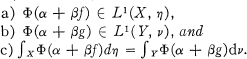
Matrices Sous-Stochastiques et Fonctions Convexes
-
- Published online by Cambridge University Press:
- 20 November 2018, pp. 631-637
-
- Article
-
- You have access
- Export citation
Quantization and Group Representations
-
- Published online by Cambridge University Press:
- 20 November 2018, pp. 1264-1276
-
- Article
-
- You have access
- Export citation
Radical Pairs
-
- Published online by Cambridge University Press:
- 20 November 2018, pp. 1086-1091
-
- Article
-
- You have access
- Export citation