
Contents
Article
A parametrization of sheets of conjugacy classes in bad characteristic
- Part of:
-
- Published online by Cambridge University Press:
- 26 January 2023, pp. 976-983
-
- Article
-
- You have access
- HTML
- Export citation
-
Let G be a simple algebraic group of adjoint type over an algebraically closed field k of bad characteristic. We show that its sheets of conjugacy classes are parametrized by G-conjugacy classes of pairs
 $(M,{\mathcal O})$ where M is the identity component of the centralizer of a semisimple element in G and
 ${\mathcal O}$ is a rigid unipotent conjugacy class in M, in analogy with the good characteristic case.


Determining sets for holomorphic functions on the symmetrized bidisk
- Part of:
-
- Published online by Cambridge University Press:
- 31 January 2023, pp. 984-996
-
- Article
-
- You have access
- HTML
- Export citation
-
A subset
 ${\mathcal D}$ of a domain
 $\Omega \subset {\mathbb C}^d$ is determining for an analytic function
 $f:\Omega \to \overline {{\mathbb D}}$ if whenever an analytic function
 $g:\Omega \rightarrow \overline {{\mathbb D}}$ coincides with f on
 ${\mathcal D}$, equals to f on whole
 $\Omega $. This note finds several sufficient conditions for a subset of the symmetrized bidisk to be determining. For any
 $N\geq 1$, a set consisting of
 $N^2-N+1$ many points is constructed which is determining for any rational inner function with a degree constraint. We also investigate when the intersection of the symmetrized bidisk intersected with some special algebraic varieties can be determining for rational inner functions.


Quasisymmetric harmonics of the exterior algebra
- Part of:
-
- Published online by Cambridge University Press:
- 10 January 2023, pp. 997-1013
-
- Article
-
- You have access
- Open access
- HTML
- Export citation
-
We study the ring of quasisymmetric polynomials in n anticommuting (fermionic) variables. Let
 $R_n$ denote the ring of polynomials in n anticommuting variables. The main results of this paper show the following interesting facts about quasisymmetric polynomials in anticommuting variables:
(1) The quasisymmetric polynomials in
 $R_n$ form a commutative subalgebra of
 $R_n$.
(2) There is a basis of the quotient of
 $R_n$ by the ideal
 $I_n$ generated by the quasisymmetric polynomials in
 $R_n$ that is indexed by ballot sequences. The Hilbert series of the quotient is given by where
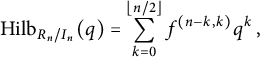 $$ \begin{align*}\text{Hilb}_{R_n/I_n}(q) = \sum_{k=0}^{\lfloor{n/2}\rfloor} f^{(n-k,k)} q^k\,,\end{align*} $$
 $f^{(n-k,k)}$ is the number of standard tableaux of shape
 $(n-k,k)$.
(3) There is a basis of the ideal generated by quasisymmetric polynomials that is indexed by sequences that break the ballot condition.


Bohr–Rogosinski radius for a certain class of close-to-convex harmonic mappings
- Part of:
-
- Published online by Cambridge University Press:
- 31 January 2023, pp. 1014-1029
-
- Article
-
- You have access
- HTML
- Export citation
-
Let
 $ \mathcal {B} $ be the class of analytic functions
 $ f $ in the unit disk
 $ \mathbb {D}=\{z\in \mathbb {C} : |z|<1\} $ such that
 $ |f(z)|<1 $ for all
 $ z\in \mathbb {D} $. If
 $ f\in \mathcal {B} $ of the form
 $ f(z)=\sum _{n=0}^{\infty }a_nz^n $, then
 $ \sum _{n=0}^{\infty }|a_nz^n|\leq 1 $ for
 $ |z|=r\leq 1/3 $ and
 $ 1/3 $ cannot be improved. This inequality is called Bohr inequality and the quantity
 $ 1/3 $ is called Bohr radius. If
 $ f\in \mathcal {B} $ of the form
 $ f(z)=\sum _{n=0}^{\infty }a_nz^n $, then
 $ |\sum _{n=0}^{N}a_nz^n|<1\;\; \mbox {for}\;\; |z|<{1}/{2} $ and the radius
 $ 1/2 $ is the best possible for the class
 $ \mathcal {B} $. This inequality is called Bohr–Rogosinski inequality and the corresponding radius is called Bohr–Rogosinski radius. Let
 $ \mathcal {H} $ be the class of all complex-valued harmonic functions
 $ f=h+\bar {g} $ defined on the unit disk
 $ \mathbb {D} $, where
 $ h $ and
 $ g $ are analytic in
 $ \mathbb {D} $ with the normalization
 $ h(0)=h^{\prime }(0)-1=0 $ and
 $ g(0)=0 $. Let
 $ \mathcal {H}_0=\{f=h+\bar {g}\in \mathcal {H} : g^{\prime }(0)=0\}. $ For
 $ \alpha \geq 0 $ and
 $ 0\leq \beta <1 $, let
 $$ \begin{align*} \mathcal{W}^{0}_{\mathcal{H}}(\alpha, \beta)=\{f=h+\overline{g}\in\mathcal{H}_{0} : \mathrm{Re}\left(h^{\prime}(z)+\alpha zh^{\prime\prime}(z)-\beta\right)>|g^{\prime}(z)+\alpha zg^{\prime\prime}(z)|,\;\; z\in\mathbb{D}\} \end{align*} $$
be a class of close-to-convex harmonic mappings in
 $ \mathbb {D} $. In this paper, we prove the sharp Bohr–Rogosinski radius for the class
 $ \mathcal {W}^{0}_{\mathcal {H}}(\alpha , \beta ) $.


Optimization of the anisotropic Cheeger constant with respect to the anisotropy
- Part of:
-
- Published online by Cambridge University Press:
- 17 February 2023, pp. 1030-1043
-
- Article
-
- You have access
- Open access
- HTML
- Export citation
-
Given an open, bounded set
 $\Omega $ in
 $\mathbb {R}^N$, we consider the minimization of the anisotropic Cheeger constant
 $h_K(\Omega )$ with respect to the anisotropy K, under a volume constraint on the associated unit ball. In the planar case, under the assumption that K is a convex, centrally symmetric body, we prove the existence of a minimizer. Moreover, if
 $\Omega $ is a ball, we show that the optimal anisotropy K is not a ball and that, among all regular polygons, the square provides the minimal value.


Fourier transformable measures with weak Meyer set support and their lift to the cut-and-project scheme
- Part of:
-
- Published online by Cambridge University Press:
- 17 February 2023, pp. 1044-1060
-
- Article
-
- You have access
- Open access
- HTML
- Export citation
-
In this paper, we prove that given a cut-and-project scheme
 $(G, H, \mathcal {L})$ and a compact window
 $W \subseteq H$, the natural projection gives a bijection between the Fourier transformable measures on
 $G \times H$ supported inside the strip
 ${\mathcal L} \cap (G \times W)$ and the Fourier transformable measures on G supported inside
 ${\LARGE \curlywedge }(W)$. We provide a closed formula relating the Fourier transform of the original measure and the Fourier transform of the projection. We show that this formula can be used to re-derive some known results about Fourier analysis of measures with weak Meyer set support.


Perfectly packing a cube by cubes of nearly harmonic sidelength
- Part of:
-
- Published online by Cambridge University Press:
- 14 February 2023, pp. 1061-1071
-
- Article
-
- You have access
- HTML
- Export citation
-
Let d be an integer greater than
 $1$, and let t be fixed such that
 $\frac {1}{d} < t < \frac {1}{d-1}$. We prove that for any
 $n_0$ chosen sufficiently large depending on t, the d-dimensional cubes of sidelength
 $n^{-t}$ for
 $n \geq n_0$ can perfectly pack a cube of volume
 $\sum _{n=n_0}^{\infty } \frac {1}{n^{dt}}$. Our work improves upon a previously known result in the three-dimensional case for when
 $\frac {1}{3} < t \leq \frac {4}{11} $ and
 $n_0 = 1$ and builds upon recent work of Terence Tao in the two-dimensional case.


Front Cover (OFC, IFC) and matter
BCM volume 66 issue 3 Cover and Front matter
-
- Published online by Cambridge University Press:
- 14 September 2023, pp. f1-f4
-
- Article
-
- You have access
- Export citation
Back Cover (OBC, IBC) and matter
BCM volume 66 issue 3 Cover and Back matter
-
- Published online by Cambridge University Press:
- 14 September 2023, pp. b1-b2
-
- Article
-
- You have access
- Export citation