Contents
Research Article
Sur Une Equation Differentielle Fonctionnelle Analytique*
-
- Published online by Cambridge University Press:
- 20 November 2018, pp. 43-46
-
- Article
-
- You have access
- Export citation
Ordinary Singularities of Algebraic Curves
-
- Published online by Cambridge University Press:
- 20 November 2018, pp. 423-431
-
- Article
-
- You have access
- Export citation
-
Let A be the local ring at a singular point p of an algebraic reduced curve. Let M (resp. Ml,..., Mh ) be the maximal ideal of A (resp. of Ā). In this paper we want to classify ordinary singularities p with reduced tangent cone: Spec(G(A)). We prove that G(A) is reduced if and only if: p is an ordinary singularity, and the vector spaces
 span the vector space
 . If the points of the projectivized tangent cone Proj(G(A)) are in generic position then p is an ordinary singularity if and only if G(A) is reduced. We give an example which shows that the preceding equivalence is not true in general.
 span the vector space
 . If the points of the projectivized tangent cone Proj(G(A)) are in generic position then p is an ordinary singularity if and only if G(A) is reduced. We give an example which shows that the preceding equivalence is not true in general.
Continuous Preimages of Spaces with Finite Compactifications
-
- Published online by Cambridge University Press:
- 20 November 2018, pp. 177-180
-
- Article
-
- You have access
- Export citation
Sommes de la Forme

-
- Published online by Cambridge University Press:
- 20 November 2018, pp. 299-307
-
- Article
-
- You have access
- Export citation
-
Dans [8], nous avons étudié l'ordre de grandeur des sommes de la forme
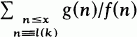 , pour
 ou k, où g(n) et f(n) appartiennent respectivement à une classe de fonctions multiplicatives et additives.

 , pour
 ou k, où g(n) et f(n) appartiennent respectivement à une classe de fonctions multiplicatives et additives.
On the Topologies of R∞
-
- Published online by Cambridge University Press:
- 20 November 2018, pp. 47-51
-
- Article
-
- You have access
- Export citation
Tauberian Conditions for the Equivalence of Weighted Mean and Power Series Methods of Summability
-
- Published online by Cambridge University Press:
- 20 November 2018, pp. 309-316
-
- Article
-
- You have access
- Export citation
-
Suppose throughout that {pn} is a sequence of non-negative numbers with p0>0, that

and that {sn} is a sequence of real numbers.

Operator Topologies and Invariant Operator Ranges
-
- Published online by Cambridge University Press:
- 20 November 2018, pp. 181-185
-
- Article
-
- You have access
- Export citation
On Integrals and Summable Trigonometric Series
-
- Published online by Cambridge University Press:
- 20 November 2018, pp. 433-440
-
- Article
-
- You have access
- Export citation
Other
Notes on Toppair, Top* and Regular Fibrations, Coglueing and Duality
-
- Published online by Cambridge University Press:
- 20 November 2018, pp. 317-329
-
- Article
-
- You have access
- Export citation
Research Article
The Zeroes of Functions Related to Dirichlet L-Functions
-
- Published online by Cambridge University Press:
- 20 November 2018, pp. 53-57
-
- Article
-
- You have access
- Export citation
-
Hecke, [3], has shown for x a real Dirichlet character modulo q, the associated Dirichlet L-function L(s, x) has infinitely many zeroes on the line

Here, using a method of Polya, [5], we show that both the real and imaginary parts of a function associated to L(s, x) through the functional equation, have infinitely many zeroes on any line

On the Approximation of Fixed Points of Locally Nonexpansive Mappings
-
- Published online by Cambridge University Press:
- 20 November 2018, pp. 441-445
-
- Article
-
- You have access
- Export citation
In Search of a Pappian Lattice Identity
-
- Published online by Cambridge University Press:
- 20 November 2018, pp. 187-198
-
- Article
-
- You have access
- Export citation
An Extrapolation Theorem for Contractions with Fixed Points
-
- Published online by Cambridge University Press:
- 20 November 2018, pp. 199-203
-
- Article
-
- You have access
- Export citation
-
In [9] de la Torre proved that if
 is a finite measure space and T is a linear operator on a real
 for some fixed p, 1 < p < ∞ , such that ||T||P ≤ 1 and simultaneously ||T||∞ ≤ l, and also such that there exists
 with Th = h and h≠0 a.e., then the dominated ergodic theorem holds for T, i.e. for every
 we have

de la Torre proved his result, by showing that the operator S, defined by Sf = (sgn h) - T(f • sgn h) for
 is positive, and by applying Akcoglu's theorem [1] to S.
 is a finite measure space and T is a linear operator on a real
 for some fixed p, 1 < p < ∞ , such that ||T||
 with Th = h and h≠0 a.e., then the dominated ergodic theorem holds for T, i.e. for every
 we have

 is positive, and by applying Akcoglu's theorem [1] to S.
Smoothability, Strong Smoothability and Dentability in Banach Spaces1
-
- Published online by Cambridge University Press:
- 20 November 2018, pp. 59-68
-
- Article
-
- You have access
- Export citation
A Kronecker-Type Theorem for Complex Polynomials in Several Variables
-
- Published online by Cambridge University Press:
- 20 November 2018, pp. 447-452
-
- Article
-
- You have access
- Export citation
On the Total Variation of a Function
-
- Published online by Cambridge University Press:
- 20 November 2018, pp. 331-340
-
- Article
-
- You have access
- Export citation
Speculations Concerning the Range of Mahler's Measure
-
- Published online by Cambridge University Press:
- 20 November 2018, pp. 453-469
-
- Article
-
- You have access
- Export citation
Outer Measures and Total Variation
-
- Published online by Cambridge University Press:
- 20 November 2018, pp. 341-345
-
- Article
-
- You have access
- Export citation
On Finitely Generated Simple Complemented Lattices
-
- Published online by Cambridge University Press:
- 20 November 2018, pp. 69-72
-
- Article
-
- You have access
- Export citation
A Probabilistic Approach to the Convolution Transform
-
- Published online by Cambridge University Press:
- 20 November 2018, pp. 205-211
-
- Article
-
- You have access
- Export citation