Contents
Research Article
Analogy in Solving Poisson's Equation
-
- Published online by Cambridge University Press:
- 20 November 2018, pp. 517-521
-
- Article
-
- You have access
- Export citation
Stability of Certain Dynamical Systems
-
- Published online by Cambridge University Press:
- 20 November 2018, pp. 371-373
-
- Article
-
- You have access
- Export citation
-
For n real variables {xi} of time t we consider the following equations:
(1)

Throughout {aij} and {fi} are assumed to be continuous. For any given initial conditions there is assumed to be at least one trajectory solution.

On the Structure of Quotient Rings Which are QFX Rings
-
- Published online by Cambridge University Press:
- 20 November 2018, pp. 203-207
-
- Article
-
- You have access
- Export citation
Best Possible Nets in a Normed Linear Space1
-
- Published online by Cambridge University Press:
- 20 November 2018, pp. 45-48
-
- Article
-
- You have access
- Export citation
-
In this note we examine the question of the existence of a best possible N-net for a bounded set in a normed linear space. A sufficient condition for existence is given which leads to easy proofs of some of the standard results. The pertinent reference here is the paper by Garkavi [1].
Let E be a normed linear space and let M be a bounded set in E. Any system of N points in E will be called an N-net. For a given M and the net SN = {y1, y2,…, yN} define

and

A Banach Space Whose Elements are Classes of Sets of Constant Width
-
- Published online by Cambridge University Press:
- 20 November 2018, pp. 679-689
-
- Article
-
- You have access
- Export citation
-
Let K be a compact subset of the real Euclidean space En . We say that K has constant width if the distance between each pair of distinct parallel hyperplanes which support K is constant. The collection of all compact convex subsets of En which have constant width is denoted
 .
 .
Convergence of Averaged Occupation Times
-
- Published online by Cambridge University Press:
- 20 November 2018, pp. 49-56
-
- Article
-
- You have access
- Export citation
-
Let X = {Xt, t ≥ 0} be a stationary Markov process with values in a measurable space (S, ℬ), transition function p, and initial distribution concentrated at a point x ∊ S. The occupation times of a set A ∊ ℬ are defined for t ≥ 0 by
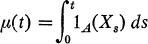
where 1A is the indicator function of A. The expected occupation times are given by
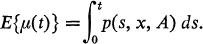
Approximation Polynomiale Generalisee Dans Certains Espaces Semi-Normes
-
- Published online by Cambridge University Press:
- 20 November 2018, pp. 523-527
-
- Article
-
- You have access
- Export citation
On GLn (B) Where B is a Boolean Ring
-
- Published online by Cambridge University Press:
- 20 November 2018, pp. 209-215
-
- Article
-
- You have access
- Export citation
Degrees of Vertices in a Friendship Graph
-
- Published online by Cambridge University Press:
- 20 November 2018, pp. 691-693
-
- Article
-
- You have access
- Export citation
Functions Belonging to a Dirichlet Subalgebra of the Disk Algebra
-
- Published online by Cambridge University Press:
- 20 November 2018, pp. 375-377
-
- Article
-
- You have access
- Export citation
Group Partitions and Mixed Perfect Codes
-
- Published online by Cambridge University Press:
- 20 November 2018, pp. 57-60
-
- Article
-
- You have access
- Export citation
Independence in Combinatorial Geometries of Rank Three
-
- Published online by Cambridge University Press:
- 20 November 2018, pp. 217-221
-
- Article
-
- You have access
- Export citation
Another Possible Abnormality of Compact Space-Time
-
- Published online by Cambridge University Press:
- 20 November 2018, pp. 695-697
-
- Article
-
- You have access
- Export citation
Some Properties of a Certain set of Interpolating Polynomials
-
- Published online by Cambridge University Press:
- 20 November 2018, pp. 529-537
-
- Article
-
- You have access
- Export citation
Uniqueness of Generalized Solutions of Abstract Differential Equations
-
- Published online by Cambridge University Press:
- 20 November 2018, pp. 379-382
-
- Article
-
- You have access
- Export citation
Extension of a Tight Set Function with Values in a Locally Convex Space
-
- Published online by Cambridge University Press:
- 20 November 2018, pp. 699-702
-
- Article
-
- You have access
- Export citation
-
The purpose of the paper is to extend a tight set function on a lattice
 with values in a locally convex space of special type to a measure on the cr-ring generated by . This result generalizes the extension theorem of Thomas [12, p. 151], which in turn contains the extension theorems of Pauc [9, p. 710], Fox [4, p. 525] and J. J. Uhl, Jr. [14, Corollary 2].
 with values in a locally convex space of special type to a measure on the cr-ring generated by
A Canonical Form For Fully Indecomposable (0,1)-Matrices
-
- Published online by Cambridge University Press:
- 20 November 2018, pp. 223-227
-
- Article
-
- You have access
- Export citation
Morphismes et Multiplications Dans Une Algèbre
-
- Published online by Cambridge University Press:
- 20 November 2018, pp. 539-542
-
- Article
-
- You have access
- Export citation
The Maximal Ideal Space of Subalgebras of the Disk Algebra
-
- Published online by Cambridge University Press:
- 20 November 2018, pp. 61-65
-
- Article
-
- You have access
- Export citation
Inner Functions and Isometries
-
- Published online by Cambridge University Press:
- 20 November 2018, pp. 383-385
-
- Article
-
- You have access
- Export citation