Contents
Research Article
The Solutions of Some Functional Equations
-
- Published online by Cambridge University Press:
- 20 November 2018, pp. 279-282
-
- Article
-
- You have access
- Export citation
-
In this paper we are concerned with functional equations of the type
1
 .
in which x, y do not appear explicitly. J. Aczel [1] has given a method forfinding real solutions of some of these equations. We prove a theorem whichcan sometimes be used to solve problems concerning the uniqueness ofsolutions of such equations.

Some Properties of the Rank and Invariant Factors of Matrices*
-
- Published online by Cambridge University Press:
- 20 November 2018, pp. 85-96
-
- Article
-
- You have access
- Export citation
Addendum
Addendum to some useful Matrix Lemmas in Statistical Estimation Theory
-
- Published online by Cambridge University Press:
- 20 November 2018, pp. 615-616
-
- Article
-
- You have access
- Export citation
Research Article
Notes on Numerical Analysis IV. On Accelerating Iteration Procedures With Superlinear Convergence
-
- Published online by Cambridge University Press:
- 20 November 2018, pp. 425-430
-
- Article
-
- You have access
- Export citation
-
In the study of algorithms for the iterative solution of an arbitrary analytic equation f(z) = 0, acceleration procedures are of importance in practice and of considerable interest in the theory of the subject. Let
 .
be an iteration formula which has a zero ξ of f(z) as attractive fixed point. An algorithm of this type is said to converge towards a root ξ of f(z) = 0 for all initial approximations z = z0 in a vicinity of ξ, of order k > 0, when
1
 .
A New Proof of an Inequality of Heinz
-
- Published online by Cambridge University Press:
- 20 November 2018, pp. 97-100
-
- Article
-
- You have access
- Export citation
-
In a recent paper, [l], Dixmier has proved Heinz' inequality by deducing it from a lemma due to Thorin. In this note it is proved directly from a convexity theorem.
Let(M(k), ℳ(k), μ(k)), k = 0, …, n, be measure spaces and Lq(k) (M(k), ℳ(k), μ(k)) be all the functions on M(k) such that


Finite Reciprocities
-
- Published online by Cambridge University Press:
- 20 November 2018, pp. 283-290
-
- Article
-
- You have access
- Export citation
-
A. P. Guinand [1] has shown that for appropriate infinite sequences an, αn,(an, αn real andpositive for all n) the relation
1
 .
implies that
2
 .


New Proofs for two Theorems of Capelli
-
- Published online by Cambridge University Press:
- 20 November 2018, pp. 431-433
-
- Article
-
- You have access
- Export citation
On the Exactness of the Homotopy Sequence
-
- Published online by Cambridge University Press:
- 20 November 2018, pp. 617-618
-
- Article
-
- You have access
- Export citation
-
This note is based on Hu's Homotopy Theory (New York, 1959), pp. 115 f.
The theorem that the homotopy sequence is exact splits into six statements. The fifth in Hu's exposition can be stated as follows: Let f:In, In-1, Jn-1→X, A, x0,
1

Then there exists a map
2

such that f~j g: In, In-1, Jn-1→X, A, x0.


Some Remarks on Ramsay's Theorem
-
- Published online by Cambridge University Press:
- 20 November 2018, pp. 619-622
-
- Article
-
- You have access
- Export citation
Remarks on Quasi-Hermite-Fejér Interpolation
-
- Published online by Cambridge University Press:
- 20 November 2018, pp. 101-119
-
- Article
-
- You have access
- Export citation
-
Let
1

be n+2 distinct points on the real line and let us denote the corresponding real numbers, which are at the moment arbitrary, by
2

The problem of Hermite-Fejér interpolation is to construct the polynomials which take the values (2) at the abscissas (1) and have preassigned derivatives at these points. This idea has recently been exploited in a very interesting manner by P. Szasz [1] who has termed qua si-Hermite-Fejér interpolation to be that process wherein the derivatives are only prescribed at the points x1, x2, …, xn and the points -1, +1 are left out, while the values are prescribed at all the abscissas (1).


A Remark on the Theorems of Lusin and Egoroff
-
- Published online by Cambridge University Press:
- 20 November 2018, pp. 291-295
-
- Article
-
- You have access
- Export citation
On Rellich's Theorem Concerning Infinitely Narrow Tubes
-
- Published online by Cambridge University Press:
- 20 November 2018, pp. 435-440
-
- Article
-
- You have access
- Export citation
Other
A Socratic Dialogue on Mathematics
-
- Published online by Cambridge University Press:
- 20 November 2018, pp. 441-462
-
- Article
-
- You have access
- Export citation
Research Article
On Extremal Properties of the Derivatives of Polynomials and Rational Functions
-
- Published online by Cambridge University Press:
- 20 November 2018, pp. 121-131
-
- Article
-
- You have access
- Export citation
-
Let p(z) be a polynomial of degree n, i. e. a finite sum of the form
 where cν are any given numbers and z=x+iy is a complex variable. To answer a question raised by the chemist Mendelieff, A. Markoff [3] proved the following theorem.
 where c
Some Useful Matrix Lemmas in Statistical Estimation Theory*
-
- Published online by Cambridge University Press:
- 20 November 2018, pp. 297-300
-
- Article
-
- You have access
- Export citation
-
In this note, we present two matrix lemmas (one without proof) which haveinteresting applications in statistical estimation theory.
LEMMA 1. Let A be a k X k positive definite matrix. Then for any k X 1vector c, we have that
1
.
On Abel's Binomial Identity
-
- Published online by Cambridge University Press:
- 20 November 2018, pp. 301-303
-
- Article
-
- You have access
- Export citation
-
The identity of Abel [1] [2] we deal with here can be stated in thefollowing form: If n is a positive integer,
(In order that all terms be defined we require a ≠ 0, b ≠ n.)
This identity and deductions from it have been very useful in many problems,for instance in mathematical statistics [3]. Usually this identity isestablished by means of the Lagrange - Bűrman theorem [4]. Here we willderive it very simply.
Other
University Training in Applied Mathematics
-
- Published online by Cambridge University Press:
- 01 April 2019, pp. 463-466
-
- Article
-
- You have access
- Export citation
Research Article
Computation of the Number of Score Sequences in Round-Robin Tournaments
-
- Published online by Cambridge University Press:
- 20 November 2018, pp. 133-136
-
- Article
-
- You have access
- Export citation
-
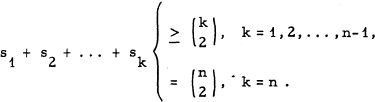
We consider round-robin tournaments of n players in which, at each encounter, the winner is awarded 1 point and the loser 0 (ties are excluded).
Let
1

be the n scores, ordered in a non-decreasing sequence. Clearly
2
Book Reviews: Comptes Rendus Critiques
Décomposition des lois de Probabilités, par Y.V. Linnik. Gauthier Villars,Paris 1962. vi + 294 pages. 55 F.
-
- Published online by Cambridge University Press:
- 01 April 2019, pp. 325-326
-
- Article
-
- You have access
- Export citation
Local Rings, by Masayoshi Nagata. Interscience Tract Number 13, New York, 1962. xiii + 234 pages. $11.00.
-
- Published online by Cambridge University Press:
- 01 April 2019, pp. 154-155
-
- Article
-
- You have access
- Export citation