Contents
Research Article
A Criterion for Taylor Summability of Fourier Series
-
- Published online by Cambridge University Press:
- 20 November 2018, pp. 345-350
-
- Article
-
- You have access
- Export citation
-
Let {ank} be a matrix defined by
1

and n taking only non-negative integer values.
Let f(x) ∈ L [0, 2π] and be periodic with period 2π outside this interval. Let the Fourier series associated with the function f(x) be given by

and let

where s is a constant.

An Elementary Proof of Johnson–Dulmage–Mendelsohn's Refinement of Birkhoff's Theorem on Doubly Stochastic Matrices
-
- Published online by Cambridge University Press:
- 20 November 2018, pp. 81-86
-
- Article
-
- You have access
- Export citation
Local Unique Factorization in the Semigroup of Paths in ℝn
-
- Published online by Cambridge University Press:
- 20 November 2018, pp. 471-475
-
- Article
-
- You have access
- Export citation
On a Functional Equation
-
- Published online by Cambridge University Press:
- 20 November 2018, pp. 235-237
-
- Article
-
- You have access
- Export citation
Complete Diagonals of Latin Squares
-
- Published online by Cambridge University Press:
- 20 November 2018, pp. 477-481
-
- Article
-
- You have access
- Export citation
On Surfaces of Order Three
-
- Published online by Cambridge University Press:
- 20 November 2018, pp. 351-355
-
- Article
-
- You have access
- Export citation
Some Progression-Free Partitions Constructed using Folkman's Method
-
- Published online by Cambridge University Press:
- 20 November 2018, pp. 87-91
-
- Article
-
- You have access
- Export citation
Sur le Dérivé du Cuboïde Eulérien
-
- Published online by Cambridge University Press:
- 20 November 2018, pp. 239-241
-
- Article
-
- You have access
- Export citation
A Note on Isomorphisms of Multiplier Algebras
-
- Published online by Cambridge University Press:
- 20 November 2018, pp. 243-245
-
- Article
-
- You have access
- Export citation
Multiplication Modules
-
- Published online by Cambridge University Press:
- 20 November 2018, pp. 93-98
-
- Article
-
- You have access
- Export citation
Bounds on Positive Integral Solutions of Linear Diophantine Equations II
-
- Published online by Cambridge University Press:
- 20 November 2018, pp. 357-361
-
- Article
-
- You have access
- Export citation
-
Let A be an m × n matrix of rank r and B an m × 1 matrix, both with integer entries. Let M2 be the maximum of the absolute values of the r × r minors of the augmented matrix (A | B). Suppose that the system A x = B has a non-trivial solution in non-negative integers. We prove (1) If r = n - 1 then the system A x = B has a non-negative non-trivial solution with entries bounded by M2. (2) If A has a r x n submatrix such that none of its r x r minors is 0 and x ≥ 0 is a solution of Ax=B in integers such that
 is minimal, then
 .
 is minimal, then
 .
On the Inequality
-
- Published online by Cambridge University Press:
- 20 November 2018, pp. 483-489
-
- Article
-
- You have access
- Export citation
-
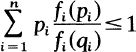
In this paper, we are concerned with the functional inequality
1
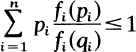
where 0 < Pi < l, 0 < qi < l, fi(p)≠0, for 0 < P < 1, (i = 1, 2,..., n)
 and n is a fixed positive integer, n ≥ 2.
Inequality (1) was studied by Rényi and Fischer, (see [1], [3]) in the special case
2
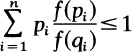
and this provided a characterization of Rényi's entropy.
 and n is a fixed positive integer, n ≥ 2.
A Counterexample in Finite Fixed Point Theory
-
- Published online by Cambridge University Press:
- 20 November 2018, pp. 99-100
-
- Article
-
- You have access
- Export citation
Note on Best Approximation of |x|
-
- Published online by Cambridge University Press:
- 20 November 2018, pp. 363-366
-
- Article
-
- You have access
- Export citation
-
In this note the best uniform approximation on [—1,1] to the function |x| by symmetric complex valued linear fractional transformations is determined. This is a special case of the more general problem studied in [1]. Namely, for any even, real valued function f(x) on [-1,1] satsifying 0 = f ( 0 ) ≤ f (x) ≤ f (1) = 1, determine the degree of symmetric approximation

and the extremal transformations U whenever they exist.
On Regular-Closed and Minimal Regular Spaces
-
- Published online by Cambridge University Press:
- 20 November 2018, pp. 491-497
-
- Article
-
- You have access
- Export citation
A Note on Reductive Operators
-
- Published online by Cambridge University Press:
- 20 November 2018, pp. 101-102
-
- Article
-
- You have access
- Export citation
-
For a bounded linear operator T on a Hilbert space
 , denote by Lat0T the lattice of all linear submanifolds
 of such that
 , and by
 (resp. Lat T) the sublattice consisting of operator ranges (resp. closed subspaces).
 , denote by Lat
 of
 , and by
 (resp. Lat T) the sublattice consisting of operator ranges (resp. closed subspaces).
Functional Dependence and Analytic Functions
-
- Published online by Cambridge University Press:
- 20 November 2018, pp. 367-369
-
- Article
-
- You have access
- Export citation
Function Spaces Continuously Paired by Operators of Convolution-Type
-
- Published online by Cambridge University Press:
- 20 November 2018, pp. 499-507
-
- Article
-
- You have access
- Export citation
A Note on Derivations II
-
- Published online by Cambridge University Press:
- 20 November 2018, pp. 509-511
-
- Article
-
- You have access
- Export citation
A Central Limit Theorem for General Stochastic Processes
-
- Published online by Cambridge University Press:
- 20 November 2018, pp. 103-104
-
- Article
-
- You have access
- Export citation