Contents
Research Article
Endomorphisms That Are the Sum of a Unit and a Root of a Fixed Polynomial
-
- Published online by Cambridge University Press:
- 20 November 2018, pp. 265-269
-
- Article
-
- You have access
- Export citation
-
If
 $C=C\left( R \right)$ denotes the center of a ring
 $R$ and
 $g\left( x \right)$ is a polynomial in
 $C\left[ x \right]$ , Camillo and Simón called a ring $g\left( x \right)$ -clean if every element is the sum of a unit and a root of $g\left( x \right)$ . If
 $V$ is a vector space of countable dimension over a division ring
 $D$ , they showed that
 $\text{en}{{\text{d}}_{\,D}}V$ is $g\left( x \right)$ -clean provided that $g\left( x \right)$ has two roots in
 $C\left( D \right)$ . If
 $g\left( x \right)=x-{{x}^{2}}$ this shows that $\text{en}{{\text{d}}_{\,D}}V$ is clean, a result of Nicholson and Varadarajan. In this paper we remove the countable condition, and in fact prove that
 $\text{en}{{\text{d}}_{\,R}}M$ is $g\left( x \right)$ -clean for any semisimple module
 $M$ over an arbitrary ring
 $R$ provided that
 $g\left( x \right)\in \left( x-a \right)\left( x-b \right)C\left[ x \right] $ where
 $a,b\in C$ and both
 $b$ and
 $b-a$ are units in $R$ .


Unimodular Roots of Special Littlewood Polynomials
-
- Published online by Cambridge University Press:
- 20 November 2018, pp. 438-447
-
- Article
-
- You have access
- Export citation
-
We call
 $\alpha \left( z \right)={{a}_{0}}+{{a}_{1}}z+\cdot \cdot \cdot +{{a}_{n-1}}{{z}^{n-1}}$ a Littlewood polynomial if
 ${{a}_{j}}=\pm 1$ for all
 $j$ . We call
 $\alpha \left( z \right)$ self-reciprocal if
 $\alpha \left( z \right)={{z}^{n-1}}\alpha \left( 1/z \right)$ , and call $\alpha \left( z \right)$ skewsymmetric if
 $n=2m+1$ and
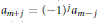 ${{a}_{m+j}}={{\left( -1 \right)}^{j}}{{a}_{m-j}}$ for all $j$ . It has been observed that Littlewood polynomials with particularly high minimum modulus on the unit circle in
 $\mathbb{C}$ tend to be skewsymmetric. In this paper, we prove that a skewsymmetric Littlewood polynomial cannot have any zeros on the unit circle, as well as providing a new proof of the known result that a self-reciprocal Littlewood polynomial must have a zero on the unit circle.


On Non-Integral Dehn Surgeries Creating Non-Orientable Surfaces
-
- Published online by Cambridge University Press:
- 20 November 2018, pp. 624-627
-
- Article
-
- You have access
- Export citation
PSL(2, 2n )-Extensions Over

-
- Published online by Cambridge University Press:
- 20 November 2018, pp. 113-116
-
- Article
-
- You have access
- Export citation
-
We construct a one-parameter generic polynomial for
 $\text{PSL}\left( 2,{{2}^{n}} \right)$ over
 ${{\mathbb{F}}_{{{2}^{n}}}}$ .


A Double Triangle Operator Algebra From SL 2(ℝ+)
-
- Published online by Cambridge University Press:
- 20 November 2018, pp. 117-126
-
- Article
-
- You have access
- Export citation
-
We consider the
 ${{w}^{*}}$ -closed operator algebra
 ${{\mathcal{A}}_{+}}$ generated by the image of the semigroup
 $S{{L}_{2}}\left( {{\mathbb{R}}_{+}} \right)$ under a unitary representation
 $\rho$ of
 $S{{L}_{2}}\left( \mathbb{R} \right)$ on the Hilbert space
 ${{L}^{2}}\left( \mathbb{R} \right)$ . We show that ${{\mathcal{A}}_{+}}$ is a reflexive operator algebra and
 ${{\mathcal{A}}_{+}}=\text{Alg }\mathcal{D}$ where
 $\mathcal{D}$ is a double triangle subspace lattice. Surprisingly, ${{\mathcal{A}}_{+}}$ is also generated as a ${{w}^{*}}$ -closed algebra by the image under $\rho$ of a strict subsemigroup of $S{{L}_{2}}\left( {{\mathbb{R}}_{+}} \right)$ .


A Characterization of Products of Projective Spaces
-
- Published online by Cambridge University Press:
- 20 November 2018, pp. 270-280
-
- Article
-
- You have access
- Export citation
A Lower Bound on the Number of Cyclic Function Fields With Class Number Divisible by n
-
- Published online by Cambridge University Press:
- 20 November 2018, pp. 448-463
-
- Article
-
- You have access
- Export citation
-
In this paper, we find a lower bound on the number of cyclic function fields of prime degree
 $l$ whose class numbers are divisible by a given integer
 $n$ . This generalizes a previous result of D. Cardon and R. Murty which gives a lower bound on the number of quadratic function fields with class numbers divisible by $n$ .


Approximation and the Topology of Rationally Convex Sets
-
- Published online by Cambridge University Press:
- 20 November 2018, pp. 628-636
-
- Article
-
- You have access
- Export citation
-
Considering a mapping
 $g$ holomorphic on a neighbourhood of a rationally convex set
 $K\subset {{\mathbb{C}}^{n}}$ , and range into the complex projective space
 $\mathbb{C}{{\mathbb{P}}^{m}}$ , the main objective of this paper is to show that we can uniformly approximate $g$ on
 $K$ by rational mappings defined from
 ${{\mathbb{C}}^{n}}$ into $\mathbb{C}{{\mathbb{P}}^{m}}$ . We only need to ask that the second Čech cohomology group
 ${{\overset{\scriptscriptstyle\smile}{H}}^{2}}\left( K,\mathbb{Z} \right)$ vanishes.


Correction to a Theorem on Total Positivity
-
- Published online by Cambridge University Press:
- 20 November 2018, pp. 281-284
-
- Article
-
- You have access
- Export citation
-
A well-known theorem states that if
 $f\left( z \right)$ generates a
 $\text{P}{{\text{F}}_{r}}$ sequence then
 $1/f\left( -z \right)$ generates a $\text{P}{{\text{F}}_{r}}$ sequence. We give two counterexamples which show that this is not true, and give a correct version of the theorem. In the infinite limit the result is sound: if $f\left( z \right)$ generates a
 $\text{PF}$ sequence then $1/f\left( -z \right)$ generates a $\text{PF}$ sequence.


Other
Index of Volume 49
-
- Published online by Cambridge University Press:
- 20 November 2018, pp. 637-640
-
- Article
-
- You have access
- Export citation
Research Article
A Note on Detecting Algebraic Cycles
-
- Published online by Cambridge University Press:
- 20 November 2018, pp. 464-471
-
- Article
-
- You have access
- Export citation
-
The purpose of this note is to show that the homologically trivial cycles contructed by Clemens and their generalisations due to Paranjape can be detected by the technique of spreading out. More precisely, we associate to these cycles (and the ambient varieties in which they live) certain families which arise naturally and which are defined over
 $\mathbb{C}$ and show that these cycles, along with their relations, can be detected in the singular cohomology of the total space of these families.

Character Degree Graphs of Solvable Groups of Fitting Height 2
-
- Published online by Cambridge University Press:
- 20 November 2018, pp. 127-133
-
- Article
-
- You have access
- Export citation
-
Given a finite group
 $G$ , we attach to the character degrees of $G$ a graph whose vertex set is the set of primes dividing the degrees of irreducible characters of $G$ , and with an edge between
 $p$ and
 $q$ if
 $pq$ divides the degree of some irreducible character of $G$ . In this paper, we describe which graphs occur when $G$ is a solvable group of Fitting height 2.


Real Hypersurfaces in Complex Two-Plane Grassmannians with Vanishing Lie Derivative
-
- Published online by Cambridge University Press:
- 20 November 2018, pp. 134-143
-
- Article
-
- You have access
- Export citation
-
In this paper we give a characterization of real hypersurfaces of type
 $A$ in a complex two-plane Grassmannian
 ${{G}_{2}}\left( {{\mathbb{C}}^{m+2}} \right)$ which are tubes over totally geodesic
 ${{G}_{2}}\left( {{\mathbb{C}}^{m+1}} \right)$ in ${{G}_{2}}\left( {{\mathbb{C}}^{m+2}} \right)$ in terms of the vanishing Lie derivative of the shape operator
 $A$ along the direction of the Reeb vector field
 $\xi$ .


Orbits and Stabilizers for Solvable Linear Groups
-
- Published online by Cambridge University Press:
- 20 November 2018, pp. 285-295
-
- Article
-
- You have access
- Export citation
-
We extend a result of Noritzsch, which describes the orbit sizes in the action of a Frobenius group
 $G$ on a finite vector space
 $V$ under certain conditions, to a more general class of finite solvable groups $G$ . This result has applications in computing irreducible character degrees of finite groups. Another application, proved here, is a result concerning the structure of certain groups with few complex irreducible character degrees.


Cyclic Cubic Fields of Given Conductor and Given Index
-
- Published online by Cambridge University Press:
- 20 November 2018, pp. 472-480
-
- Article
-
- You have access
- Export citation
On the Modularity of Three Calabi–Yau Threefolds With Bad Reduction at 11
-
- Published online by Cambridge University Press:
- 20 November 2018, pp. 296-312
-
- Article
-
- You have access
- Export citation
-
This paper investigates the modularity of three non-rigid Calabi–Yau threefolds with bad reduction at 11. They are constructed as fibre products of rational elliptic surfaces, involving the modular elliptic surface of level 5. Their middle
 $\ell$ -adic cohomology groups are shown to split into two-dimensional pieces, all but one of which can be interpreted in terms of elliptic curves. The remaining pieces are associated to newforms of weight 4 and level 22 or 55, respectively. For this purpose, we develop a method by Serre to compare the corresponding two-dimensional 2-adic Galois representations with uneven trace. Eventually this method is also applied to a self fibre product of the Hesse-pencil, relating it to a newform of weight 4 and level 27.

Scattering Length and the Spectrum of –Δ + V
-
- Published online by Cambridge University Press:
- 20 November 2018, pp. 144-151
-
- Article
-
- You have access
- Export citation
-
Given a non-negative, locally integrable function
 $V$ on
 ${{\mathbb{R}}^{n}}$ , we give a necessary and sufficient condition that
 $-\Delta +V$ have purely discrete spectrum, in terms of the scattering length of $V$ restricted to boxes.


Comparison Geometry With L 1-Norms of Ricci Curvature
-
- Published online by Cambridge University Press:
- 20 November 2018, pp. 152-160
-
- Article
-
- You have access
- Export citation
-
We investigate the geometry of manifolds with bounded Ricci curvature in
 ${{L}^{1}}$ -sense. In particular, we generalize the classical volume comparison theorem to our situation and obtain a generalized sphere theorem.

On the Relation Between the Gaussian Orthogonal Ensemble and Reflections, or a Self-Adjoint Version of the Marcus–Pisier Inequality
-
- Published online by Cambridge University Press:
- 20 November 2018, pp. 313-320
-
- Article
-
- You have access
- Export citation