Contents
Research Article
Kiss-Precise Sequential Rotatable Designs
-
- Published online by Cambridge University Press:
- 20 November 2018, pp. 207-217
-
- Article
-
- You have access
- Export citation
Sur Le Calcul Des Zeros D'un Operateur Discontinu Par Iteration
-
- Published online by Cambridge University Press:
- 20 November 2018, pp. 541-544
-
- Article
-
- You have access
- Export citation
A New Method in Arithmetical Functions and Contour Integration
-
- Published online by Cambridge University Press:
- 20 November 2018, pp. 381-387
-
- Article
-
- You have access
- Export citation
-
If f is a suitable meromorphic function, then by a classical technique in the calculus of residues, one can evaluate in closed form series of the form,

Suppose that a(n) is an arithmetical function. It is natural to ask whether or not one can evaluate by contour integration
(1.1)

where f belongs to a suitable class of meromorphic functions. We shall give here only a partial answer for a very limited class of arithmetical functions.
Oscillation Criteria for Second Order Nonlinear Delay Equations
-
- Published online by Cambridge University Press:
- 20 November 2018, pp. 49-56
-
- Article
-
- You have access
- Export citation
-
It is the purpose of this paper to establish oscillation criteria for second order nonlinear differential equations with retarded argument. Specifically, we consider the equation
1.1

where f ∊ C[0, + ∞) x R 2, g ∊ C[0, + ∞), and
1.2

We shall restrict attention to solutions of (1.1) which exist on some ray [T, + ∞). A solution of (1.1) is called oscillatory if it has no largest zero.
Open, Connected Functions
-
- Published online by Cambridge University Press:
- 20 November 2018, pp. 57-60
-
- Article
-
- You have access
- Export citation
On the Expected Number of Visits of a Particle before Absorption in a Correlated Random Walk
-
- Published online by Cambridge University Press:
- 20 November 2018, pp. 389-395
-
- Article
-
- You have access
- Export citation
Pointwise Compact Spaces
-
- Published online by Cambridge University Press:
- 20 November 2018, pp. 545-549
-
- Article
-
- You have access
- Export citation
Analytic Evaluation of Certain Characteristic Classes(1)
-
- Published online by Cambridge University Press:
- 20 November 2018, pp. 219-223
-
- Article
-
- You have access
- Export citation
On the Irregular Sets of a Transformation Group
-
- Published online by Cambridge University Press:
- 20 November 2018, pp. 225-232
-
- Article
-
- You have access
- Export citation
-
We assume throughout that (X, T, π) is a transformation group [2], where X is a topological space which is always assumed to be regular and Hausdorff. We call a point x ∊ X regular under T if for any open set U in X and any subset G of T such that
 , there exists an open set V containing x, such that VG ⊆ U [7]. Let R(X) denote the interior of the set of all the regular points of X under T, and I(X) the set of irregular points of X under T, that is the set of points which are not regular under T.
 , there exists an open set V containing x, such that VG ⊆ U [7]. Let R(X) denote the interior of the set of all the regular points of X under T, and I(X) the set of irregular points of X under T, that is the set of points which are not regular under T.
Uniqueness of the Coefficient Ring in Some Group Rings
-
- Published online by Cambridge University Press:
- 20 November 2018, pp. 551-555
-
- Article
-
- You have access
- Export citation
On Certain Quotients of Grothendieck Groups
-
- Published online by Cambridge University Press:
- 20 November 2018, pp. 397-400
-
- Article
-
- You have access
- Export citation
Densities and Measures of Linear Sets
-
- Published online by Cambridge University Press:
- 20 November 2018, pp. 61-66
-
- Article
-
- You have access
- Export citation
-
If In , I∞ denote the intervals [0, n), [0, ∞) respectively, we propose to examine the properties of an upper and lower density
(1)

(1)

of a set S belonging to the power set
 of I∞ where m*,m* denote the outer and inner (linear) Lebesgue measures.


 of I
A Converse Problem in Matrix Differential Equations
-
- Published online by Cambridge University Press:
- 20 November 2018, pp. 401-403
-
- Article
-
- You have access
- Export citation
-
Suppose X and F are nxn matrix solutions of the n X n matrix differential equation
(1)
such that
(2)
where J is some interval.
A Central Limit Theorem for Multiplicative Systems
-
- Published online by Cambridge University Press:
- 20 November 2018, pp. 67-73
-
- Article
-
- You have access
- Export citation
On a Class of Positive Linear Operators
-
- Published online by Cambridge University Press:
- 20 November 2018, pp. 557-559
-
- Article
-
- You have access
- Export citation
-
In a recent paper [3] Meir and Sharma introduced a generalization of the Sα- method of summability. The elements of their matrix, (a nk ), are defined by
(1)
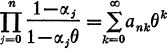
where
 is a sequence of complex numbers. if 0 < αj < l for each j = 0, 1, 2,… then a nk ≥0 for each n = 0, 1, 2,… and k = 0,1,2,…
 is a sequence of complex numbers. if 0 < α
The Fitting Length of a Finite Soluble Group and the Number of Conjugacy Classes of its Maximal Metanilpotent Subgroups
-
- Published online by Cambridge University Press:
- 20 November 2018, pp. 233-237
-
- Article
-
- You have access
- Export citation
On Selecting a Spurious Observation
-
- Published online by Cambridge University Press:
- 20 November 2018, pp. 75-78
-
- Article
-
- You have access
- Export citation
Profinite Modules
-
- Published online by Cambridge University Press:
- 20 November 2018, pp. 405-415
-
- Article
-
- You have access
- Export citation
Existence of Solutions of Abstract Differential Equations in a Local Space
-
- Published online by Cambridge University Press:
- 20 November 2018, pp. 239-244
-
- Article
-
- You have access
- Export citation
-
Let H be a Hilbert space; ( , ) and | | represent the scalar product and the norm respectively in H. Let A be a closed linear operator with domain DA dense in H and A* be its adjoint with domain DA*. DA and DA* are also Hilbert spaces under their respective graph scalar product. R(λ; A*) denotes the resolvent of A* ;
 complex plane. We write L = D — A, L* = D — A*; D = (l/i)(d/dt).
 complex plane. We write L = D — A, L
The Eigenvalues and Singular Values of Matrix Sums and Products. VII (1)
-
- Published online by Cambridge University Press:
- 20 November 2018, pp. 561-569
-
- Article
-
- You have access
- Export citation