Contents
Original Article
Flexibility of Lyapunov exponents with respect to two classes of measures on the torus
- Part of:
-
- Published online by Cambridge University Press:
- 31 May 2021, pp. 737-776
-
- Article
-
- You have access
- Export citation
-
We consider a smooth area-preserving Anosov diffeomorphism
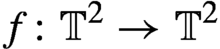 $f\colon \mathbb T^2\rightarrow \mathbb T^2$ homotopic to an Anosov automorphism L of
 $\mathbb T^2$. It is known that the positive Lyapunov exponent of f with respect to the normalized Lebesgue measure is less than or equal to the topological entropy of L, which, in addition, is less than or equal to the Lyapunov exponent of f with respect to the probability measure of maximal entropy. Moreover, the equalities only occur simultaneously. We show that these are the only restrictions on these two dynamical invariants.

Back Cover (OBC, IBC) and matter
ETS volume 42 issue 8 Cover and Back matter
-
- Published online by Cambridge University Press:
- 06 July 2022, pp. b1-b2
-
- Article
-
- You have access
- Export citation
Original Article
Minimal flows with arbitrary centralizer
- Part of:
-
- Published online by Cambridge University Press:
- 29 December 2020, pp. 310-320
-
- Article
-
- You have access
- Export citation
-
Given a G-flow X, let
 $\mathrm{Aut}(G, X)$, or simply
 $\mathrm{Aut}(X)$, denote the group of homeomorphisms of X which commute with the G action. We show that for any pair of countable groups G and H with G infinite, there is a minimal, free, Cantor G-flow X so that H embeds into
 $\mathrm{Aut}(X)$. This generalizes results of [2, 7].
Topological weak mixing and diffusion at all times for a class of Hamiltonian systems
- Part of:
-
- Published online by Cambridge University Press:
- 25 May 2021, pp. 777-791
-
- Article
-
- You have access
- Open access
- Export citation
Front Cover (OFC, IFC) and matter
ETS volume 42 issue 9 Cover and Front matter
-
- Published online by Cambridge University Press:
- 04 August 2022, pp. f1-f2
-
- Article
-
- You have access
- Export citation
Original Article
Thermodynamics of smooth models of pseudo–Anosov homeomorphisms
- Part of:
-
- Published online by Cambridge University Press:
- 18 May 2021, pp. 1284-1326
-
- Article
-
- You have access
- Open access
- Export citation
Front Cover (OFC, IFC) and matter
ETS volume 42 issue 1 Cover and Front matter
-
- Published online by Cambridge University Press:
- 07 December 2021, pp. f1-f2
-
- Article
-
- You have access
- Export citation
Back Cover (OBC, IBC) and matter
ETS volume 42 issue 9 Cover and Back matter
-
- Published online by Cambridge University Press:
- 04 August 2022, pp. b1-b2
-
- Article
-
- You have access
- Export citation
Original Article
Almost existence from the feral perspective and some questions
- Part of:
-
- Published online by Cambridge University Press:
- 10 June 2021, pp. 792-834
-
- Article
-
- You have access
- Export citation
Back Cover (OBC, IBC) and matter
ETS volume 42 issue 1 Cover and Back matter
-
- Published online by Cambridge University Press:
- 07 December 2021, pp. b1-b2
-
- Article
-
- You have access
- Export citation
Front Cover (OFC, IFC) and matter
ETS volume 42 issue 3 Cover and Front matter
-
- Published online by Cambridge University Press:
- 03 February 2022, pp. f1-f4
-
- Article
-
- You have access
- Export citation
Back Cover (OBC, IBC) and matter
ETS volume 42 issue 3 Cover and Back matter
-
- Published online by Cambridge University Press:
- 03 February 2022, pp. b1-b4
-
- Article
-
- You have access
- Export citation
Front Cover (OFC, IFC) and matter
ETS volume 42 issue 2 Cover and Front matter
-
- Published online by Cambridge University Press:
- 12 January 2022, pp. f1-f4
-
- Article
-
- You have access
- Export citation
Back Cover (OBC, IBC) and matter
ETS volume 42 issue 2 Cover and Back matter
-
- Published online by Cambridge University Press:
- 12 January 2022, pp. b1-b6
-
- Article
-
- You have access
- Export citation