We partner with a secure submission system to handle manuscript submissions.
Please note:
You will need an account for the submission system, which is separate to your Cambridge Core account. For login and submission support, please visit the
submission and support pages.
Please review this journal's author instructions, particularly the
preparing your materials
page, before submitting your manuscript.
Click Proceed to submission system to continue to our partner's website.
To save this undefined to your undefined account, please select one or more formats and confirm that you agree to abide by our usage policies. If this is the first time you used this feature, you will be asked to authorise Cambridge Core to connect with your undefined account.
Find out more about saving content to .
To send this article to your Kindle, first ensure no-reply@cambridge.org is added to your Approved Personal Document E-mail List under your Personal Document Settings on the Manage Your Content and Devices page of your Amazon account. Then enter the ‘name’ part of your Kindle email address below. Find out more about sending to your Kindle.
Find out more about saving to your Kindle.
Note you can select to save to either the @free.kindle.com or @kindle.com variations. ‘@free.kindle.com’ emails are free but can only be saved to your device when it is connected to wi-fi. ‘@kindle.com’ emails can be delivered even when you are not connected to wi-fi, but note that service fees apply.
Previous studies suggest that individuals with tattoos and piercings exhibit higher impulsive personality traits compared to peers without body modifications. No studies on body modifications and core-symptoms of ADHD are available.
Objectives
This study aimed to compare self-reported ADHD symptoms between non-clinical adults with and without body modifications.
Methods
A non-clinical adult Swedish population (n=815) completed the Adult ADHD self-report scale (ASRS-v1.1) and answered questions concerning body modification. ADHD diagnosis served as exclusion criterion. Three grouping variables were analysed separately; tattoo status, piercing status and a combination of having both tattoo and piercing. Linear regression compared mean ASRS total- and subscale scores between individuals with and without body modification according to each grouping variable, while adjusting for candidate covariates age and sex.
Results
The prevalence of each body modification variable was; 30% for tattoo, 18% for piercing other than earlobe and 12% for combination of tattoo and piercing. Any combination of body modification was associated with significantly higher ASRS total- and subscale scores compared to no body modification. The most pronounced differences between groups were for the combination of tattoo and piercing, and on the hyperactivity/impulsivity (HI) subscale; revealing adjusted mean differences of 4.3 points (range 0-72) on the ASRS-total score (p <0.001) and 2.6 points (range 0-36) on the ASRS HI subscale (p <0.001).
Conclusions
Body modification was associated with more pronounced ADHD core symptoms amongst non-clinical adults. Although statistically significant, the clinical significance is uncertain. The prevalence rates of body modifications in our cohort indicate that they are becoming cultural normal.
Adolescents with major depressive disorder (MDD) often show reduced prefrontal functional connectivity with the subcortical regions than healthy controls (HC) (Tang et al., 2018). However, relatively little is known about longitudinal effects of antidepressant (AD) treatment on resting state functional connectivity (RSFC) in the prefrontal cortex (PFC).
Objectives
This study aimed to investigate abnormal PFC RSFC in MDD adolescents compared to HC and longitudinal effects of AD on PFC RSFC.
Methods
This study included 59 adolescents with MDD and 43 HC. MDD adolescents were treated with escitalopram in an 8 week, open-label trial. The treatment outcome was assessed by Children’s Depression Rating Scale (CDRS-R) and patients showing at least a 40% improvement in CDRS-R scores from baseline to week 8 were defined as “responders”. Functional and T1 images collected before and after treatment were processed using AFNI and Freesurfer. Our seed was the lateral PFC (LPFC, BA46). T-tests and repeated measures ANCOVAs, controlling for age and IQ, were conducted to examine abnormal PFC RSFC and longitudinal effects of AD on LPFC RSFC.
Results
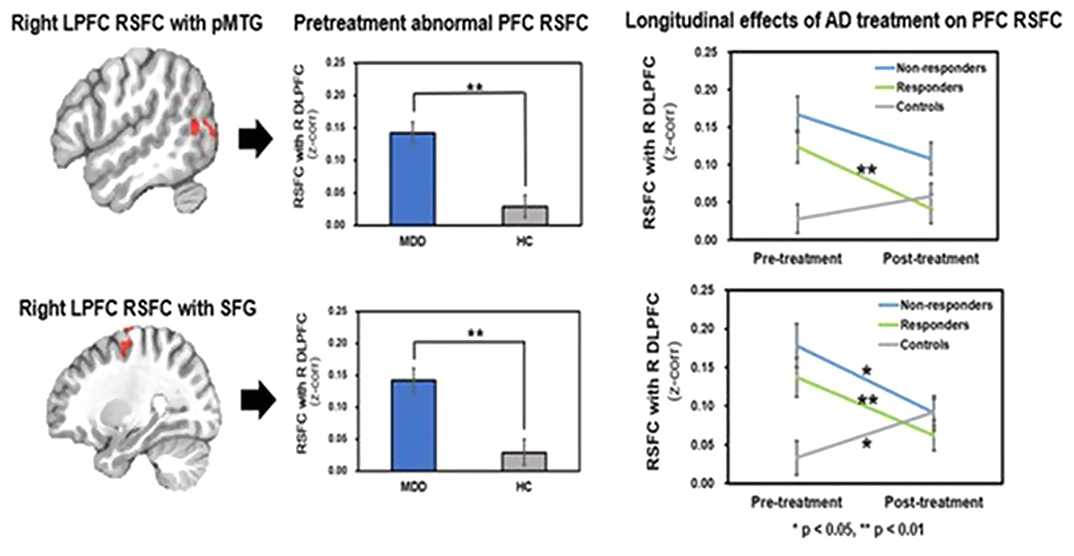
Relative to HC, MDD showed increased LPFC RSFC with the posterior middle temporal gyrus (pMTG) and superior frontal cortex (SFG) involved in attentional networks. Responders showed greater changes in LPFC RSFC with the MTG and SFG after AD treatment compared to non-responders and HC (Figure 1).
Conclusions
Our finding suggests that reduced LPFC RSFC with the pMTG and SFG reflecting decreased attentional network connectivity may serve as a biomarker to predict AD treatment outcome in adolescents with MDD.
Major depressive episodes (MDE) occur in major depressive (MDD) and bipolar disorders (BD), and are frequently complicated by borderline personality disorder (BPD). Mixed affective symptomatology is a hallmark of BD, and affective lability of BPD; both may markedly influence illness course. However, direct comparisons of outcome of depression in MDD, BD and BPD are scarce.
Objectives
To investigate course of illness and outcome of depression in MDD, bipolar and borderline patients.
Methods
In this six-month, prospective cohort study of secondary-level psychiatric MDE patients (n = 95), after initial assessment, the patients (N = 95) completed biweekly online assessments of mood symptoms. We divided the follow up period into qualitatively different mood state periods based on multiple prospective information sources. We examined mixed affective symptoms and borderline symptom severity dimensionally. Outcomes assessed included clinical course, time to first full symptomatic remission, and factors predicting these.
Results
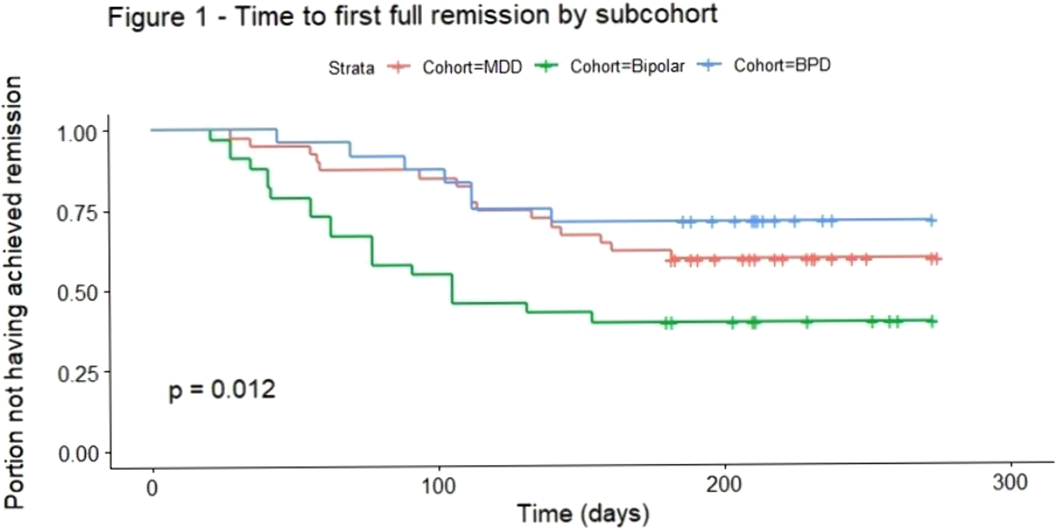
Remission rates according to DSM-5 were similar in MDD, MDE/BD and MDE/BPD patients. Bipolar patients experienced more shorter qualitatively distinct mood state periods during follow-up than the others. Bipolar disorder was associated with shorter (HR = 2.44, 95% CI = 1.27–4.67, see fig. 1) and dimensionally assessed BPD severity with longer time to first remission (HR = 0.95 per point., CI = 0.91–1.00).
Conclusions
Course of illness differs between the three depressive groups in the medium term. Bipolar depressive patients have the most alternating course and the shortest time to first remission. Dimensionally assessed severity of BPD may be prognostic of longer depressive remission latency.
Disclosure
I am employed by a psychiatric treatment provider, treating e.g. patients suffering from depression, bipolar disorder and borderline personality disorder.
Depression and anxiety are very frequent and associated with high societal costs, much suffering and functional impairment. Employment is essential and pivotal recovery after sick-leave. In many countries, health care interventions are delivered separately from vocational rehabilitation services. This fragmented placement of interventions often implies lack of coordination, creating despair among sick-listed persons.
Objectives
The aim of this trial was to investigate an integrated mental health care and vocational rehabilitation intervention to improve and hasten the return-to-work process among people sick-listed with anxiety or depression.
Methods
In this RCT, participants were randomly allocated to A) integrated interventions (INT), B) improved mental health care (MHC) or B) service as usual (SAU). Primary outcome was time to return-to-work during 12-month. Secondary outcomes were time to return-to-work at 6-month follow-up; levels of anxiety, depression, stress symptoms and social and occupational functioning at 6-month follow-up; and return-to-work measured as proportion in work at 12-month follow-up.
Results
631 individuals randomized. INT showed higher proportion in work compared with both SAU and MHC at the 12-month follow-up. We found no differences regarding return-to-work time at either the 6- or 12-month follow-up. No differences in symptoms between SAU, MCH or INT were detected, but MHC and INT showed lower scores on Cohen’s perceived stress scale compared with SAU at 12-month follow-up.
Conclusions
Although INT did not hasten return-to-work, it yielded higher proportion in work compared with MHC and SAU.
Abnormalities in emotion recognition (ER) are frequently reported in depression, with lowered recognition accuracy in patients with major depressive disorder (MDD) when compared to healthy individuals. Mindfulness was found to directly impact the severity of depressive symptoms, by negative cognition and dysfunctional reaction recognition.
Objectives
The aims of this study were to compare ER and mindfulness levels between MDD patients and healthy controls (HC), as well as to examine whether ER and mindfulness are related to symptom severity in MDD patients.
Methods
68 patients with MDD and 93 HC participated in the study. A sociodemographic form, Reading the Mind in the Eyes Test (RMET), Five Facet Mindfulness Questionnaire-Short Form (FFMQ-S) and the Montgomery Asperg Depression Scale (MADRS) were administered. Group comparison in ER and mindfulness was assessed using the Multivariate analysis of covariance (MANCOVA). Bivariate correlations and multiple linear regression analyses were performed to assess the associations between depression severity, ER and mindfulness in the patient group.
Results
Better ER and higher levels of mindfulness were found in HCs relative to the MDD group. A positive association between depression severity and the non-reactivity facet of mindfulness was found, indicating that in the MDD group non-reactivity was a significant predictor for depression severity. On the other hand, ER was not significant in predicting symptom severity.
Conclusions
Non-reactivity, unlike other dimensions of mindfulness, seems to increase with the severity of depressive symptoms among MDD patients. To particularly focus on this subdimension in mindfulness techniques may yield better outcomes in alleviation of depressive symptoms.
Enhancing understanding of depression symptom interactions between parents and associations with subsequent child emotional difficulties will inform targeted treatment of depression to prevent transmission within families.
Objectives
To use a network approach to identify ‘bridge’ symptoms that reinforce mother and father depression, and whether bridge symptoms, as well as other symptoms, impact subsequent child emotional difficulties.
Methods
Symptoms were examined using two unregularized partial correlation network models. The study included 4,492 mother-father-child trios from a prospective, population-based cohort in the United Kingdom. Mother and father reports of depression symptoms were assessed when the child was twenty-one months old. Child emotional difficulties were reported by the mother at ages nine, eleven and thirteen years.
Results
Bridge symptoms mutually reinforcing mother and father depression symptoms were feelings of guilt and self-harm ideation, whereas anhedonia acted as a bridge from the father to the mother, but not vice-versa (fig.1, network 1). The symptom of feelings of guilt in mothers was the only bridge symptom which directly associated with child emotional difficulties. Other symptoms that directly associated with child emotional difficulties were feeling overwhelmed for fathers and anhedonia, sadness, and panic in mothers (fig.1, network 2).
Conclusions
Specific symptom interactions are central to the co-occurrence of depression symptoms between parents. Of interest, only one of the bridge symptoms associated with later child emotional difficulties. In addition, specific symptom-to-child outcomes were identified, suggesting that different symptoms in mothers and fathers are central for increased vulnerability in children.
Mixed depressive states portend greater rates of impulsivity, attempted suicide, treatment resistance, and poorer outcome than non-mixed forms of depression. The neurocognitive bases of such affective states have not been defined yet.
Objectives
This work represents an attempt to clarify the neuropsychology underlying mixed depressive states.
Methods
Thirty subjects with affective disorders with mixed depression (MxD), 54 subjects with non-mixed depression (nonMxD), 73 euthymic subjects (Eu) and 93 healthy comparisons (HC) underwent a neurocognitive battery including the Trail-Making Test (TMT), the Controlled Word Fluency Test (WFT) and the Semantic Fluency Test (SFT), the Wisconsin Card Sorting Test (WCST, the Rey Auditory Verbal Learning Test RAVLT, the Rey-Osterrieth Complex Figure Test ROCFT, the Raven’s Progressive Matrices (RPM), and the Interference Component of the Stroop Test (ST). Between-group differences were performed through multiple one-way analyses of variance. Post-hoc analyses were performed using Tukey post-hoc tests.
Results
HC performed better than the three patient groups in all the aforementioned neurocognitive tests. Eu performed better in RPM, TMT, SFT than nonMxD, and better on ST WCST than both nonMxD and MxD. MxD showed better performances in RPM, TMT-A, WCST than nonMxD, and more errors and less reaction times in the ST than nonMxD.
Conclusions
Mixed depressive states are characterized by enhanced attentional resources and greater set shifting abilities than non-mixed depressive states. On the other hand, they have less cognitive control than non-mixed depression. Such findings might explain some typical features observed in subjects with mixed depression, such impulsivity, suicidality, emotional reactivity and behavioral dyscontrol.
The Portuguese shortest version of the Perinatal Depression Screening Scale/PDSS-7 proved to be valid and reliable, in Portugal and Brazil, but it is essential to analyze its operational characteristics before using it for screening purposes.
Objectives
To determine PDSS-7 cut-off points and associated conditional probabilities to screen for major depression, according to the DSM-5.
Methods
he pregnancy sample was composed of 259 women in the second trimester (Mean gestation weeks=17.83±4.750). The postpartum sample consisted of 241 women assessed between the 2nd-6thmonths postpartum(M=17.99±4.689 weeks postpartum). All women completed the PDSS-7 and were interviewed with the Diagnostic Interview for Psychological Distress(Pereira et al., 2017), a semi-structured clinical interview to assess the most prevalent psychiatric disorders in the perinatal period according to the DSM-5 criteria. MedCalc was used to perform ROC analysis.
Results
During pregnancy, the major depression prevalence was of 4.6%(n=12). The cut-off point that maximizes the Youden Index(J=.98, 95%CI: .97-.99; AUC=.99; se=.004; p<.001) was of 18(95%CI:17-19), which resulted in a sensitivity of 100%(71.5%-100%), a specificity of 97.98%(95.3%-99.3%), a positive predictive value/+PP of 68.8%(48.0%-84.0%) and a negative predictive value/-PP of 100%. In the postpartum, the major depression prevalence was of 10.4%(n=25). The cut-off point(J=.79, 95%CI: .63-.82; AUC=.89; se=.036; p<.001) was of 14(95%CI: 12-16), with a sensitivity of 85.0%(69.3%-93.2%), a specificity of 85.0%(69.3%-93.2%), a +PP of 56.5%(46.1%-67.3%) and a -PP of 97.5%(94.6%-98.8%).
Conclusions
The Portuguese version of PDSS-7 presents good combinations of sensitivity and specificity, being accurate and usable to screen for depression during pregnancy and in the postpartum both in research and primary health care.
Repetitive transcranial magnetic stimulation (rTMS) is a non-invasive neuromodulatory treatment option, which is used in a variety of neurological and psychiatric diseases. It is approved for depression treatment and recommended in international guidelines. A significant reduction in treatment duration was achieved by using theta burst stimulation (TBS) protocols, which are practicable and non-inferior to conventional TMS.
Objectives
To analyse the efficacy and safety of intermittent theta burst stimulation (iTBS) of left DLPFC in inpatients with treatment-resistant depression.
Methods
We evaluated n=44 inpatients with treatment resistant major depressive disorder (n=37) and bipolar depression (n=7), who were treated with the 5 Hz intermittent TBS once daily for 3-6 weeks according to clinical decision. A total of 600 pulses and 200 bursts were applied in each treatment session. Clinical and response data were obtained by chart review.
Results
Mean age at time of first stimulation was 54 years. 61,3 % of patients were female. On average, the current episode started 21 months before the first stimulation. In total, 924 treatment sessions were performed. On average, patients received 21 sessions. The mean MADRS Score pre-treatment was 27.2. Post-treatment, there was a clear reduction in depression severity (MADRS 18.3). No severe adverse events and no seizures occurred in this clinical observational analysis.
Conclusions
Intermittent TBS is efficacious and safe in patients with chronic and refractory depression.
Invasive vagus nerve stimulation (VNS) is an adjunctive long-term treatment option for chronic and recurrent difficult-to-treat depression (DTD).
Objectives
In this prospective observational open-label case series we report on the effects of invasive VNS on depression severity, medication load and the need of maintenance electroconvulsive therapy (ECT) and esketamine treatment after 12 months.
Methods
Patients were treated with invasive VNS according to clinical indication. All patients were included in the Restore-Life-Study. The assessment of depression severity (MADRS) and concomitant treatment was performed at baseline and in 3-months intervals postoperatively over a 12 months period.
Results
Twelve patients were treated with adjunctive VNS due to unipolar (n=10) and bipolar (n=2) depression. The majority of patients were female (n=9). The mean age at baseline was 53.8 years (range 38-66). Patients were severely affected by a variety of depression symptoms which was reflected in high MADRS Scores (median 29, mean 28) at baseline. All patients received at least 2 or more psychotropic drugs at baseline. After 12 months of VNS a clear reduction of MADRS Scores (41 % on average) was seen (12-months MADRS Score median 17, mean 18). After 12 months, one patient each was discontinued from maintenance ECT and esketamine, respectively. The median of drug load was reduced from 4,56 to 4,06 after 12 months.
Conclusions
Invasive VNS is an effective treatment option in the long-term management of DTD to reduce the need of concomitant drug dose and maintenance treatment.
Disclosure
E Kavakbasi received speaker fees from Livanova. BT Baune received speaker and advisor fees from Livanova. The patients were included in the Restore-Life Study sponsored by LivaNova.
Leadership in healthcare organisations is crucial to continually improve and provide high quality compassionate care. Leadership development and training enables the psychiatrists in developing these essential skills. Focusing on how to enhance leadership development through leadership skills training and experiential learning should be a priority. However, little is known about the extent to which this leadership skills training is available across Europe in the early stage of the career of psychiatrists.
Objectives
To investigate the access to leadership development opportunities among European psychiatric trainees and early career psychiatrists (ECPs) and their perceptions related to leadership skills training.
Methods
Cross-sectional study, using an online survey consisting of multiple-choice questions and free text responses.
Results
Participants from 33 European countries took part in this survey, where the majority were female. More than half were general adult psychiatric trainees and more than a quarter ECPs. About half indicated having no access to leadership skills training within their training program, with only about 10% being satisfied with the training received. About half sought additional training outside their program. A vast majority requested training in leadership skills to be included in a psychiatric training program.
Conclusions
Our study provides an overview of important gaps in availability and access to leadership skills training amongst psychiatric trainees and ECPs across Europe. We hope that this study will help inform future actions pertaining to development and improvement of leadership skills training for trainees and ECPs across Europe.
Cognitive reappraisal (CR) is a cognitive regulation strategy aimed at changing how people think about certain stimuli in order to change their emotional impact. CR strategies have been used in research to try to change eating behaviors and other food-related responses. This study is the first to use a behavioral measurement to examine the effect of CR on food attentional bias (FAB) in people with elevated FAB.
Objectives
It was hypothesized that CR would reduce FAB. Ninety-five participants were randomly assigned to one of three groups: CR, upregulation (UP) or controls (CN).
Methods
All participants performed a computerized Visual Dot Probe (VDP) task using food stimuli to measure their FAB before and after the manipulation. The CR group recited five sentences aimed at curtailing the reward of high caloric food. Participants in the UP group recited five sentences aimed at strengthening the reward of high caloric food. The CN group recited five mundane sentences about their day. Participants also self-reported on eating disordered symptomology and BMI.
Results
People with elevated FAB had more disordered eating than people low on FAB. A significant interaction was observed between group and time (pre/post-test), with the lowest FAB levels in the CR group following the manipulation.
Conclusions
CR, a self-administered strategy can be effective in reducing FAB. CR may be an effective strategy for developing resistance to tempting food stimuli and curbing high caloric food intake. Being highly attentive to food cues may contribute to obesity. The attentional bias paradigm can be used to detect early signs of FAB.
There is growing concern about how people with eating disorders are impacted by the widespread societal restructuring during the COVID-19 crisis.
Objectives
We aimed to examine how factors relating to the impact of the pandemic associate with eating disorders and quantify this relationship while adjusting for concurrent and longitudinal parameters of risk.
Methods
We gathered demographic, behavioral and clinical data pre- and mid-pandemic as well as childhood trauma history from a longitudinal online survey of 489 adults (mean age 23.4 years) recruited from the Neuroscience in Psychiatry Network (NSPN). Using pre-pandemic (T1) and concurrent (T2) data we aimed to predict eating disorders at mid-pandemic (T2). We deployed hierarchical generalized logistic regression to ascertain the strength of longitudinal and concurrent associations.
Results
Pre-pandemic eating disorder scores strongly associated with concurrent eating disorder (z=5.93). More conflict at home mid-pandemic (z=2.03), pre- (lower sensation seeking z=-2.58) and mid-pandemic (higher lack of perseverance z=2.33) impulsivity traits also associated with mid-pandemic eating disorder. Significant correlations between pandemic-related disrupted lifestyle and eating disorder psychopathology both pre- and mid-pandemic were observed.
Conclusions
Conflict at home mid-pandemic and specific aspects of impulsiveness significantly associated with concurrent eating disorder when adjusted for pre-pandemic eating disorder symptoms, baseline demographics, behavioral traits, history of traumatic experiences and concurrent psychopathology. These results provide insight into the struggles of those suffering with eating disorders during the COVID-19 pandemic and highlight the importance of impulsiveness traits and the immediate family environment in their experience of illness during the pandemic.
Emerging evidence suggests that the COVID-19 pandemic had a negative impact on mental health. In particular, patients with Anorexia nervosa (AN) may have faced increased symptom severity.
Objectives
To compare the clinical characteristics of inpatients with AN admitted amidst the COVID-19 pandemic versus the two previous years.
Methods
Retrospective observational study of inpatients admitted between January 2018 and December 2020 in a psychiatry inpatient unit of a tertiary hospital.
Results
There were 11 admissions of patients with AN in 2020 (8 from March onwards), a 22% increase relative to 2019, which in turn saw a 28% increase in admissions relative to 2018. Most patients had an AN diagnosis previous to the pandemic. The majority were undergoing outpatient treatment for over a year. Two patients were admitted within a month of outpatient treatment. There was an increase in admissions through the emergency service in 2020. The most frequent diagnostic was AN binge-eating/purging type in 2020 and 2019, whereas in 2018 the AN restrictive type was dominant. Mean BMI at admission and average length of stay were similar across the three years. Readmission in a 12-month period was 54,5% in 2020 (22,2% in 2019 and 42,9% in 2018).
Conclusions
Despite the widespread impression of a negative impact of the pandemic on AN patients, in our study the clinical characteristics of AN patients admitted in 2020 were mostly similar to the two previous years. Readmissions were higher in 2020, therefore future analysis of data from 2021 might be more enlightening.
Neuroimaging findings have reported aberrant functional connectivity in brain regions involved reward system in individuals with anorexia nervosa (AN) altering hedonic processing over food. Likewise, endocannabinoids such as Anandamide (AEA) and 2-Arachidonoylglycerol (2-AG) have been involved in rewarding aspects of food intake.
Objectives
To identify nucleus accumbens (NAcc) functional connectivity with whole-brain comparing between individuals with AN and controls. Furthermore, in a sub-study, to explore the interaction between NAcc functional connectivity and peripheral AEA and 2-AG levels.
Methods
A total of 60 adult women (18 to 56 years of age) took part in the present study. Twenty-six individuals belonged to the AN group (BMI<18) and 34 to the HC group (BMI=18-24.99). All participants underwent functional magnetic resonance in resting-state, and blood samples were obtained in fasting.
Results
Negative functional connectivity was observed in the AN group compared with the control group between the NAcc and the cerebellum (pFWE<.001), between the NAcc and the insula (pFWE<.001), between the NAcc and the supramarginal gyrus (pFWE=.019), and between the NAcc and the postcentral gyrus (pFWE=.010). Analyses exploring the association between NAcc functional connectivity and peripheral endocannabinoids levels displayed altered NAcc-cerebellum functional connectivity was negatively associated with peripheral 2-AG levels in the AN group (r= -.553; p=.011).
Conclusions
Understanding the interaction between the reward system and peripheral endocannabinoids in patients with AN could contribute to better elucidate the pathophysiology of this disorder. Future studies will need to further investigate the clinical and therapeutic implications of these findings in patients with AN.
Sexual minorities have been coming out more than ever before. However, Tunisian laws and society are still not supportive of LGBT (lesbian, gay, bisexual and transgender) rights. To this day, Tunisian doctors are requisitioned to carry out anal tests as part of expert testimonies in cases of conviction for homosexuality.
Objectives
Assess Tunisian physicians’ attitudes and knowledge towards LGBT patients.
Methods
We conducted a cross-sectional study in October 2021, among 445 Tunisian physicians and medical students. Data were collected via an anonymous self-administered online questionnaire including sociodemographic data and the LGBT Development of Clinical Skills Scale (LGBT-DOCSS).
Results
The overall LGBT-DOCSS score was quite good (4.47 ±0.85). The attitudes of Tunisian doctors were better than their knowledge (p=0.01; t=2.6), which was better than their clinical preparedness (p<10-3; t=25) in treating LGBT patients. Doctors who self-identify as sexual minorities and those who interacted with LGBT people in their daily lives, were less stigmatising, more able to treat them and had better knowledge of their needs. Those who had had sexology training (5%) had better LGBT-DOCSS score (p=0.013), better knowledge (p=0.045) and preparedness (p<10-3) in treating LGBT patients but did not appear to be less stigmatising than the rest of the group (p=0.9). Religiosity was associated with a more stigmatising attitude (p<10-3), but had no impact on knowledge or preparedness.
Conclusions
This study points to gaps, identified by doctors themselves when faced with an LGBT patient. A more inclusive health system requires better matching of health services to the needs of the whole population without discrimination.
Aging raises wide-ranging issues within social, economic, welfare, and health care systems. Life satisfaction is regarded as an indicator of the quality of life which, in turn, is associated with mortality and morbidity in older adults.
Objectives
Life Satisfaction is a dimension of happiness and well-being which represents the quality of life in both literacy and every aspect of a person. The purpose of the article is to assess the level of life satisfaction and the factors associated with life satisfaction in old age.
Methods
This research was conducted in a cross-sectional study using 36 items from Satisfaction and Well-being of Elderly (Thai semi-structured in-depth interviews) tools to collect data. The population used in this study was Thai people over 60 and used multistage probability sampling, were held with 2000 elderly individuals from 13 health regions of Thailand.
Results
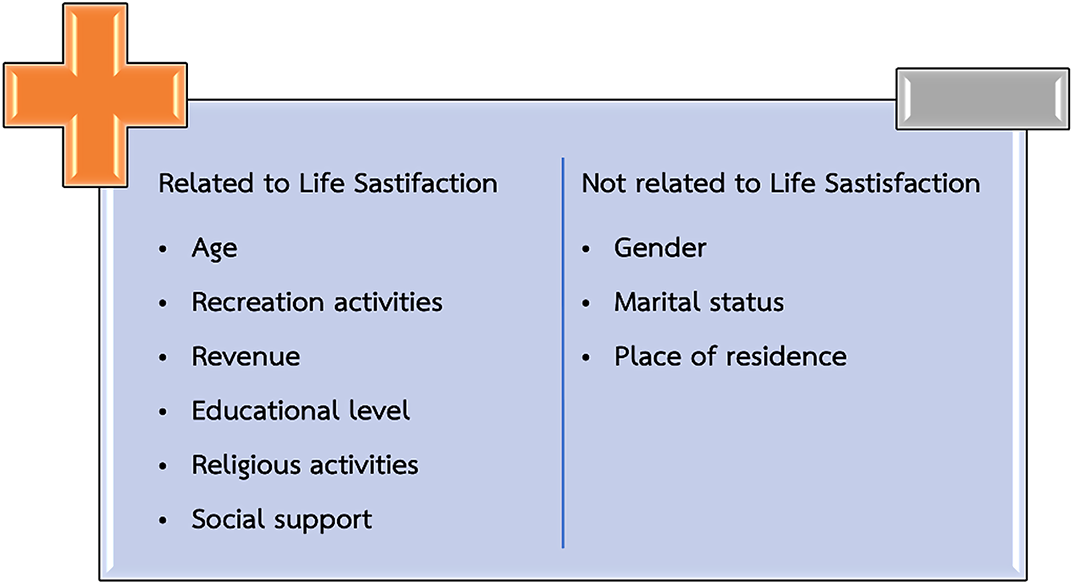
Of the 2000 samples, the overall life satisfaction was moderate (54.1%). Upon data analysis, ten categories were extracted. However, there are 7 factors that significantly influence the level of life satisfaction of the Thai elderly at p < 0.05: Age, Occupation, Recreational activities, Revenue, Education level, Religious activities, and Social Support. Moreover, when tested with Pearson Correlation found that the relationship between and Thai brief screening for depression (2Q) was low correlated (r -0.121, P=0.000).
Conclusions
Aging should be foreseen and forethought to increase life satisfaction. The following can be effective in increasing life satisfaction in the elderly: Placing greater emphasis on spiritualism in life, employment of the elderly, and promoting positive leisure in the elderly.
Dual pathology during pregnancy, described as the co-occurrence of substance use and mental health problems, is one of the leading preventable causes of maternal and perinatal mortality and morbidity; however, effective and accessible treatments are lacking.
Objectives
As part of the WOMAP(Woman Mental Health and Addictions on Pregnancy) initiative, our study aimed to evaluate the effectiveness of an e-health-based psychotherapeutic program compared to enhanced usual care.
Methods
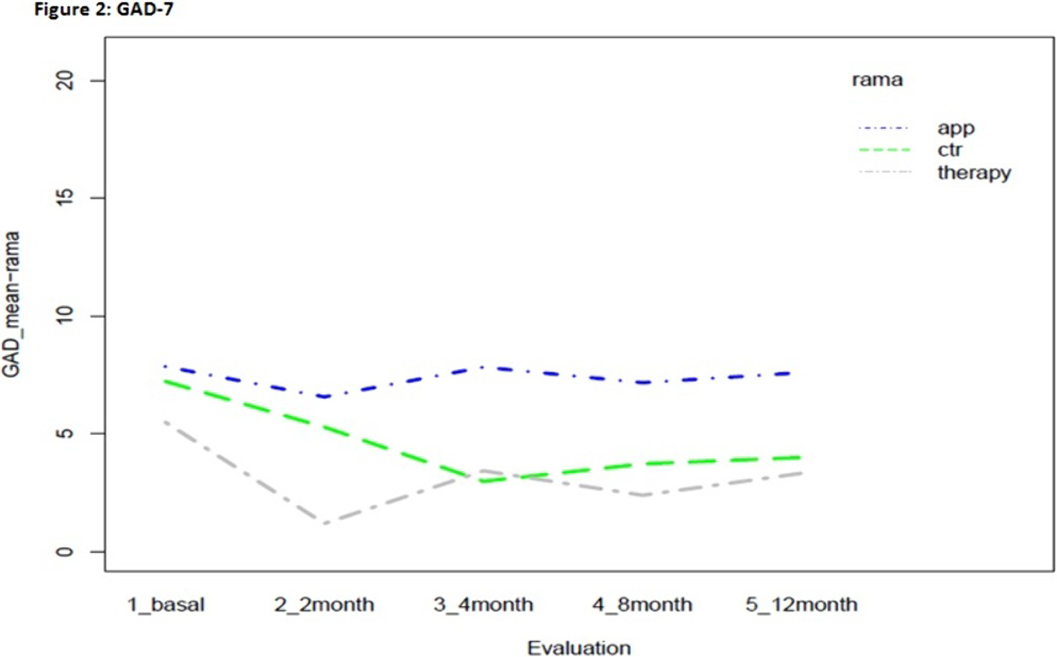
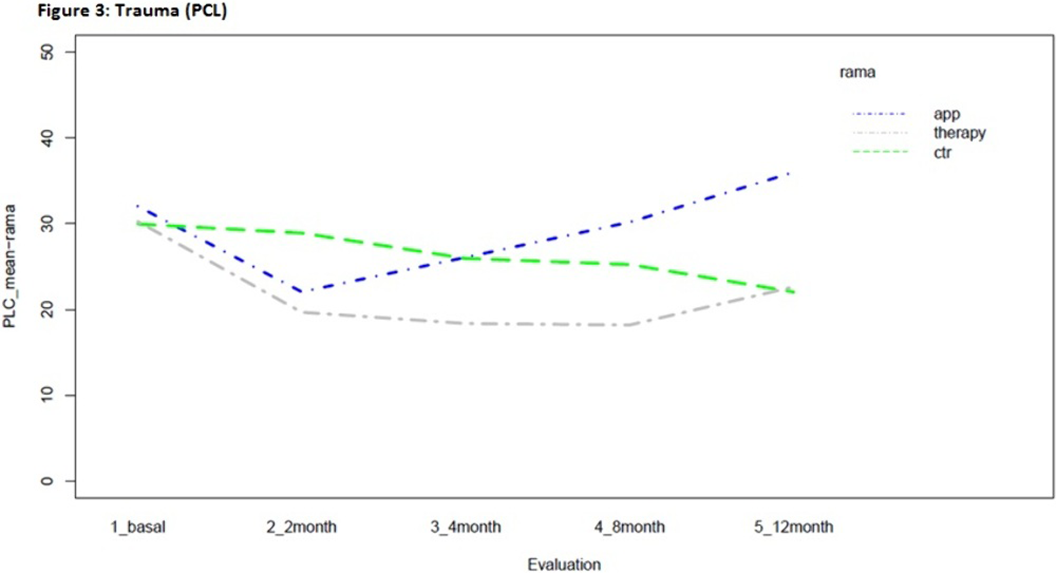
This effectiveness clinical trial was conducted between 2016-2020 in 5 hospitals in the Madrid (Spain) metropolitan area. 2014 pregnant women under 26 weeks of pregnancy were screened. Eligible participants(n=120) were those who screened positive for co-occurring symptoms (AC-OK screener) and were not receiving specialized behavioral treatment. Participants were assessed in depth at baseline, 2,4,8 and 12 months(PHQ-9;GAD-7;PCL-5;AUDIT;DAST;Fagerström) and randomized to the usual care control group(n=38) or to two groups of a 10-session pregnancy-adapted psychotherapeutic program, one delivered by App/internet(n=41) and one by telephone(n=41). Intent-to-treat analyses assessed effectiveness.
Results
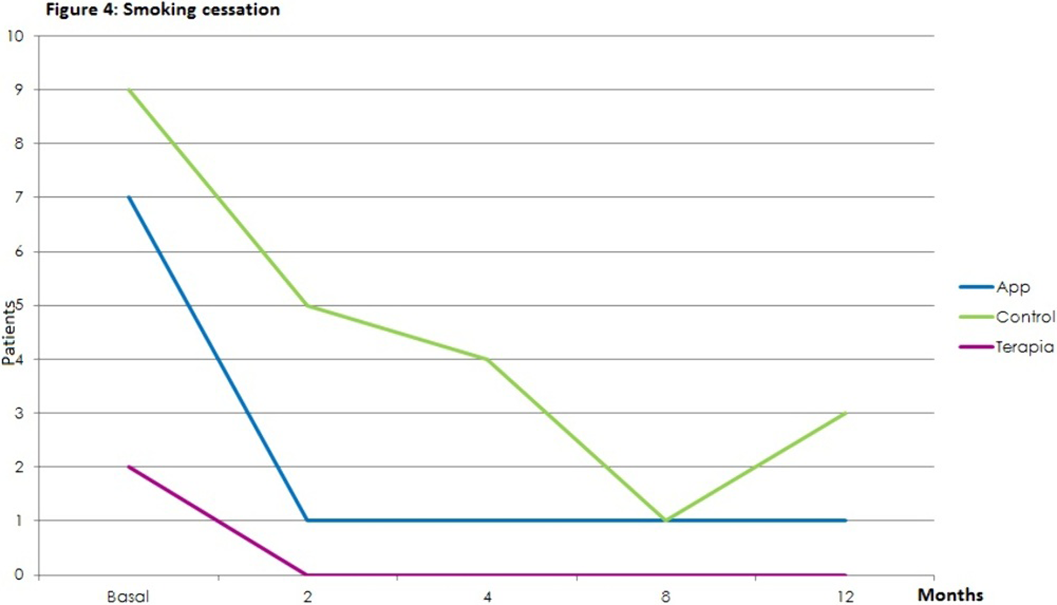
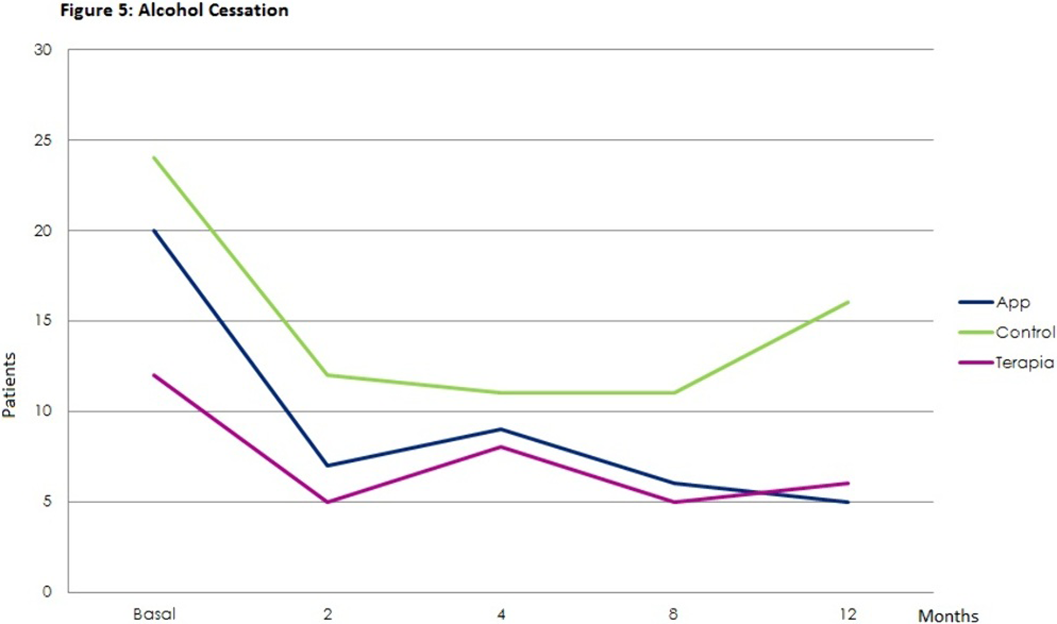
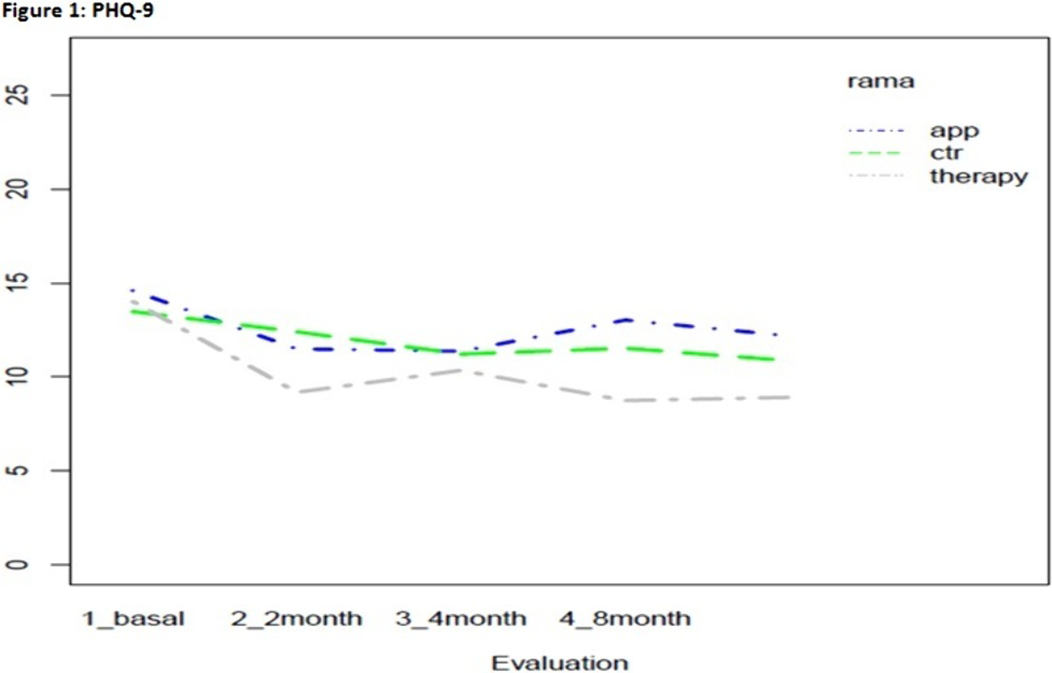
Statistically significant effects of the intervention were found for mental health symptoms in the telephone group as compared to the control and App/internet groups, with an improvement effect starting earlier (2 months) and lasting longer (figures 1-3). Regarding substance use, due to the lack of other substances consumption, only smoking and alcohol cessation rates were analyzed. Patients in the App/internet and telephone groups discontinued significantly more, earlier and for a longer period compared to the control group(figures 4-5).
Conclusions
E-health psychotherapeutic programs could benefit pregnant women with dual disorders. An App/internet implementation could only be useful if focused solely on substances.
Rumination is a transdiagnostic risk factor to psychopathology that has mostly been studied in relation to depression (Nolen-Hoeksema, 1991). However, rumination may also occur in response to positive events and emotions (Feldman et al., 2008), and may be a protective factor as it is associated with higher positive affect (Harding et al., 2017).
Objectives
We aimed to examine ruminative response to positive affect (RPA) in daily life and explore its relationship with daily positive and negative affect. We hypothesized that daily positive and negative affect would be associated with daily RPA even after controlling for trait-level RPA and depressive rumination.
Methods
We carried out a daily diary study with university students (n=178). After filling out the baseline survey assessing trait-level rumination, participants had to answer short surveys online about their daily affect and daily rumination every evening for 10 consecutive days. We analyzed our data with multilevel regression in R.
Results
In line with our expectations, daily RPA was significantly associated with daily positive (β=0.16) and negative affect (β=-0.07), while trait-level rumination scores were not significantly associated with daily positive and negative affect. The within-person relationship was stronger between RPA and positive affect (β=0.17) than the between-person relationship (β=0.09). Daily and trait-level rumination were weakly correlated (r=0.218-0.284).
Conclusions
Under ecologically valid conditions, we found that daily rumination was more important in daily affective experiences than trait-level rumination. Understanding whether one’s current affect is more strongly associated with trait-level, state-level or even contextual factors may yield better intervention strategies for affective disorders.
Some projects have described post-disaster psychosocial services and planning across Europe. However, little is known about the real psychosocial disaster responses such as low-intensity initiatives after a terrorist attack
Objectives
This study aims (1) to describe psychological support (PS) in the immediate (<48 hours), post-immediate (48 hours – 1 week) periods and more than one week after a terrorist attack among terror-exposed people, and (2) to identify factors associated with a lack of short-term PS among those who suffered from mental health disorders.
Methods
This study used data from a longitudinal survey of 189 civilians exposed to the January 2015 terrorist attacks conducted 6 months after the attacks. Factors associated with lack of PS after the attacks was identified using a Robust Poisson regression in three separate models (for the 3 periods).
Results
Among participants who suffered from PTSD (n=34), depression (n=74), or anxiety (n=59) 6-9 months after the terrorist attacks, respectively, 9%, 18% and 12% did not received psychological support. The lack of immediate PS was associated with geographical distance, type of exposure, and support in daily life. The lack of post-immediate PS was associated with geographical distance, peri-traumatic reactions and past psychological follow-up. The lack of PS after one week was associated with geographical distance and social isolation.
Conclusions
Characteristics of exposition and social support seem to play an important role in lack of PS after a terrorist attack and highlights the need to use strategies to reach out to people regardless of the type of exposure.