We partner with a secure submission system to handle manuscript submissions.
Please note:
You will need an account for the submission system, which is separate to your Cambridge Core account. For login and submission support, please visit the
submission and support pages.
Please review this journal's author instructions, particularly the
preparing your materials
page, before submitting your manuscript.
Click Proceed to submission system to continue to our partner's website.
To save this undefined to your undefined account, please select one or more formats and confirm that you agree to abide by our usage policies. If this is the first time you used this feature, you will be asked to authorise Cambridge Core to connect with your undefined account.
Find out more about saving content to .
To send this article to your Kindle, first ensure no-reply@cambridge.org is added to your Approved Personal Document E-mail List under your Personal Document Settings on the Manage Your Content and Devices page of your Amazon account. Then enter the ‘name’ part of your Kindle email address below. Find out more about sending to your Kindle.
Find out more about saving to your Kindle.
Note you can select to save to either the @free.kindle.com or @kindle.com variations. ‘@free.kindle.com’ emails are free but can only be saved to your device when it is connected to wi-fi. ‘@kindle.com’ emails can be delivered even when you are not connected to wi-fi, but note that service fees apply.
Amisulpride is an atypical antipsychotic. Rabbit syndrome(RS) may be seen after antipsychotics use a few days or long‐term application. RS occurs after more frequent typical antipsychotics and also in rare cases atypical antipsychotics.Its characterized by the involuntary rhythmic movements of the lips however involves no tongue movements.
Objectives
Case report and reflection on its etiology
Methods
Case report and literature review
Results
A 28-year-old female with a diagnosis of schizophrenia applied with the complaints and symptoms of withdrawal, do not want to leave the house, physical anergy and avolition that started after stopped taking her medications. She was admitted to the psychiatry service and amisulpride treatment was started and was gradually increased to 800 mg/day. After 30 days of hospitalization, the patient was discharged with mild recovery. 14 days after the discharge, because of the abnormal involuntary movements in mouth, the patient applied. In clinical examination without tounge involvement, rhythmic motions were observed in the lips and jaw.Neurological examination, labrotory tests and cranial screening were all normal. She was evaluated by a private psychiatrist and was diagnosed with RS. Amisulpride treatment changed to olanzapine treatment with 15 mg/day. After two months, RS spontaneously regressed.
Conclusions
The resolution of the involuntary movements following discontinuation of amisulpride in our case, supported the diagnosis of RS. Although the mechanism by which RS emerges as a side‐effect of amisulpride is not fully understood, the drug’s high affinity for and selective binding to dopaminergic D2 and D3 receptors are thought to be responsible for this involuntary motion disorder.
Sexual dysfunction (SD) can often be a side-effect of treatment with antipsychotics (APS). It often jeopardizes long-term adherence to treatment, while deeply affecting the patient’s quality of life. The pathogenic mechanisms may be associated with postsynaptic dopamine antagonism, a1-antagonism and prolactin elevation. APS-induced hyperprolactinemia has been linked to the occurrence of galactorrhea, gynecomastia, amenorrhea and SD.
Objectives
To synthesize the available evidence on the management of APS-related sexual dysfunction, with a main focus on the second-generation antipsychotics.
Methods
A search for randomized controlled trials (RCT) published between 2021 and 2011 on PubMed was made using the keywords “sexual”; “dysfunction”; “antipsychotic” and “treatment”, from which resulted sixteen articles. Only six of those were considered relevant for the study’s objectives.
Results
Three studies focused on the comparison between different APS and prolactin levels and SD occurrence, showing that treatment with aripiprazole is mostly related to prolactin levels with the normal range and a lower incidence of sexual dysfunction. Addition of aripiprazole to previous APS may be associated with normalization of sexual function and pose as a possible management option. Adjunctive treatment with tadalafil showed no significant effect on its primary outcome.
Conclusions
There seems to be a general consensus that patients treated with first-generation antipsychotics (FGA), along with risperidone, paliperidone and amissulpride show higher prolactin levels and incidence of SD. Whether there is a causal relationship between these two variables still remains a question. Larger and more prolonged trials are still needed to evaluate APS-related sexual dysfunction and its management.
Risperidone, a second generation antipsychotic, shows high affinity with serotoninergic and dopaminergic D2 receptors, but also adrenergic and H1 histaminergic receptors. Previous studies have shown an increase in eosinophile count associated with the second-generation antipsychotics through the histaminergic path.
Objectives
The presentation of a case in which eosinophilia was associated with risperidone withdrawl which has not been described so far.
Methods
A 46-year-old woman with schizophrenia diagnosed at the age of 22 was admitted in our inpatient psychiatric clinic with psychotic symptoms relapse after she voluntarily discontinued risperidone. The patient was fully evaluated with full laboratory tests, a brain CT scan, EEG and her medical and psychiatric histories were recorded.
Results
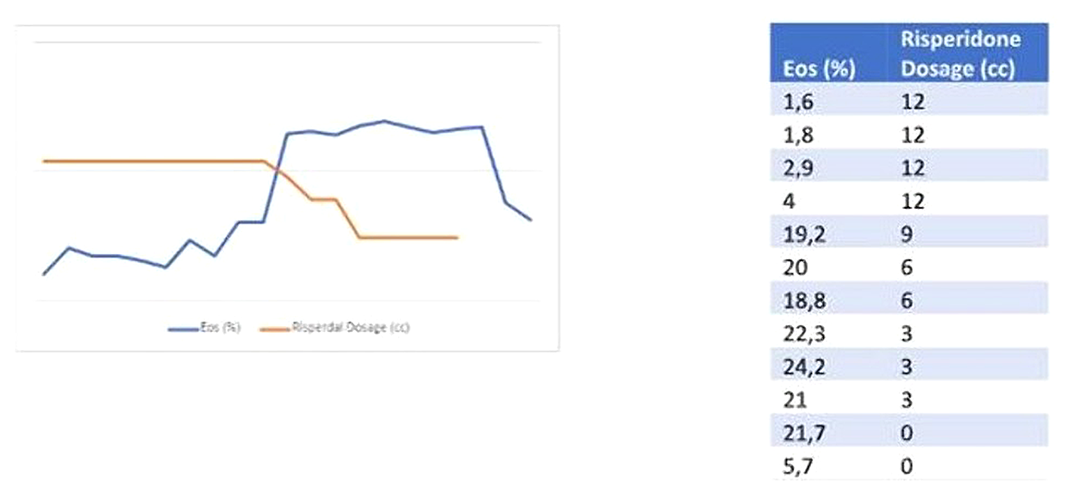
Risperidone was reinitiated but due to the persistence of symptoms it was switched to clozapine which lead to full remission. It was observed though, that while gradually decreasing risperidone dosage (Figure 1.), eosinophile count was raising and it was normalized after complete discontinuation. Eosinophilia was also present in other instances that the patient discontinued taking risperidone according to her personal history. Other causes of eosinophilia (allergic, inflammatory) were fully excluded.
Conclusions
Risperidone discontinuation could lead to an elevated eosinophile count. There is limited research in this topic and it is yet to be clarified whether the elevation is due to stopping one antipsychotic or switching between two different antipsychotics. It is important to run laboratory tests regularly with every treatment modification.
Aripiprazole (ARI) is an atypical antipsychotic drug with D2 partial agonist properties, usually prescribed to treat mood disorders (major depression or bipolar disorder) and schizophrenic disorder (schizophrenia or schizoaffective disorder). Dopamine receptor agonists, as is ARI, have been implicated in some cases of impulse-control problems, such as gambling disorder (GD), increased spending, hypersexuality and compulsive eating.
Objectives
Currently, it is hypothesized that aripiprazole may cause impulse-control problems because it can produce a hyperdopaminergic state in the mesolimbic pathway (reward system) through its predominant action on dopamine D3 receptors. We intend to do a non-systematic review of the scientific information regarding this subject.
Methods
The authors revised the published literature about this topic, selecting relevant articles, systematic reviews and case reports, with the topic words: “aripiprazol”, “gambling disorder” and “dopamine receptor” in scientific data base.
Results
Overall, a few cases of ARI-induced pathological gambling as well as ARI-induced hypersexuality have been reported. In one study it was verified that comorbid psychiatric and substance use disorders were common among those who have experienced GD or worsened GD after beginning ARI treatment. In another study, it was verified that the group of patients who reported this alleged side-effect were mostly young (mean age, 33.6 years), mostly men (88.2%) and most lived alone.
Conclusions
Attributing to dopamine agonists the only factor that can explain the onset of GD is simplistic and dangerous. Many other potential risk factors, including individual vulnerability factors (temperament, genetics) as well as environmental factors, must be considered.
Clozapine is a drug that can cause several side effects. Among the less commonly described is a drug-induced lung disease. Due to its non-specific clinical presentation, it represents a diagnostic challenge. The diagnosis is made based on: 1. Association of exposure to the agent and development of symptoms, 2. Pulmonary infiltration, 3. Exclusion of other causes, 4. Withdrawal of symptoms when the agent is excluded from therapy. To date, there have been only a few descriptions of this condition.
Objectives
Case report of rare side effect of clozapine.
Methods
Case report
Results
Case report: male patient (37) with schizophrenia, was hospitalized after a brutal suicide attempt. The PCR test for COVID-19 that was routinely performed on admission was negative. After the introduction of clozapine into therapy, the patient became febrile. There was a drop in oxygen saturation, a Lung CT scan showed inflammatory changes („ground-glass opacities“), and COVID-19 pneumonia was suspected. Due to the worsening of the mental state, the dose of clozapine was increased. The physical condition further deteriorated: febrile, sO2 declining. After repeated PCR tests for COVID-19 (all negative), interstitial pneumonia caused by clozapine was suspected, and clozapine was excluded from therapy. The physical condition started to improve. Quetiapine was introduced, and occasional episodes of agitation were relieved with intramuscular diazepam. In the following days, the patient’s mental state improved and he was discharged.
Conclusions
Despite its superiority over other antipsychotics, clozapine was with good rationale ranked third in treatment guidelines for schizophrenia.
Hydroxychloroquine an antimalarial medication has been approved in March 2020 by FDA for treatment of hospitalized patient with COVID-19 infection. Even thus, its efficacy has been controversial, it still being used worldwide. This medication also causes some serious side effects. Here we present a case of a woman with a very long history of treatment resistant schizoaffective disorder, on clozapine, who develops QT prolongation after receiving hydroxychloroquine for the treatment of COVID-19 infection.
Objectives
Despite the controversy, this case aims to shed light on the importance of monitoring QTc via EKG in patient receiving hydroxychloroquine7. More importantly to avoid antipsychotic while patient is receiving this medication since both hydroxychloroquine and most antipsychotic can increase QTc.
Methods
This case report was written by reviewing chart of the patient and also via direct interaction and interviews with the patient.
Results
This case report showed and increased in QTc interval after receiving hydroxychloroquine, which is also reported by others including Moussa Sleh et al in their article on Effect of Chloroquine, Hydroxychloroquine, and Azithromycin on the Corrected QT Interval in Patients With SARS-CoV-2 Infection4. The increase in Qtc could have been worse if Clozapine was not stopped during this time.
Conclusions
COVID-19 pandemic has caused more than 700000 deaths around the globe and more than 150000 deaths in the United States of America. Psychiatric patients are also getting hospitalized and receiving treatment with hydroxychloroquine. Holding anti-psychotics and monitoring of QTc via EKG resulted crucial in limiting the adverse effect of QT prolongation of both medications.
Tremor is the most common movement disorder in adults. Due to the visibility, feelings of shame are often present. Many (psycho)pharmacological drugs can induce tremor or increase its severity as a side effect. Sometimes the burden of this side effect is greater than the burden of the psychiatric problem.
Objectives
Knowledge of the different kinds of tremor in psychiatry, and the drugs that may be responsible. Differential diagnosis Treatment of tremor in psychiatry.
Methods
A literature search on the most recent insights into classification, diagnosis, differentiation and treatment was carried out with emphasis on drug-induced tremor and its treatment.
Results
The basic classification is resting, action and intention tremor. Tremors may be due to neurological and metabolic syndromes. Differentiation can often be made according to the time of onset, relation with starting or increasing the dosage of the medication and the course. Rest tremor is often related to antipsychotics and antiemetics and action tremor to lithium, antidepressants, valproic acid, and other anticonvulsants, but also to many drugs used in somatic conditions. The development of intention tremor should alarm the doctor because it could be an intoxication. Treatment of drug-induced tremor consists of reducing the dose or discontinuing the drug in question or switching to another drug with less risk of tremor. If this is not effective, adding a tremor suppressant may help (propranolol, primidone in action tremor and anticholinergics or amantadine in resting tremor.
Conclusions
Tremor is a common side effect of many (psycho)pharmacological agents and treatment is often possible.
Clozapine is commonly associated with adverse hematological outcomes. However, incidence of blood dyscrasias in the north African population is scarce.
Objectives
The aim of this study was to assess the incidence of hematological side effects in a Tunisian sample of clozapine treated patients.
Methods
We conducted a retrospective longitudinal chart review of 64 patients on clozapine enrolled in our clozapine consultation between January 1, 2000 and September 2020.
Results
Our sample consisted of 15 women (23.5%) and 49 men (76.5%), mean age was 41.34 ±9.32 years. Patients were diagnosed with schizophrenia in 70.3% of the cases, 7 (10.9%) had a bipolar disorder and 12 (18.8%) had a schizoaffective disorder.We found blood dyscrasias in 21 patients (32.8%). Hematological abnormalities were as follow: 2 cases of agranulocytosis, 8 cases of neutropenia, 13 cases of thrombocytopenia, 5 cases of leukocytosis, 5 cases of eosinophilia and 3 cases of anemia. The incidence rate of hematological side effects was 0.1 case/year- person. The mean clozapine dose at the time of onset of the hematological side effect was 309.52 mg/day(range 25-600 mg/day).The median duration of clozapine treatment prior to developing hematological side effects was 119.71±126.52 days.Clozapine discontinuation was decided in 11 cases due to hematological side effects and reintroduced in 9 cases after normalization of blood count.
Conclusions
This study emphasis on the importance of a regular long-term monitoring of blood count to ensure early detection of hematological side effects.
Ayahuasca (AYA) is a psychotropic plant from South America used for religious purposes by indigenous people of the Amazon. Increasing evidence indicates that AYA may have therapeutic potential in the treatment of mental health disorders like depression – a common life-disrupting, highly recurrent disorder – that is among the leading causes of disability worldwide.
Objectives
The aim of this exploratory study is to gather and assess scientific evidence about clinical effects of AYA in the treatment and symptomatological expression of patients with depression.
Methods
A literature research was conducted on PubMed, starting from the MeSH terms: “Banisteriopsis” and “Depression”. Results corresponding to investigations using AYA, and based on an adult population with depressive disorders, were selected for our analysis.
Results
The research provided 8 results, of which 6 met the defined criteria. Different types of studies with variable samples were considered, including retrospective and prospective observational studies, meta-analysis and a narrative review. Overall, evidence about the use of AYA in depressive disorders is associated to reductions in depression scales, to significant antidepressant effects and in mediating improvement of grief symptoms. AYA administration increased introspection and positive mood, self-acceptance, empathy, openness and potentiated improvements in emotional processing. The underlying potential mechanisms, adverse effects and the current limitations related to its study and use are analysed and discussed.
Conclusions
The use of AYA in depression shows promising results that should be further explored in controlled trials with larger sample sizes, in order to better evaluate its clinical effects, safety profile and related short and long-term effects.
Nowdays there are different strategies for the treatment of smoking cessation. The treatment include drugs such as varenicline, which acts as a high-affinity partial agonist for the alpha-4 beta-2 nicotinic acetylcholine receptor subtype (nACh). We report a case of a suicidal behaviour in a 39 year-old woman with no previous history of mental illness, who was brought to the emergency department after intentional intoxication with benzodiazepines. The patient was on 10th day of treatment with varenicline.
Objectives
To present a case of sucidal behavior that developed in a 39 year-old woman after starting varenicline. Review of literature and total number of cases reported in the european database of suspected adverse drug reactions (EudraVigilance).
Methods
We carried out a literature review in Pubmed electing those articles focused on mental disorders in those patients that have been taking varenicline. Review number of cases suicidal behavior reported by the European database of suspected adverse drug reactions.
Results
A 39-year-old female was brought to the emergency department after voluntary ingestion of Lorazepam 1mg (40 tablets) in a sucide attempt. The family reported the starting of thoughts of suicide after 1 week of treatment. No previous history of mental disorders. The patient reported low mood and drowsiness in the last 5 days not linked to any cause. After 5 days of discontinuation these mood symptoms and sucidal behavior remited.
Conclusions
Varenicline is associated with different neuropsychiatric sypmtoms. In patients with or without history of mental disorders we should warn about the symptoms for discontinuation of the treatment.
Lymphocytic colitis is an unusual side-effect of the treatment with SSRIs particularly sertraline. According to several sources, this side effect could be underdiagnosed and underreported.
Objectives
We present the case of a 31-year-old female patient who presented watery non-bloody diarrhea for a month. The patient had been diagnosed with Persistent Depressive Disorder six years prior to the episode and was being treated with sertraline.
Methods
A case report is presented alongside a review of the relevant literature regarding Lymphocytic colitis, its differential diagnosis and treatment.
Results
The case was coordinated between the out-patient psychiatry department and the patient’s Family Medicine specialist. The patient underwent a complete panel of tests including blood and stool test, and colonoscopy. The biopsy showed results compatible with the aforementioned diagnosis. Since the only pharmacological treatment which could cause or trigger lymphocytic colitis was sertraline, it was removed and treatment with oral budesonide was started with good results.
Conclusions
Lymphocytic colitis in the context of the treatment with SSRIs, particularly sertraline, is a side-effect which is more prevalent than what was thought in the past. A close coordination between psychiatrists and GP is of vital importance for the adequate treatment of mental health problems and treatment’s side-effects. It is important to bear in mind this possible side-effect to increase patient’s safety.
5-Methoxy-N,N-Dimethyltryptamine (5-MeO-DMT) is a tryptamine with ultra-rapid onset and short duration of psychedelic effects. Prospective studies for other tryptamines have suggested beneficial effects on mental health outcomes.
Objectives
In preparation for a study in patients with depression, the present study GH001-HV-101 aimed to assess the impact of four different dose levels of a novel vaporized 5-MeO-DMT formulation (GH001) administered via inhalation as single doses, and in an individualized dose escalation regimen on the safety, tolerability, and the dose-related psychoactive effects in healthy volunteers (n=22). Further, we aimed to assess the impact on cognitive functioning, mood, and well-being.
Methods
The psychedelic experience was assessed with a novel Peak Experience Scale (PES), the Mystical Experience Questionnaire (MEQ), the Ego Dissolution Inventory (EDI), the Challenging Experience Questionnaire (CEQ), and the 5-Dimensional Altered States of Consciousness Questionnaire (5D-ASC).
Results
5-MeO-DMT produced dose-related increments in the intensity of the psychedelic experience ratings on all questionnaires, except the CEQ. Prominent effects were observed following single doses of 6, 12, and 18 mg on PES and MEQ ratings, while maximal effects on PES, MEQ, EDI, and 5D-ASC ratings were observed following individualized dose escalation of 5-MeO-DMT. Measures of cognition, mood, and well-being were not affected. Vital signs at 1 and 3 h after administration were not affected and adverse events were generally mild and resolved spontaneously.
Conclusions
Individualized dose escalation of 5-MeO-DMT may be preferable over single dose administration for clinical applications that aim to enhance the short-term psychoactive effects to elicit a strong therapeutic response.
Disclosure
This study was funded by GH Research PLC, Dublin, Ireland.
Nitrous oxide (NO), also known as “laughing gas” is a colorless gas used as an anesthetic, a propellant in some foods, an engine performance enhancer and a recreational drug. When inhaled, it is known to provoke a rapid feeling of euphoria or excitement for a short period of time, dissociative phenomena and sometimes laughter. As its fellow anesthetic agent and NMDA-receptor antagonist, ketamine, NO is being studied for its possible therapeutic profile in treatment resistant major depression (TRMD).
Objectives
TRMD is a serious illness, that urges for effective alternative treatments. In that regard, we explored the recent studies conducted in these patients, using NO in different dosages when compared to placebo.
Methods
The authors revised the published literature about this topic, selecting relevant articles with the topic words: “Depression”, “Treatment Resistant Major Depression” and “Nitrous Oxide” in scientific data base.
Results
Since 2018, at least two randomized clinical trials have demonstrated that NO has considerable antidepressant effects in TRMD, when compared to placebo. Investigators noted that these positive effects where maintained at least for two weeks after a single 1-hour inhalation. In a more recent study, scientists compared different NO concentrations (25% vs. 50%) concluding that the 25% concentration had similar efficacy with a lower risk of adverse effects.
Conclusions
There appears to be encouraging results when treating patients with TRMD with NO in a 25% concentration. Nonetheless, there is need for further investigation, namely through studies that compare NO with other valid TRMD treatments and not only versus placebo.
Amenorrhea secondary to hyperprolactinemia is one of the frequent adverse effects associated with the use of atypical antipyschotics. It is often neglected but can interrupt the compliance of treatment. Several studies indicate that olanzapine does not significantly affect serum prolactin levels in the long term, although contrary has been observed in few case reports.
Objectives
To report a case of olanzapine-induced amenorrhea due to hyperprolactinemia.
Methods
A 27-year-old woman with history of stillbirth 5 months prior, presented to OPD with hallucinatory behaviour and socio-occupational dysfunction for 5 months. She was on tianeptine 12.5 mg, escitalopram 10 mg and alprazolam 0.5 mg at presentation and was having regular menses. On assessment, she was diagnosed with unspecified psychosis. Her ongoing medications were stopped and she was started on Olanzapine (optimized to 20 mg/day) after which she reported significant improvement however developed amenorrhea within next 2 months hence advised to consult Obgyn. Urine pregnancy test came out negative and prolactin level was found to be 64.2 ng/ml. Other investigations including MRI were within normal limit. Olanzapine was cross tapered with Aripiprazole (maintained at 10 mg/day). Clonazepam was advised SOS for anxiety.
Results
After 1 month of aripiprazole treatment, monthly menses resumed and prolactin level returned to normal range. No biological dysfunction or other side effects were reported by the patient.
Conclusions
Olanzapine-induced amennorhea secondary to hyperprolactinemia, is a rare but possible event. We report a case in which olanzapine induced amenorrhea normalized after switching to aripiprazole. Baseline prolactin level should be obtained as they help in the management of patients with neuroleptic-induced hyperprolactinemia.
Aripiprazole is an antipsychotic that differs from the group in that it is a partial agonist of the D2 receptor, being also a partial agonist of 5HT1A and an antagonist of 5HT2A.Most antipsychotics cause a decrease in libido, affecting both sexual desire and function. According to the literature, D2 partial agonists can cause the appearance of compulsive behaviors as an adverse effect in 6-24% of patients. Among these behaviors you can find hypersexuality. In most cases, it subsides when treatment is stopped. We describe the case of a patient with bipolar disorder who develops hypersexual behaviors following the aripiprazole treatment. This is a 61-year-old bipolar patient receiving valproate and risperidone. It requires hospital admission due to manic symptoms where dysfunctional tremor is observed. Change from risperidone to aripiprazole. Subsequently, hypersexual behaviors appear, increased libido, obsession with sexual activities (compulsive masturbation with TV programs, mobile applications, cartoons) as well as delusional ideas about “receiving sexual gazes” with no other maniac symptomps.
Objectives
To determine the possibility that hypersexuality was induced by treatment with aripiprazole.
Methods
The appearance in the time line of hypersexuality after the change of treatment would be indicative of causality.
Results
After switching back to risperidone, compulsive sexual behaviors disappear but not the delusional idea of being the focus of sexual gazes by everyone.
Conclusions
Although it is not a common adverse effect, hypersexuality is listed in the literature as a rare adverse effect.
Lithium has a narrow therapeutic window. Frequent monitoring of both serum levels and clinical signs of toxicity is warranted because toxicity may be present even when concentrations are within the therapeutic range. Persistent neurological signs and symptoms of lithium intoxication gained clinical attention in the 1980s and were named Syndrome of Irreversible Lithium-Effectuated Neurotoxicity (SILENT).
Objectives
To review the long-term neurological sequelae of lithium intoxication (SILENT) to highlight their clinical presentation, assessment, management and preventive measures.
Methods
Non-systematic review of literature through search on PubMed/MEDLINE for publications up to 2021, following the terms syndrome of irreversible lithium-effectuated neurotoxicity.
Results
Neurological manifestations of lithium poisoning may persist, even after effective removal of the drug – SILENT. The most frequent sequelae are cerebellum and brain stem dysfunction, extrapyramidal symptoms and dementia. They may last for weeks, months or years. Infection, dehydration, deteriorating renal function or the addition of other drugs may precipitate acute toxicity. Irreversible damage is difficult to treat. Some cases show spontaneous recovery that may be total, but in others, sequelae persist. Helpful measures include the avoidance of acute intoxications with lithium, long-term and continuous dose adjustment and serum level monitoring, stricter exclusion criteria for starting lithium, and aggressive treatment of acute neurotoxicity. Once the long-term neurologic sequelae have set in, the patient should be managed according to the impediment (physical rehabilitation, speech, cognitive training).
Conclusions
It is important to raise the awareness of SILENT so that clinicians are able to avoid it. There should be a low threshold for suspecting the existence of toxicity.
Depressive episodes are associated with higher morbidity, mortality (mostly suicidality. Despite the high prevalence and the devastating impact of this condition, there is a long‐standing debate about its treatment, particularly about the use of antidepressants. International guidelines and expert consensus recommend to avoid AD for bipolar depression, or to use AD with caution and as second line treatment only if the depressive episode shows poor response to mood stabilizers (MS) and to some second generation antipsychotics (SGA) (cariprazine, lurasidone, quetiapine and olanzapine combined with fluoxetine) in monotherapy and in combination. Contrary to the advice of guidelines and experts, 50%–80% of acute bipolar depressive episodes are treated with AD in everyday clinical practice.
Objectives
To evaluate the effectiveness and the safety of AD acute treatment in patients with bipolar depression
Methods
Literature review (PubMed)
Results
Short‐term safety, switching and suicidality did not differ significantly, and no suicide attempt was observed. Concerning long‐term safety, patients with bipolar depression had a significant reduction of depressive and total recurrences during the first year.
Conclusions
Acute AD treatment of bipolar depression is effective in the short term and safe in the short‐ and long‐term
One of the most frequent side effects seen when prescribing sertraline and clozapine together is the appearance of a seizure crisis. This event is usually related to an increase of plasmatic concentration due to interactions of these drugs with blood components.
Objectives
To investigate the effects of clozapine when combined with other drugs, especially its effects increasing plasmatic concentration.
Methods
A patient was treated sith 300 mg/day of clozapine followed by a treatment with sertraline 50 mg/day, which increases plasmatic concentration. The combination of these treatments produced seizures. Other works published about interactions are reviewed.
Results
It is important to monitor clozapine dosages to avoid increasing plasmatic concentration, especially if other drugs that have this effect are also administered.
Conclusions
It is important to monitor clozapine dosages to avoid increasing plasmatic concentration, especially if other drugs that have this effect are also administered.
Over time the prevalence of methamphetamine associated psychosis (MAP) has increased globally including Asia and Europe. Shoptaw et al looked at an RCT and concluded that olanzapine is superior to haloperidol in terms of tolerability and the side effect profile as it causes fewer extrapyramidal symptoms. Another study by Xue et al compared the efficacy of olanzapine and haloperidol and found that they had comparable effects but the onset time in the olanzapine group was significantly earlier than the haloperidol group. Srisurapanont et al analyzed 6 RCTs and concluded that quetiapine and olanzapine are probably superior than aripiprazole and risperidone.
Objectives
The purpose of this review is to find out if olanzapine is better than other antipsychotics in treating methamphetamine-induced psychosis.
Methods
PubMed, SCOPUS, and Web of Science literature databases were screened and filtered by using specific search terms, inclusion/exclusion criteria. Texts of the selected articles and trials were reviewed and the search terms generated a total of 248 results from the databases. After applying the criteria 200 citations were left and 15 papers were reviewed.
Results
The literature review concluded that olanzapine can be used as an effective treatment for methamphetamine-induced psychosis. Olanzapine can help to reduce the psychotic symptoms in MAP with a quicker onset and lesser side effects.
Conclusions
Olanzapine can help in the treatment of methamphetamine-associated psychosis and can be considered as the first-line therapy. Research is further needed with a higher pool of candidates in the future to compare the efficacy and tolerability of different typical and atypical antipsychotics.
Drug reaction with eosinophilia and systemic symptoms (DRESS) syndrome refers to a cluster of clinical symptoms/signs related to drug hypersensitivity. The main clinical features include fever, skin rash, eosinophilia, enlarged lymph nodes, atypical lymphocytosis, and involvement of at least one internal organ. Clozapine-related DRESS syndrome has been rarely reported, but this may be due to a different clinical presentation pattern compared to DRESS for other culprit drugs.
Objectives
We aimed to assess clusters of main clinical features of clozapine-related DRESS.
Methods
We ran a network analysis for clinical manifestations in the pooled sample of all previous published cases of clozapine-related DRESS.
Results
We observed a triad of core symptoms (i.e., organ implication, fever, and eosinophilia) among DRESS criteria co-occurring in 59.3% (n=16) of 27 patients. The organs most likely to be involved in clozapine-related DRESS included lungs, liver, heart, and kidneys. Fever was also present in almost all cases (n=25 patients), while eosinophilia was observed in two thirds of the sample (n=18 patients).
Conclusions
Regarding clinical manifestations clozapine-related DRESS may differ from DRESS for other culprit drugs as skin reaction is not very typical; thus, clinicians need to consider DRESS as a potential diagnosis even in absence of a skin reaction. When managing clozapine-treated patients with the core triad of organ implication, fever, and eosinophilia clinicians should consider guidelines for DRESS treatment.