We partner with a secure submission system to handle manuscript submissions.
Please note:
You will need an account for the submission system, which is separate to your Cambridge Core account. For login and submission support, please visit the
submission and support pages.
Please review this journal's author instructions, particularly the
preparing your materials
page, before submitting your manuscript.
Click Proceed to submission system to continue to our partner's website.
To save this undefined to your undefined account, please select one or more formats and confirm that you agree to abide by our usage policies. If this is the first time you used this feature, you will be asked to authorise Cambridge Core to connect with your undefined account.
Find out more about saving content to .
To send this article to your Kindle, first ensure no-reply@cambridge.org is added to your Approved Personal Document E-mail List under your Personal Document Settings on the Manage Your Content and Devices page of your Amazon account. Then enter the ‘name’ part of your Kindle email address below. Find out more about sending to your Kindle.
Find out more about saving to your Kindle.
Note you can select to save to either the @free.kindle.com or @kindle.com variations. ‘@free.kindle.com’ emails are free but can only be saved to your device when it is connected to wi-fi. ‘@kindle.com’ emails can be delivered even when you are not connected to wi-fi, but note that service fees apply.
On March, Tunisian government imposed lockdown measures on cities to contain the COVID19 outbreak. Media coverage, social distancing, quarantine and isolation led to a global atmosphere of anxiety and depression.
Objectives
To assess the level of anxiety and depression among citizens of southern Tunisia and theirs associated factors.
Methods
We conducted a cross-sectional, descriptive and analytical online-based survey, from April 19, 2020, to May 5, 2020 on 331 citizens living in south of Tunisia. During this period, the total confirmed cases of COVID-19 exceeded 900 in Tunisia. We used a self-administered anonymous questionnaire containing citizen’s sociodemographic and clinical data. Hospital Anxiety and Depression Scale (HAD) validated in the Tunisian dialectal version was used to assess anxiety and depression. Data were analysed using SPSS version 21.
Results
The 331 Participants were males (35%), singles (43,2%),aged between 20 and 40 years old(71%). From them, 37.5 % were suffering from anxiety and 42% of them from depression. Anxiety was correlated to the personal history of anxiety (p<10-3), the depression (p<10-3), the fear of contamination (p<10-3), the increased consumption of coffee and tea (p=0.005) and sleep disorders (p<10-3). Meanwhile, depression was associated to a past psychiatric history (p=0.001), a personal experience of psychological violence (p=0.011), increased cannabis use (p=0.011) and a broken sleep (p=0.007).
Conclusions
Our study identified a high prevalence of adverse psychological symptoms experienced by Tunisian citizens during this first wave of virus spread. Mitigating coronavirus effect on mental health is becoming an international public health priority.
COVID-19 has changed entire lives. Lockdowns all over the world have resulted in social isolation and whole populations started to live a new social norm.
Objectives
In this presentation I will discuss the role social media has played in social interactions during lockdown. Mainly if social media use has replaced social face to face interactions. This both in terms of quantity and emotional quality of interactions. I will be using a study we conducted in Malta in this regard.
Methods
It seems that social media use has increased during lockdown. To analyse this in Malta we studied a dataset comprising more than 50,000 comments and more than 150,000 interactions that has been extracted from Facebook covering a time span of four months. These months were the first wave of COVID- 19 cases in Malta. We conducted a quantitative and qualitative data analysis to establish the social polarity of the content.
Results
I will discuss how social media has in part replaced the social face to face interactions during COVID- 19 pandemic initial months, and use the results of the study we conducted in Malta as an example.
Conclusions
It would be useful to analyse further the use of social media in the new social norm caused by COVID- 19. Most importantly how it could be used to decrease social isolation effectively and increase psychological wellbeing.
It is large known that Coronavirus outbreak has had a psychological impact on the general population, specifically on those with a mental disease as Borderline Personality Disorder (BPD) and their relatives.
Objectives
The aim of the study is to identify and examine the individual and familiar impact of the coronavirus outbreak on patients diagnosed with BPD and their parents.
Methods
A qualitative research design using focus groups was selected to identify and discuss participants’ experiences, beliefs, perceptions and attitudes. The target population consisted of patients with BPD and their parents. Participants were recruited from the BPD psychiatric service from the Hospital Universitari de la Vall de Hebron (Barcelona, Spain). Data was collected via two focus groups, one with patients with BPD and other with their parents. Content analysis was used to determine categories and themes.
Results
The qualitative analysis of participants’ perceptions are presented using the following themes: changes and difficulties during lockdown, after lockdown concerns and challenges, general learning, and future needs. Results identify factors associated with the COVID-19 outbreak and other factors already present as family dynamics and individual difficulties.
Conclusions
Findings have been discussed focusing on individual and familiar impact, and allows us to consider challenges precipitated by the COVID-19 pandemic. The study evidence that a family intervention approach is essential to enhance BPD treatment.
‘Health‐related stigma’ is typically known as social rejection or exclusion of individuals and populations suffering from specific health problems. Results on previous infectious diseases showed that stigma can be experienced by survivors but also by health‐care workers (HCW). Several factors contribute to stigma associated with infectious diseases, such as people’s knowledge, myths and stories transmitted by the mass and social media and psychosocial variables, such as risk perception and fear of being infected. COVID‐19 is a new disease with many unknown aspects and, naturally, people are afraid of the unknown.
Objectives
To reflect on infectious diseases and social stigma during covid-19 pandemics.
Methods
Pubmed and Google Scholar search.
Results
Stigmatization can considerably increase psychosomatic distress and disturbance and can negatively affect people with infection and those at risk of infection in seeking medical care. HCWs and volunteers working in the field may also become stigmatized, leading to higher rates of distress, stress, and burnout When people avoid groups or geographic areas related to infectious diseases, this can pose significant economic losses. Thus, stigma is more than a mere negative outcome of infectious diseases; it is both a factor that contributes to the epidemics and pandemics and a disease in itself.
Conclusions
Anticipating disease‐related stigma during the COVID‐19 pandemic enables policy‐makers to address it, restricting its adverse effects. The hidden burden caused by this stigma can cause severe consequences for patients, HCW, and public health measures, so, coordinated psychological interventions to overcome this crisis seems essential.
The epidemic caused by the SARS-CoV-2, which began in Wuhan city in December 2019, quickly spread to various countries around the world. On march Italy had already become the second country after China in terms of number of infections and deaths and Emilia Romagna was the second region in Italy by number of cases after Lombardy. On 11th of March 2020 through the “Stay at home” decree, the entire nation was sheltered-in-place (SIP).
Objectives
Main objective is to understand immediate psychological effects on sheltered in place persons living in Emilia Romagna.
Methods
This study is based on a cross-sectional online survey conducted anonymously in the period between the tenth and seventeenth day of SIP. We used Zung Anxiety Self-Assessment Scale, Insomnia Severity Index and Perceived Stress Scale 4. SPSS 21.0 was used for data analysis.
Results
We collected data on 651 individuals. About 38% of the sample reported having sleep problems; 31% of the population has a minimal-moderate level of anxiety while 4% marked-severe; finally, 54% of the interviewees perceive a moderate level of stress while 31% high. The MANOVAs showed that anxiety is influenced by gender, age, level of education and occupational status. Greater levels of stress are shown by individuals who declared the fear of contracting the virus and the concern of financial loss.
Conclusions
Our results could be used as a “psychological baseline” meanwhile the outbreak of COVID-19 is still ongoing. Despite the few days of SIP, we found the presence of a significant incidence and pervasive prevalence of psychological distress.
Faced with the global health emergency, a product of Covid-19, the educational system was forced to change its dynamics, assuming new challenges and adapting to virtual environments (Sierra, López, Azar & Trevethan, 2020). In this sense, the teaching task from home supposes an increase in the hours dedicated to their work, since they have seen the need to be trained in digital platforms to be able to respond to the changes derived from confinement; which can quietly generate professional wear and tear.
Objectives
Analyze the relationship between professional burnout and increased workload on teachers
Methods
A cross-sectional study of correlational scope was carried out in 60 (n = 60) teachers, working actively at a higher education institution. A sociodemographic scale was designed to identify the hours dedicated to work before and during confinement and to evaluate professional burnout, the adaptation of the MBI instrument for the Colombian population was used (Barbato, Córdoba, González, Martínez & Tamayo, 2011)
Results
A 50% increase in the workload of teachers was observed during confinement, besides, a statistically significant correlation between professional burnout and the increase in hours dedicated to work (Table 1)
Conclusions
It was possible to conclude that the significant increase in the workload in teachers correlates positively with levels of emotional exhaustion and depersonalization; however, no correlations were observed between workload and personal achievement of higher education teachers.
The COVID-19 pandemic caused employment related challenges worldwide. Adults diagnosed with Autism Spectrum Disorders (ASD) are especially vulnerable, due to pre-existing employment challenges, intolerance to changes and uncertainty and high levels of related anxiety.
Objectives
To examine COVID-19 related changes in work experiences and mental health of employees with ASD who held a steady job before the COVID-19 outbreak.
Methods
Data were collected from 23 participants diagnosed with ASD (4 females), aged 20–49, who answered an online administered survey at two timepoints: prior to the COVID-19 outbreak, and during the outbreak. Self-reports included measures of background and employment status; mental health (General Health Questionnaire-12); job satisfaction (Minnesota Satisfaction Questionnaire); and satisfaction of psychological needs at work (Psychological Need Satisfaction and Frustration – Work domain).
Results
Participants who continued to physically attend work maintained pre-COVID-19 levels on all assessed variables. Participants who transitioned to remote work from home preserved their salary levels and job satisfaction, but showed a marginally significant deterioration in mental health and a significant decrease in the satisfaction of their needs for competence and autonomy at work. Unemployed participants showed a significant decrease in mental health.
Conclusions
Results highlight employment as a protective factor from the potential negative implications of COVID-19 on mental-health of employees with ASD. Employees who transition to working from home require personalized work-support plans due to the possible negative effects of this transition on mental health. Maintaining the routine of physically reporting to work should be preferred, when possible.
Healthcare professionals report about anxiety, depression, and fear during pandemic COVID-19 worldwide. Resilience becomes the high-powered important mechanism that reduces stress impact on the emotional state of healthcare professionals.
Objectives
We suggested that effective resilience is associated with less COVID-19’s fear, as well as less anxiety, and depression; healthcare professionals’ mental health depends on age, gender, as well as involvement in the care of patients with COVID-19.
Methods
211 healthcare professionals participated in the study and were evaluated with the Connor-Davidson Resilience 10-item scale (CD-RISC-10), Fear of COVID-19 Scale, PHQ-9, GAD-7.
Results
A negative correlation between resilience and fear of COVID-19 (p≤0,01), anxiety (p≤0,01), and depression (p≤0,001) was found. Positive correlations were found between depression, anxiety, and fear of COVID-19 (p≤0,001), between age and fear of COVID-19 (p≤0,05). No statistically significant association between age and depression, anxiety, or resilience was found. The significant difference of COVID-19 fear depending on gender – female vs male (p≤0,05) was found. No statistically significant difference in resilience and emotional state in healthcare professionals depending on the involvement in the care of patients with COVID-19 were found.
Conclusions
Resilience is associated with better mental health in healthcare professionals during the COVID-19 pandemic. Anxiety and depression are connected with the fear of COVID-19 and highly comorbid in healthcare professionals. The elder age and female gender are among the risk factors for a more deteriorated mental state. Fear of COVID-19, mental state, and resilience are not associated with healthcare professionals’ involvement in the care of patients with COVID-19.
The world has given serious thought to epidemics, disasters and crises. One of the most important mental disorders that can be caused by epidemics, disasters and crises is the Post-Traumatic Stress Disorder (PTSD). The Coronavirus (COVID-19) pandemic is one of the most serious global health crises.
Objectives
We deal with the appearance of symptoms of PTSD among Bahraini society as a consequence to COVID-19 pandemic. We aim to investigate two main aspects: PTSD and the correlation between the pandemic COVID-19 and the appearance of PTSD symptoms in the Bahraini society.
Methods
This research was conducted based on the Davidson Trauma Scale (DTS), developed by Jonathan Davidson in 1995, according to the DSM-IV criteria.
Results
The findings of our research concluded that the percentage of PTSD among a group of Bahraini society members following the outbreak of COVID-19 was 11.1%.
Conclusions
conducting awareness campaigns as part of the media plan to combat COVID-19. Designing and applying treatment programs for PTSD for those in need. Allocating mental institutions from the public and private sectors to be used as rehabilitation centers for PTSD patients.
Due to the Covid 19 pandemic, the Tunisian government has taken several measures, which had a psychological impact on adults and children.
Objectives
Studying the initial impact of the Covid 19 pandemic on Tunisian parents and children.
Methods
One week after the proclamation of sanitary lockdown in Tunisia, parents were invited to answer voluntarily an anonymous questionnaire posted on social media. The stress level of the parent was measured by the Impact Event Scale Revised (IES-R).
Results
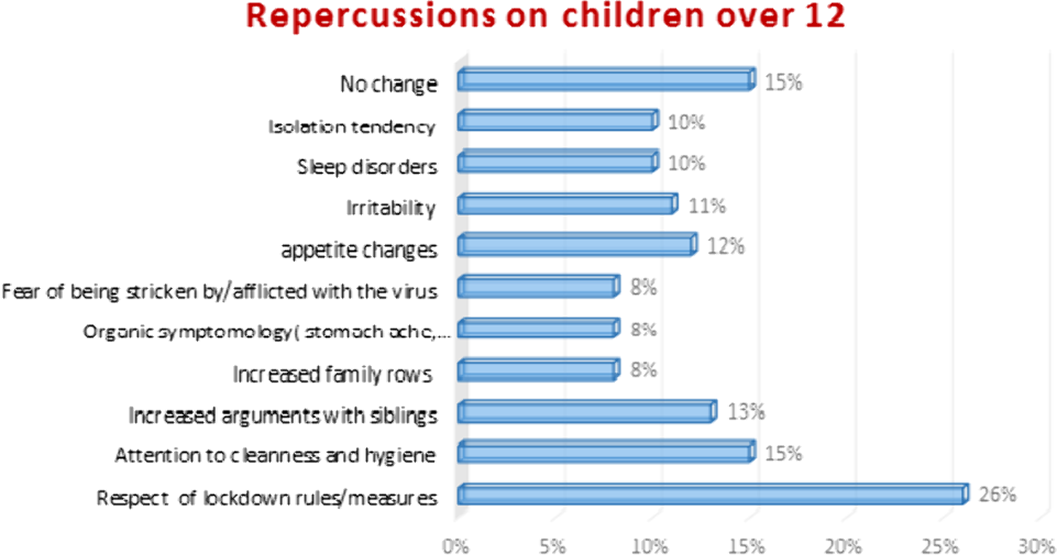
This questionnaire was answered by 138 parents.88% of them were mothers. Changes in working arrangements were made by 87.2% of fathers and 79.8% of mothers. Only 1% of parents did not teach their children about hygienic rules. Parents had a child aged 12 or less in 91% and aged more than 12 in 41.4%. Behavioral changes were reported in 60% for children aged 12 or younger (Graphic 1) and in 20% for those older than 12 (Graphic 2) The IES-R mean score was 28.9 ±18.The severity of the impact was associated with the female sex (p=0.04).We found a positive correlation between the IES-R score and the symptomatology of children with p=0.001 and r=0.518 when the age was superior to 12 and with p<0.001 and r=0,52 when the age was under 12.
Conclusions
The Covid pandemic in Tunisia affected both parents and children. Psychological intervention is essential to help them get out of this crisis with less damage.
The new coronavirus (COVID-19) is being a threat to global health. Pregnancy is considered a state of vulnerability to mental health and can be even greater if they are facing the current pandemia.
Objectives
Within this framework, we wanted to inquire about the state of mental health, and more specifically, about depression, during pregnancy during pandemia COVID-19 and their opinion of the health team∙s professionals that controls pregnancy and how they are involved in the assessment of their mental health status. Also know her fears and uncertainties about the virus and its possible consequences (complications during pregnancy, childbirth or confinement at home, possible contact with COVID-19 positive patients).
Methods
A cross-sectional study was carried out that includes 73 pregnant women from Spain, during September 2020, through an anonymous, voluntary and multiple response type online survey which included questions about socio demographic aspects and the Beck Depression Inventory.
Results
The average age was 32 years. 90.41% were with a partner or married. The results of Beck’s questionnaire: 24.65% have moderate/severe depression. 25.65% had or had thought about consulting a mental health professional, 90.41% considered that professionals had not asked about their mental health during pregnancy. 98.89% reported fear of becoming infected and having to confine themselves at home and 97.26% reported fear of get COVID and affect the health of the unborn baby.
Conclusions
COVID-19 represents a huge challenge for pregnant women’s mental health. The Development and implementation of mental health service, skilled and aware of this area is crucial, for this vulnerable population.
The COVID-19 pandemic presents symptomatic heterogeneity, so the differential diagnosis is even more relevant and more in patients with mental disorders. COVID-19 is a new disease that is under study and affects people over 65 with the greatest severity worldwide. The most frequent psychiatric symptoms are behavioral disturbances and confusional syndrome among those affected.
Objectives
The objective is to demonstrate the importance of differential diagnosis in patients with psychiatric symptoms and covid-19.
Methods
Patients aged 71 and 77, admitted to psychiatry. They present drowsiness that alternates with episodes of psychomotor agitation in which they verbalize fear of the coronavirus. Personal history: bipolar disorder and schizoaffective disorder. Psychopathological exploration: Spatial-temporal disorientation, uncooperative, fluctuating state of consciousness, verborrheic, salty and incoherent speech at times. Dysphoric mood. Psychomotor restlessness predominantly at night, verbal heteroaggressiveness. Negative to ingestion due to odynophagia. Sensory-perceptual alterations and nihilistic delusions “the virus has killed me, I’m already dead.” Upon admission, they present a cough and fever and are treated with azithromycin and dexamethasone for suspected COVID-19. Complementary tests: chest X-ray bilateral pleural effusion. Cranial CT: Diffuse cortical and subcortical brain parenchyma retraction pattern. PCR positive coronavirus.
Results
After overcoming the infection and with psychopharmacological treatment the confusional syndrome remitted.
Conclusions
Confusional syndrome can present with different psychiatric symptoms, so the differential diagnosis is very important and even more so in patients older than 65 years who present somatic pathologies or acute infections. The differential diagnosis of confusional syndrome is key to adequate treatment and favor the prognosis.
Pregnancy is a special risk factor for suicide attempts among females (Andrew E. Czeizel et al. 2011). Situational factors such as the novel coronavirus (COVID-19) have also been reported to impact on individual’s mental health.
Objectives
Examine the effect of COVID-19 and its association with mental health and attempt suicide risk in pregnant population.
Methods
A cross-sectional study that includes 113 pregnant women from Spain, through an anonymous, voluntary and multiple response type online survey which included questions about socio demographic aspects, COVID-19’s aspects and mental health.
Results
Of the 112 pregnant patients surveyed, only 2 reported suicidal ideation. The age of the respondents was 32 and 33 years, both of whom were in the 2nd trimester of pregnancy. Both report that it was the first pregnancy and affirm a worsening of their economic situation since the beginning of the COVID-19 pandemic. One of them did not have a partner / marriage and was living with a relative, in turn this respondent was unemployed. Both responded that they were “always” worried about the possible outcome of the COVID-19 pandemic and that their fears had increased, being difficult to control and let them pass. It is very relevant that both agree that they “never” felt that the professionals who carried out the pregnancy controls asked or inquired about their current state of mental health.
Conclusions
Antepartum suicidal ideation is an important and common complication of pregnancy, specially in COVID-19’s times, healthcare professionals who follow pregnancy should detect high-risk suicidal patients and be able to carry out a suicide prevention program.
COVID-19 outbreak has significantly affected the mental health of people worldwide. The first wave of the pandemic began during the beginning of March 2020, and included significant preventative measures. Previous research on mental health differences between the genders has found that women were more likely to exhibit symptoms of anxiety during the COVID-19 outbreak.
Objectives
The aim of our study was to assess the differences between the genders in depression, anxiety, and stress.
Methods
An online survey designed for the purposes of this study was distributed using the snowballing method during April and May of 2020. The survey consisted of two parts: sociodemographic and clinical data, and COVID-19 related data. Participants also filled out the Depression, Anxiety and Stress Scale (DASS-21) - a well validated, self-questionnaire instrument. T-test for independent samples was used to evaluate the differences between the genders.
Results
Out of the initially sent 563 surveys, a total of 161 were included in further analyses (28.6% response rate). Mean age of the sample was 42.2±10.2 and 65.2% of the participants were female. Mean scores on DASS-21 were as follows: 8.78±6.66 on depression, 9.78±7.39 on anxiety and 7.76±7.14 on stress. Females scored significantly higher on depression (t=-2.25, p=0.029), anxiety (t=-2.25, p=0.028), stress (t=-2.44, p=0.017), and total DASS-21 score (t=-2.44, p=0.016).
Conclusions
The results of our study imply that female participants exhibit higher levels of depression, anxiety, and stress during the COVID-19 pandemic. Larger, population-based studies could provide a mroe in-depth answer to the importance of these differences for the general population.
With the spread of the coronavirus pandemic, there has been the dissemination of an enormous amount of information, through multiple channels, from different sources and with an often unverifiable basis (infodemic). In recent years, there has been debate in the literature about the possibility that different information channels (social media vs traditional media) can determine a more or less extensive emotional contagion regardless of the severity and direct exposure to the stressful event and more precisely through a ‘secondhand’ exposure to events.
Objectives
We want to investigate whether the information channel or the amount of time dedicated to the update is associated with greater psychological sequelae.
Methods
This study is based on a cross-sectional online survey conducted anonymously in the period between the tenth and seventeenth day of shelter in place in Italy. We used Zung Anxiety Self-Assessment Scale and Perceived Stress Scale 4. SPSS 21.0 was used for data analysis.
Results
We collected data on 1047 individuals. In our sample, the Internet was the primary health information channel (55%) followed by TV (36%). Most TV and internet users spend about 1-3 hours a day for the update. There was no correlation between the time spent or the information channel used and higher levels of stress and anxiety.
Conclusions
In our opinion, this relationship between the time spent receiving information or the most widely used information channel and psychological disorders is not clear. Is it the news channel causing an emotional contagion or are the most anxious people looking for news anywhere and anytime?
Covid-19 was declared a pandemic by the WHO on March 11th and efforts have been made to minimize the impact that this new disease can produce. The mental health effects of this pandemic can be severe considering that each year close to 800.000 people die by suicide. This pandemic could increase those numbers, although this is not inevitable.
Objectives
This work reviewed the current available data on possible causes for a suicide rate increase and to try to understand if suicide is already increasing worldwide.
Methods
Non-systematic review of the literature with selection of scientific articles published in the past 6 months; by searching Pubmed and Medscape databases using the combination of MeSH descriptors. The following MeSH terms were used: Covid-19; suicide; SARS-Cov2; pandemic.
Results
Multiple factors can account for an increase in suicide rates such as isolation with a sense of decreased belongingness and increased burdensomeness. A synergy with known suicide precipitants can also occur such as domestic violence, intra-familiar conflicts, alcohol consumption and access to means. Media communication can represent a danger with constant reports about the crisis. And lastly the loss of employment and financial stressors can produce an important impact.
Conclusions
In conclusion, Covid-19 will produce an important impact in many spheres of society, one of which will be mental health. If at the start of this crisis a widespread sense of solidarity was present with the maintenance of precipitant factors for suicide we expect to see an increase in suicide rates.
Sleep disturbances can occur as a result of major stressful events. Additionally, research evidence suggests that COVID-19 pandemic may have negatively impacted the quality of sleep among various populations. However, individuals respond differently to the stress, uncertainty and social isolation related with COVID-19 pandemic.
Objectives
This study aimed to explore the changes in sleep quality and pattern among voluntary psychiatric patients visiting our clinic in Romania during COVID-19 pandemic.
Methods
We implemented a cross-sectional study over a period of 3 months, utilizing a Romanian-translated version of the Pittsburgh Sleep Quality Index (PSQI) which was administered through Google Forms web application. Participants lacking digital skills were provided with guidance for completing the questionnaire. Informed consent was obtained prior to participating in this study and data anonymity and confidentiality were ensured.
Results
Among a total of 98 responders, 63% reported a global PSQI score greater than 5, indicating poor sleep. Approximately 25% of participants subjectively marked their sleep as either fairly bad or very bad. When analysing the 7 components of PSQI, our participants struggled most with long sleep latency. About a third of participants reported using sleep medication (both prescription and over-the-counter) three or more times a week within the past month.
Conclusions
Considering the fact that the current situation is likely to evolve for an unknown period of time, there is a dire need to assess the effect of prolonged adjustments in daily routine and their impact on the sleep and the quality of life of our patients.
The COVID-pandemic context is characterized by a global ambiguity, reflecting the unexpected onset of pandemic, unpredictability and amplitude of the related dangers, questionability and the side effects of the policy measures used to protect people.
Objectives
The development of theoretical framework for understanding variability in the reactions to COVID situation and self-regulatory mechanisms.
Methods
Conceptualization and analysis of individual psychotherapy cases in the framework of psychodynamic approach.
Results
Five typical patterns of anxiety, defensive functioning and mentalization structures were identified: Paranoial pattern is marked by flooding with persecutory anxiety, exaggerated subjective uncertainty. reflected in chaotic boundlessness, incoherence, fantasies of hostility, splitting and polarization of self and others. Depressive pattern reflects inability to sustain ambiguity due to deficiency of internal supports, overly dependence on others, conformity, obedience to authority and denial of personal standards and individuality. Noogenic pattern refers to negative affective states, generated by the ambiguity, contradictions and ambivalence of information. The means to regulate it include the lowering of the level of psychical functioning, with cognitive simplification, preference for order, routine and predictability. Transgression pattern suggests maniacal fascination with the dissipation of limits, normative restraints and rules, and the triumph of the narcissistic-perfectionist permissiveness. Constructivity pattern consists of the pleasure from explorations and insights, creation of new meanings, creative reappraisal and reconstruction of ambiguous situations.
Conclusions
The typical patterns of experiencing ambiguity that were singled out may have diagnostic and prognostic significance in evaluating the individual resource potential in situations of COVID related dangers and isolation.
Psychological problems are common among the pediatric population suffering from a chronic illness, especially compared to the normal population. Stressful life events, such as social distancing measures implemented to counter the COVID-19 pandemic emergency, can strongly influence their epidemiology.
Objectives
The aim of this study was to assess the prevalence rate of depressive and anxiety symptoms among an Italian pediatric population affected by chronic illness and already under a Children Hospital psychological follow-up program during COVID-19 lockdown.
Methods
We conducted a cross-sectional study among 54 Italian children and adolescents affected by chronic illness (mean age: 15y; range: 8.9-18y) during the COVID-19 epidemic period. We assessed depressive and anxiety symptoms with the Patient Health Questionnaire (PHQ-9) and the Generalized Anxiety Disorders (GAD-7) questionnaire during scheduled follow-up checks or teleconsulting.
Results
Preliminary results showed an elevated prevalence of depressive and anxiety symptoms (51% and 48% respectively) among chronically ill children during the COVID-19 outbreak. When compared with a non-ill pediatric population (Zhou et al. 2020), rates are + 7.3% higher for depression and + 10.6% for anxiety.
Conclusions
Chronic ill pediatric patients are a vulnerable group and require careful consideration. For this reason, the healthcare system should be able to implement and guarantee adequate mental health support programs and continuity of care. Further research is necessary since the COVID-19 outbreak could be repeated.
The coronavirus pandemic (COVID-19) has affected the functioning and capacity of healthcare systems worldwide. COVID-19 has also disproportionately affected older adults, including those living with dementia. In the context of COVID-19, decision-making surrounding place of care and place of death in this population involves significant new challenges.
Objectives
To explore key factors that influence place of care and place of death decisions in older adults. A secondary aim was to investigate key factors that influence the process and outcome of these decisions in older adults. To apply findings from current evidence to the context of COVID-19.
Methods
Rapid review of reviews, undertaken using WHO guidance for rapid reviews. Ten papers were included for full data extraction. These papers were published between 2005-2020. Data extracted was synthesised using narrative synthesis, with thematic analysis and tabulation.
Results
Papers included discussed actual place of death, as well as preferred. Results were divided into papers that explored the process of decision-making, and those that explored decision-making outcomes. Factors such as caregiver capacity, the availability of multidisciplinary teams, cultural appropriateness of care packages and advanced care planning were found to be key.
Conclusions
The process and outcomes of decision-making for older people are affected by many factors – all of which have the potential to influence both patients and caregivers experience of illness and dying. Within the context of COVID-19, such decisions may have to be made rapidly and be reflexive to changing needs of systems and of families and patients.