We partner with a secure submission system to handle manuscript submissions.
Please note:
You will need an account for the submission system, which is separate to your Cambridge Core account. For login and submission support, please visit the
submission and support pages.
Please review this journal's author instructions, particularly the
preparing your materials
page, before submitting your manuscript.
Click Proceed to submission system to continue to our partner's website.
To save this undefined to your undefined account, please select one or more formats and confirm that you agree to abide by our usage policies. If this is the first time you used this feature, you will be asked to authorise Cambridge Core to connect with your undefined account.
Find out more about saving content to .
To send this article to your Kindle, first ensure no-reply@cambridge.org is added to your Approved Personal Document E-mail List under your Personal Document Settings on the Manage Your Content and Devices page of your Amazon account. Then enter the ‘name’ part of your Kindle email address below. Find out more about sending to your Kindle.
Find out more about saving to your Kindle.
Note you can select to save to either the @free.kindle.com or @kindle.com variations. ‘@free.kindle.com’ emails are free but can only be saved to your device when it is connected to wi-fi. ‘@kindle.com’ emails can be delivered even when you are not connected to wi-fi, but note that service fees apply.
The presence of low-activity alleles of the MAOA gene increases the risk of hostility.
Objectives
To study the association of hostility with high and low-active variants of the MAOA gene in an open population of men 45-64 years.
Methods
Under the WHO International Program MONICA-psychosocial and HAPIEE a representative sample of men aged 45–64 years (n = 781 men, average age was 56.48 ± 0.2 years) examined in 2003-2005. All respondents independently completed a questionnaire on hostility. From the surveyed sample using the random number method 156 men were selected who were genotyped for MAOA-uVNTR polymorphism.
Results
It was found the level of hostility in the population of men was 60.3%. In persons with low-active alleles of the MAOA-L gene (allele 2 and 3) a high level of hostility was more common - 50.9%. The results of building a logistic regression model showed that the presence of low-active alleles (2; 3) of the MAOA gene increases the likelihood of hostility OR = 2,103 (95% CI 1,137-3,889, p = 0.018).
Conclusions
Our findings allow us to conclude that the low-active allele of the MAOA-L gene is associated with hostility.
Shame and guilt are often discussed in their association with depression. However, there is a need in deeper understanding of relationship between these emotions and depressive symptoms in personality disorders, where affective patterns do not reach the level of clinical depression.
Objectives
To examine the differences in shame and guilt levels in normal subjects and patients with personality disorders and their association with depressive symptoms.
Methods
In total, 28 patients (M=36.07, SD=11.87) diagnosed with personality disorders and 76 (M=29.67, SD=8.87) healthy individuals were recruited to take part in this study. Patients and healthy controls had equivalent educational level. Participants were given two standardized tests: Beck Depression Inventory and Test of Self-Conscious Affect (TOSCA) – 3.
Results
There were significant differences in levels of guilt between patients with personality disorders (M=64.79, SD=6.78) and healthy individuals (M = 59.92, SD = 11.86), t (102) = 2.603, p = .011. Patients also demonstrated higher levels of shame (M=47.86, SD=9.70) than the participants without diagnoses (M = 43.38, SD = 14.96), however, these differences were not significant t (102) = 1.47, p > .05. It was found that depressive symptoms in normal population but not in patients significantly correlated with levels of guilt (r(76) = .124, p <.01) and shame (r(76)=.188, p<.01).
Conclusions
It might be assumed that shame and guilt play different roles in emotional sphere of healthy individuals and patients with personality disorders, being associated with depressive symptoms in norm and unrelated to depressive symptoms in personality disorders.
Empathy is generally viewed as a “positive” trait, while the Dark Triad traits are regarded as a “negative” side of a Dark personality. The perception of Risk is less univocal, as it plays a role in both courage and questionable behavior.
Objectives
We posed the following research questions: 1. Is risk linked to empathy and the Dark Triad traits? 2. Which traits help distinguish between participants with contrasting latent profiles (determined cumulatively for the specified personality variables)?
Methods
Participants (n=250) completed three questionnaires: the Dirty Dozen, Personality Factors of Decision-making and the Questionnaire of Cognitive and Affective Empathy (QCAE). Correlation and Latent profile analysis (LPA) were performed.
Results
Risk was linked to Machiavellianism, psychopathy, and decentration (positively) and to emotion contagion and affective empathy (negatively). Rationality was positively correlated with cognitive empathy. Machiavellianism correlated negatively with rationality and online simulation (a cognitive empathy subscale). Empathy subscales were linked to psychopathy (negatively) and to narcissism (positively). LPA established two latent profiles: the smallest BIC value was obtained for the model with two profiles (log-likelihood: -3204.013, df=77, BIC=-6833; VEE). Analysis of means revealed that Class 1 was characterized by significantly higher Dark Triad values and higher Risk, whereas Class 2 was characterized by lower Dark Triad traits, lower Risk, and higher Rationality (see Figure 1).
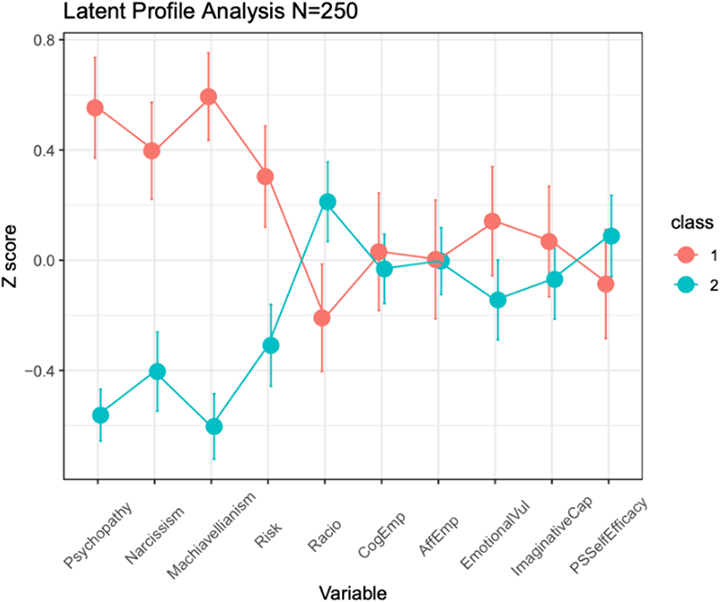
Figure 1. Latent profile analysis
Conclusions
The Dark Triad traits and Risk are the more discriminative variables, while Empathy subscales do not help distinguish between the two classes of participants. The study was supported by the Russian Foundation for Basic Research, project 19-29-07069.
The countertransference of the therapist is crucial in psychotherapy. Although the concept of countertransference arose from psychoanalysis, it is considered a construct that occurs in any type of therapy.
Objectives
The purpose of this review is to examinate the relationship between personality disorders and countertransference.
Methods
A systematic literature review was performed on PubMed using the keywords “personality disorder” and “countertransference”. All papers published between 2015 and 2020 were evaluated.
Results
There were significant relationships between and patients’ personality disorders and patterns of countertransference. Criticized countertransference were associated with paranoid and antisocial personality disorders. Borderline personality disorders was related to helpless, overwhelmed, and overinvolved responses. Narcissistic and schizotypal personality disorders were associated with disengaged therapist responeses. Helpless countertransference was associated with schizoid personality disorders. Avoidant personality disorders was associated with postive responses. Special/overinvolved therapist responses were associated with obsessive-compulsive personality disorders
Conclusions
Several studies suggest that therapists’ emotional responses occur consistently in any kind of therapy. Moreover, specific personality disorders are associated with concrete emotional responses. Therefore, therapists can make therapeutic and diagnostic use of their conuntertransference.
People with personality disorders (PD) share some impairments in personality functioning (e.g. identity, intimacy, empathy) that are also associated with inner or interpersonal conflicts, and sometimes also with different strategies of moral disengagement (MD). It is unclear whether MD strategies are related to individuals with/without PD and their willingness to have social contacts with representatives of otherness (like minorities, physically handicapped, etc.).
Objectives
Comparison of the differences in MD strategies and social distance to the otherness of healthy controls and people with PD, and the influence of personality functioning.
Methods
Moral Disengagement Scale which measures eight MD strategies, the Semi-Structured Interview for Personality Functioning DSM-5 assessing the Self and Interpersonal functioning, and Bogardus Social Distance Scale measuring perceived social distance toward various representatives of otherness are applied in two samples (general population and personality disorders).
Results
People with PD showed a significantly higher propensity to use various MD strategies than healthy controls with moderate effect size (.34–.49). Moral disengagement is facilitated by different aspects of personality functioning in both samples, sharing the impairments in maintaining close relationships. Both samples differed in MD strategies connected with higher social distancing.
Conclusions
People with PD are more prone to moral disengagement than healthy adults. MD appears to be facilitated by different aspects of personality functioning in both samples. Some representants of otherness are more related to specific MD strategies. We hypothesize that understanding of specific MD strategies used by people with PD can provide insight and explain some of their behavior.
Previous studies didn’t find any connection between Neuroticism and authoritarian personality or social dominance orientation, but xenophobic attitudes might be hold even apart from these constructs.
Objectives
In our study we compared subjects with high Neurtoticism score with controls with a focus on racism and social distance.
Methods
The Bogardus Social Distance Scale (BSDS) is a measure of perceived social distance of a subject towards concrete outgroups. Modern Racism Scale (MRS) and The Blatant and Subtle Prejudice Scales (BSRS) are scales measuring racism. For our study we used the Neuroticism scale of the Eysenck Personality Questionnaire (EPQ). Also, we asked about personal conflicts with outgroup members and how subjects perceived their unpleasantness and importance. We measured the attitudes towards Romani, Vietnamese, foreigners, homeless people, migrants, people with mental disease and people with a physical disability.
Results
People with the high neuroticism score (SD≥1; N=48) showed significantly higher scores in racism. In comparison to control group (CG; N=96), their social distance differed significantly towards Romani, Vietnamese and migrants. Effect sizes were however on the threshold between weak and moderate. After Bonferroni correction, only the social distance towards migrants remained significant. People with the high neuroticism score didn’t report higher rate in conflict with outgroup members than HC.
Conclusions
People with the high neuroticism score showed different pattern in attitudes towards outgroup members, but not in conflict with them, which might point at higher need of internalization of negative attitudes.
Psychopathy is a personality disorder characterized by lack of empathy, grandiosity, an impulsive lifestyle and antisociality. Anti-social personality disorder (ASPD) and psychopathy are distinct concepts presenting different criteria. Most people with a diagnosis of psychopathy also meet criteria for ASPD while the reverse is not true. Along the years there has been an increasing interest in investigating genetic and neurobiological factors.
Objectives
To analyze the neurobiological factors involved in psychopathy and anti-social personality disorder according to the scientific knowledge available.
Methods
Review of scientific literature via PubMed search, using the terms “anti-social personality disorder”, “biology or etiology or pathophysiology and psychopathy”.
Results
The strongest evidence base for a genetic pathway is associated with the low-expression variant of the Monoamine Oxidase-A (MAO-A) which is linked to the X chromosome. Other genetic factors involve the 5-HTT gene, dopamine receptor genes (DRD4 and DRD2) and genetic polimorfisms at SNAP25 t-snare protein, OXT gene and the CNR1 and FAAH cannabinoid receptor gene. Structural differences in the brain have been noticed such as reduced gray matter volume in the orbitofrontal cortex, gray matter volume reductions in the mid-anterior insula and left anterior temporal cortex, subtle reductions in gray matter volume across several paralimbic and limbic areas.
Conclusions
There is considerable evidence regarding various possible underlying neurobiological processes in psychopathy although it is insufficient to suggest a single biological etiology and environmental influences cannot be excluded from a complete understanding of this disorder. The neurobiological correlates found hold promise for new research and treatment.
In our study, we aimed to understand how an individual perceives everyday life, as well as, which role the features of metacognitions and personality play in this process. Everyone is immersed in society and therefore exposed to external influences. Attention has already been focused on the relationship between metacognition and social context. “Internal orientation” depends largely on our personal and family history, socio-economic situation, group membership, and cultural context.
Objectives
The sample consisted of 30 participants (women and men, M=25,7, Sd=3,6), selected by the criterion of personal interest in this research.
Methods
The study consisted of several stages. The first stage was devoted to the theoretical analysis of everyday life in modern psychology. The data were processed using descriptive qualitative analysis using the phenomenological method, where we identified categories (Central topics) among the participants ‘ responses. To study the features of metacognition, we selected methods for assessing metacognitive involvement in awareness of internal activity, as well as metacognitive beliefs. The metacognitive awareness inventory questionnaire (MAIL) (Schraw & Dennison, 1994) in adaptation (Karpov & Skiteva, 2005) allows you to assess the level of metacognitive engagement, answer the question about the level of metacognitive awareness of the participant.
Results
Pearson correlation is revealed a significant relationship between MAI and cognitive self-consciousness (p=0.003), positive beliefs (p=0.002), and needs of controling the thoughts (p=0.076).
Conclusions
Our research opens the study of the subjective dimensions of person-situation-activity and offers a way of linking research on personality with research on the social processes whereby persons conduct their everyday lives.
Personal traits influence persons’ perception of the social environment. Therefore analyzing stories with the non-specific plot can enable to distinguish particular characteristics.
Objectives
The aim is to determine the features of verbal self-presentation of people with high and low scores on the Machiavellian scale.
Methods
1. For the selection of particular participants, who have high and low scores, the questionnaire «Dark triad» of Egorova was used. 2. For collection stories of respondents, a series of interviews was carried out with extra stimulus. There were 20 conversations. Age was from 19 to 29 (m = 23; sd = 7,1).
Results
The opportunity to predict personal traits in general stories was proved. There is a confrontation between the person and the world in the speech of the Machiavellians. Their stories usually have a strong hero, other characters are ignored by the main person. Machiavellians want a safe and calm place that allows them to be themselves. We assume that this is a consequence of the fact that they have to dissemble in society. This statement requires further verification Non-Machiavellians are concerned by the opinion of society, that affects their life and behavior. They act for the well-being of the world while their own feelings are being ignored. There is a feeling of guilty in non-Machiavellians’ tales which is connected with failures around them.
Conclusions
The study was piloted interviewing method (with stimulus material) for the study of indirect verbal self-presentation. Differences were found between the people’s self-presentation with an accentuation of Machiavellianism and non-Machiavellianism.
Borderline Personality Disorder is defined from its impulsivity issues regarding relationships, abandonment and rejection issues and emotional regulation problems. This personality disorder issue are hard to treat and often related to poor treatment outcomes. Nonetheless, Dialectical Behavioral Therapy stands as a great therapeutical approach that can be adapted.
Objectives
We tested a 6-month CBT protocol (ECCCLORE)-3 modules respectively working on emotion regulation, distress tolerance and relationships- in a French context to compare its effectiveness to treatment as Usual (TAU).
Methods
We recruited 56 patients suffering from BPD, 34 receiving ECCCLORE treatment and 22 receiving TAU. We assessed BPD traits, impulsivity with UPPS, aggressiveness with AQ12, Suicidal risk with SBQr and Hopelessness with H.
Results
Our results revealed the effectiveness of this 6 months DBT adaptation for decreasing BPD traits and most of clinical dimensions. The dynamic analysis revealed the mediating effect of AQ12.
Conclusions
Shortened treatment protocol are effective for reducing symptoms. Further research is needed to replicate these results.
In our days the professional reliability of servicemen is an important issue. Servicemen not only protect the state but also ensure a stable and harmonious life of society (Vagin, 2012). This profession is extreme for life, therefore the significance of human error in this profession is very high. Study of personal characteristics forming professional reliability is important for professional psychological selection. The study was supported by the RFBR #19-013-00799 А.
Objectives
Study of the psychological factors for reliability of servicemen.
Methods
The study involved 708 servicemen, the average age of 20.3 (min – 18, max – 32), the sample consisted only of men. The methodological package included the following methods: Managerial stress survey — MSS (Leonova, 2007), The Sixteen Personality Factor Questionnaire (Kapustina, 2001).
Results
The exploratory factor analysis revealed that the professional reliability includes the following personal characteristics: low level of Сhronic stress (-0.851), Emotional Stability (0.823), Motivational Distortion (0.761), Apprehensiveness (-0.716). The Kaiser-Meyer-Olkin Measure of Sampling Adequacy = 0.781, and Bartlett’s test of sphericity = 865.26 (p = 0.0001), the total variance of this factor is 62.4%.
Conclusions
According to this factor, the profile of professional reliability of each serviceman was compiled: low stress level, self-confidence, non-fearfulness, efficiency, high self-esteem, personal maturity. In the future, confirmatory factor analysis will be performed, and the relationship of this scale with objective data will be investigated.
Mentalization (MZ) is the capacity by which people make sense of their own’s and others’ mental states; when compromised, it is associated with several mental disorders (Bateman & Fonagy, 2010). A valid instrument to assess MZ is missing and required for the Portuguese population.
Objectives
To develop and validate a Portuguese version (Questionário de Mentalização – QMZ) of the Mentalization Questionnaire (MZQ) (Hausberg et al., 2012).
Methods
A sample of 184 Portuguese medical students (mean age = 21.6 ± 2.47 years, 59.8% female) was used to explore the psychometric properties of the scale, using reliability and factor analysis (varimax rotation method).
Results
The QMZ exhibited a Cronbach’s alpha score of .80. All items contributed to its reliability. Based on the scree plot of Cattell and interpretability of items, a 2-factor and a 5-factor structures were further explored. The former explained 38.8% of the total variance (VE) and included a regulation of affect (VE= 27.3%, α=.79) and a self-reflection and emotional awareness (VE= 11.5%, α=.62) factors. The latter explained 60.6% of the total variance and incorporated the following dimensions: self-control (VE= 27.3%, α=.74), daily relationships (VE= 11.5%, α=.67), self-comprehension (VE= 8.1%, α=.54), close relationships (VE= 7.0%, α=.41) and self-monitoring (VE= 6.7%, α=.52). The 5-factor structure was closer to the dimensional concept of mentalization.
Conclusions
The QMZ has proved to be a promising instrument, with adequate psychometric properties, confirmed by its acceptable construct, criterion and factorial validity and reliability to assess mentalization in Portuguese language.
Primary psychopathy, although not included in DSM-5, is a personality trait characterized by callousness, unemotionality and a low sensitivity to anxiety and fear. From a psychophysiological standpoint, individuals with this trait exhibit a number of alterations, most notably lower heart rate at rest and lower heart rate variability (HRV).
Objectives
We investigated the relationship between primary psychopathy and heart rate dynamics in response to emotional stimuli in a healthy community sample. In the high psychopathy participants we expected to find lower HRV and a general lower cardiovascular responsiveness to aversive emotional stimuli.
Methods
The study was carried out on male students with high (HP) and low scores (LP) of primary psychopathy according to Levenson’s LSRP. The stimuli were 15 short movie clips of different emotional content (Erotic, Scenery, Neutral, Compassion and Fear), lasting 2 minutes each and presented during ECG recording. Mean heart rate (HR) and HRV were analyzed.
Results
Concerning HR, a Category by Group interaction revealed that participants in the HP group did not differentiate among emotional movie clips, whereas those in the LP group manifested significant reduced HR to Fear and Scenery compared to the other clips. Concerning HRV, the main Group effect showed in HP participants a lower HRV than LP subjects, irrespective of the film categories.
Conclusions
Using ecological stimuli is considered more effective in evoking spontaneous emotions, and our results point to a clear alteration of emotional cardiovascular response in high primary psychopathy trait individuals selected from a community sample.
Although there are several empirical studies exploring the relationship between problematic Internet use and personality traits, few had considered perfectionism.
Objectives
To explore the association between generalized problematic Internet use and perfectionism.
Methods
A sample of 433 Portuguese university students (Mage = 20.15 years, SD = 1.77, range = 18-25 years) completed the Generalized Problematic Internet Use Scale 2/GPIU and the Multidimensional Perfectionism Composite Scale – short version.
Results
GPIU total score (rs=.16**), Mood Regulation (rs=.22**), and Deficient Self-Regulation (rs=.13**) were correlated with Positive Striving factor. GPIU total score (rs=.38**), Preference for Online Social Interaction (rs=.16**), Mood Regulation (rs=.28**), Deficient Self-Regulation (rs = .33**), and Negative Consequences (rs=.41**) were significantly correlated with Evaluative Concerns factor. A one-way between groups analysis of variance was conducted to explore the relation between GPIU and perfectionism. Subjects were divided into three groups according to their GPIU risk levels (Group1:low-risk; Group2:medium-risk; Group3:high-risk). There was a statistically difference at p >.05 level in Positive Striving scores for the three risk level groups: F (2,430)=4.39, p=.013, and in Evaluative Concerns scores, F (2,430)=28.83, p=<.001. Post-hoc comparisons using the Tukey USD test, for Positive Striving, indicated that the mean score for Group1 (M=39.21, SD=8.56) was significantly different from Group3 (M=43.69, SD=9.74). Considering Evaluative Concerns, the mean score for Group1 (M=39.86, SD=11.31) was significantly different from Group2 (M=46.91, SD=11.42) and from Group3 (M=51.75, SD=8.54).
Conclusions
GPIU is consistently related to maladaptive perfectionism. Future longitudinal studies are needed to clarify the bidirectional association between GPIU and perfectionism traits.
The development of complex human-machine systems has led to greater demands on operators’ skills, and has increased the importance of human error (Pribytkova et al, 2012; Vondráčková et al, 2017; Jian Ai Yeow, 2014). For this reason performance reliability, defined as operators’ capacity to conduct essential work processes in a high-quality and timely manner (Bodrov, Orlov, 1998) has become a topical subject.
Objectives
This study concerns an investigation of subjective predictors of operators’ reliability, namely personality risk factors (supported by the RFBR #19-013-00799).
Methods
Subjects: 67 operators and 69 engineers at a hydro-power station. Personality traits were assessed using Sobchik’s verbatim Russian translation of the MMPI (Sobchik, 1990). Performance reliability was assessed using simple and complex sensorimotor reaction tests as standard procedures for the pre-shift assessment of operators.
Results
In the operators’ group significant correlations (Spearman’s test) were found between the level of quality of complex sensorimotor reactions and the level of such personal traits as impulsiveness and individualism: a higher manifestation of these traits was associated with a higher level of mistakes in conducting the pre-shift psychophysiological test (p<0,05). With the engineers there was a significant link between the higher speed of simple sensorimotor reactions and higher optimism scores.
Conclusions
The results suggest that a tendency to behave spontaneously, and orientation to one’s own needs, could be risk factors in terms of operator reliability. They also reveal the specifics of reliability predictors in different professions at the power plant.
Both original Big Three Perfectionism Scale (BTPS; Smith et al. 2016), and the Portuguese version validated with a sample of university students (Lino et al. 2018) evaluates three second-order factors (rigid, self-oriented and narcissistic perfectionism) and ten facets.
Objectives
To confirm the BTPS three-factors-ten-dimensions’ structure in a sample of Portuguese adults from the general population.
Methods
A sample of 467 adults (70.7% females; Mean age=38.44±12.27; range: 25-82) answered the BTPS Portuguese version and other validated perfectionism measures (Multidimensional Perfectionism Scales from Frost and Hewitt & Flett; Self-Presentation Perfectionism Scale). To study the temporal stability a sub-sample of 132 participants completed the BTPS again after approximately five weeks. SPSS and AMOS software was used.
Results
The second order model presented an acceptable fit (X²/df=3.115; TLI=.811; CFI=.825; RMSEA=.067). There was also evidence of a general factor comprising all the 45 items (X²/df=3.127; TLI=.809; CFI=.823; [JA1] RMSEA=.068). The Cronbach alphas of the three factors ranged from a=.88 to a=.92; and facets had a>.70 showing a total of a=.94. Total and dimensional scores showed significant positive and moderate to high correlations with the other perfectionism measures and their test-retest correlation coefficients were r=.85 (p<0.001).
Conclusions
This study confirms the validity and reliability of the Portuguese BTPS underlying three-factors structure. Additionally, we found, for the first time, that BTPS can also be validly and reliably used to measure a global perfectionism construct. It is our intention to develop a shorter version the Portuguese BTPS in the near future.
Openness, conscientiousness, extroversion, agreeableness and neuroticism are known as the Big Five personality traits (BFPT). They are theoretical building blocks of the personality and comprise wide and interconnected spectra. Artificial intelligence (AI) could help to grasp their complexity.
Objectives
To investigate whether AI could predict the BFPT from themselves.
Methods
Data from 2,697 questionnaires were analysed using an AI. The short form of the International Personality Item Pool was used to assess the BFPT. Four of the BFPT scores were employed to predict the fifth one and the procedure was repeated for all of them alternatively. The AI was conservatively tuned to maximize the one-way random intraclass correlation coefficient (ICC) between predicted and real values. Their Pearson’s r was calculated too. The free and open source programming language R was used for all the analyses. Dataset source: Hansson, Isabelle; Berg, Anne Ingeborg; Thorvaldsson, Valgeir (2018), “Can personality predict longitudinal study attrition? Evidence from a population-based sample of older adults”, Mendeley Data, V1, doi: 10.17632/g3jx8zt2t9.1
Results
Openness, conscientiousness, extroversion, agreeableness and neuroticism predictions obtained ICC of 0.219, 0.146, 0.306, 0.354, 0.121 and Pearson’s r of 0.254, 0.149, 0.393, 0.446, 0.122 respectively. The results for extroversion and agreeableness were indicative of fair performance.
Conclusions
AI might be useful to predict personality traits, mainly extroversion and agreeableness. This could be utile in many situations, such as dealing with missing data or deciding whether to formally test someone. Finally, the AI used in this study is freely available, allowing anyone to experiment.
Work experience develops not only professional skills, but also affects people’s personal characteristics. A long period of intensive work usually promotes the development of professional deformations. Prolonged exposure in stressful conditions is a risk factor for developing professional deformations. Military service is intense and stressful. Armed forces personnel work is related to unquestioning execution of orders and extreme working conditions (Kozlova, 2013). These risk factors may cause professional deformations of personality. The study was supported by the RFBR #19-013-00799 А.
Objectives
Influence of working activity on professional deformations development in military personnel.
Methods
The research involved 708 participants, the sample consisted only of men. Average age 20.3 years (min – 18, max – 32). They fulfilled 2 standardized questionnaires: Managerial stress survey — MSS (Leonova, 2007), The Sixteen Personality Factor Questionnaire (ed. Kapustina, 2001).
Results
Based on the findings the following outcome can be seen: the high scores of the Acute stress (M=45,7; SD=5,2), medium level of Chronic stress (M=43,6; SD=6,5), and Professional deformations (M=43,4; SD=7,1). In particular it turned out that burnout syndrome (M=46,1; SD=6,9), neurotic reactions (M=45,4; SD=7,0) and behavioral risk factors (M=46,7; SD=8,7) are high.
Conclusions
In that way, we can assume that Professional deformations aren’t developed by military personnel in our research. That point of view confirms on Acute and Chronic stress level. Despite the fact that there are some behavioral risk factors. That can cause a reduction of work efficiency and a decline in the health level of military personnel.
The aim of this research is to study the five major personality traits in a sample of call center employees in the Rabat-Salé-Kénitra Region, Morocco.
Objectives
Demonstrate the domination of certain personality dimensions over others in this population.
Methods
This is a cross-sectional epidemiological study that involved 121 individuals, including 59 men and 62 women with an average age of 31.74 ± 7.93. The personality traits were assessed using the Big Five test.
Results
The results show that, (63.64%) of our sample has a more dominant extraversion pole, while (36.36%) of the participants have a more dominant introversion pole. (66.12%) of our study subjects have a dominance of agreeableness dimension, while for (33.88%) of the sample the disagreeableness dimension dominates. Almost parity is observed between those in our sample who have a dominance of the conscientiousness pole (50.41%), and those who have a dominance of the impulsivity pole (49.59%). 74.38% of the participants have a dominance of the neuroticism pole, while (25.62%) have a dominance of the emotional stability pole. (57.02%) has a dominance of the openness pole, while (42.98%) have a dominance of the closedness pole.
Conclusions
This study sample is characterized to a large extent by extraversion and agreeableness; moreover this study has shed light on the dominance of the neuroticism trait in this kind of population. However, considering this study concerned only one region, it would be interesting to widen the geography of the survey to acquire more exhaustive results.
Methodological foundations of Lev Vygotsky’s school enable to reveal the mechanisms shaping personality disorders and to explore the process of disorder formation. The genesis of symptoms is examined in the context of the social situation of child’s development and historical environment.
Objectives
2 groups of children (aged 5,5-7): (1) upper middle class, from prestigious development center (n = 31); (2) lower middle class, from social assistance center (n = 35).
Methods
The following methods were used: СAT (Bellak); objective description of the cultural and social context of the child’s development; long-term observation.
Results
1) Deviations of personal development in children from the first group are expressed in individualism and related narcissism. This feature is actualized in CAT stories with the situation of rivalry between the characters (t. 1, 4, 5): the central character is either ignored by the child, or pampers the “small” character, which represents the child’s identification model (t. 3, 7). Another feature is intolerance to frustration; frustration is ignored in pictures dealing with this topic (t. 8, 10). 2) For the second group, typical features include anxiety, rigidity when acting not according to the rules. These features are manifested at the beginning of the CAT test and in situations when self-expression is required (t. 1). Moreover, children demonstrate the negative sense of self, which is expressed in identification with losing characters (t. 2) and in projections of the early social fears (t.8)
Conclusions
The social and genetic approach enables more thorough and careful examination of the onset of the deviation.