We partner with a secure submission system to handle manuscript submissions.
Please note:
You will need an account for the submission system, which is separate to your Cambridge Core account. For login and submission support, please visit the
submission and support pages.
Please review this journal's author instructions, particularly the
preparing your materials
page, before submitting your manuscript.
Click Proceed to submission system to continue to our partner's website.
To save this undefined to your undefined account, please select one or more formats and confirm that you agree to abide by our usage policies. If this is the first time you used this feature, you will be asked to authorise Cambridge Core to connect with your undefined account.
Find out more about saving content to .
To send this article to your Kindle, first ensure no-reply@cambridge.org is added to your Approved Personal Document E-mail List under your Personal Document Settings on the Manage Your Content and Devices page of your Amazon account. Then enter the ‘name’ part of your Kindle email address below. Find out more about sending to your Kindle.
Find out more about saving to your Kindle.
Note you can select to save to either the @free.kindle.com or @kindle.com variations. ‘@free.kindle.com’ emails are free but can only be saved to your device when it is connected to wi-fi. ‘@kindle.com’ emails can be delivered even when you are not connected to wi-fi, but note that service fees apply.
Stigma is a major burden and impediment for treatment and recovery in serious mental disorders, especially psychotic disorders. Therefore, it has been proposed to replace the term schizophrenia by psychosis susceptibility or psychosis spectrum disorder.
Objectives
We have assessed stigma in the media through a 10-year survey of Flemish daily newspapers (2008-2017) by comparing the way schizophrenia and autism are portrayed. We added the term psychosis for the years 2013-17 to assess its suitability as a less stigmatising alternative.
Methods
Via the websites of the seven Flemish newspapers, we searched for all articles published between 01 Jan 2008 and 31 Dec 2017 containing the keywords autism, schizophrenia, and related terms. The collected articles (n = 5,337) were then graded to their stigmatising content. We added the term psychosis for the years 2013-17.
Results
In the collected articles the coverage of autism was mostly positive, whereas the coverage of schizophrenia was predominantly negative. The contrast was very substantial (p < 0.0001) and stable over the years. The portrayal of psychosis turned out to be mostly positive in the broadsheet newspapers and mostly negative in the tabloid papers.
Conclusions
The social stigma attached to schizophrenia and psychosis is poignantly reflected in the Flemish newspapers. The fact that a comparable disorder such as autism is depicted in a much more favourable way than schizophrenia indicates that a more positive image of schizophrenia is not only desirable but also achievable. Psychosis gives mixed results, a finding up for discussion.
Horticultural therapy is used as alternative treatment option in rehabilitation programs for patients suffering from chronic mental disorders. In Greece, the Psychiatric Hospital of Thessaloniki was the first that organized a organized Rehabilitation Program approved by the Greek Ministry of Health, the “Green Unit - Monada Prasinou”.
Objectives
The purpose of this study was to investigate the effect of horticultural intervention on the functionality of patients employed in the Green Unit of the Psychiatric Hospital of Thessaloniki.
Methods
The Mini-ICF-APP Social Functioning Scale was used to evaluate the functionality of the patients. Horticulture therapy included actual gardening and other agricultural activities. The sample consisted of two groups, 22 inpatient of the Green Unit and 22 patients of outpatient units as a control group. The majority of the patients suffered from Schizophrenia spectrum disorders. Both patients’ groups were evaluated over 12 months (May 2018- May 2019).
Results
At baseline evaluation, the patients of the Green Unit patients presented higher scores only in the mobility and endurance subscale. A year later there was a statistically significant difference in all thirteen subscales. Shortly, the patients were rated as more consistent, organizational, social, flexible, responsible, more confident and enterprising, more adaptable and more able to take care of themselves.
Conclusions
The results suggest that horticulture as a therapeutic method had beneficial effects in all dimensions of patient functionality confirming the hypothesis that such programs should be a priority in the effort of psychosocial reintegration of patients suffering from chronic mental disorders.
Analysis of problems arising in communication between parents and their children with disabilities is a part of biopsychological examination of disease.
Objectives
The study was aimed at exploring the parent-child communication in children suffering from chronic neurological disorders in order to organize the optimal psychological rehabilitation.
Methods
The study consisted of two stages: 1) CAT (Bellak) and drawing tests, performed by child; 2) experiment involving both parent and child, making up a story together (CAT-H, parallel to the task performed by the child). Parents filled in a questionnaire on their communication with the child; its results were compared to the situations of real communication. Other methods used included: observation, analysis of family situation and child’s development; coding of communicative elements; analysis of the story by the method by N. Burlakova (Burlakova, 2001). The study involved 34 persons: 17 children (aged 7–10) + 17 parents (15 mothers, 2 fathers). The dyads were studied when the children received treatment in the hospital (resided in the hospital together with the parent).
Results
1) Activity of the child together with the parent revealed several communicative patterns, which correlated differently to the estimation of communication by the parent. 2) The types of inner dialogues in children were discovered, which gave concrete expression to the inferiority feeling caused among others by the communication in the parent-child dyad. 3) The organization of the research enabled to follow the “production” of dialogues of self-awareness in children with chronical diseases.
Conclusions
The conducted research enables organization of individualized psychological and psychotherapeutical aid.
HIV-positive patients with schizophrenia spectrum disorders experience burden of double stigma. Comorbid pathology may alter structure of stigma and shall be considered in development of individual destigmatization programs.
Objectives
Study of psychiatric stigma features in HIV-positive and HIV-negative patients with schizophrenic disorders.
Methods
ISMI (Ritsher et al., 2003), PDD (Link et al., 1991) – to study stigma in 70 patients divided into three groups with respect to their diagnosis (I — F20.x, II — F21.x, III— F2x+HIV); BPRS (Overall & Gorham, 1962) – to assess psychiatric status, RSAS (Eckblad et al., 1982) – to assess anhedonia. Dispersion analysis (Kruskal and Mann–Whitney tests), Spearman and Pearson correlation were used.
Results
Patients with comorbid HIV-infection showed increased level of perceived stigma, although they resisted the stigma internalization better than others did (Table 1).
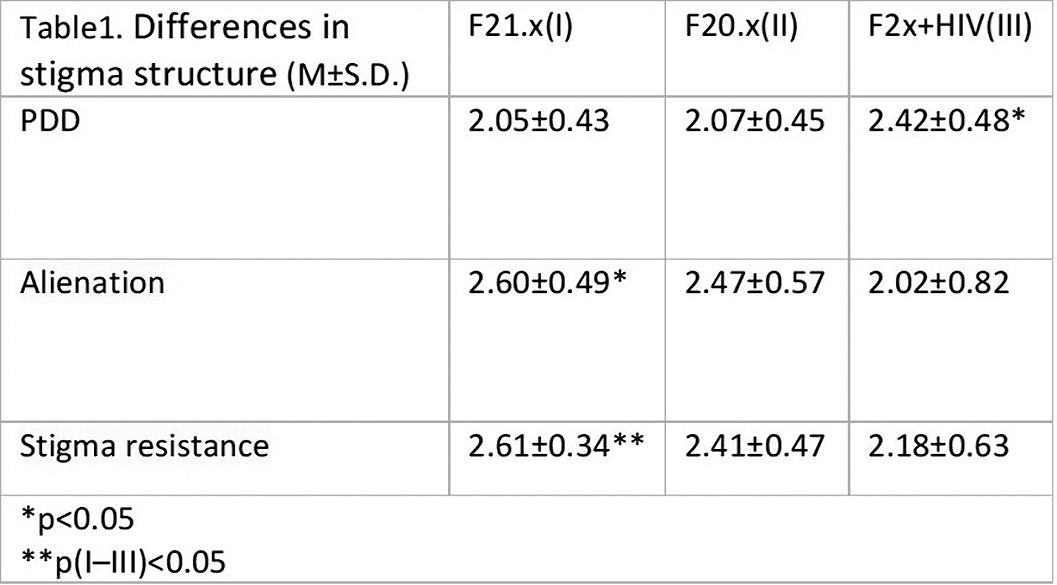
Patients with schizotypal disorders and patients at early stages of HIV infection experienced the most alienation and frailty to internalization of stigma (Tables 1, 2).
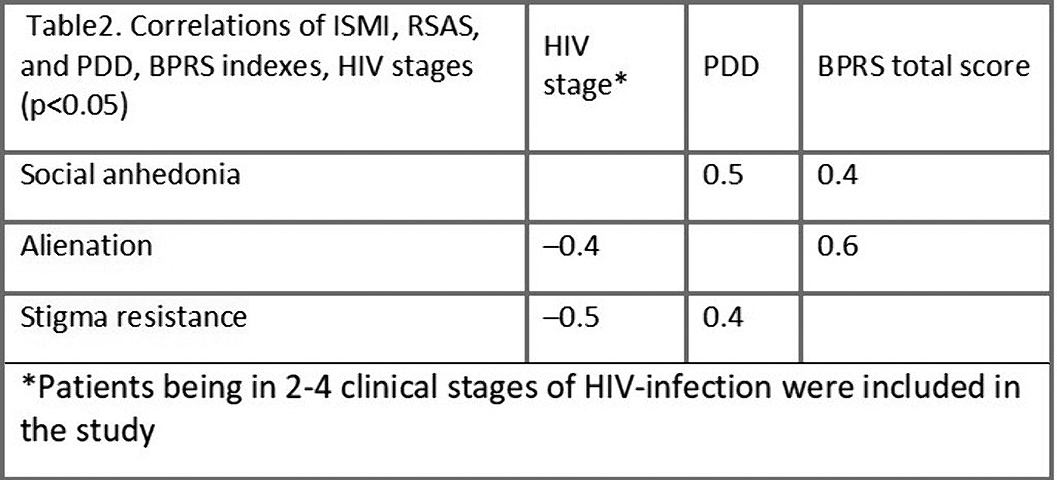
Correlation relationship between social anhedonia and perceived stigma (r=0.5, p<0.05) observed in patients with HIV infection.
Conclusions
Comorbid HIV infection in psychiatric patients contributes to the psychiatric stigma structure. Differentiated approaches in rehabilitation of HIV-positive mental patients should be used.
The Cognitive Disorders Unit carries out sessions of Psychoeducational Groups (PG) for caregivers of patients diagnosed with cognitive impairment (CI). The aim is to educate about the disease, improve the caregiver’s self-care and learn how to take better care of the sick.
Objectives
Analyze the profile of the caregivers that participate in PG and assess changes in their psychological state.
Methods
Subjects: 110 caregivers of patients diagnosed with mild-moderate CI who have participated in PG. Methodology: sociodemographic data of the caregiver and patient are collected. The following scales are passed: General-Health-Questionnaire (GHQ-12), Global-Deterioration-Scale, Barthel-Index. 5 sessions of 90 minutes are carried out every fortnight. An opinion questionnaire and the GHQ-12 are administered at the end of the sessions.
Results
86% of caregivers are women: 37% spouses and 55% daughters; mean age 57; 92% of patients live with the caregiver. 62% of caregivers present some kind of psychological disorder that is significantly reduced (p=0,0003) after some sessions. After PG: 65% of caregivers are able to further enjoy their daily activities 46% improve concentration capacity 42% improve sleeping and mood. Opinion Questionnaire Results: 98% of caregivers are satisfied with the activities, the topics addressed and their applicability.
Conclusions
The participants in PG were mostly daughters of patients, with average age 57, and living in the same household. Participation in PG improves the information and skills of caregivers, and reduces psychological disorders by improving their mood, their ability to concentrate, their quality of sleep and enjoyment of daily activities.
Horticultural therapy is a professional practice that is increasingly used in a lot of mental health rehabilitation programs. This therapy was introduced in the Comunitary Rehabilitation Service of INAD, considering its beneficial results in patients with severe mental disorder in combination with the usual rehabilitation program.
Objectives
We would like to study the benefits of this therapy compared to the usual in our patients.
Methods
This is an explanatory study for the purpose of establishing the association between the application of a Therapeutic Horticulture Program and the Clinical Symptomatology of Schizophrenia. A research with an experimental design Pre and Post-Test was carried out, by applying a Horticulture Program and evaluating with PANSS after 6 months its effects on the Clinical Symptomatology. The participants of the experimental group were selectively chosen. The only selection criteria were to attend the orchard at least once a week and be diagnosed with a schizophrenic disorder. The control group was chosen according to the number of members that made up the other group, with the criterion that they did not perform any outdoor activities and also had a diagnosis of schizophrenia.
Results
The comparison of the Pre and Post-Test measures in the case of the experimental group reports the presence of statistically significant differences in the scale of positive symptomatology composite scale and general scale.
Conclusions
This psychopathological improvement of those participants open a door to possible applications of this therapy as a psychosocial treatment.
Executive dysfunction (ED) is an important clinical dimension that need to be evaluated in neurologic and psychiatric disorders, due to this factor’s impact over patients functionality, quality of life, and overall prognosis. Working memory, inhibition, set shifting, and fluency are the most widely accepted dimensions of ED. The evaluation of these aspects in clinical practive should be more frequently implemented, because they may offer an image about the patients ability to cope with new situations, stressful events, social challenges being included.
Objectives
To determine the most appropriate methods of ED evaluation in psychiatric practice.
Methods
A literature review was conducted through main electronic databases, and papers published between January 2000 and August 2020 were included in the analysis.
Results
Wisconsin Card Sorting Test (WCST), Halstead-Reitan Neuropsychological Battery, Cambridge Neuropsychological Automated Battery (CANTAB), Wechsler Adult Intelligence Scale (WAIS), and Controlled Oral Word Association Test (COWAT) have been the most frequently cited instruments for ED evaluation. The neuropsychiatric disorders in which ED was recommended in clinical trials were schizophrenia and other psychotic disorders, neurocognitive disorders, bipolar disorders, and major depressive disorders. An integrated approach, that combines initial evaluation and periodic monitoring of symptoms severity, global functioning, quality of life, and ED severity should be considered standard-of-practice for neuropsychiatric disorders.
Conclusions
ED is an important dimension of clinical evaluation in many psychiatric disorders that is useful because the results may correlate to the patients prognosis, quality of life, and overall functional evolution.
The current stage of research on mental disorders is associated with the use of system approaches to the development of the scientific foundations of psychiatric care.
Objectives
Approach to solving problems that arise in the diagnosis of psychopathological conditions, assessing their severity, as well as evaluating the effectiveness of psychosocial treatment and rehabilitation.
Methods
Clinical, psychometric, system analysis methods and algorithms of the Analytical Hierarchy Process (AHP) [1] were used.
Results
When assessing a patient’s condition and behavior, it is necessary to make decisions (diagnosis, development of treatment and rehabilitation plans) based on heterogeneous information (genetic, neuronal and environmental, involving individual characteristics, as well as family and social context). This information is hierarchically organized and includes quantitative and qualitative data. Exposure at each of these different levels can affect the onset and course of the disease, and therefore should be considered in primary prevention and subsequent psychosocial therapy and rehabilitation of patients. Analysis of the problems of assessing psychopathological states and related psychosocial problems shows that these problems can be presented in the form of appropriate hierarchies, the structure of which must be taken into account when processing the initial information. The main advantages of the AHP include the use of the relationship scale (fundamental scale) for processing heterogeneous data based on expert, clinical information.
Conclusions
The approach provides correct integration of heterogeneous characteristics when considering diagnostic procedures, psychosocial therapy and rehabilitation.1. Mitikhin V.G., Solokhina T.A. S.S. Korsakov Journal of Neurology and Psychiatry, 2019, 2: 49-54. doi:10.17116/jnevro201911902149
Accurate and objective risk assessment is important in the evaluation of many mental disorders and behaviours. For example, in the evaluation of suicidal behaviour or the assessment of accidents in ADHD. Video games could contribute to improve the assessment and increase engagement.
Objectives
Our hypothesis is that the proposed videogame can precisely evaluate risk. In addition, the developed game is able to indirectly assess the risk. This feature is useful in setups where patients are prone to lie.
Methods
We have developed a car driving video game where users are told that they should drive near to the border but not too much. We record distance to the border and each key pulsation every 0.1 seconds.
Results
It has been observed that the median of recorded distance positively correlated with the score obtained by Self-report of Risk-taking Behaviors (SRB). In addition, the interquartile range significant correlates with the global score obtained in this questionnaire.
Conclusions
The proposed videogame is able of performing an accurate risk assessment. Our game takes seven minutes and it does not need complicated nor expensive hardware and could be deployed online. Results obtained open up new possibilities of creating video games which make an objective assessment risk.
Assessing mentalizing abilities is a complex issue. Only recently an instrument assessing mentalizing capacity as a whole, the Reflective Functioning Questionnaire (RFQ), has been developed.
Objectives
To reach the purpose of our study, we investigated the psychometric proprieties of the Italian version of the RFQ.
Methods
The study was conducted on a sample including a group of violent offenders and a group of community participants. All subjects fulfilled the RFQ, the Personality Inventory for DSM-5 (PID-5) and the Aggression Questionnaire (AQ).
Results
The theoretical model was defined and analysed by using Partial Least Squares–Path Modelling with high-order construct definition. Data showed good psychometric proprieties of the Italian version of the RFQ. Also, specific patterns of correlations were identified between the RFQ subscales and both PID-5 and AQ scores. Offenders significantly differed from controls only in relation to one subscale of the RFQ.
Conclusions
Data supported the factorial structure of the RFQ found in the original validation study. Results also support the existence of a second-order variable, mentalizing, resulting from the convergence of hypomentalizing and hypermentalizing.
The construct of nature relatedness (NR) has received a growing attention in the last decades. Past research suggest that NR may be involved in both positive (e.g. well-being) and negative (e.g. technological addictions) psychological outcome.
Objectives
In addition, some evidences suggest that the construct may be tightly related to emotion regulation capacities. Despite Nisbet et al. (2009) recently developed a short measure to investigate the construct, this has not been still validated in the Italian context.
Methods
We performed three studies to validate the Italian version of the NRS-6 and to extend the nomological network of the construct. In the first study, we tested, throughout Structural Equation Modelling, the factorial structure of the instrument and gender invariance. In the second study, construct validity of the instrument was tested examining correlation pattern between NRS-6 scores and scores obtained on the Connection to Nature Scale, the Difficulties in Emotion Regulation Scale and the Ways of Savoring Checklist. Finally, a longitudinal study tested the temporal stability of the measure and the predictive role of NR on technological addiction.
Results
Data documented a good factorial structure of the instrument, satisfying invariance proprieties and a good test-retest reliability. Also, analyses supported the good convergent and predictive validity of the instrument.
Conclusions
The Italian version of the NRS-6 appears a reliable and useful tool that can be used in future research. Our studies extend the nomological network of the construct shedding light on the tight relationship of NR with the capacity to regulate positive emotions.
Dementia is a major cause of disability worldwide. About 25%-40% of patients with mild to moderate dementia are affected by sleep-awake cycle disturbances, including increased daytime sleepiness and insomnia. However, little is known about the specific impact of excessive daytime sleepiness on the cognitive decline of dementia patients.
Objectives
To evaluate the impact of daytime sleepiness on the cognitive decline of dementia patients. Additionally, longitudinal associations with functional impairment and neuropsychiatric symptoms will be explored.
Methods
A longitudinal study will be conducted in a psychogeriatric consultation. Patients will be consecutively invited according to predefined eligibility criteria. Those aged ≥65 years, with dementia diagnosis or Mini-Mental State Examination (MMSE) <24, and with a knowledgeable caregiver, will be included. The exclusion criteria are: a caregiver <18 years, terminally ill, incapable to communicate or with a known diagnosis of insomnia, sleep related respiratory disorders, central hyperinsomnia, restless legs syndrome or sleep paralysis. Participants will undergo an assessment with a comprehensive protocol including: Montreal Cognitive Assessment (MoCA), Barthel and Lawton Index, Epworth Sleepiness Scale (ESS), Neuropsychiatric Inventory (NPI) and Global Deterioration Scale (GDS). Participants will be re-assessed 6 months after the initial evaluation. The Health Ethics Committee of Hospital Universitário de São João granted the study authorization (nº 260/2020).
Results
Findings will be disseminated via publication in peer-reviewed journals and presentations at national and international scientific conferences.
Conclusions
This study will address key questions on the relation of daytime sleepiness and dementia outcomes, in order to undertake corrective and preventive non-pharmacological and pharmacological approaches.
While extensive recent data details risk factors for psychoses in urban milieu, insights regarding recovery processes in cities are scarce. This hampers the translation of promising epidemiological and neuroimagery findings into effective therapeutic strategies. Given the twofold higher incidence of psychoses in cities and the fact that 68% of world population will be urban by 2050, it becomes an urgent matter of psychiatric care.
Objectives
This presentation details specific targets for therapeutic interventions in city context to further discuss a pioneering participatory project with the aim to conceive a novel city specific recovery-oriented program.
Methods
Based on most recent research data, some of which our own, a comprehensive survey of urbanicity studies and an overview of main avenues for developments will be presented.
Results
Urban milieu is a complex dwelling space made of protective and disruptive features. During each life course they may form unique combinations hampering or enhancing psychological well-being. Urban living is not only correlated with higher prevalence of psychoses, but also with better access to health care and lower rates of treatment resistant schizophrenia, pointing to some beneficial aspects of city living on recovery processes. The interplay between personal characteristics, urban resources and supportive social environments seems pivotal to recovery calling for multilevel interventions (CBT interventions, peer-support, go-alongs, resocialization) and integration of different stakeholders (patients, peer-practitioners, community actors).
Conclusions
Participatory approach (design thinking, urban lab etc.) represents an important means of innovation and ensures the best match between patients needs and therapeutic propositions.
Both the COVID-Anxiety Scale and the Fear of Coronavirus-19 Scale have been recently developed to facilitate research on COVID-19 anxiety.
Objectives
To examine the psychometric properties of Russian translations of the COVID-Anxiety Scale and the Fear of Coronavirus-19 Scale.
Methods
In order to examine the psychometric properties of Russian translations of the COVID-Anxiety Scale and the Fear of Coronavirus-19 Scale, a total of 341 Russian adults completed both measures.
Results
First, a high level of COVID-19 anxiety was found in the sample. Second, confirmatory factor analysis demonstrated that the Russian translations of both the COVID-Anxiety Scale and the Fear of Coronavirus-19 Scale had satisfactory psychometric properties, with both scales having a hypothesised one-factor structure. Third, a significant positive association was found between both the COVID anxiety scales. Fourth, higher COVID anxiety scores were associated with being female, and being older.
Conclusions
These findings provide initial evidence for the satisfactory properties of the Russian translations of the COVID-Anxiety Scale and the Fear of Coronavirus-19 Scale. Further research is suggested that examines the prevalence and psychological correlates of COVID-19 anxiety.
Modern Russian health psychology does not have the necessary tools for studying health anxiety in children, and therefore it is necessary to identify methods aimed at assessing the presence/absence and severity of children’s health anxiety.
Objectives
To validate the “Short Health Anxiety Inventory” to a sample of school-age children who do not have serious physical disabilities.
Methods
The sample: 193 respondents (average age-12.5; 117-girls). We used: “Short Health Anxiety Inventory” (SHAI; Salkovskis et al., 2002), Children CPQ (Factor C), “Attitude toward Health” questionnaire (Berezovskaya, 2005) (emotional scale), STAI (Spielberger, 2002), EPI (Eysenck, 1963) (neuroticism scale).
Results
Correlation analysis suggests that “health anxiety” is a separate construct. The discriminativeness criterion shows that each individual statement, as well as the whole inventory, is aimed at measuring the same construct. The retest reliability assessment (4 weeks later) shows the results: the “Health Anxiety” scale - 0.892 (p≤0.01), the “Alertness to bodily sensations” scale - 0.889 (p≤0.01), the “Fear of negative consequences” scale - 0.815 (p≤0.01). Correlations between the scales shows the values: 0.943 (p≤0.01) - for the general scale, 0.392 (p≤0.01) - for the “Alertness to bodily sensations” scale, 0.675 (p≤0.01) - for the “Fear of negative consequences” scale. The original three-component structure of the questionnaire is confirmed. The Russian version of the inventory showed internal consistency (alfa-Cronbach’s coefficient - 0.835), retest reliability, discriminativeness, external and constructive validity.
Conclusions
The results indicate that the SHAI can be used to study health anxiety in children due to its psychometric characteristics, simplicity and ease of use.
In China, the indications of paliperidone extended in schizophrenia adolescents (12-17 years) was approved by National Medical Products Administration (NMPA) in 2017. But, the utilization of paliperidone in this group needs to be further investigated.
Objectives
To assess paliperidone utilization in schizophrenia adolescents.
Methods
The study employed the electronic medical records (EMRs) database from a psychiatry specialized hospital (PH) and a general hospital (GH), respectively. General information, including birth date, gender, visit date, diagnosis (inpatient and outpatient) with ICD-10 coding, drug characterize, prescription date and dosage, was de-identified and standardized for analysis. Schizophrenia adolescents (ICD-10: F20.x) received at least one prescription of paliperidone between 2018 and 2019 were included in this study. Index date was defined as the date of first identified paliperidone prescription. The patients were followed up until the end of 2019 with the last record, or upon reaching 18 years. The database was analyzed based on days of supply, administration frequency, and daily dose.
Results
Overall, 112 and 117 eligible patients were included in the present study from PH and GH, respectively. The median drug supply was 179.0 days and 44.0 days, respectively, during which median number of prescriptions patients received was 6.0 and 3.0. Paliperidone was mostly initiated alone (57.1% and 88.9%) with frequency of once daily (97.3% and 88.9%), and the median of average daily dose during follow-up was 5.7 mg/day and 6.0 mg/day, respectively.
Conclusions
The duration of paliperidone usage was very different in two hospitals, but the dosages in both hospitals were generally agreed with prescribing information.
Psychotic disorders often cause a drastic change in the life situation of the affected individual. Personality is an aspect that can affect the symptoms and social function in psychotic disorders.
Objectives
No study has examined stability of personality traits exceeding five years in patients with schizophrenia. The aim of this study was to investigate the stability of personality traits over a 13-year period among patients with psychotic disorder and healthy individuals and to evaluate case-control differences.
Methods
At three occasions during a 13-year period patients with psychotic disorders (n=28) and non-psychotic individuals (n=57) completed Swedish universities Scales of Personality (SSP). For all the individuals within- and between-subject analyses were performed at three occasions for all 13 subscales and the three overall factors of SSP. Correlations, means and SDs were calculated.
Results
Tests of within-subject correlations showed differences in two subscales: Lack of Assertiveness, which were influenced by age and Physical Trait Aggression, where patients ratings were stable, whereas controls rated themselves less aggressive at higher age. Between-subjects correlations showed differences regarding any of the parameters diagnosis, time, age, gender or age x gender in nine of the 13 subscales as well as in factor Neuroticism.
Conclusions
Long term follow-up showed a generally high stability of personality traits measured with SSP, especially among patients. Between-subject analyses over the 13 years showed that patients differed compared to controls for the SSP factor Neuroticism as well as the subscale Detachment, which is in accordance with previous studies.
In First Episode Psychosis (FEP), Suicidal Behaviours (SB), Violent Behaviours (VB) and substance use are frequent respectively 10% to 30%, 34.5% and 50% (Pompili et al., 2011), (Tournier et al., 2013). The role of substance use in facilitating SB and VB is described (Large et al., 2011).
Objectives
We aim to evaluate the impact of substance use in FEP patients. Our hypothesis is that substance use is associated with more SB or VB before first admission.
Methods
First admission files of 45 patients diagnosed ICD10 F20 to F29 during the 2013-2018 period were retrospectively studied. SB, VB and substance use (Cannabis, alcohol and opiate/cocaine) before admission were collected. Correlation between SB and VB were tested with cannabis, alcohol, opiate/cocaine use with chi2 Pearson independance test.
Results
The frequencies of suicidal behaviours and violent behaviours were 25 % and 22.7 %. The frequencies of cannabis use, alcohol use, opiate/cocaine use were 56.1 %, 10 % and 16.3 %. A strong significant correlation was found between opiate/cocaine use and violent behaviour, p = 0.011 Chi2 was 6.471 DF 1. No other significant correlations were found.
Conclusions
Suicidal behaviours and violent behaviours are known to be more frequent in psychotic patients with addictive comorbidity. Our french rural hospital retrospective study confirms that violent behaviours in first admission psychotic patients are strongly associated with opiate/cocaine substance use comorbidity.
In order to prevent relapse and increase medication adherence, primary care physicians and psychiatric inpatient units should consider referring patients with delusional disorder (DD) to specialized outpatient clinics for treatment and follow-up.
Objectives
This poster describes a sample of DD patients referred to a specialized unit for DD and documents rates of follow-up care.
Methods
Over a 2-year period, 29 individuals were consecutively referred to the Parc Tauli -Delusional Syndrome Working Group, which provides treatment and clinical care for patients with delusional disorders for a catchment area of nearly 450.000 inhabitants in Sabadell (Barcelona, Spain). Criteria for inclusion in the program are relatively flexible. Referred patients are evaluated at baseline and at 6 months following their first appointment. Treatment and case management are offered by a multidisciplinary team consisting of psychiatric, nursing, and social work personnel. Psychological interventions are also offered.
Results
Of the 29 persons initially referred, 27 attended at least one scheduled appointment. Twenty-one out of the 27 patients received a confirmed diagnosis of DD (14 women,7 men), 2 suffered from schizophrenia and 4 were diagnosed with other psychiatric disorders and referred to other programs: primary care (n=2), affective program (n=1) and addictions unit (n=1). A breakdown of DD subtypes follows: persecutory (n=10,47.6%), jealous (n=4,19%), somatic (n=5,23.81%), mixed (n=2,9.5%). Three patients with DD (14.3%) were lost to follow-up. Attendance rates of the 21 DD patients: 80.4% (Women:77.67%, Men:100%).
Conclusions
For a traditionally difficult-to-engage population, adherence to multidisciplinary clinic appointments was relatively high. Loss to follow-up was lower than would have been expected.
Conflict of interest
AGR has received honoraria, registration for congresses and/or travel costs from Janssen, Lundbeck-Otsuka and Angelini.
Although eye-movement disorders are one of the most replicated deficits in the psychiatric literature, the strong heterogeneity of results is still an unexplained issue that could be effectively addressed with a quantitative review of evidence.
Objectives
For this reason, a large-scale metanalytic study comprising more than 200 studies was conducted to analyse the presence of eye-movement deficits in schizophrenia patients, as compared to healthy controls.
Methods
To this aim, saccadic eye movements were grouped based on the type of task required (e.g., standard, predictive) and the quantification method used (e.g., number, duration, amplitude). For each sub-group separate meta-analysis were computed. Cohen’s d was used as measure of effect size. Risk of bias within and between studies and heterogeneity were also analysed.
Results
indicated low Cohen’s d with the exception of the number of correct antisaccades – where schizophrenia patients reportedless correct anti-saccadesthan healthy controls - and antisaccades error rate – where schizophrenia patients reported a higher number of errors than healthy controls.
Conclusions
Antisaccades emerged as better suited to differentiate between patients and healthy controls, thus making them the most promising candidate as a possible biomarker for schizophrenia.