We partner with a secure submission system to handle manuscript submissions.
Please note:
You will need an account for the submission system, which is separate to your Cambridge Core account. For login and submission support, please visit the
submission and support pages.
Please review this journal's author instructions, particularly the
preparing your materials
page, before submitting your manuscript.
Click Proceed to submission system to continue to our partner's website.
To save this undefined to your undefined account, please select one or more formats and confirm that you agree to abide by our usage policies. If this is the first time you used this feature, you will be asked to authorise Cambridge Core to connect with your undefined account.
Find out more about saving content to .
To send this article to your Kindle, first ensure no-reply@cambridge.org is added to your Approved Personal Document E-mail List under your Personal Document Settings on the Manage Your Content and Devices page of your Amazon account. Then enter the ‘name’ part of your Kindle email address below. Find out more about sending to your Kindle.
Find out more about saving to your Kindle.
Note you can select to save to either the @free.kindle.com or @kindle.com variations. ‘@free.kindle.com’ emails are free but can only be saved to your device when it is connected to wi-fi. ‘@kindle.com’ emails can be delivered even when you are not connected to wi-fi, but note that service fees apply.
Although suicide showed an association with personality disorders, few studies focused on narcissism. This association is interesting, especially in what authors called a “narcissism epidemic”, considering narcissistic wounds to which subjects could be subjected.
Objectives
To systematically review studies investigating the association between narcissism and suicidal risk.
Methods
We focused on the association between narcissism (NPD, narcissistic traits) and suicide (Suicidal Ideation (SI), Non-suicidal Self-Injury (NSSI), Deliberate Self-Harm (DSH), Suicide Attempt (SA) and Suicide (S)). Studies were identified through a PubMed-based search. Reference lists were examined to extract additional articles. This review was performed according to PRISMA Statement.
Results
We included 33 studies. Most studies evaluated narcissism through DSM, showing heterogeneous results. NPD was associated with low impulsivity and high planning, but also with a higher number of SAs. Studies evaluating narcissism as a trait were more coherent. SI, NSSI and DSH showed an association with vulnerable narcissism. These associations were explained by mediation and moderation models including shame and dissociation. The grandiose component was associated with severe repetitive NSSIs and S in high suicidal risk samples. Impulsivity showed no effect.
Conclusions
It is possible to develop hypothesis, even if not causal relationships, on the association between narcissism and suicidal risk. Grandiose narcissism seemed to be protective for suicidal outcomes with low intent to die, while vulnerable narcissism seemed to be associated. However grandiose narcissism seemed to be a risk factor for suicidal outcomes with high intent to die, showing low impulsivity and high planning and severity. New studies, differentiating between narcissistic components, are needed.
Suicidogenic effects COVID-19 pandemic are expected to reveal themselves not immediately, but within a longer period.
Objectives
To evaluate the prevalence of suicidal tendencies in university students during the COVID-19 outbreak and specify the psychosocial characteristics of the students with a low anti-suicidal barrier to mitigate their suicide risks.
Methods
The research was done via an on-line survey, which covered 536 students of both sexes (aged 21.46±2.95), who studied in Russian universities and who filled in a structured questionnaire during their distance learning due to COVID-19 outbreak.
Results
We revealed that 11.38% of the respondents (57.47% of whom are males) with a low anti-suicidal barrier showed suicidal tendencies by allowing the possibility of committing a suicide in a certain situation. Among them were more Russian students than international ones (p=.0272). They also certainly exceeded the students with the developed anti-suicidal barrier in taking alcohol (p=.0126), in underestimating their own health (p=.0053), in expressing happiness (p=.0001), and in degree of religious belief (p=.0001). They perceived the situation associated with the COVID-19 outbreak with a more strongly manifested anxiety due to the fear of their own infection with coronavirus (p=0.0347). At the same time, they acted less responsibly in following personal restrictive measures aimed to reduce the risk of infection (p=.0002).
Conclusions
Students with suicidal tendencies during the COVID-19 outbreak present a risk group in COVID-19 spread and infection. The pandemic can intensify anti-vital sufferings and enhance the risk of committing suicide in individuals with suicidal tendencies, which should be taken into account in prevention programs.
Sexual minority individuals consistently report higher rates of mental disorders and suicidal behavior than heterosexuals. However, much of this research is limited to Anglo-Saxon studies and no information on Portuguese reality is available.
Objectives
The purpose of this study is to compare levels of mental functioning and suicidal behavior among heterosexual, bisexual, and homosexual individuals in Portugal.
Methods
Using online surveys, 1140 individuals (62.40% women, Mage = 36.83, SDage = 13.39, 76.4% heterosexual, 9.4% bisexual, and 14.2% gay or lesbian) completed the BSI subscales for depression and anxiety symptoms, as well as the Suicide Behaviors Questionnaire-Revised.
Results
Self-identified bisexual participants presented higher levels of depressive and anxiety symptoms and higher levels of suicidal ideation and likelihood of suicidal behavior than homosexual and heterosexual participants (who scored the lowest); yet, homosexual participants showed higher levels of suicide attempts. Also, depression and anxiety symptoms were strongly and positively correlated with all dimensions of suicidal behavior. Finally, hierarchical multiple regression analysis showed that higher levels of depression and non-heterosexual sexual orientations were significant predictors of suicidal ideation and the likelihood of suicidal behavior.
Conclusions
The present study adds to the evidence that sexual minority individuals are at risk of increased mental health problems and suicidal behavior, compared to heterosexuals, and reiterates the need for local political and legislative efforts to normalize LGB identities, fighting continued institutional heterosexism, interpersonal intolerance. Mental health providers and mental health policymakers need to consider these results if they want to address inequalities in mental health and in suicidality among these minority groups.
Depressed patients with early traumatic experiences may represent a clinically distinct subtype with worse clinical outcome. Since early traumatic experiences alter the development of systems that regulate the stress response, certain personality features may influence coping strategies, putting individuals with depression and a history of early traumatic experiences at greater risk of suicidal behaviour.
Objectives
To determine whether impulsivity mediates the relationship between early traumatic experiences and suicidal behaviour in patients with major depressive disorder (MDD).
Methods
The sample included 190 patients [mean age (SD)=53.71 (10.37); females: 66.3%], with current MDD. The Childhood Trauma Questionnaire-Short Form (CTQ-SF), the List of Threatening Experiences (LTE), and the Barratt Impulsiveness Scale-11 (BIS-11) were used to assess childhood and adulthood adverse life events and impulsivity. We developed mediation models by bootstrap sampling methods.
Results
81 (42.6%) patients had previous suicide attempts (SA). CTQ-SF-Total and BIS-11-Total scores were higher in MDD patients with previous SA. Correlation analyses revealed significant correlations between the CTQ-SF-Total and BIS-11-Total, CTQ-SF-Total and HDRS-Total, and BIS-11-Total and HDRS-Total scores. Regression models found that CTQ-SF-Total, BIS-11-Total, and HDRS-Total scores were associated with SA. Mediation analyses further revealed the association between CTQ-SF-Total and SA was mediated by the indirect effect of the BIS-11-Total score (b=0.007, 95% CI=0.001, 0.015), after controlling for sex, HDRS-Total, and LTE-Total.
Conclusions
Impulsivity could mediate the influence of childhood trauma on suicidal behaviour. This will help understand the role of risk factors in suicidal behaviour and aid in the development of prevention interventions focused on modifiable mediators when risk factors are non-modifiable.
Suicide is a global health problem. The elderly is the range with the highest suicide rate and suicidal behaviors are more lethal, with greater planning and less possibility of rescue. In the elderly, Major Depressive Disorder is the diagnosis most frequently associated with suicidal behavior. 15% of the elderly with a depressive picture commit suicide. Loneliness, the main cause of suicides in the elderly population.
Objectives
The objective of the clinical case presented is to address the risk factors for suicide in the elderly.
Methods
80-year-old patient, widower who makes a suicide attempt by ingesting glyphosate. Personal history: Acute myocardial infarction 1 month ago. Not mental illness. Family stressors: illness of his granddaughter, loss of his son’s job. Personal stressors: Loss of autonomy due to ischemic heart disease. The patient was admitted to the Intensive Care Unit with acute pulmonary edema secondary to the suicide attempt. Psychopathological exploration: Conscious, oriented and collaborative. Depressive mood in relation to the stressors presented. Makes partial criticism of the suicide attempt, recognizes its seriousness and planning.
Results
Diagnosis: Moderate depressive episode. SAD PERSONS scale: 9 High risk.
Conclusions
The risk factors for suicide in older people can be medical, psychiatric, psychological, family environment and social - environmental factors. There are hardly any specific action protocols that allow early intervention and suicide prevention in the elderly. As social health professionals, we must work on the elaboration and application of these, since consummated suicide represents a major public health problem throughout the world.
Suicidal behaviour and cognition: A systematic review with special focus on prefrontal deficits Introduction: Suicide is a major health concern worldwide, thus, identifying risk factors would enable a more comprehensive understanding and prevention of this behaviour. Neuropsychological alterations could lead to difficulties in interpreting and managing life events resulting in a higher risk of suicide.
Objectives
Objective: Bibliographic review about the influence of neuropsychological deficits on suicidal behaviour.
Methods
Method: A systematic literature search from 2000 to 2020 was performed in Medline (Pubmed), Web of Science, SciELO Citation Index, PsycInfo, PsycArticles and Cochrane Library databases regarding studies comparing cognition of attempters versus non-attempters that share same psychiatric diagnosis. Results: 1.885 patients diagnosed with an Affective Disorder (n = 1512) and Schizophrenia/ Schizoaffective Disorder (n = 373) were included.
Results
In general comparison, attention was found to be clearly dysfunctional. Regarding diagnosis, patients with Schizophrenia and previous history of suicidal behaviour showed a poorer performance in executive function. Patients with current symptoms of an Affective Disorder and a previous history of suicidal attempt had poorer performance in attention and executive function. Similarly, euthymic affective patients with history of suicidal behaviour had worse decision-making, attention and executive function performance compared to euthymic non-attempters.
Conclusions
Patients who have attempted suicide have a poorer neuropsychological functioning than non-attempters with a similar psychiatric disorder in attention and executive function. These alterations increase vulnerability for suicide.
Conflict of interest
Jessica Fernández-Sevillano is beneficiary of the Pre-PhD Training Programme of the Basque Government. Dr. Gonzalez-Pinto has received grants and served as consultant, advisor or CME speaker for the following entities: Almirall, AstraZeneca, Bristol-Myers
The Interpersonal Theory of Suicide posits that thwarted belongingness (TB) and perceived burdensomeness (PB) are proximal causes of current suicidal desire, while the acquired capability predicts suicide attempts (Joiner, 2005).
Objectives
This study examined the psychometric properties of the Interpersonal Needs Questionnaire (INQ-15-I), as a measure of the two constructs, on a sample of 458 Italian university students.
Methods
After examining the socio-demographic, clinical and psychosocial characteristics of the sample, we tested the differences in current suicidal ideation and lifetime suicide risk among students. We conducted a confirmatory factor analyses to identify the latent structure of the INQ-15-I and we tested the reliability, criterion concurrent validity and convergent/discriminant validity.
Results
The socio-demographic, clinical and psychosocial features of the sample are in line with the literature on the topic. A two-factor related model with 15 item, showed a good fit to the data and subscales showed excellent internal consistencies (α ≥ 0.84). TB, but mostly PB, were mainly correlated with concurrent suicidal ideation and less with suicidal risk. Divergent validity has emerged with the constructs of the acquired capability. Convergent validity is supported for similar constructs such as depression, low reasons for living, anxiety, interoceptive awareness, psychological pain, loneliness, absence of social support and low self-esteem.
Conclusions
INQ-15-I provides a valid measure of the interpersonal needs among Italian university students by indirectly investigating suicidal risk factors. It also suggest specific clinical intervention areas in suicide prevention. Thus it may be included in suicide risk assessment protocols in Italy.
Huntington Disease (HD) is a genetic, progressive neurodegenerative disorder. Its clinical features include motor dysfunction, cognitive impairments, and psychiatric symptoms. The association between HD and suicide is well documented, and the risk of suicide in HD is higher than in patients with other neurological diseases.
Objectives
We aim to review the literature regarding suicidal behaviour in HD.
Methods
We performed an updated review in the PubMed database using the terms “suicide”, “suicidal behaviour” and “Huntington Disease”. The included articles were selected by title and abstract.
Results
The most relevant risk factors associated with suicidality in HD are depression, anxiety, and aggression, so the presence of psychiatric diagnoses should be closely monitored. No consistent results have been found regarding gender. Evidence for periods of elevated risk of suicidal behaviour in HD is mixed and the data on specific pharmacological interventions for alleviating suicidal ideation in HD is scarce.
Conclusions
Patients with HD are at a high risk for suicide. This risk is further increased when a comorbid psychiatric disorder is present. It is important for the practicing psychiatrist to be aware of this association to correctly manage patients with HD, thus helping prevent suicidal behaviour.
The prevalence of borderline personality disorder (BPD) is significant, ranging from 0.5% to 5.9% in the general population. This personality disorder is associated with high rates of suicide attempt and for suicide attempt recurrence.
Objectives
Review recent studies of predictors of suicide attempt and for suicide attempt recurrence in patients with borderline personality disorder.
Methods
This is a literature review via Medline and Sciences Direct. The database was searched using the combination of the keywords “borderline” with “suicide”, “borderline personality disorder” with “suicide”, “borderline personality disorder” with “suicide attempts” “borderline personality disorder” with “suicide recurrence”.
Results
Recently it has been shown that BPD has a greater correlation with suicidal behavior than that of characterized depressive disorders. Several studies have shown that suicidal behavior in patients with BPD was associated with the coexistence of antisocial personality disorder, depression, hostility, impulsivity, a high number of suicide attempts and a first suicide attempt at a young age. Recently it has been established that the predictors of suicidal recidivism are the high number of suicide attempts, the female sex and single life status.
Conclusions
Special attention should be paid to predictive factors for suicide attempt and for suicide attempt recurrence in the clinical evaluation of patients with borderline personality disorder, especially in suicidal crisis.
Suicide attempts and suicidal ideation are peculiar aspects of several cluster b disorders, including Narcissistic Personality Disorder. Similarly, difficulty in regulating negative affects can play a role in the relationship between narcissist features and suicidal ideation. To date, it is still unclear which facet of narcissism is more related to the desire to die and which other factors are involved in this relationship.
Objectives
To offer preliminary empirical evidences concerning the relationship between narcissism, emotion regulation and suicide ideation.
Methods
We administered Pathological Narcissism Inventory (PNI), Difficulties in Emotion Regulation Scale (DERS) and Beck Scale for Suicidal Ideation (BSI) to a sample of individuals with Suicide ideation (n= 68) and a sample of community participants (n=140).
Results
Controlling for age and gender, we found that BSI scores correlated significantly with the vulnerable dimension of narcissism, but not with the grandiose one, and with all DERS dimensions. Nevertheless, emotion dysregulation moderates the relationship between vulnerable narcissism and suicidal ideation.
Conclusions
Suicide ideation seems to be deeply connected with the vulnerable dimension of pathological narcissism and the relationship between the constructs is partially mediated by emotion dysregulation. Future directions and clinical implications are discussed.
Cluster B personality disorders are characterized by a higher prevalence of suicidal ideation and behavior than others, and Narcissistic Personality Disorder is no different. Very intense feelings of shame, intolerable for the individual, are often found in patients with Narcissistic Personality Disorder and may have a role in suicidal behavior.
Objectives
To offer preliminary empirical evidences concerning the relationship between narcissism, shame and suicide ideation.
Methods
We administered Pathological Narcissism Inventory (PNI), Test of Self Conscious Affects (TOSCA) and Beck Scale for Suicidal Ideation (BSI) to a sample of individuals with Suicide ideation (n= 65) and a sample of community participants (n=65).
Results
Controlling for age and gender, in the merged sample we found that BSI scores correlated significantly with the vulnerable dimension of narcissism and with TOSCA Interpersonal Shame subscale. In the clinical sample, Interpersonal shame partially mediates the relationship between vulnerable narcissism and suicidal ideation.
Conclusions
Shame seems to play a key role in the relationship between the vulnerable facet of narcissism and suicidal ideation, although the profound mechanism by which it works remains to be understood. Future directions and clinical implications are discussed.
Addictive behaviors and suicide have important risks that need to be explored for any patient followed at the department of psychiatry, possibly endangering his vital and psychosocial prognosis.
Objectives
Our study aims to identify the link between addictive behavior and suicidal behavior in patients followed at the psychiatry department at the regional hospital of Gabes.
Methods
We conducted a cross-sectional, descriptive and analytical study carried out on a clinical population who consult in the psychiatry department in the Gabes’s regional hospital during the period from January 1st, 2020 to September 30, 2020.Sociodemographic and clinical data of the patients as well as their personal and family history were assessed. The evaluation of psychopathological disorders was carried out according to the diagnostic criteria of DSM-5. Suicide Behaviors Questionnaire (SBQ) was used for suicide risk assessment. Fagerstrom questionnaire in its validated French version was used to assess the of nicotine dependence. The exploration of childhood physical and emotional trauma was carried out by the Childhood Trauma Questionnaire (CTQ) scale. Data were analysed using the software SPSS.
Results
100patients were included. The mean age was 45.5years. TableI: Breakdown of addictive behavior and suicide attempts by gender. TableII: Common vulnerability factors between addictive behavior and suicidality
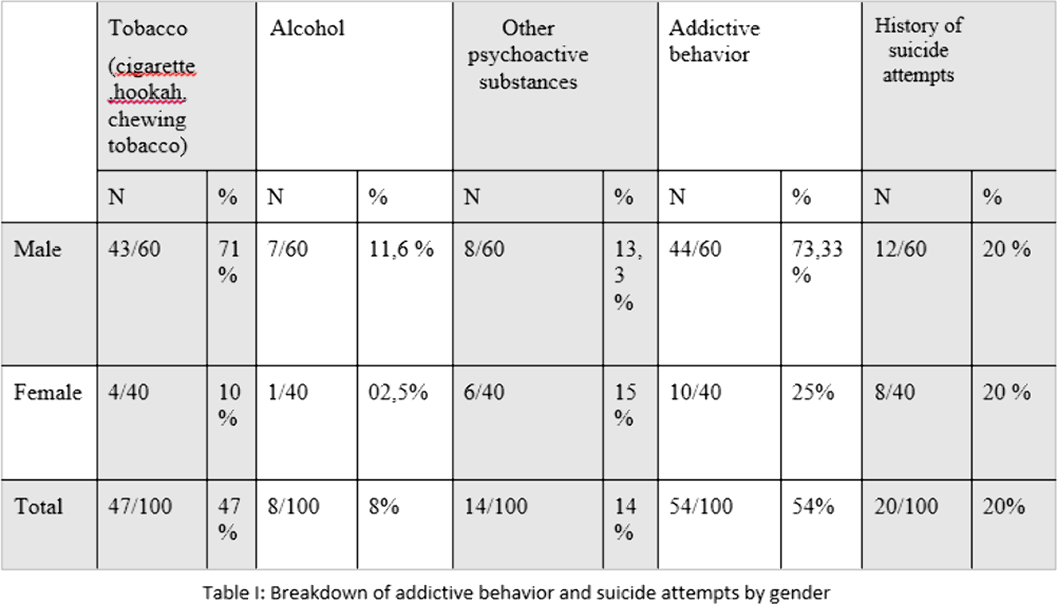
The analytical study showed that suicide attempts were correlated with addictive behaviors (p = 0.03) and that suicidal recurrence was correlated with addictive behaviors (p = 0.01).
Conclusions
Suicidal behavior in patients followed in psychiatry is closely linked to addictive behavior, hence the importance of early management.
Personal and environmental factors may contribute to psychological distress in medical students. As a result, they are more susceptible to suicidal ideation, a serious public health problem.
Objectives
Estimate the prevalence and recognize associated factors of Suicide Ideation and Suicide Attempt among medical students at the Federal University of Sergipe, Brazil.
Methods
A cross-sectional study was performed with randomly selected students between April and June 2019. A structured online questionnaire about sociodemographic characteristics, educational process, and the current psych emotional experiences, besides Beck Scale for Suicide Ideation (BSI), which detects the presence of suicidal ideation, were applied. Statistical evaluation was performed with descriptive analysis and logistic regression for the evaluation of multiple variables.
Results
The study included 133 students, with an average age of 22.9±3.5 and 51,9% were male. Among this sample, 27,1% had suicidal ideation. The frequency is higher in those students who family income <10 minimum wages (OR=3.47) and who were not satisfied with the course (OR=3.52). Furthermore, the frequency of suicide attempt was 15.8%. It was higher among those who claimed to use a doctor-prescribed psychopharmaceutical (OR=10.46) and who lost some discipline in the course (OR=8.17). Ideation and attempt were significantly associated (p<0.001).
Conclusions
Frequency of suicidal ideation was high, associated with dissatisfaction related to the educational process, as well as lower family income. History of attempted suicide was also frequent and associated with ideation. Intervention and prevention measures are required.
Seasonal changes, climatic factors such as temperature, sunlight intensity and precipitations as well as temporal factors seem to have an influence on suicidal behavior.
Objectives
Our study aimed to analyse the association between seasonal changes, climatic variations, temporal factors and suicide attempts.
Methods
A retrospective descriptive and analytical study was undertaken including all patients consulting for the first time at Gabes psychiatry department from the 4th March 2009 to the 25th September 2020 for suicidal attempt. Sociodemographic and clinical data as well as suicidal attempts’ characteristics were assessed. Meteorologic data, related to the years 2009 through 2020, were obtained from the official weather website of Tunisia.
Results
278 patients were collected, including 217 female. Mean age was 26. Suicidal patients were unmarried (75.9%), childless (79.1%) and unemployed (47.5%). Results showed that suicidal attempts occurred most frequently in summer (32.5%) specifically in June and July (10.9% for each). Regarding the distribution of suicide attempts over the days of the week, the highest rate was observed on Monday (22.5%) and the lower one on Friday. There were a correlation between high temperature and suicide attempt by hanging (p=0.006), between days of sunlight and manifestations preceding the suicidal attempt (p=0.04) and between rainfall and anxiety disorder leading to suicidal attempt (p=0.03).We finded also an association between the summer and risk behavior such as runaways (p=0.024).
Conclusions
A better identification of seasonality, climatic and temporal factors in suicidal behavior could allow a better prevention in suicidal attempts and a reduction in death by suicide
The life changes and limitations associated with Covid-19 clearly have serious psychological implications. The life of adolescents has also changed significantly in many areas: study, communication with peers, contact with family, etc. and not all adolescents have adapted to these changes equally easily.
Objectives
Study adolescents’ perception of Covid-19, describe the effect of self-isolation on adolescent emotional well-being, and examine changes in the family system through the eyes of a teenager.
Methods
The study involved two groups of adolescents: the first (G1) - 174 students of a Moscow school and the second (G2) - 39 adolescents hospitalized in a children’s psychiatric clinic in connection with suicidal actions. Teenagers filled out the author’s questionnaire, Short Health Anxiety Inventory (Salkovskis), Analysis of Family Anxiety (Eidemiller, Yustickis), Prohibition on the expression of feelings (Kholmogorova).
Results
Participants in G2 significantly more often than G1 reported that their functioning worsened (it became more difficult to study - 72% versus 51%; more difficult to communicate - 76% versus 41%, more conflicts with family members - 49% versus 25%). G2 demonstrated a significantly higher level of family anxiety (M = 17.3 and M = 12.1 p<0.01), a more pronounced prohibition on expressions of negative emotions (M = 37.2 and M = 21.3 p<0.01). The level of anxiety (for one’s own health, well-being of relatives and financial stability) is also significantly higher in G2.
Conclusions
Many adolescents in self-isolation need the support of relatives and the help of specialists. For a number of teenagers, self-isolation has become a crisis situation.
The mental health effects of Coronavirus2019(COVID-19) outbreak might be profound, including higher suicide rates.This phenomena is likely to become a more pressing concern as the pandemic spreads.While remarkable social distancing interventions have been implemented to reduce the rate of new infections,the potential for adverse outcomes on suicide risk is high, especially among vulnerable populations.
Objectives
The aim is to do a review of the literature of suicide prevention during the COVID-19 outbreak.
Methods
Non-systematic review of the literature with selection of scientific articles published in the last 7 months; by searching the Pubmed databases, the following MeSH terms were used: Suicide prevention; COVID-19
Results
In order to prevent suicide, urgent consideration must be extend beyond general mental health approaches. A wide-ranging interdisciplinary response that recognises how the pandemic might heighten risk is needed. The application of knowledge about effective suicide prevention is the key. Mental health services should develop clear remote assessment and care pathways, and staff training to support new ways of dealing with. Publications on mental health and psychological effects of COVID-19 outbreak provide important information and recommendations for all three levels of suicide prevention: primary, secondary, and tertiary.
Conclusions
The challenge of the COVID-19 outbreak might bring with it an opportunity to advance the field of suicide prevention and, thus, to save lives, which also represent a public health priority. The mental health community, backed by active vigilance and international collaboration, should be prepared and can use this challenging period to advance suicide prevention.
Suicide attempts are common and constitute a serious problem for public health.Thus, it is very important to evaluate risk factors for suicidal behavior.
Objectives
The purpose of this study was to explore the socio-demographic and clinical profile of attempted suicide patients consulting in the psychiatry department in Gabes (southern of Tunisia).
Methods
It was a retrospective descriptive and analytical study covering all patients who had attempted suicide during the period from the 1st of May, 2009 to September 25th, 2020 and who were referred to the psychiatry department in the regional hospital of Gabes. Sociodemographic and clinical data of the patients as well as characteristics of the suicide attemptswere assessed.
Results
Socio-demographic profile of the suicidal consultant in psychiatry department corresponded to a single (73.4%) female (78.8%), with a mean age of 26 years, from an urban area (46%). Suicide attempts were most often by the intentional drug ingestion (67.8%), committed between March and August in 54% of cases. At most of the time, the suicidal person was alone (85%) at home (94%) when he committed his suicidal attempt. He did not communicate his intention to commit suicide in 46% of the cases and only 22 cases (7.9%) notified a person before the suicide attempt and 12.6% afterwards. Suicide behavior was impulsive in 79.5% of the cases and a verbal expression of a desire to die was only noted in 24.5% of cases.
Conclusions
Our results suggest a systematic and specific psychiatric evaluation of any patient who attempts suicide.
Nowadays, suicide is a global public health problem thus detection of risk factors more specifically individual factors can be used as a method for prevention and intervention.
Objectives
The aims of our study were to assess the incidence of suicidal recurrence and its individual associated factors.
Methods
A retrospective descriptive and analytical study was undertaken including all patients consulting for the first time at Gabes psychiatry department (in southern Tunisia) from the 4th March 2009 to the 25th September 2020 for suicidal attempt. Sociodemographic and clinical data as well as suicidal attempts’ characteristics were assessed. The statistical analysis was executed on the software SPSS (20th edition).
Results
278 patients were collected including 217 female. The mean age was 26. Suicidal patients were unmarried (75.9%), childless (79.1%) and unemployed (47.5%). The common suicidal attempt method was voluntary drug intoxication (67.8%). Interference of individual factors was reported in 77% of cases, especially difficulties to cope with stress (46.4%), followed by low self-esteem (36.5%), personal psychiatric history (17.3%), personal medical history (8.3%) and alcohol or drug abuse (6.1%). A suicidal re-attempt was notedin 24.9 % of cases. Recurrence was associated with the female gender (72.4%), difficulties to cope with stress (<10-3) and low self-esteem (p=0.012).
Conclusions
After the first suicidal attempt, it’s crucial to identify the individual factors that seems to have an influence on subsequent suicidal behaviour in order to ensure a proper treatment.
Detecting warning signs of suicide attempts is a particular difficult task. However, people who plan to commit suicide almost always announce it to someone in some way.
Objectives
Aims of this study were to describe signs preceding the suicide attempt in a group of suicidal persons and its links with suicidal recurrence.
Methods
It was a retrospective study that included all the patients who attempted suicide during the period from May 1st, 2009 to September 25th, 2020 and who were referred to the psychiatry department of the regional hospital of Gabes. Sociodemographic and clinical data as well as suicidal attempts characteristics were assessed.
Results
278 patients were included (female=78.1%), with mean age of 26. The common suicidal attempt method was intentional drug intoxication (67.8%). At least, one clinical manifestation was reported by 75.2% of suicide patients. The most common signs were the tendency to isolation (47.1%), a change in character or behavior (46.6%), thoughts of death (29.6%), anxiety or agitation (24.8%) and recent worsening of the pre-existing psychiatric symptoms (24.3%). Suicidal recurrence affected 24.8% of patients. It was correlated to the presence of a mental disorder (p<10-3), the presence of reflections on death (p=0.02), the onset of a state of anxiety or agitation (p<10-3), recent worsening of pre-existing psychiatric symptoms (p = 0.001) and verbal expression of suicidal thoughts (p<10-3).
Conclusions
The pre-suicidal syndrome is frequently heralded by changes in the patient’s character or behavior. Some suicidal warning signs are associated with the risk of suicidal recurrence.
Perception of and relationship to pain are considered as important factors of suicidal behavior (Joiner, 2005, Klonsky & May, 2015, O’Connor & Kirtley, 2018, Galynker, 2017). Some studies of pain demonstrated that there are common mechanisms of emotional and physical pain (DeWall & Baumeister, 2006, MacDonald & Leary, 2005, Eisenberger, Lieberman, & Williams, 2003).
Objectives
The aim was to validate Discomfort Intolerance Scale and Pain Catastrophizing Scale on the female adolescent sample and to reveal their relationship to suicidal experience.
Methods
183 adolescents females (13-21 years old) filled Discomfort Intolerance Scale (Schmidt, Richey, & Fitzpatrick, 2006) and The Pain Catastrophizing Scale (Sullivan, Bishop, & Pivik, 1995). Then they replied to items related to their own or their friends’ suicidal experience.
Results
Factor analysis for PCS explained 73.6% of variance with Cronbach’s alphas .77-.91. Factor analysis of DIS explained 67.1% of variance with Cronbach’s alphas .63-.70. There were no relationships between suicidal-related experience and pain-related experience.
Conclusions
Discomfort Intolerance Scale and Pain Catastrophizing Scale could be used as reliable and valid methods of measuring relationship to pain in studies of adolescents, although we found no associations between them and suicidal intentions.