We partner with a secure submission system to handle manuscript submissions.
Please note:
You will need an account for the submission system, which is separate to your Cambridge Core account. For login and submission support, please visit the
submission and support pages.
Please review this journal's author instructions, particularly the
preparing your materials
page, before submitting your manuscript.
Click Proceed to submission system to continue to our partner's website.
To save this undefined to your undefined account, please select one or more formats and confirm that you agree to abide by our usage policies. If this is the first time you used this feature, you will be asked to authorise Cambridge Core to connect with your undefined account.
Find out more about saving content to .
To send this article to your Kindle, first ensure no-reply@cambridge.org is added to your Approved Personal Document E-mail List under your Personal Document Settings on the Manage Your Content and Devices page of your Amazon account. Then enter the ‘name’ part of your Kindle email address below. Find out more about sending to your Kindle.
Find out more about saving to your Kindle.
Note you can select to save to either the @free.kindle.com or @kindle.com variations. ‘@free.kindle.com’ emails are free but can only be saved to your device when it is connected to wi-fi. ‘@kindle.com’ emails can be delivered even when you are not connected to wi-fi, but note that service fees apply.
The Covid-19 outbreak has shown to negatively impact on mental health. Several anecdotical and theoretical evidences argued that lockdown measures would have increased subjective feelings of loneliness and addictions’ proneness.
Objectives
In addition, preliminary data underlined a possible increase in the frequency of gaming and social media use. Increased loneliness levels are likely to account for increased gaming and social media addiction during the lockdown.
Methods
We conducted a longitudinal study administering to a sample of 154 Italian adults several self-report questionnaires at the beginning of lockdown (Time 1) and three days before the end of the lockdown (Time 2). We therefore assessed loneliness feelings, frequency of gaming and social media use as well as both gaming and social media addiction. Data were analysed using Structural Equation Modelling.
Results
We observed that loneliness levels longitudinally predicted both gaming and social media addiction also controlling for gaming and social media use at Time 1.
Conclusions
Increased feelings of loneliness, a well-known risk factor for gaming and social media addiction, may be a central variable heightening vulnerability to the onset or the maintenance of technological addiction during forced social isolation. Thus, future prevention interventions may want to target this issue.
Alcohol use disorder (AUD) is highly related to various comorbidities, such as cancer, cognitive impairment, cirrhosis, chronic sclerosing stomatitis, stroke, and depression. The CAGE (Cut down, Annoyed, Guilty, Eye-opener) questionnaire is a simple screening material to make a diagnosis of alcoholism.
Objectives
Our study aimed to find an optimal cut-off point of CAGE for alcohol-related comorbidities in Taiwan.
Methods
We performed demographic analysis for 280 participants with AUD and categorized them into two groups according to CAGE scores. We applied receiver operator characteristic (ROC) analysis to determine optimal cutting point of CAGE in predicting physical and mental problems among alcohol users. Statistical analysis was performed with the Statistical Software Stata version 12.0 (StataCorp LP, College Station, TX, USA).
Results
The mean age of participants was 45.9 ± 10.5 years, and all of them were male. Among 280 participants, 134 (47.9%) had physical diseases, including 37 (13.2%) with liver disease, 10 (3.6%) with pancreatitis, 22 (7.9%) with gout, and 5 (1.8%) with esophageal varices; while 33 (11.8%) had one or more mental illnesses. Patients with CAGE score greater than 3 were more likely to have both mental health problems and/or physical diseases, especially hepatic disease and esophageal varices.
Conclusions
This study revealed that with CAGE score greater than 3, male patients with AUD are at higher risks of both physical and mental comorbidities. Further research as well as female participants are needed to identify the associations between the severity of alcohol use disorder and related diseases for comprehensive evaluation in Taiwan.
Recently, clinical models based on neuroscientific evidence have highlighted the detrimental role of executive functions impairments in negatively contributing to the functional decline of patients with Substance Use Disorder (SUD). Yet, despite these potential implications, the screening tools that are typically used to assess such impairments are not specific for patients presenting addiction and are not able to properly sketch their dysfunctional executive control profile.
Objectives
This study aimed at testing the clinical potential of a novel screening battery for neurocognitive disorders in addiction.
Methods
The screening battery was tested on 151 patients with SUD and 55 control subjects. The battery consisted of five neuropsychological tests tapping on verbal and working memory, focused attention, and cognitive flexibility and two computerized neurocognitive tasks (Stroop and Go/No-go tasks adapted for the evaluation of interference inhibition, executive control, and attention bias towards drugs of abuse).
Results
Statistical analyzes showed worse cognitive performance in patients with SUD compared to controls, both at neuropsychological tests of cognitive flexibility, focused attention and verbal memory and at neurocognitive tasks, suggesting the presence of deficit of regulatory mechanisms involved in inhibition and orientation of attention/cognitive resources. These results were also confirmed by second-level analyses where the role of age and education as potential moderators was checked, suggesting the robustness of the tested measures.
Conclusions
The results further stress the link between specific executive impairments and SUD and suggest the potential of the battery as a quick yet valid neurocognitive screening tool.
Age-related features of alcohol addiction in elderly women (AAEW) have not been studied properly. The WHO classifies 60-75 years as elderly age (‘early old age’), when morphological and physiological functions of all organs and systems fade away, causing severe post-intoxication and withdrawal disorders, giving organic tint to alcohol dependence clinical picture, and rapid onset of alcoholic mental degradation of personality.
Objectives
To study specific clinical, diagnostic and pathophysiological basis of alcohol dependence in aged women for innovative approaches to AAEW treatment.
Methods
Clinical and medical history questioning, international tests and scales to identify alcohol dependence and complications in elderly women. Follow-up monitoring of basic biochemical, clinical, laboratory and electrophysiological findings at treatment runtime.
Results
Multifactorial study and specific gender features in AAEW development allowed to identify abundant dual comorbidity, prevalence, high degree of affective disorders (depression, anxiety, dysphoria) combined with various somatic conditions and diencephalic symptoms in this alcoholic disease pattern. New treatment modality for alcohol dependence in elderly women was proposed and tested; along with classical detoxification and symptomatic therapy, the patients received anxiolytic agent (serotonin receptor stimulator) Buspirone SANDOZ, 5 mg 3 times a day, followed by individually corrected effective dose. The drug stopped anxiety, balanced the mood, causing no addiction. Buspirone was combined with bromine and sodium sulfate transcerebral electrophoresis № 5 and selective psychotherapy.
Conclusions
The proposed integrated therapy for AAEW was proven to be effective by statistical reliability and patient-specific clinical illustrations.
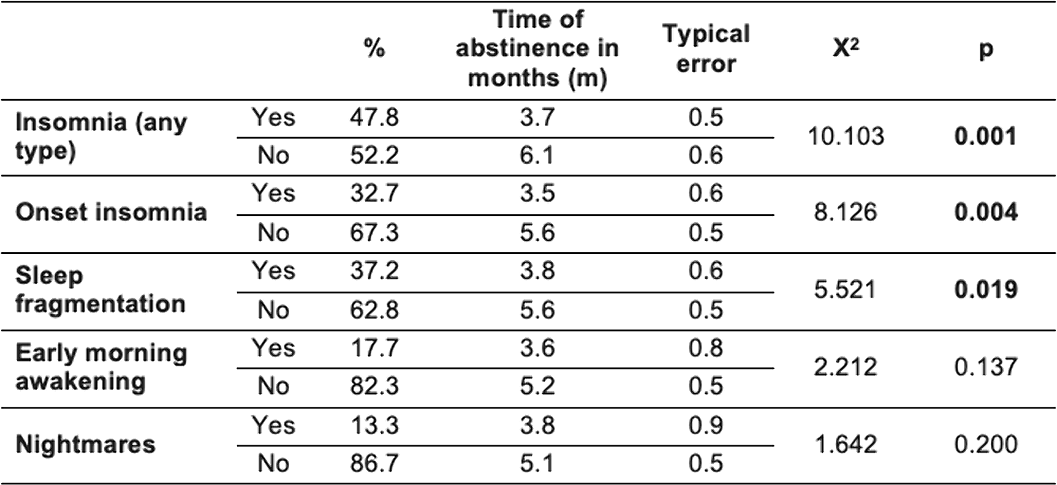
Insomnia has been related to a more severe substance use disorder presentation (1). There are few longitudinal studies in outpatients center for SUD treatment that evaluate how insomnia impacts on relapses.
Objectives
To analyze how insomnia impacts on the time of the first substance relapse in SUD outpatients after the onset of addiction treatment.
Methods
This is a one-year follow-up study performed on 116 patients (73.3% males; mean age 43.4±14.3) for whom we had information from baseline insomnia and the time for the first relapse. A Kaplan-Meier survival analysis was performed. This is part of a greater research on Alexithymia in SUD in a longitudinal study.
Results
The initial sample consisted of 116 patients, information on relapses was available for 113 patients. The main substances used at baseline were alcohol (62.1%), cocaine (56.0%), cannabis (42.2%), and opiates (30.2%).
Conclusions
It is important to evaluate insomnia at the onset of addiction treatment because insomnia may be related to earlier relapses. Furthermore, it should be analyzed further on how insomnia treatment impact on substance relapses. REFERENCES 1. Miller MB, Donahue ML, Carey KB, Scott-Sheldon LAJ. Insomnia treatment in the context of alcohol use disorder: A systematic review and meta-analysis. Drug Alcohol Depend. 2017;181:200-207. doi:10.1016/j.drugalcdep.2017.09.029
An urgent problem all over the world is the growing number of adolescents with maladaptive (Internet addicted) Internet use.
Objectives
To study the prevalence of various types of online behavior in adolescents in the southern regions of Siberia (Caucasians and Mongoloids).
Methods
4351 adolescents aged 12-18 in the city of Krasnoyarsk and the city of Abakan (Republic of Khakassia) were surveyed. Ethnicity is determined by the nationality of the mother. Online behavior was studied using the Chen Internet Addiction Scale (CIAS): adaptive internet use (API) – 27-42 points, non-adaptive (NPI) – 43-64 points and pathological (PPI) ≥ 65 points. The indicators were compared in 2 groups: Caucasians and Mongoloids. The program “Statistica 12” was used, the percentage of the share, the significance of the differences (p) and the values of the Pearson χ2 test were indicated.
Results
Caucasians by their mothers accounted for 3663 (84.2%) and the share of Mongoloids reached 688 (15.8%). AIP was recorded in 44.0% of Caucasians and 7.9% of Mongoloids (p <0.0001; χ2 = 1474.99), NPI was recorded in 34.7% of Caucasians and 6.2% of Mongoloids (p <0.0001; χ2 = 1084.65), PPI was found in 5.5% of Caucasians and 1.7% of Mongoloids (p <0.0001; χ2 = 90.49).
Conclusions
Ethnic features of the prevalence of online behavior in adolescents in the southern regions of Siberia include a higher frequency of NPI and PPI in Caucasians compared to Mongoloids. The reported study was funded by RFBR according to the research project № 18-29-22032\18.
Conflict of interest
The reported study was funded by RFBR according to the research project № 18-29-22032\18.
Alcohol dysphoria is a pathognomonic, severe, and therapeutically resistant syndrome considerable for alcohol and drug-addicted patients. The term “dysphoria” (from Greek δυσφορέω to suffer, torment, annoy) means an abnormally low type of mood, characterized by anger, gloom, irritability, feelings of hostility to others. In addictology, it is often identified in the withdrawal syndrome structure.
Objectives
To develop innovative improvement in treatment for alcohol dysphoria.
The proposed method involves a complex of anti-affective, anti-abstinence, anti-craving pharmacological agents and drug-free methods, and differs from those conventional, along with psychotherapeutic potentiation, by additional targeted pharmacological triad (peroral Carbamazepine 200 mg twice a day: in the morning and in the evening; intramuscular Halopril (Haloperidol) 1 ml (5 mg) daily; oral Sonapax 1 tablet (25 mg) three times a day for 3-5 day treatment) used for a new purpose. 17 patients experienced this method. Efficacy: alcohol dysphoria acute manifestations were relieved by our method within 3-5 days that 37.8% exceeds conventional treatment. In 15 minutes, patients decreased irritability, motor restlessness, stress, cravings for alcohol. In 30 minutes, the patients fell asleep. Sleep lasted 3.5 hours on average. Subsequently, patients denied craving for alcohol, calmed down emotionally and psychomotorically, wished to be treated for alcoholism. No dysphoric relapses were observed.
Conclusions
The proposed multimodality method alleviates alcohol-induced dysphoria, involving pharmacotherapeutic triad along with psychotherapeutic potentiation.
Alcohol amnesia and palimpsests belong to understudied areas in addictology concerning the pathogenesis, risk factors, and development of effective integrated, targeted modalities of therapy, prevention, and after-treatment care.
Objectives
Development of a new integrated, pathogenetically grounded approach to the emergency and routine therapy for immediate and long-term consequences of amnestic alcohol intoxication.
Methods
Modern complex clinical-psychopathological, pathopsychological, laboratory, electrophysiological, biochemical examination; method of analogues and prototype analytical examination.
Results
Integrated anti-amnestic pharmacotherapeutic triad: Noobut IC (Phenibut) orally, before meals, for 6 days, twice a day: 250 mg in the morning, 500 mg at night, within days 7-14 250 mg twice: in the morning and at night; Vitaxon 2.0 ml daily, intramuscularly, No10 totally; ozone therapy for 10 days (ozone dissolved in olive oil, 6 mg/100 ml concentration), 5 ml orally 3 times a day. Complex therapy is concurrent with synergistic psychotherapeutic potentiation. Supportive anti-relapse prevention of alcohol-induced amnesia, palimpsests with Noobut IC: 1 tablet (250 mg) orally in the morning for 2 months. The pathogenetic support of the pharmacotherapeutic triad in treatment for alcohol addiction, comorbid with amnestic disorders, is pathogenetically focused on pharmacological properties of each component of the triad and their potentiating effects, involving most pathogenetic mechanisms of this disease.
Conclusions
Relieving and prophylactic efficacy of the proposed pharmacological triad (Noobut, Vitaxon, ozone and concurrent psychotherapeutic potentiation) is proven by the statistical reliability method and illustrated by clinical examples of patient-specific research.
Currently, alcohol dependence is characterized by immediate onset of dipsomania states (code F10.26, ICD-10) interpreted in clinical addictology as reliable diagnostic signs of morbid alcohol dependence. These are classified clinically by rate, severity, therapeutically resistant post alcohol comorbidities (alcohol-induced polyneuropathy, hepatic dysfunctions, etc.), and by the presence of “lucid spaces”, when patients, depleted physically and mentally by hypertoxic alcohol abuse states, periodically (after binge drinking) intake no alcohol.
Objectives
Effectiveness improvement and reducing time of treatment for hypertoxic alcohol abuse states by reasonable pathogenetic use of highly effective drugs, wide polymodality and synergistic pharmacological range, with few side effects, potential for inclusion to the conventional standard treatment patterns according to thiamine concepts.
Methods
Valid clinical-diagnostic, laboratory, biochemical, electrophysiological, psychological (scaling, testing), statistical methods for identification of alcohol dependence complicated by hypertoxic alcohol abuse states.
Results
A new method of alleviating the hypertoxic intoxication in alcohol dependence has been developed on representative clinical material, which involves conventional pharmacological and drug-free symptomatic remedies and methods. Along with psychotherapeutic potentiation, a therapeutically targeted pharmacological complex was prescribed: intramuscular Vitaxon № 10 per course; Sibazon 0.5% solution, 2 ml intramuscular, 3-5 injections per course; oral Phenazepam, one tablet (0.001g) twice a day for 10-14 days; Cocarnit one ampoule daily intramuscular injection, for a course of 3-10 injections.
Conclusions
The effectiveness of the proposed pharmacological complex has been proven by the statistical reliability method and illustrated by clinical examples of patient-specific research.
Amnesia and palimpsests occurring and recurring in alcohol addicts due to alcohol intoxication (Ebrietas alcoholica) are accompanied by hazardous memory failures, gradual mental degradation and psychoorganic syndrome, which evidences urgent clinical, therapeutic and therapeutic issue in addictology, psychiatry, forensic medicine, sociology, medical psychology, etc. At EPA initiative (2019), research interest in non-invasive brain stimulation tools and methods for such populations was activated.
Objectives
Development of a patentable method of treatment in addictology using pyracetam and nicotinic acid transcerebral electrophoresis (TCE).
Methods
Valid clinical-diagnostic, laboratory, biochemical, electrophysiological, psychological (scaling, testing), statistical methods for identification of alcohol dependence complicated by amnestic disorders.
Results
The method of treatment of alcohol dependence complicated by amnestic disorders (Patent 141785 UA) provides complex pharmacological and drug-free therapy. Antiamnesic drugs are administered by TCE bilaterally; pyracetam 20% solution to the left orbit through active negative electrodes, and nicotinic acid 0.1% solution to the right orbit (positive electrode in the occipital fossa), current of 2-4 mA, 20-30 minutes exposure. The procedure was performed daily with a TCE device, for a 10-day course of treatment along with psychotherapeutic potentiation. TCE provides the ionic implementation of pharmacological agents in the brain and their physiological electrical stimulation.
Conclusions
In a representative clinical trial, using statistical methods and generated bank of patient-specific observations, significant potentiating effects of combined drug-free, non-invasive transcerebral electrical stimulation and electrophoretic implementation of pyracetam and nicotinic acid were demonstrated.
Severe acute psychosis significantly alters patient’s quality of life in patients with alcohol dependence. The aim of the investigation were examination value quality of the life patients with alcohol dependence who have recently suffered of acute psychotic disorder. The factor influencing the quality of life is the psychoorganic syndrome after acute psychosis.
Objectives
120 patients with alcohol dependence who had recent history of acute psychosis were examined.
Methods
Psychopathological.
Results
The psychorganic syndromes at these patients were investigated. The Index quality of the life in these patients was assessed due to type of the psychorganic syndromes. The dynamics of the Index quality of the life at patients with psychorganic syndrome during the treatment were described. The subjective assessment of their condition in patients with hard psychorganic syndrome was dissociated from the assessment of doctors and relatives. The explaining the characteristics of the consequences of the transferred psychotic disorder to the patients turned out to be important for overcoming anosognosia. The Index quality of the life in these patients was assessed repeatedly at the same time, there was a significant decrease in the difference in the assessment of the quality of life by patients with relatives.
Conclusions
The importance of value quality of the life from the point of the patient, relatives of the patient and physician was underlined. The assesment of Index quality of the life is important important to explain the peculiarities of the postpsychotic state to the patients and their relatives in order to develop rehabilitation programs and carrying out psychotherapeutic activities.
Addictive behaviors on the workplace are a real public health problem because of its consequences not only on workers but also on productivity at work.
Objectives
To explore the relationship between addictive behaviors and productivity at work among employees of a Tunisian oil rig.
Methods
A cross-sectional study was conducted in the first half of 2018. The assessment of work productivity was done using the validated WPAI-GH questionnaire. Smoking dependence was assessed via the Fagerström score and alcohol abuse by the FACE questionnaire.
Results
It was 94 employees working in an onshore oil field with an average age of 41.1 years. Average job seniority was 14.3 years. Active smoking was noted in 34.7% of cases. Alcohol consumption was noted in 19.1% of cases. In the 7 days preceding the survey, the average percentage of absenteeism was 3.64 ± 21.7% and the presenteeism was 17.66 ± 25.58%. The average decline in productivity was 14.8 ± 43.7% and the average decline in daily activities was 20.21 ± 31.45%. These parameters were not correlated with smoking and alcoholism.
Conclusions
Addictive behaviors in the workplace still a denied reality.Increasing awareness and clarifying expectations can be a good first step in order to ameliorate employee functioning and decrease productivity problems.
Sleep disorders are a substantial public health issue with serious consequences on patients’ quality of life. Cannabis has been recently suggested as a potential treatment for patients with sleep disorders; however, research on the relationship between cannabis and sleep is still in its infancy.
Objectives
The aim of this investigation was to assess whether cannabis use was associated with improved sleep quality.
Methods
Our study comprised 173 participants, 42 cannabis users and 131 non-cannabis users, who completed the Pittsburgh Sleep Quality Index (PSQI), the most common self-reported measure of sleep quality. The scale provides a global PSQI score and seven component domain scores, including subjective sleep quality, sleep latency, sleep duration, habitual sleep efficiency, sleep disturbances, use of sleep medication, and daytime functions.
Results
Cannabis users self-reported statistically significantly healthier scores than non-cannabis users in the global PSQI as well as the specific domains of subjective sleep quality, sleep latency, as well as sleep disturbances.
Conclusions
This preliminary evidence points to the possibility that cannabis could provide effective treatment for patients with sleep disorders. Research into the constituents of cannabis that may have a differential impact on sleep and sleep disorders is warranted.
Workaholism is an “irrational commitment to excessive work” as described by Cherrington. It’s considered as an emerging phenomenon that has been the topic of much debate. Indeed, over the last four decades, many contradictions have arisen among researchers investigating its negative consequences.
Objectives
-Determine the prevalence of workaholism among a population of engineers. -Evaluate the socio-professional impact of workaholism on this population.
Methods
This study is a descriptive-cross sectional analysis conducted on active engineers for one month. Data were collected through an online questionnaire, including socio-professional data and the WART (Work Addiction Risk Test) questionnaire.
Results
Our population consisted of 75 engineers with an average age of 29± 4.6 years and sex-ratio of 1.2. Among this group, 26.7% of engineers were at risk of work addiction, while a certain addiction was noted among the third of the population. Workaholism was positively correlated with the lack of entertainment, especially sports activity (p= 0.012). Moreover, workaholic subjects were more likely to work more than 8 hours a day (p=0.004) and without a weekly break (p=0.043). Workaholism was not associated with the level of job satisfaction.
Conclusions
Workaholism is an emerging phenomenon among engineers that can lead, in some cases, to depression and burnout. Therefore, the role of the occupational physician consists in the detection of early signs of workaholism and in raising awareness of this hidden problem.
Although one third of patients with Bipolar Disorder have an addiction to Cannabis or an abused consumption, the interaction between cannabis use and bipolar disorder remains controversial.
Objectives
To evaluate the use of cannabis among patients with Bipolar Disorder and to compare the socio-demographic and clinical characteristics between patients who are consumers and non-consumers.
Methods
This is a retrospective, descriptive study including all patients treated for type I bipolar disorder in the psychiatric department of Tahar Sfar Hospital of Mahdia (Tunisia). In addition to socio-demographic and clinical characteristics, we collected data on cannabis use (age at first consumption and frequency of consumption).
Results
Our study population consisted of 84 male patients followed for bipolar I disorder. The mean age was 36.8 ± 11.3 years. Among these patients, 23 (27.8%) had regular cannabis use. The average age at first consumption was 21.6 ± 7.2 years. Bipolar patients with regular cannabis consumption had an earlier age of onset of the disorder (p = 0.02). They had higher numbers of manic episodes (p = 0.05), higher number of manic episodes with severe intensity (p = 0.04), higher number of manic episodes with mixed characteristics(p = 0.04), a higher number of hospitalizations (p = 0.01) with longer hospital stays (p = 0.02).
Conclusions
Cannabis use among patients with type 1 bipolar disorder is associated with an unfavorable course of the disorder. Early diagnosis and appropriate management of this comorbidity seem to be essential for improving the prognosis of bipolar disorder.
Protracted abstinence syndrome represent group of attenuated psyc that lead to a persistant sense of discomfort among misuse patients after detoxification and may last for some months.Poor sleep in terms of duration and quality is one of the major symptoms of protracted abstinence syndrome
Objectives
To assess polysomnography parameters as potential risk for relapse over six months
Methods
60 male patients with heroin misuse according to DSM V have been recruited immediately after detoxification phase, they were not receiving other psychactive substances or medications, polysomnography was done in the second week after detoxification to allow washout of medications used during detoxification and then a monthly sleep assessment through sleep diary and daytime sleepiness using visual analogue scale. Relapse was prooved through urine test.
Results
Sample contained 60 male patients with heroin misuse disorder, detoxified successfully with a mean age 35.47±7.32 and addiction severity index total score 3.21±0.22, polysomnography was done to all sample patients one week after detoxification, 20% relapsed by the third month, rising to 30% by the six month. NREM stages I and II, both limb movement and arousal indices showed significant differnce between relapsed and non-relapsed patients.
Conclusions
Sleep disturbance is common among detoxified heroin misuse patients. Polysomnographic parameters such as percentage of NREM I and I, arousal index and limb mouvement index can potentially predict future relpase over six month follow up period.
After developing an existential model of addiction, it became evident that there are major differences between the existential and medical models of addiction.
Objectives
This research aims to investigate the boundary and overlap between the existential and medical models of addiction.
Methods
The existential model was compared and contrasted with a narrative literature review of the medical model of addiction.
Results
Through the existential definition being-with-drug, addiction is conceptualised in terms of a relationship with the drug and the impact on one’s sense of self. The medical model focuses on diagnostic criteria, genetic and environmental risk and protective factors, and an underlying neurobiological explanation. In contrast to the prevalent disease model, the existential view maintains that drug addiction is a coping mechanism used to mitigate existential and neurotic anxiety which results from facing or avoiding the existential givens. Phenomenological research supporting existential psychotherapy in addiction is contrasted with the quantitative medical research which forms the basis for current addiction guidelines. A comparison of both models is presented focusing on the issues of coping, choice, responsibility, mandatory treatment, medication, psychotherapy and the therapeutic relationship. The biopsychosocial model is compared to van Deurzen’s modes of existence, which provides the basis for existential psychotherapeutic interventions. Furthermore, existential literature was examined to determine whether an individual can authentically choose to live addicted.
Conclusions
Both models fall short of giving a holistic view of addiction. A combination of models is necessary to address the diversity of issues patients present with.
Comorbid substance misuse in mental illness presents a significant challenge to mental health services. It may lead to higher rates of relapse, hospital admissions and poorer treatment outcomes. Up to 47% of inpatients in Irish mental health units may experience substance misuse. Despite the Irish government’s ‘Vision for Change’ policy (2006), access to specialised services remains variable.
Objectives
Evaluate: -prevalence of substance misuse at an Irish mental health unit. -quality and detail of the recorded substance misuse history. -access to specialised services for patients experiencing substance misuse.
Methods
A retrospective chart review of inpatients in a mental health unit over 12 months, was completed. Information recorded included: demographic details, diagnosis, substance use history; access to substance misuse services. Microsoft Excel was utilised for data input and analysis.
Results
267 patients were admitted over twelve months. Substance misuse was the primary diagnosis of 6% and the secondary diagnosis of 67%. 46% of patients reported current substance misuse, 52% reported historical substance misuse. Frequency and quantity of use was documented in 65% and 48% of cases respectively. 4% of patients with a substance misuse history were in current contact with addiction services.
Conclusions
Although 46% of patients reported substance misuse, only 4% were in contact with specialised addiction services. This highlights a significant unmet need. There was variability in the quality of the recorded substance misuse history. In order to fully understand comorbid substance misuse, this be addressed. The addition of a more formatted substance misuse section, to admission proformas, may help to alleviate this issue.
Currently, Buprenorphine maintenance therapy (BMT) is an evidence-based treatment in retaining patients who are dependent on opioids. However, factors influencing retention are often measured objectively. Studies on patient’s perspectives on take home BMT in developing countries are limited.
Objectives
This study examines the potential factors influencing treatment compliance in the early phase of Buprenorphine maintenance treatment from the patient’s perspective
Methods
Participants (n=89) who were initiated on BMT were recruited and followed after six weeks. A semi-structured interview was conducted with 62 patients who remained in treatment and 24 patients who dropped out of the study
Results
Based on the semi qualitative analysis some of the factors which facilitated the patient’s retention in treatment were: (1) Effectiveness in blocking withdrawal symptoms (2) effectiveness in reducing their cravings and controlling their opioid use (3) decreased fear of withdrawal and/or missing doses(4) improvement in the quality of life(5) patient-related factors like family support (6) effectiveness of the treatment program. Around nine percent of patients reported family support as the reason for retention, which is not noticed in other studies. Barriers reported by the patients while on medication were: (1) negative effect experienced with medication (2) program related difficulties like distance, unavailability (3) major life event interrupting the treatment (4) patient-related factors like low mood, financial constraints.
Conclusions
Understanding factors associated with barriers to treatment provide insights into preventable factors that contribute to premature drop out from BMT and to improve clinical practice, policy decisions, or future research.
Excessive alcohol consumption is an ever-topical issue regardless of social or medical problems (pandemic). In these conditions (global medical crisis),to the problem of alcohol consumption has been added a new dimension.
Objectives
The main purpose of this study is to analyze the impact of the COVID-19 pandemic on hospitalizations diagnosed with acute intoxication in the hospital. In Romania, the measures due to the pandemic were instituted starting with March 15 2020.
Methods
The study was performed retrospectively between 01.01.2020 - 30.09.2020 in the Psychiatric Hospital ‘Elisabeta Doamna’ Galati. ICD-10 criteria were used to establish the diagnosis of the disorder.
Results
In total, 458 cases were admitted during the period mentioned, of which 401 were male (87.56%), female 57 cases (12.44%). The average age of patients was 45.67 years ± 0.695, with minimum age of 19 years and maximum age of 93 years. The month with the most admissions was January with 80 (17.46%) March by 79 (17.25 %). The months with the fewest hospitalizations were April with 27 cases (5.89%) and July with 35 cases (7.64%).
Conclusions
The analysis of the data shows that as measures specific to the epidemic crisis were instituted, the number of hospitalizations decreased significantly by about 3 times.