We partner with a secure submission system to handle manuscript submissions.
Please note:
You will need an account for the submission system, which is separate to your Cambridge Core account. For login and submission support, please visit the
submission and support pages.
Please review this journal's author instructions, particularly the
preparing your materials
page, before submitting your manuscript.
Click Proceed to submission system to continue to our partner's website.
To save this undefined to your undefined account, please select one or more formats and confirm that you agree to abide by our usage policies. If this is the first time you used this feature, you will be asked to authorise Cambridge Core to connect with your undefined account.
Find out more about saving content to .
To send this article to your Kindle, first ensure no-reply@cambridge.org is added to your Approved Personal Document E-mail List under your Personal Document Settings on the Manage Your Content and Devices page of your Amazon account. Then enter the ‘name’ part of your Kindle email address below. Find out more about sending to your Kindle.
Find out more about saving to your Kindle.
Note you can select to save to either the @free.kindle.com or @kindle.com variations. ‘@free.kindle.com’ emails are free but can only be saved to your device when it is connected to wi-fi. ‘@kindle.com’ emails can be delivered even when you are not connected to wi-fi, but note that service fees apply.
Knowledge about muscular dystrophies and in particular X-linked inherited disorders such as Duchenne and Becker Muscular Dystrophy has been gradually acquired as more research studies have been conducted to better understand the pathogenesis, management and prognosis of these conditions. However, little is known about a probable correlation between muscular dystrophies and neuropsychiatric disorders. We present the case of a 41-year-old male with history of a mild rare form of muscular dystrophy and elevated CPK level, who presents with psychotic symptoms that resolve with proper management of the underlying medical condition.
Objectives
The purpose of this case report is to emphasize the importance of being mindful when diagnosing patients with a psychiatric illness as psychotic symptoms could also result from underlying rare muscular dystrophies.
Methods
A comprehensive review of literature using databases, such as PubMed and Google Scholar was conducted to gain a better understanding of this specific disorder and to rule out conditions that present in a similar way. Keywords used were Muscular Dystrophy, Elevated CPK, Psychosis, Becker, Duchenne.
Results
Data shows that patients with these muscular dystrophies have mutations that affect Dp71 expression. Moreover, Dp71 is expressed in postsynaptic membranes in the glutaminergic pathway whose alteration might contribute to neuropsychiatric disorders. As there is growing body of evidence of rhabdomyolysis encountered in patients treated with antipsychotics, there is less data available about a possible causal relationship between rhabdomyolysis and subsequently elevated CPK inducing psychosis.
Conclusions
Further studies could be helpful to explore a possible correlation between an elevated CPK level and psychotic symptoms as demonstrated by this case report. A thorough history taking, psychiatric and medical evaluations would prevent misdiagnosis of psychiatric disorders and would lead to proper management of these rare cases.
Burnout is prevalent in residents and coping is one of the important modifying factors.
Objectives
This study aimed to investigate coping strategies, burnout, and their relationship among residents.
Methods
A cross-sectional descriptive study was conducted among residents from October 2019 to April 2020 in Thailand. The Brief COPE Inventory Thai version and The Maslach Burnout Inventory Thai version were used, and the associations between coping strategies and burnout were examined.
Results
The number of 280 residents replied the questionnaire (response rate 41.5%). The most favored copings were self-distraction and acceptance and the least common were denial and substance use. Most residents had high level of emotional exhaustion (n = 113, 40.4%) and moderate level of reduced personal accomplishment (n = 99, 35.4%). However, low degree of depersonalization was reported predominantly (n = 164, 58.6%). The coping of venting, behavioral disengagement and self-blame independently predicted emotional exhaustion and depersonalization. Behavioral disengagement was the only predictor of burnout in all dimensions, whereas positive reframing is the only strategy that had independent and protective effect against burnout in all dimensions.Table 1
Multivariate analysis of factors associated with emotional exhaustion
Variablesaassociated with emotional exhaustion
β (S.E.)
95% CI
P value
Venting
.17** (.50)
(.50, 2.46)
< .01
Behavioral disengagement
.29*** (.51)
(1.52, 3.55)
< .001
Self-blame
.15** (.47)
(.30, 2.15)
.01
Planning
.15** (.51)
(.32, 2.33)
.01
Positive reframing
-.26*** (.50)
(-3.08, -1.12)
< .001
Table 2
Multivariate analysis of factors associated with depersonalization
Variablesaassociated with depersonalization
β (S.E.)
95% CI
P value
Sex
-.12* (.58)
(-2.37, -.07)
.04
Alcohol use
.18** (.75)
(.74, 3.69)
< .01
Venting
.14* (.26)
(.07, 1.11)
.03
Behavioral disengagement
.18** (.25)
(.28, 1.27)
< .01
Self-blame
.21*** (.23)
(.38, 1.28)
< .001
Positive reframing
-.18* (.23)
(-1.17, -.27)
< .01
Use instrumental support
-.14* (.24)
(-1.03, -.10)
.02
Table 3
Multivariate analysis of factors associated with personal accomplishment
Only statistically significant variables are displayed
Conclusions
A large number of residents had emotional exhaustion. Behavioral disengagement and positive reframing were the most influential coping strategies related to burnout. This study might inform residency training program of some specific approaches for burnout prevention.
Mental health disorders are among the most burdensome health concerns in the world; it affects more than 970 million people in 2019. These disorders deteriorate all aspects of life, especially the professional field, impacting mainly physical capability, daily functioning, and productivity among the working-age population.
Objectives
To study the socio-professional and medical characteristics of workers with psychiatric disorders and to assess the repercussions of these pathologies on work ability.
Methods
A descriptive and retrospective study included all the medical files of workers with psychiatric disorders who were referred to the occupational medicine department at Charles Nicolle Hospital for a medical opinion of fitness for work during the period from January 1, 2014, to December 31, 2020.
Results
The average age of the 224 cases collected was 41.74± [25-60 years] with a sex ratio of 0.67. The average professional seniority was 13.4 years±8.27 years. The most common occupational sectors were health (38.1%) and communication (20.2%). The patients were mainly suffering from either an anxiety-depressive disorder (36.6%) or psychosis (11.6%). These included 21 cases of bipolar disorder, 21 cases of schizophrenia, two cases of chronic hallucinatory psychosis and 3 cases of delusional psychosis. Forty-three patients were fit to continue working, 133 patients were fit with restrictions and twenty-six were unfitted to work.
A professional reclassification was recommended for 37 patients in positions with a lower mental load. One employee suffering from advanced schizophrenia was offered early retirement on grounds of disability. Permanent unfitness was pronounced in 11.6% of cases.
Conclusions
The impact of mental disorders on cognitive abilities can be so significant as to result in temporary or permanent unfitness for work. However, the decision of medical fitness for work for the same psychiatric pathology may vary from one individual to another and from one workstation to another.
ASD are heterogeneous pathological conditions characterized by difficulties in establishing social contacts and the manifestation of repetitive behavior. An atypical trajectory of brain maturation, impaired neurogenesis, synaptogenesis, and an imbalance in the excitatory and inhibitory systems of the CNS form the morphofunctional basis of the ASD.
Objectives
To understand the functioning of this complexly organized system in time and space, a three-dimensional model is needed. The closest in vitro model of the human brain from early embryonic stages to aging is brain organoids. Human brain organoids are self-organizing three-dimensional cell aggregates derived from pluripotent stem cells (hiPSCs)
Methods
Organelles generalize neurogenesis, gliogenesis, synaptogenesis, cell migration and cell differentiation, gyrification of the cerebral cortex, and reflect the connections of brain regions.
Results
The use of telencephalon organelles in the RAS model revealed a deficit in neuronal migration, acceleration and disruption of cell cycle synchronization, aberrant cell proliferation, abundant synaptogenesis, temporary deviations in the development of the cortex, increased branching of neurons, unbalanced inhibitory differentiation of neurons, high activity of ion channels is a consequence of a violation of FOXG1 activity. Organelles generalize neurogenesis, gliogenesis, synaptogenesis, cell migration and cell differentiation, gyrification of the cerebral cortex, and reflect the connections of brain regions.The use of telencephalon organelles in the RAS model revealed a deficit in neuronal migration, acceleration and disruption of cell cycle synchronization, aberrant cell proliferation, abundant synaptogenesis, temporary deviations in the development of the cortex, increased branching of neurons, unbalanced inhibitory differentiation of neurons, high activity of ion channels is a consequence of a violation of FOXG1 activity .
Conclusions
hiPSCs can provide insight into the cellular mechanisms underlying ASD as a neuropsychiatric disorder, providing access to the development of platforms for in vitro drug screening and individualized patient therapy.
Treatment Resistant Depression (TRD) is a complex, heterogeneous and multifactorial clinical condition that affects patients’ quality of life, their psychosocial functioning as well as suicidal risk. Intranasal esketamine is a new add-on treatment specifically approved for TRD.
Objectives
The aim of the study was to evaluate the efficacy and safety of intranasal esketamine treatment combined with intensive Cognitive Behavioral psychotherapy (CBT), together with treatment satisfaction, in two complex clinical cases of TRD with high suicidal risk in a 12 months follow-up.
Methods
Two male patients, 67 and 63 years old, with TRD, defined by at least two therapeutic failures with SSRI/SNRI and positive screening for high suicidal risk at the Columbia Suicide Severity Rating Scale, were selected for treatment with intranasal esketamine + CBT as an add-on to SSRI/SNRI antidepressant therapy. Psychopathological assessment were made by means of Hamilton Depression Rating Scale (HAM-D), Hamilton Anxiety Rating Scale (HAM-A), Columbia Suicide Severity Rating Scale (C-SSRS), Clinical Global Impression (CGI), Short Form Health Questionnaire (SF-36 items) at T0, every 7 days for the first 3 months, then every month. Treatment satisfaction was evaluated by means of the Client Satisfaction Questionnaire (CSQ-8), administered by trained nursing staff at 1, 3, 6 and 12 months. CBT specifically focused on depression was administered by a certified psychotherapist, weekly for the first 4 months, fortnightly for the next 3 months, monthly for the remaining 3 months.
Results
After 2 administrations of esketamine the total HAM-D score was reduced by an average of 10 units and the suicidal risk was progressively reduced to zero according to C-SSRS. After 12 months one of the two patients reached and actually maintains clinical remission; the other one maintains a condition of mild depression; both without suicidal ideation and with a significant increase in perceived quality of life. Treatment was well tolerated, with mild and temporary adverse effects, self-limited to the administration sessions. CBT has contributed to increasing insight, cognitive resources, social interaction and self-esteem, and has made it possible to structure and carry on new life projects. The variation of the mean scores for CSQ-8 shows that esketamine + CBT treatment was considered as very satisfactory throughout the observation period.
Conclusions
Intranasal esketamine associated with intensive CBT sessions showed to be effective, safe and satisfactory in the real world clinical management of two complex cases of TRD with high suicidal risk, improving quality of life, social functioning and eliminating suicidal ideation within 12 months follow-up. Satisfaction with the treatment contributed to strengthening adherence and improving the operator-patient therapeutic relationship.
Maintenance electroconvulsive therapy (mECT) is an option in the treatment of affective disorders which progress is not satisfactory. It is certainly neglected and underused during the clinical practice.
Objectives
To evaluate the efficacy of mECT in reducing recurrence and relapse in recurrent depression within a sample of three patients.
Methods
We followed up these patients among two years since they received the first set of electroconvulsive sessions. We applied the Beck Depression Inventory (BDI) in the succesives consultations for evaluating the progress.
Results
The three patients were diagnosed with Recurrent Depressive Disorder (RDD). One of them is a 60 year old man that received initially a cycle of 12 sessions; since then he received 10 maintenance sessions. Other one is a 70 year old woman that received initially a cycle of 10 sessions; since then she received 6 maintenance sessions. The last one is a 55 year old woman that received initially a cycle of 14 sessions; since then she received 20 maintenance sessions.
All of them showed a significant reduction in depressive symptoms evaluated through BDI and clinical examination. In the first case, we found a reduction in the BDI from the first consultation to the last that goes from 60 to 12 points; in the second case, from 58 to 8 points; and in the last case, from 55 to 10 points. The main sections that improved were emotional, physical and delusional.
As side-effects of the treatment, we found anterograde amnesia, lack of concentration and loss of focus at all of them.
Conclusions
We find mECT as a very useful treatment for resistant cases of affective disorders like RDD.
It should be considered as a real therapeutic option when the first option drugs have been proved without success.
Bipolar disorder or manic-depressive psychosis is a severe recurrent psychiatric disorder that, if left untreated, can lead to severe social harm, disability and neurotrophic changes in the brain. However, social and psychological factors play a key role in the onset and progression of the disorder. Therefore, a bio-psycho-social therapeutic approach in the form of an integrated model of “Collaborative Care” is recommended.
Objectives
Determining the main factors interfering with the decision of fitness to work in bipolar disorders according to work requirements.
Methods
Clinical cases including health professionals (HP) was carried out. Cases were examinated at a specialized occupational health Clinics including HP between 2018 and 2022. Data was collected from medical records and by questioning patients directly in case of missing data.
Results
Four HP were included in the study. All suffering from bipolar disorder. The average age was 37 years [28,49]. All were women. Two were divorced and one single. Two anesthesia technicians, a nurse and a cleaner. Two were smokers. Two were transferred to another department because non psycho-education of colleagues at work, dealing with patients, verbal and physical agressivness and cognitive disorders. The two anesthesia technicians were judged unfit for work because of their work responsability and the need for the integrity of all cognitive faculties in the workplace.
Conclusions
In order to decide the fitness to work, occupational physician must consider both bipolar disorder impact and workplace exigency. The adequacy between disease stability and others security is iteratively revised.
Omega-3 polyunsaturated fatty acids (PUFAs) have been studied in relation to mental illness. Among the most important omega 3 fatty acids, eicosapentaenoic acid (EPA) and docosahexaenoic acid (DHA) stand out, both derived from alpha-linolenic acid. Both EPA and DHA are essential fatty acids. Consequently, mammals are not capable of synthesizing them and must incorporate them through the consumption of products such as fish oil. The interest about the role of omega 3 fatty acids for the treatment of patients with impulsiveness, hostility and aggressiveness is growing and originated from the finding of a low level of EPA and DHA in the central nervous system of these individuals.
Objectives
To determine the evidence on the effectiveness of omega-3 acids in reducing severe symptoms in patients diagnosed with Borderline Personality Disorder.
Methods
A literature review was carried out in Epistemonikos, using the descriptors: “borderline personality disorder” AND “Omega-3”. 7 results are obtained. The results of a time limit of 10 years with meta-analyses and systematic reviews were filtered, obtaining 7 results and selecting 3 of them for their relevance to the PICO question. Subsequently, the search was repeated using the same descriptors and time limit in the Cochrane Library, NICE, and Pubmed; no selection was made by coincidence of those previously selected.
Results
The first systematic review studied the effectiveness of omega-3 fatty acids in symptomatology associated with BPD, with differentiation of the domains of affective, impulsive and cognitive-perceptual symptoms. Within the meta-analysis, 5 randomized controlled trials (RCTs) were included that compared omega-3 fatty acids with placebo or any active comparator, four of these RCTs verified the effect of omega-3 acids in 137 patients with BPD or behavior related to the BPD.
The second systematic review, conducted in the Cochrane Collaboration, performed a meta-analysis of randomized comparisons of drug versus placebo. Twenty-seven trials testing first- and second-generation antipsychotics, mood stabilizers, antidepressants, and omega-3 fatty acids were included. For supplemental omega-3 fatty acids, significant effects were found in one study (n = 49 ) for reduction in suicidality (RR = 0.52, 95% CI 0.28 to 0.95) and depressive symptoms (RR = 0.48, 95% CI 0.28 to 0, 81).
Conclusions
Available data indicate that marine omega-3 fatty acids improve BPD symptoms, particularly impulsive behavioral dyscontrol and affective dysregulation, reducing depressive symptoms and suicidal tendencies. Marine omega-3 fatty acids could be considered as a complementary therapy for the improvement of severe symptoms associated with patients with BPD.
Psychiatric disorders are more prevalent in children with mild (MID) to borderline intellectual functioning (BIF). Rare pathogenic variants in neurodevelopmental genes increase the risk for psychiatric disorders and may explain the comorbidity. Despite these patients represent up to 35% of those attended at mental health services, genetic diagnosis is usually not offered. The identification of mentioned variants could lead to improved clinical care.
Objectives
To identify pathogenic variants responsible of the psychiatric disorders in mild and borderline intellectual functioning.
To correlate phenotypic and genetic profiles to personalize diagnostic, clinical care and support to clinicians and families.
Methods
Whole exome sequencing (WES) was performed on 99 enrolled children/adolescent (6-18 yo) affected by a psychiatric condition diagnosed following DSM-5 criteria, and either MID (IQ 55-69) or BIF (IQ 70-85). Severity and interference of IQ and psychiatric comorbidity was evaluated using several psychometric tests (Conners, CDI, STAIC, CAARMS, CBCL and hONOSCA). Inheritance pattern was assessed through Sanger sequencing. ACMG/AMP guidelines were used for variant classification.
Results
In our cohort, 64% patients presented BIF and 36% MID. 45% of the patients had 2 or more psychiatric diagnoses, the most prevalent (87%) being attention deficit hyperactivity disorder and, in second place, autism spectrum disorder (51%).
WES identified pathogenic/likely pathogenic variants in 30% of analyzed patients (30/99), 80% of the variants were de novo. There is no significant difference in patient severity between those with a genetic diagnosis and those without.
Conclusions
Rare deleterious and de novo variants in neurodevelopmental genes are responsible for the comorbidity that exists between psychiatric disorders and mild/borderline intellectual disability.
The high diagnostic yield obtained from our exome sequencing approach demonstrates the need to offer genetic testing in children with psychiatric disorders and comorbid mild to borderline intellectual functioning.
Finally, patients being identified with a genetic diagnosis are subsequently attended in a specialised unit for rare disorders to receive personalised clinical management.
Schizophrenia is a chronic disease that deteriorates the functionality of patients, especially when raising a family and caring for children. We are interested in analyzing the characteristics of mothers and fathers diagnosed with schizophrenia and their degree of global activity when switching from oral treatments to injectable treatments.
Objectives
1 To evaluate the quality of life and functional level of mothers with schizophrenia treated with quarterly paliperidone palmitate. 2. To compare the quality of life and functional level when switching from oral treatment to long-acting injectables.
Methods
Participants were 3 mothers and 3 fathers, 33-40 years old, with a diagnosis of schizophrenia in monotherapy who changed treatment with monthly paliperidone palmitate to quarterly paliperidone palmitate LD IM (525 mg/every 12 weeks). Retrospective data collection. QLS quality of life scale.
Results
Six patients were included, caregivers of 1 child (80%), 2 children (20%) who met the inclusion criteria and completed the questionnaires. After its application and correction by means of non-parametric tests (N<30). During oral treatment, scores are observed in the QLS questionnaire of: intrapsychic functions mean 34.2, interpersonal relationships mean 19, instrumental role mean 8, daily activities mean 8. After 12 months of treatment with intramuscular paliperidone palmitate (injectable every 12 weeks ) scores were obtained: intrapsychic functions mean 36, interpersonal relationships mean 23, instrumental role mean 15, daily activities mean 11. A better functioning of the patients was observed in the instrumental categories and daily activities. As well as the patients referred better adherence to treatment.
Conclusions
In our experience, injectable long-acting Paliperidone Palmitate every 12 weeks is associated with the perception of a better quality of life in parents with schizophrenia and increases administration facilities as well as planning in their daily lives.
The COVID-19 pandemic has affected the mental health of the global population (Dragioti et al. J Med Virol 2022;94(5):1935-49). The first lockdown brought the hardest and most sudden impact on work, educational, social, and recreational activities. Moreover, the fruition of mental health services was restricted, and non-urgent appointments were delayed or converted into telepsychiatry. Thus, it was reasonable to hypothesize different trends of urgent consultations regarding mental health.
Objectives
To detect quantitative and qualitative changes in patients presenting to our Emergency Departments (ED) during the early phase of the pandemic compared to the previous year.
Methods
We conducted a retrospective, multicenter study in Venezia (historical center, mainland) through systematically reviewing the psychiatric consultations in our ED, during the first 16 weeks since 8-Mar-2020 and the same period of 2019. The protocol was approved by the local Ethics Committee as UPSI-19 (Urgent PSychiatric consultations In COVID-19). The statistical analysis was conducted with the software R; Interval Risk Ratio (IRR) with 95% CI was calculated for absolute frequency, primary diagnosis, leading symptoms, and outcomes of these consultations.
Results
In the early phase of the pandemic, in our ED we assisted to a significant decrease in psychiatric consultations: 372 vs 441, IRR=0.84(0.73-0.96). Data revealed a reduction of referral for suicidal behavior (IRR=0.52(0.33-0.80)) and anxiety symptoms (IRR=0.60(0.42-0.87)). Primary diagnoses of patients were not different between the two periods explored. There was a slight increase in admissions (150 vs 121), and a significant decrease in less severe clinical pictures.
Conclusions
In the timeframe considered, we assisted to a significant decrease in referrals from the ED, possibly related both to fewer non-locals and to less frequent non-severe presentations. Despite the type of patients (for underlying diagnoses) remained unmodified, an interesting reduction of anxiety symptoms and suicidal behavior was noticed. Literature from ED studies during the first wave are consistent with our finding regarding the number of visits; suicide attempts seemed unmodified or decreased elsewhere (Giner et al. Curr Psychiatry Rep 2022;24(1):1-10). Limitations of our study include peculiarities of the Venetian territory, limited sample and time of observation. Future directions encompass the integration with data from the community setting and later developments.
Patients affected by mental disorders are known to have a decreased life expectancy.
One of the main reasons are cardiovascular diseases. It is known that tobacco and hypertension are risk factors to develop them. WHO estimates that hypertension is diagnosed and treated in less than half of adults with hypertension, and even less in patients with severe mental illness.
Objectives
To describe the demographic characteristics of patients with tobacco comsumption and hypertension admitted to a short-term hospitalization unit.
Methods
A three-month retrospective observational study. Data were collected by interviewing incoming patients and performing a blood pressure measurement, with no exclusion criteria.
Results
Of 172 patients admitted, 100 were smokers of whom 49 were men and 51 were women. Among the smokers, a total of 18 patients were diagnosed with hypertension and 79 were not diagnosed. Within the group of patients not diagnosed with hypertension, elevated blood pressure was recorded in 5 of them. A total of 67 patients were non-smokers, 23 of whom were male and 44 female. Among the non-smokers, 19 were diagnosed with hypertension and 48 were not, despite which elevated blood pressure levels were recorded in 4 of them. No data were collected from 5 patients.
Conclusions
The prevalence of smokers in our sample was 58%. The prevalence of patients diagnosed with hypertension was 21,51% which is coherent with the existent literature. We did not find a higher percentage of hypertensive patients among the smokers admitted. There were patients who suffered from hypertension and were not diagnosed or treated previously.
Growing evidence supports a possible link between gut microbiota and attention-deficit/hyperactivity disorder (ADHD) via the gut-brain axis. Short-chain fatty acids (SCFAs), the major metabolites produced by gut microbiota through anaerobic fermentation, may influence gut-brain communication.
Objectives
To determine the alterations of gut microbiota and fecal SCFAs in children diagnosed with ADHD compared to healthy subjects.
Methods
Fecal samples were collected from children with ADHD (n=10), and age- and sex-matched healthy controls (n=10) for gut microbiota and SCFAs analysis.
Results
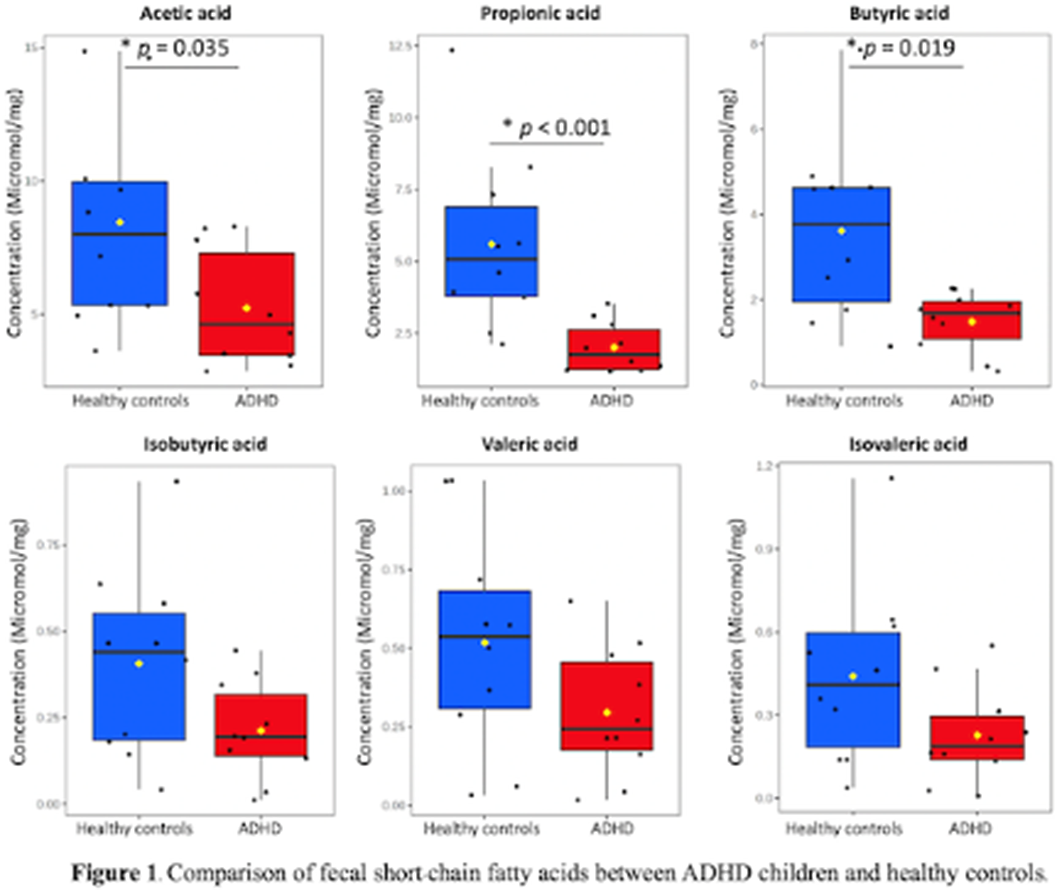
There were no significant differences in the abundance of any bacterial phyla in feces between groups. However, fecal concentrations of acetic acid, propionic acid, and butyric acid were significantly lower in children with ADHD compared to those of controls (Figure1). Interestingly, acetic acid and propionic acid levels were negatively correlated with ADHD symptoms (Table 1). Macronutrient and fiber intake, determined from food frequency questionnaires, did not differ between groups.Table 1.
The regression analyses predicting ADHD symptoms scores from fecal short-chain fatty acids level.
B
p-value
95%CI
Inattention score
Acetic acid
-0.14
0.009
-0.24, -0.04
Propionic acid
-0.18
0.006
-0.30, -0.06
Hyperactive/Impulsive score
Acetic acid
-0.10
0.031
-0.20, -0.01
Propionic acid
-0.14
0.018
-0.25, -0.03
Combined score
Acetic acid
-0.12
0.014
-0.22, -0.03
Propionic acid
-0.16
0.008
-0.27, -0.05
Image:
Conclusions
Our findings suggested that gut dysbiosis was possibly developed in children with ADHD, as indicated by a significant decrease in fecal SCFAs. In fact, fecal acetic acid, propionic acid, and butyric acid may potentially be the early detector for ADHD. In addition, fecal acetic acid and propionic acid could be potential biomarkers for the severity of ADHD.
Evidence is growing for the bio-immuno-metabolic model of pathogenesis in anorexia nervosa (AN), an eating disorder with a chronic and relapsing nature. The role of the gut microbiome in this process is also receiving intense research interest. The gut microbiome and the use of probiotics and prebiotics have been extensively studied in gastrointestinal (GI) disorders such as inflammatory bowel disease (IBD) and functional GI disorders (FGIDs). Exploring links between AN and these GI disorders may open new avenues of treatment such as the use of probiotics and prebiotics in AN.
Objectives
This review explores: i) GI presentation in AN and its relationship with the gut microbiome ii) factors influencing the gut microbiome presentation in AN including dietary patterns iii) whether the gut microbiome may be involved in the pathogenesis and maintenance of AN iv) gut microbiome presentation in GI disorders and commonalities with AN v) evidence for the potential use of probiotics and prebiotics as adjunct treatment in AN.
Methods
GI symptomatology and gut microbiome presentation in AN were examined through literature searches. Gut microbiome changes related to common dietary patterns in AN were explored. Microbiome changes that may influence development or maintenance of AN were considered. Microbiome alterations seen in relevant GI disorders were explored and commonalities considered between these and alterations in the microbiome in AN. Literature searches were performed for the use of probiotics and prebiotics in AN and relevant GI disorders.
Results
GI symptoms occur commonly in AN with evidence suggesting some symptoms continuing beyond weight restoration. Significant disruption of the gut microbiome has been associated with AN with some changes related to typical dietary patterns seen during AN development. Additionally, similarities exist between microbiome alterations in AN and those seen in IBD and FGIDs indicating factors apart from the diet, such as a pro-inflammatory milieu, in play. These changes may not only influence GI presentation in AN but may also have a role in maintenance of the disorder. Some evidence suggests that the pre-morbid gut microbiome may influence risk for AN development. Preliminary evidence of the use of probiotics in AN indicates a positive influence on immune modulation although no evidence exists as yet of their influence on AN symptomatology. There has been extensive research into the use of probiotics and prebiotics in IBD and FGIDs with some evidence for reduction in disease parameters and symptomatology with the use of multi-strain probiotics.
Conclusions
Some theoretical, mechanistic and clinical evidence exists for the use of probiotics in ameliorating GI symptoms in AN. However, further research is needed into the context of the gut microbiome changes in AN, the specifics of efficacy and the effects that probiotics and prebiotics may have in AN.
Early neurodevelopmental deviations, such as abnormal cortical folding patterns, are a candidate biomarker for major depressive disorder (MDD). Previous studies on patterns of abnormal cortical gyrification in MDD have provided valuable insights; however, the findings on cortical folding are controversial.
Objectives
We aimed to investigate the association of MDD with the local gyrification index (LGI) in each cortical region at the whole-brain level and the association of the LGI with clinical characteristics of MDD, including recurrence, remission status, illness duration, severity of depression, and medication status of patients with MDD.
Methods
We obtained T1-weighted images of 234 patients with MDD and 215 healthy controls (HCs). LGI values were automatically calculated using the FreeSurfer software according to the Desikan–Killiany atlas. LGI values from 66 cortical regions in the bilateral hemispheres were analyzed. We compared the LGI values between the MDD and HC groups using the analysis of covariance, including patients’ age, sex, and years of education as covariates. The association between clinical characteristics and LGI values was investigated in the MDD group.
Results
Compared with HCs, patients with MDD showed significantly decreased LGI values in the cortical regions, including the bilateral ventrolateral and dorsolateral prefrontal cortices, medial and lateral orbitofrontal cortices, insula, right rostral anterior cingulate cortex, and several temporal and parietal regions, with the highest effect size in the left pars triangularis (Cohen’s f = 0.361; P = 1.78 × 10⁻¹³). As for the association of clinical characteristics with LGIs within the MDD group, recurrence and longer illness duration of MDD were associated with increased gyrification in several occipital and temporal regions, which showed no significant difference in LGIs between MDD and HC groups.
Conclusions
Considering that the aforementioned cortical regions are involved in emotion regulation, abnormal cortical folding patterns in such regions may be associated with the dysfunction of emotion regulation-related neural circuits, which may lead to MDD. These findings suggest that LGI may be a relatively stable neuroimaging marker associated with the trait of MDD predisposition.
After the war in Bosnia-Herzegovina that lasted from 1992 to 1995, the populations gradually rebuilt their lives haunted by the spectrum of personal and collective painful souvenirs. Regarding the children who were born after the war, some mothers would rather not talk about it to protect their children from what they might be feeling while others would definetely share what they have experienced to protect their children. Because the intergenerational transmission of war trauma from mother to baby has been poorly explored among populations who recently lived in a warzone, we seeked to highlight the particularity of the interpersonal relations between the mother and her child in connection with maternal psychotrauma, by searching the factors of influence on the functioning of the dyad.
Objectives
The main objective of this study is to determine and conceptualize the modes of transmission of trauma from the study of mother-baby interactions in a Bosnian environment, after the war in Bosnia-Herzegovina.
Methods
In 2003, 40 mothers and their babies aged 2 to 36 months living in Sarajevo were enrolled in the study. Among these mothers, 31 lived in or near the warzone and 9 were either displaced in other areas of the country or were refugees in foreign countries. We assessed the level of severity of post-traumatic stress disorder (PTSD) using the Clinician Administered PTSD Scale (Blake et al, 1998). In order to examine the quality of the mother-child dyads of mothers who lived through the war, we videorecorded a 10-minute free play of 23 dyads in their home environment. Then the interactions were coded using the National Institute of Child Health and Human Development observation grid by two independent raters.
Results
The results showed that all mothers who lived through the war presented post-traumatic symptoms but only half of them showed a PTSD. Videotaped observations of mother-child interactions during playtimes revealed that their interactions are less linked to the mother’s PTSD than to the influence of PTSD on maternal attitudes and thereby extending to those of their infant. They are less sensitive to their children’s signals. They are also more intrusive and detached. Overall, they are more focused on themselves than on their child when they are interacting. As a result, their children are more focused on play and less actively engaged in communicating with their mothers.
Conclusions
The interactions between the mother and her child cover a set of relatively complex processes during which the two partners influence each other. When a mother lives through the war, she will pass on to her child an often painful life story. And thus, it is not only the content but also the way she transmits it that influences how the child receives the objects of the transmission.
In recent years, mental health professionals have faced a lot of difficulties and challenges in their work and often need the help of colleagues themselves.
Objectives
To study the specifics of self-reflection of mental health professionals in different years (January 2020 - October 2022)
Methods
Since 2002, Institute of Integrative Family Therapy has been using an approved registration card, which is filled in and handed over after completion of work by all specialists working with families. The maps contain sections describing the progress of work, hypotheses, system parameters of the family, features of the state of the specialist and clients, and so on. We conducted a content analysis of the cards: in 2020, 531 cards were considered, in 2021 - 390, in 2022 - 464 cards.
Results
There are differences in the subjective assessment by specialists of their condition over the years. In the description for the section “Themes and questions in family work that elicited strong emotional reactions from the therapist(s”), professionals began to mention their reactions of fear and confusion more often than before. So, in 2020, fear was mentioned by 4 and confusion by 17 specialists, in 2021 - by 5 and 16, in 2022 - by 36 and 121, respectively. In the section related to the reasons for changing the working (systemic) hypothesis, specialists changed the hypothesis more often (in 2020 - in 53 cases, in 2021 - 40, in 2022 - 98). “The degree of satisfaction of the specialist (-s) with the results of working with the family (in points from 1 to 10, where 1 - absolutely not satisfied, 10 - satisfaction exceeded all expectations" was assessed in 2022 by specialists lower than in previous years: the average value in 2020 - 8.8; in 2021 - 8.9; in 2022 - 6.2.
Conclusions
Supervision, as a form of professional growth and support from a more experienced colleague, is becoming an indispensable component of the work of a specialist helping families in 2022. Assistance in overcoming “dead end” and advising difficult cases due to the experience of the supervisor, on the one hand, allows specialists to understand the situation, offer alternative hypotheses, teach new interventions, on the other hand, it helps the supervised colleague to reflect on the case, analyze its “blind” zones, understand mistakes and summarize the unique experience gained in the psychotherapy of a “difficult” patient.
A wide variety of traits is heritable and has genetic loading, including schizophrenia spectrum disorders (SSDs) and its associated neurocognitive features. The genetic architecture of SSDs is polygenic, with the contribution of thousands of single nucleotide polymorphisms of small effect with an estimated SNP-heritability of 24%. The same occurs with neurocognitive phenotypes such as intelligence or educational attainment. Therefore, the method of polygenic risk scores (PRS) is useful in estimating the genetic burden of such traits. Moreover, the use of PRS in a sample of genetically related individuals would allow analyzing the contribution of genetic and environmental factors involved in the development of the disorder and its candidate endophenotypes.
Objectives
To estimate PRS for schizophrenia, and polygenic scores for intelligence and educational attainment in patients with First Episode Psychosis (FEP), their first-degree relatives (siblings and parents), and a group of healthy controls.
Methods
The sample is comprised of 579 participants of the PAFIP-FAMILIAS project in Santander, Spain (133 FEP patients, their 244 first-degree relatives, and 202 healthy controls). All provided sociodemographic information and completed the same neuropsychological battery. Participants’ DNA was extracted from venous blood samples, and genotyping was performed at the Centro Nacional de Investigaciones Oncológicas (CeGen) by the Global Screening Array v.3.0 panel (Illumina). Data quality control, imputation, calculation of PRS, and genetic association analysis are being performed using PLINK, SHAPEIT, IMPUTE2, SPSS and R.
Results
Data analysis is currently in progress, at the quality analysis stage, in collaboration with the Institute of Psychiatric Phenomics and Genomics (IPPG) in Munich, Germany. We expect to find higher PRS for schizophrenia in FEP patients, while their first-degree relatives will potentially show intermediate risk scores between patients and healthy controls. A similar finding is expected regarding intelligence and educational attainment, as FEP patients may show more genetic burden for low intelligence and education.
Conclusions
The estimation of PRS has demonstrated to be valuable in studying complex traits such as schizophrenia. We believe that by applying this method in a family design can provide interesting insights on the development of SSDs and its potential endophenotypes, and potentially useful in their prevention.
There has been an exponential rise in SSRI prescribing, between 2021 and 2022 there was a 5% increase. The majority of SSRI prescription initiation takes place in primary care. This is a national trend and mirrored internationally.
Objectives
The study was undertaken to understand barriers to deprescribing both prescribing clinicians and patients and the potential of dependence caused by continued prescribing of SSRI and SNRI. We wanted to understand deprescribing challenges and both clinical anxiety and difficulty experienced and see if there is a correlation with the Drug use screening tool (DUST) tool.
Methods
Those patients who were stable on SSRI were offered lowering of dose and deprescribing as part of routine medication reviews. During medication reviews patients were asked about willingness to embark on a deprescribing schedule. Patients were screened during medication reviews on the DUST to see if this can be used to predict difficulty with deprescribing. We designed a deprescribing difficult questionnaire to assess the difficulty experienced by clinicians during a deprescribing consultation. We were able to study the is a correlation with DUST scores and Clinician experience of difficulty and challenge in deprescribing of the SSRI and SNRI.
Results
Current alcohol drinkers and smokers were less likely to deprescribe from their antidepressants. Clinicals should do a risk assessment using the DUST screening tool checking for risk of dependence. There is an R value of 0.1586 (P-value is 0.018848) between the correlation of patients increased length time and increased DUST score causing an increased risk of dependence. The average R-score across the three practices between patient’s length of time being on medications and their DUST score is R= 0.18705 (P value of 0.01)
Conclusions
Inability to access IAPT therapies, shortened length of CBT sessions and lack of post IAPT support caused poor patient experience and contributed to reluctance to re-engage with IAPT services. Both cascade and incremental prescribing following lower doses without documentation of the limitations of medication results in unrealistic expectations generated from the prescribing. There is positive correlation between length of SSRI and SNRI prescribed, DUST scores, and Clinical challenge scores with patients’ unwillingness to be deprescribed. Patients should have a DUST score review prior to having been put onto any antidepressant as there is a potential link between increased DUST score and lower chances of willingness to deprescribe. Clinicians need to counsel patient of risk of dependence. The likelihood is these are drugs of dependence and clinicians should counsel patients of these risks and given review dates and offered deprescribing.
The response to placebo is robust in studies of various antidepressant treatments. The strong placebo response, combined with the absence of side-effects, has prompted suggestions to use the ethically sound open-label placebo (OLP) as a treatment for depression.
Objectives
The aim of the present study was to assess the efficacy of OLP in the setting of a randomized controlled trial for the treatment of unipolar depression.
Methods
Thirty-eight patients (28 females, 73.7%) were randomized to either an eight-week treatment with OLP (n=18) or four week of treatment as usual (TAU) followed by four weeks of OLP (n=20). Clinical and socio-demographic measures were assessed at baseline, after four weeks, and at the end of the trial. Response to treatment was determined using the Quick Inventory of Depressive Symptomatology (QIDS SR-16).
Results
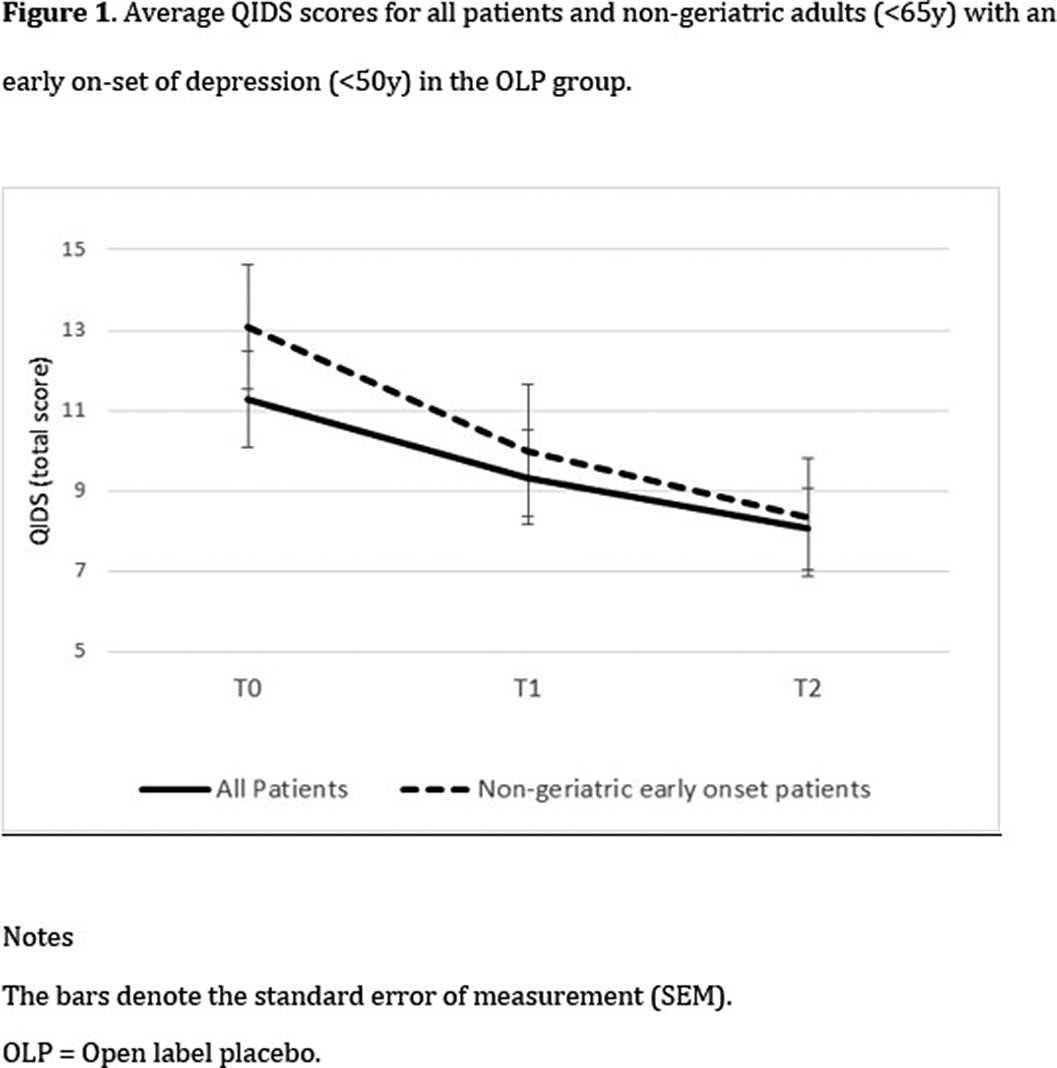
There was an overall decrease in depression levels over time, F(2,35) = 3.98, p = .028). A significant group x time interaction was found only among non-geriatric patients (<65y) with an early onset of depression (<50y), F(2,22) = 3.89, p = .036]. Post-hoc tests indicated a significant decrease during the first four weeks, but only in the OLP group, t(11) = 2.29, p = .043.Table 1:
Demographic measures of OLP and TAU patients.
Measures
OLP (n = 18)
TAU (n =20)
Statistical analyses
Age (years) [Mean ± SD]
48.17 ± 16.86
51.65 ± 17.68
t(36) = -0.62, p = .539
Education level (years) [Mean ± SD]
15.61 ± 3.66
14.22 ± 2.62
t(34) = 1.31, p = .200
Gender (male/female) [no.]
4 / 14
6 / 14
X2(1) = 0.30, p = .587
Age of onset (years) [Mean ± SD]
34.19 ± 15.82
32.45 ± 17.72
t(36) = 0.32, p= .752
Number of depressive episodes (no.) [Mean ± SD]
2.58 ± 2.61
6.64 ± 9.16
t(21) = -1.47, p = .156
Number of hospitalizations (no.) [Mean ± SD]
0.12 ± 0.33
0.17 ± 0.38
t(33)= -0.40, p = .689
Notes
OLP = Open label placebo; SD = Standard deviation; TAU = Treatment as usual.
Image 3:
Conclusions
Our findings support the possibility that OLP is an effective treatment for the relatively young population of patients suffering from depression. Additional studies are warranted in order to explore the use of open-label placebo in clinical work.