We partner with a secure submission system to handle manuscript submissions.
Please note:
You will need an account for the submission system, which is separate to your Cambridge Core account. For login and submission support, please visit the
submission and support pages.
Please review this journal's author instructions, particularly the
preparing your materials
page, before submitting your manuscript.
Click Proceed to submission system to continue to our partner's website.
To save this undefined to your undefined account, please select one or more formats and confirm that you agree to abide by our usage policies. If this is the first time you used this feature, you will be asked to authorise Cambridge Core to connect with your undefined account.
Find out more about saving content to .
To send this article to your Kindle, first ensure no-reply@cambridge.org is added to your Approved Personal Document E-mail List under your Personal Document Settings on the Manage Your Content and Devices page of your Amazon account. Then enter the ‘name’ part of your Kindle email address below. Find out more about sending to your Kindle.
Find out more about saving to your Kindle.
Note you can select to save to either the @free.kindle.com or @kindle.com variations. ‘@free.kindle.com’ emails are free but can only be saved to your device when it is connected to wi-fi. ‘@kindle.com’ emails can be delivered even when you are not connected to wi-fi, but note that service fees apply.
To determine the proportion of patients in symptomatic remission and recovery following a first-episode of psychosis (FEP).
Methods
A multistep literature search using the Web of Science database, Cochrane Central Register of Reviews, Ovid/PsychINFO, and trial registries from database inception to November 5, 2020, was performed. Cohort studies and randomized control trials (RCT) investigating the proportion of remission and recovery following a FEP were included. Two independent researchers searched, following PRISMA and MOOSE guidelines and using a PROSPERO protocol. We performed meta-analyses regarding the proportion of remission/recovery (symptomatic plus functional outcomes). Heterogeneity was measured employing Q statistics and I2 test. To identify potential predictors, meta-regression analyses were conducted, as well as qualitative reporting of studies included in a systematic review. Sensitivity analyses were performed regarding different times of follow-up and type of studies.
Results
One hundred articles (82 cohorts and 18 RCTs) were included in the meta-analysis. The pooled proportion of symptomatic remission was 54% (95%CI [30, 49–58]) over a mean follow-up period of 43.57 months (SD = 51.82) in 76 studies. After excluding RCT from the sample, the proportion of remission remained similar (55%). The pooled proportion of recovery was 32% (95%CI [27–36]) over a mean follow-up period of 71.85 months (SD = 73.54) in 40 studies. After excluding RCT from the sample, the recovery proportion remained the same. No significant effect of any sociodemographic or clinical predictor was found.
Conclusions
Half of the patients are in symptomatic remission around 4 years after the FEP, while about a third show recovery after 5.5 years.
This study aimed to investigate the effectiveness of mindfulness-based cognitive therapy (MBCT) as a complementary approach in patients with bulimia nervosa (BN) or binge eating disorder (BED), and to assess how the reduction of the cognitive load of words related to eating disorders (ED) could constitute an intermediate factor explaining its global efficacy.
Methods
Eighty-eight women and men participated in clinical assessments upon inscription, prior to and following 8-week group MBCT. Mindfulness skills were assessed using the five facet mindfulness questionnaire; eating behaviors were assessed using the Three Factor Eating Questionnaire (TFEQ); comorbid pathologies were assessed using the beck depression index and the state-trait anxiety inventory. The cognitive load of words associated with ED was assessed through a modified version of the Stroop color naming task.
Results
Mindfulness skills improved significantly (p < .05) after group MBCT. The improvement of TFEQ scores was accompanied by reduced levels of depressive mood and trait anxiety. The positive impact of MBCT on TFEQ score was directly related to an improvement of the performance in the Stroop task.
Conclusions
MBCT represents an interesting complementary therapy for patients with either BN or BED, at least when cognitive and behavioral domains are concerned. Such efficacy seems to be mediated by the reduction of the cognitive load associated with ED stimuli, which offers a possible explanation of how MBCT could reduce binge-eating behaviors. Other studies are needed, in independent centers, to focus more directly on core symptoms and long-term outcome.
Paliperidone 3-monthly (PP3M) long-acting injection has proven efficacy and effectiveness in schizophrenia. Little is known of its effectiveness in other diagnoses.
Methods
All patients starting PP3M were followed up for 2 years. Main outcome measures were relapse and discontinuation from PP3M. Post hoc we examined outcomes in those switched back to one monthly paliperidone (PP1M) long-acting injection.
Results
Overall, 186 patients were followed-up. At the 2-year end point, 110 patients (59%) were still receiving PP3M, and 129 (70%) were receiving some form of paliperidone long-acting injection. Discontinuation from paliperidone long-acting injections (PPLAIs) was more likely with a nonschizophrenia diagnosis (hazard ratio [HR] for continuation 0.429 [95% confidence intervals (CI) – 0.21, 0.87 p = 0.018)), and prior clozapine use [in PP3M patients; HR for discontinuation 1.87 [95% CI – 1.05, 3.30 p = 0.032]). Relapse occurred in 20 (11%) of those receiving PP3M. Relapse on PP3M and PPLAIs was more likely in nonschizophrenia diagnosis (HR 0.17 for remaining relapse-free [95% CI – 0.06, 0.50; p = 0.001]; HR 0.21 [95% CI – 0.08, 0.58 p = 0.002], respectively), polypharmacy in PP3M patients (HR for relapse 7.91 [95% CI – 3.73, 22.9; p < 0.001]) and PPLAI patients (HR for relapse 6.45 [95% CI – 2.49, 16.5; p < 0.001]), and prior clozapine use in PP3M patients (HR for relapse 6.11 [95% CI – 1.82, 20.5; p = 0.003]) and PPLAI patients (HR for relapse 4.52 (95% CI – 1.51, 13.5; p = 0.007).
Conclusions
Outcomes with PP3M are excellent in practice, even when used outside its formal license. PP3M was relatively more effective in those with an F20 schizophrenia diagnosis and in those never before considered for or prescribed clozapine.
Certain neuropsychiatric symptoms (NPS), namely apathy, depression, and anxiety demonstrated great value in predicting dementia progression, representing eventually an opportunity window for timely diagnosis and treatment. However, sensitive and objective markers of these symptoms are still missing. Therefore, the present study aims to investigate the association between automatically extracted speech features and NPS in patients with mild neurocognitive disorders.
Methods
Speech of 141 patients aged 65 or older with neurocognitive disorder was recorded while performing two short narrative speech tasks. NPS were assessed by the neuropsychiatric inventory. Paralinguistic markers relating to prosodic, formant, source, and temporal qualities of speech were automatically extracted, correlated with NPS. Machine learning experiments were carried out to validate the diagnostic power of extracted markers.
Results
Different speech variables are associated with specific NPS; apathy correlates with temporal aspects, and anxiety with voice quality—and this was mostly consistent between male and female after correction for cognitive impairment. Machine learning regressors are able to extract information from speech features and perform above baseline in predicting anxiety, apathy, and depression scores.
Conclusions
Different NPS seem to be characterized by distinct speech features, which are easily extractable automatically from short vocal tasks. These findings support the use of speech analysis for detecting subtypes of NPS in patients with cognitive impairment. This could have great implications for the design of future clinical trials as this cost-effective method could allow more continuous and even remote monitoring of symptoms.
Personality traits have been associated with long-term suicide risk but their relationship with short-term risk is still unknown. Therefore, to address this gap, we explored the moderating effect of personality traits on the relationship between the Suicide Crisis Syndrome (SCS) and short-term suicidal behaviors (SB).
Sampling and Methods
Adult participants (N = 459) were administered the Suicide Crisis Inventory (SCI), a validated self-report questionnaire designed to measure the intensity of the Suicidal Crisis Syndrome, the Big Five Inventory for personality traits, and the Columbia Suicide Severity Rating Scale for SB at intake and at a 1-month follow-up. The PROCESS macro in SPSS was used to test the moderation model. Covariates hypothesized to influence the results were added: age, gender, ethnicity, years of education, and depressive symptomatology on the Beck Depression Inventory. This study was a secondary analysis drawn from a larger study on the SCS.
Results
SCI total score had a significant positive relationship with SB at the 1-month follow-up for patients with lower levels of extraversion, agreeableness, conscientiousness, and openness, respectively. Hence, these four traits were protective against SB. There was an association between SCI and SB for patients with high levels of neuroticism at the 1-month follow-up.
Conclusions
High levels of neuroticism served as a risk factor, whereas high levels of the other Big Five traits were protective factors against short-term SB in the context of elevated SCS symptoms. Thus, personality traits play a role in moderating the relationship between the SCS and imminent SB.
The Positive and Negative Syndrome Scale (PANSS) is widely used in schizophrenia and has been divided into distinct factors (5-factor models) and subfactors. Network analyses are newer in psychiatry and can help to better understand the relationships and interactions between the symptoms of a psychiatric disorder. The aim of this study was threefold: (a) to evaluate connections between schizophrenia symptoms in two populations of patients (patients in the acutely exacerbated phase of schizophrenia and patients with predominant negative symptoms [PNS]), (b) to test whether network analyses support the Mohr 5 factor model of the PANSS and the Kahn 2 factor model of negative symptoms, and finally (c) to identify the most central symptoms in the two populations.
Methods
Using pooled baseline data from four cariprazine clinical trials in patients with acute exacerbation of schizophrenia (n = 2193) and the cariprazine–risperidone study in patients with PNS (n = 460), separate network analyses were performed. Network structures were estimated for all 30 items of the PANSS.
Results
While negative symptoms in patients with an acute exacerbation of schizophrenia are correlated with other PANSS symptoms, these negative symptoms are not correlated with other PANSS symptoms in patients with PNS. The Mohr factors were partially reflected in the network analyses. The two most central symptoms (largest node strength) were delusions and uncooperativeness in acute phase patients and hostility and delusions in patients with PNS.
Conclusions
This network analysis suggests that symptoms of schizophrenia are differently structured in acute and PNS patients. While in the former, negative symptoms are mainly secondary, in patients with PNS, they are mainly primary. Further, primary negative symptoms are better conceptualized as distinct negative symptom dimensions of the PANSS.
Intelligence is inversely associated with schizophrenia (SCZ) and bipolar disorder (BD); it remains unclear whether low intelligence is a cause or consequence. We investigated causal associations of intelligence with SCZ or BD risk and a shared risk between SCZ and BD and SCZ-specific risk.
Methods
To estimate putative causal associations, we performed multi-single nucleotide polymorphism (SNP) Mendelian randomization (MR) using generalized summary-data-based MR (GSMR). Summary-level datasets from five GWASs (intelligence, SCZ vs. control [CON], BD vs. CON, SCZ + BD vs. CON, and SCZ vs. BD; sample sizes of up to 269,867) were utilized.
Results
A strong bidirectional association between risks for SCZ and BD was observed (odds ratio; ORSCZ → BD = 1.47, p = 2.89 × 10−41, ORBD → SCZ = 1.44, p = 1.85 × 10−52). Low intelligence was bidirectionally associated with a high risk for SCZ, with a stronger effect of intelligence on SCZ risk (ORlower intelligence → SCZ = 1.62, p = 3.23 × 10⁻¹⁴) than the reverse (ORSCZ → lower intelligence = 1.06, p = 3.70 × 10⁻²³). Furthermore, low intelligence affected a shared risk between SCZ and BD (OR lower intelligence → SCZ + BD = 1.23, p = 3.41 × 10⁻⁵) and SCZ-specific risk (ORlower intelligence → SCZvsBD = 1.64, p = 9.72 × 10⁻¹⁰); the shared risk (ORSCZ + BD → lower intelligence = 1.04, p = 3.09 × 10⁻¹⁴) but not SCZ-specific risk (ORSCZvsBD → lower intelligence = 1.00, p = 0.88) weakly affected low intelligence. Conversely, there was no significant causal association between intelligence and BD risk (p > 0.05).
Conclusions
These findings support observational studies showing that patients with SCZ display impairment in premorbid intelligence and intelligence decline. Moreover, a shared factor between SCZ and BD might contribute to impairment in premorbid intelligence and intelligence decline but SCZ-specific factors might be affected by impairment in premorbid intelligence. We suggest that patients with these genetic factors should be categorized as having a cognitive disorder SCZ or BD subtype.
Posttraumatic stress disorder (PTSD) is traditionally understood as a disorder that occurs more commonly in women than in men, and in younger age groups than in older age groups. The objective of this study was to determine if these patterns are also observed in relation to International Classification of Diseases (ICD-11) PTSD and complex PTSD (CPTSD).
Methods
Secondary data analysis was performed using data collected from three nationally representative samples from the Republic of Ireland (N = 1,020), the United States (N = 1,839), and Israel (N = 1,003), and one community sample from the United Kingdom (N = 1,051).
Results
Estimated prevalence rates of ICD-11 PTSD were higher in women than in men in each sample, and at a level consistent with existing data derived from Diagnostic and Statistics Manual of Mental Disorders (DSM)-based models of PTSD. Furthermore, rates of ICD-11 PTSD were generally lower in older age groups for men and women. For CPTSD, there was inconsistent evidence of sex and age differences, and some indication of a possible interaction between these two demographic variables.
Conclusions
Despite considerable revisions to PTSD in ICD-11, the same sex and age profile was observed to previous DSM-based models of PTSD. CPTSD, however, does not appear to show the same sex and age differences as PTSD. Theoretical models that seek to explain sex and age differences in trauma-related psychopathology may need to be reconsidered given the distinct effects for ICD-11 PTSD and CPTSD.
Reality-monitoring process enables to discriminate memories of internally generated information from memories of externally derived information. Studies have reported impaired reality-monitoring abilities in schizophrenia patients with auditory hallucinations (AHs), specifically with an exacerbated externalization bias, as well as alterations in neural activity within frontotemporoparietal areas. In healthy subjects, impaired reality-monitoring abilities have been associated with reduction of the paracingulate sulcus (PCS). The current study aimed to identify neuroanatomical correlates of reality monitoring in patients with schizophrenia.
Methods
Thirty-five patients with schizophrenia and AHs underwent a reality-monitoring task and a 3D anatomical MRI scan at 1.5 T. PCS lengths were measured separately for each hemisphere, and whole-brain voxel-based morphometry analyses were performed using the Computational Anatomy Toolbox (version 12.6) to evaluate the gray-matter volume (GMV). Partial correlation analyses were used to investigate the relationship between reality-monitoring and neuroanatomical outcomes (PCS length and GMV), with age and intracranial volume as covariates.
Results
The right PCS length was positively correlated with reality-monitoring accuracy (Spearman’s ρ = 0.431, p = 0.012) and negatively with the externalization bias (Spearman’s ρ = −0.379, p = 0.029). Reality-monitoring accuracy was positively correlated with GMV in the right angular gyrus, whereas externalization bias was negatively correlated with GMV in the left supramarginal gyrus/superior temporal gyrus, in the right lingual gyrus and in the bilateral inferior temporal/fusiform gyri (voxel-level p < 0.001 and cluster-level p < 0.05, FDR-corrected).
Conclusions
Reduced reality-monitoring abilities were significantly associated with shorter right PCS and reduced GMV in temporal and parietal regions of the reality-monitoring network in schizophrenia patients with AHs.
The high prevalence of smoking in individuals who are at ultra-high risk (UHR) for psychosis is well known and moderate cognitive deficits have also been found in UHR. However, the association between smoking and cognition in UHR is unknown and longitudinal studies are lacking.
Method
A cohort study with 330 UHR individuals and 66 controls was conducted, as part of the European network of national schizophrenia networks studying gene–environment interactions (EU-GEI). At baseline and after 6, 12, and 24 months, smoking behavior was assessed with the Composite International Diagnostic Interview and cognitive functioning with a comprehensive test battery. Linear mixed-effects analyses were used to examine the multicross-sectional and prospective associations between (change in) smoking behavior and cognitive functioning, accounting for confounding variables.
Results
At baseline, 53% of UHR and 27% of controls smoked tobacco. Smoking UHR and controls did not significantly differ from nonsmoking counterparts on the tested cognitive domains (speed of processing, attention/vigilance, working memory, verbal learning, or reasoning/problem solving) across different assessment times. Neither smoking cessation nor initiation was associated with a significant change in cognitive functioning in UHR.
Conclusions
No associations were found between smoking and cognitive impairment in UHR nor in controls. However, the fact that one in every two UHR individuals report daily use of tobacco is alarming. Our data suggest that UHR have fewer cognitive impairments and higher smoking cessation rates compared to patients with first-episode psychosis found in literature. Implications to promote smoking cessation in the UHR stage need further investigation.
The European impact of the clinical high risk for psychosis (CHR-P) paradigm is constrained by the lack of critical mass (detection) to power prognostic and preventive interventions.
Methods
An ITAlian partnership for psychosis prevention (ITAPP) was created across CHR-P centers, which were surveyed to describe: (a) service, catchment area, and outreach; (b) service users; and (c) interventions and outcomes. Descriptive statistics and Kaplan–Meier failure function complemented the analyses.
Results
The ITAPP included five CHR-P clinical academic centers established from 2007 to 2018, serving about 13 million inhabitants, with a recruitment capacity of 277 CHR-P individuals (mean age: 18.7 years, SD: 4.8, range: 12–39 years; 53.1% females; 85.7% meeting attenuated psychotic symptoms; 85.8% without any substance abuse). All centers were multidisciplinary and included adolescents and young adults (transitional) primarily recruited through healthcare services. The comprehensive assessment of at-risk mental state was the most widely used instrument, while the duration of follow-up, type of outreach, and preventive interventions were heterogeneous. Across 205 CHR-P individuals with follow up (663.7 days ± 551.7), the cumulative risk of psychosis increased from 8.7% (95% CI 5.3–14.1) at 1 year to 15.9% (95% CI 10.6–23.3) at 2 years, 21.8% (95% CI 14.9–31.3) at 3 years, 34.8% (95% CI 24.5–47.9) at 4 years, and 51.9% (95% CI 36.3–69.6) at 5 years.
Conclusions
The ITAPP is one of the few CHR-P clinical research partnerships in Europe for fostering detection, prognosis, and preventive care, as well as for translating research innovations into practice.
One common denominator to the clinical phenotypes of borderline personality disorder (BPD) and major depressive disorder (MDD) is emotion regulation impairment. Although these two conditions have been extensively studied separately, it remains unclear whether their emotion regulation impairments are underpinned by shared or distinct neurobiological alterations.
Methods
We contrasted the neural correlates of negative emotion regulation across an adult sample of BPD patients (n = 19), MDD patients (n = 20), and healthy controls (HCs; n = 19). Emotion regulation was assessed using an established functional magnetic resonance imaging cognitive reappraisal paradigm. We assessed both task-related activations and modulations of interregional connectivity.
Results
When compared to HCs, patients with BPD and MDD displayed homologous decreased activation in the right ventrolateral prefrontal cortex (vlPFC) during cognitive reappraisal. In addition, the MDD group presented decreased activations in other prefrontal areas (i.e., left dorsolateral and bilateral orbitofrontal cortices), while the BPD group was characterized by a more extended pattern of alteration in the connectivity between the vlPFC and cortices of the visual ventral stream during reappraisal.
Conclusions
This study identified, for the first time, a shared neurobiological contributor to emotion regulation deficits in MDD and BPD characterized by decreased vlPFC activity, although we also observed disorder-specific alterations. In MDD, results suggest a primary deficit in the strength of prefrontal activations, while BPD is better defined by connectivity disruptions between the vlPFC and temporal emotion processing regions. These findings substantiate, in neurobiological terms, the different profiles of emotion regulation alterations observed in these disorders.
To examine the mortality risk of current and life-time depressive as well as anxiety disorders, whether this risk is moderated by sex or age, and whether this risk can be explained by lifestyle and/or somatic health status.
Methods
A cohort study (Lifelines) including 141,377 participants (18–93 years) which were followed-up regarding mortality for 8.6 years (range 3.0–13.7). Baseline depressive and anxiety disorders according to Diagnostic and Statistical Manual of Mental Disorders, fourth edition criteria were assessed with the Mini International Neuropsychiatric Interview and lifetime diagnoses by self-report. All-cause mortality was retrieved from Statistics Netherlands. Cox-regression was applied to calculate proportional hazard ratios, adjusted for lifestyle (physical activity, alcohol use, smoking, and body mass index) and somatic health status (multimorbidity and frailty) in different models.
Results
The mortality rate of depressive and anxiety disorders was conditional upon age but not on sex. Only in people below 60 years, current depressive and anxiety disorders were associated with mortality. Only depressive disorder and panic disorder independently predicted mortality when all mental disorders were included simultaneously in one overall model (hazard ratio [HR] = 2.18 [95% confidence intervals (CI): 1.56–3.05], p < 0.001 and HR = 2.39 [95% CI: 1.15–4.98], p = 0.020). Life-time depressive and anxiety disorders, however, were independent of each other associated with mortality. Associations hardly changed when adjusted for lifestyle characteristics but decreased substantially when adjusted for somatic health status (in particular physical frailty).
Conclusions
In particular, depressive disorder is associated with excess mortality in people below 60 years, independent of their lifestyle. This effect seems partly explained by multimorbidity and frailty, which suggest that chronic disease management of depression-associated somatic morbidity needs to be (further) improved.
Depressive symptoms and cognitive impairment often coexisted in the elderly. This study investigates the effect of late-life depressive symptoms on risk of mild cognitive impairment (MCI).
Methods
A total of 14,231 dementia- and MCI free participants aged 60+ from the Survey of Health, Ageing, and Retirement in Europe were followed-up for 10 years to detect incident MCI. MCI was defined as 1.5 standard deviation (SD) below the mean of the standardized global cognition score. Depressive symptoms were assessed by a 12-item Europe-depression scale (EURO-D). Severity of depressive symptoms was grouped as: no/minimal (score 0–3), moderate (score 4–5), and severe (score 6–12). Significant depressive symptoms (SDSs) were defined as EURO-D score ≥ 4.
Results
During an average of 8.2 (SD = 2.4)-year follow-up, 1,352 (9.50%) incident MCI cases were identified. SDSs were related to higher MCI risk (hazard ratio [HR] = 1.26, 95% confidence intervals [CI]: 1.10–1.44) in total population, individuals aged 70+ (HR = 1.35, 95% CI: 1.14–1.61) and women (HR = 1.28, 95% CI: 1.08–1.51) in Cox proportional hazard model adjusting for confounders. In addition, there was a dose–response association between the severity of depressive symptoms and MCI incidence in total population, people aged ≥70 years and women (p-trend <0.001).
Conclusions
Significant depressive symptoms were associated with higher incidence of MCI in a dose–response fashion, especially among people aged 70+ years and women. Treating depressive symptoms targeting older population and women may be effective in preventing MCI.
We aimed to assess the changes in public stigma towards people with mental health problems in Czechia; and to investigate the association between these and the exposure to the ongoing mental health care reform and one of its implementation projects focused on reducing stigma.
Methods
We analyzed data from three cross-sectional surveys representative of the Czech adult population. We used linear regression models to compare population attitudes and desire for future contact with people with mental health problems between the 2013/2014 baseline and the 2019 follow-up. In our 2019 sample, we employed linear regression models to assess the relationship between exposure to mental health care reform and nation-wide anti-stigma campaign, and population stigmatizing attitudes and intended behavior. We utilized a propensity score matching procedure to mitigate potential bias.
Results
The 2013, 2014, and 2019 datasets consisted of 1797, 1810, and 1077 participants, respectively. Population attitudes improved significantly between 2014 and 2019 (B = 0.99, 95% CI = 0.06; 1.93), but we did not detect a change in population desire for future contact with people with mental health problems. Exposure to the nationwide anti-stigma campaign or mental health care reform was associated with more favorable attitudes (B = 4.25, 95% CI = 2.07; 6.42 and B = 7.66, 95% CI = 3.91; 11.42), but not with higher desire for future contact with people with mental health problems.
Conclusions
Mental health care reform and its nation-wide anti-stigma project seems to have a positive impact on population attitudes, but not on desire for future contact with people with mental health problems.
Clinical case of 10-year-old patient with anorexia nervosa at the stage of severe cachexia. Features of the disease, diagnosis, treatment and methods of restoration of nutrition. Anorexia nervosa is an eating disorder (ED), severe pathology, manifested by severe complications, high disability and can cause death. ED has traditionally been perceived as a disease affecting women. However, this pathology occurs men, is 10-25% of the total number of patients with ED, or 1-2% in the population.
Objectives
Describe the difficulties in identifying ED in men that affect diagnosis and treatment, especially if they are underage patients.
Methods
Patient I. 10 years, selectivity in food from 4 years, during the week before hospitalization complete rejection of food and water. When entering the clinic height 127, weight 19 kg, BMI 11. In the clinical picture anxiety, low mood, fear of eating and weight gain. The duration of the disease for about one year. Clinical and psychopathological method.
Results
Diagnosis F50.0 anorexia nervosa in the stage of severe cachexia. Treatment: olanzapine and fluvoxamine in the age dosages, parenteral Kabiven infusion, individual and group psychotherapy. Psychoeducation of parents and Maudsley method therapy. As a result of treatment improved mood, decreased anxiety associated with eating and weight gain. At the time of discharge from the clinic height 127, weight 30 kg, BMI 18.
Conclusions
The clinical case indicates the need to increase the attention of pediatricians, psychologists, psychiatrists and other doctors in connection with the growth and rejuvenation of ED in the male population.
Only little is known about COVID-19 which is now playing its engulfing function in terms of devouring global health, resulting in a crisis that is as novel as the novel Coronavirus strain itself. Both, the structure and function of COVID-19 have been documented and further research is in progress to fill the lacuna. With significant levels of globalization, COVID-19 spreads rapidly around the globe.
Objectives
Masses are hoping for a vaccine as their ultimate object of liberation. People are talking about crashing economy, but what about the crash of humans from their being? Here, a biological, psychological, and psychoanalytic understanding of COVID-19 is investigated. The impact of physical isolation has been documented, but mental isolation remains an uncharted space. The psychological trace—the paleontological psychic trauma of experiencing a pandemic as a witnessing subject is not much talked about. This effort is to open the paths to understanding COVID-19 which may seem pathless at first.
Methods
Primary sources are used along with an intradisciplinary and interdisciplinary unison of psychiatry, psychology, psychoanalysis, yoga, and meditation.
Results
Yoga and meditation for strengthening both physical and psychological immunity along with facilitating the acceptance of psychological impact which is unregistered in the minds of a large population is elucidated.
Conclusions
It is in the interdisciplinary and intradisciplinary unison that preparedness for future pandemics could be curated.
Our 15-years follow-up ReMIND project aims to re-assess an epidemiological and a clinical sample of adults (Wave 3), who were assessed in preadolescence (Wave 1) and adolescence (Wave 2), to evaluate symptoms trajectories and their relationship with genetic/epigenetic data, environmental risk factors and neuroimaging measures.
Objectives
Here, we depict preliminary results regarding the epidemiological sample.
Methods
We assessed internalizing and externalizing symptoms in 40 italian subjects (25 F) from general population at three waves (W1 mean age: 12±0,82; W2 mean age: 17±0,88, W3 mean age: 28±1), through the Child Behavior Checklist (W1 and W2) or the Adult Self Report (W3), and perinatal risk factors through a socio-anamnestic questionnaire, by a new online platform (MedicalBit). We analyzed symptoms trajectories and their relation with perinatal risk factors through a repeated measures multivariate analysis of variance (rm-MANOVA).
Results
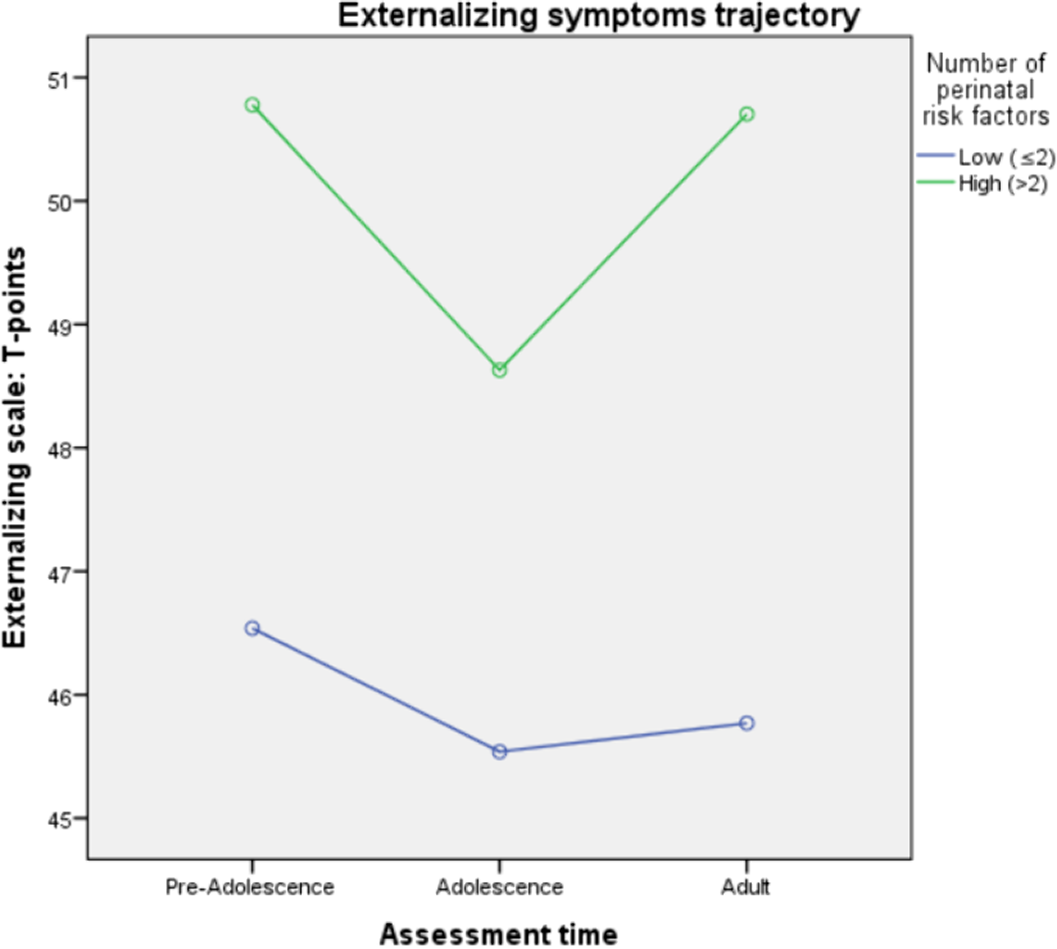
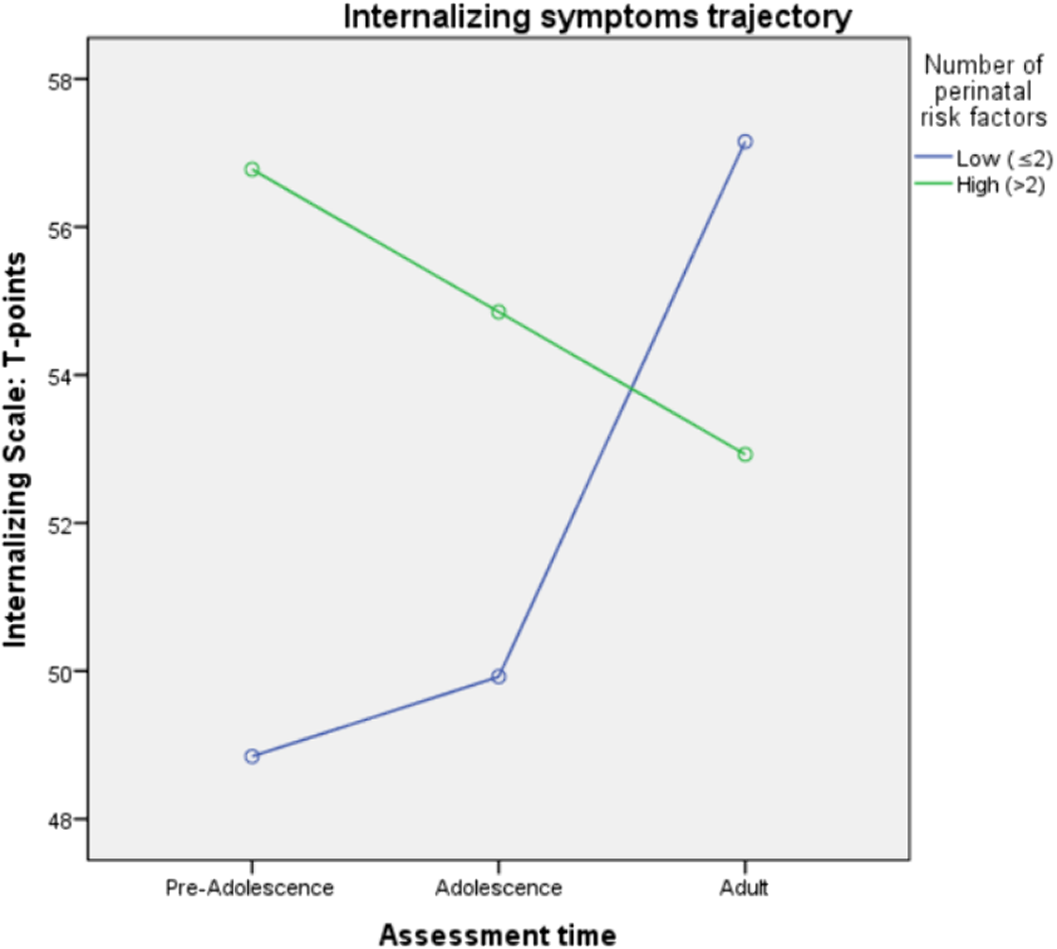
rm-MANOVA results show that high number of perinatal risks was significantly associated with higher internalizing symptomatology in preadolescence but not in adolescence and adult life. The mean difference was 8 T-points. The same trend is evident in adolescence but not in adult age (Graph 1). Perinatal risk factors did not have a significant effect on externalizing symptoms at any time point, despite a non-significant trend is evident (Graph 2).
Conclusions
Our preliminary results suggest a trend of increased internalizing symptoms from childhood to adulthood and a significant role of perinatal risk factors in pre-adolescence. Further investigations are necessary to better understand symptoms trajectories and the role of biological and environmental factors.