We partner with a secure submission system to handle manuscript submissions.
Please note:
You will need an account for the submission system, which is separate to your Cambridge Core account. For login and submission support, please visit the
submission and support pages.
Please review this journal's author instructions, particularly the
preparing your materials
page, before submitting your manuscript.
Click Proceed to submission system to continue to our partner's website.
To save this undefined to your undefined account, please select one or more formats and confirm that you agree to abide by our usage policies. If this is the first time you used this feature, you will be asked to authorise Cambridge Core to connect with your undefined account.
Find out more about saving content to .
To send this article to your Kindle, first ensure no-reply@cambridge.org is added to your Approved Personal Document E-mail List under your Personal Document Settings on the Manage Your Content and Devices page of your Amazon account. Then enter the ‘name’ part of your Kindle email address below. Find out more about sending to your Kindle.
Find out more about saving to your Kindle.
Note you can select to save to either the @free.kindle.com or @kindle.com variations. ‘@free.kindle.com’ emails are free but can only be saved to your device when it is connected to wi-fi. ‘@kindle.com’ emails can be delivered even when you are not connected to wi-fi, but note that service fees apply.
Delusion of pregnancy has been described as a false and fixed belief of being pregnant despite factual evidence to the contrary. Pseudocyesis is a condition in which the patient has all signs and symptoms of pregnancy except for the confirmation of the presence of a fetus. There has been described symptoms as abdominal distention, cessation of menses, morning sickness, etc.
Objectives
The aim of this work was to distinguish between pseudocyesis and pseudopregnancy. This case presents a single 49-year-old woman, who developed the delusion of being pregnant after months of lonely confinement during Covid-19 quarantine.
Methods
She had missed her period for 10 months. She was convinced that she could feel the fetal movements. Her thought content revealed delusion of persecution, reference, and delusion of being pregnant. She did not reveal any hallucinations. Blood tests and brain imaging revealed no abnormalities. □The treatment was started with Paliperidone 100mg/month, and clonazepam 2mg/d.
Results
The patient showed a substantial improvement within 10 weeks of treatment. Pseudocyesis and delusional pregnancy have been rarely described on scientific bibliography. A distinction has been demonstrated based on the consideration of the associated psychotic features that might be present in delusions of pregnancy, which were described in the current case. On the other hand, pseudocyesis clinical presentation is centered on the false signs and symptoms of pregnancy.
Conclusions
Antipsychotics played a key role in the delusion of pregnancy. Psychodynamic and supportive psychotherapy could play a pivotal role in the management of pseudocyesis.
The 2019 coronavirus epidemic (CoViD-19) in Italy originated in Lombardy, on February 21, 2020. The Fondazione IRCCS Policlinico San Matteo di Pavia has been involved in the management of the outbreak since its beginning
Objectives
We evaluated all the population who went to the ED for intossication and substance abuse to assess the severity of cases evaluated as exit code and rate of hospitalization.
Methods
We enrolled all patients accessing our ED for intossication and substance abuse form February 22 to May 1, 2020 and during the same period of the previous year.
Results
We enrolled 142 patients. 41 in the CoViD period and 101 in 2019. The vital parameters, and sex were overlapping. patients during the pandemic were younger (38 vs 46) The priority codes for the medical examination were not different. CoViD pandemic patients have higher codes (yellow and red) for the medical examination (66% vs 59%); discharge severity codes (red) more frequently than in the reference period (2.4% vs 0.9%) and more frequently need hospitalization (26.8% vs 16.8%).
Conclusions
The epidemic has led to a reduction of accesses for intossication and substance abuse. Patients had more frequent hospitalization needs and more severe exit codes. the data may be due to the fact that during the pandemic only the most serious patients access the E.D., but also to the fact that a pandemic has contributed to destabilizing this class of fragile patients.
People who use drugs (PWUD) are now at the intersection of two public health emergencies – the Covid-19 pandemic and the overdose crisis. They may be at heightened risk of overdose due to increased isolation, worsened mental health, and changes to the illicit drug supply. The province of British Columbia (BC) in Canada is anticipated to experience a record-breaking year of overdose deaths as over 1,500 people (32.9 deaths per 100,000) have died from overdose in 2020. In response, BC released new clinical guidelines in March to allow the prescribing of pharmaceutical alternatives aiming to reduce PWUD’s risk of overdose and contracting Covid-19.
Objectives
We examined the risk and protective factors for overdose during these dual crises. We explored how the Covid-19 pandemic has impacted the mental health and substance use of PWUD and their access to treatment and harm reduction services.
Methods
We are conducting a survey among patients with opioid use disorder at a major hospital in Vancouver, BC. It includes the following domains: sociodemographic characteristics; mental and physical health; substance use patterns; opioid overdose history; access to treatment, harm reduction services; impacts of Covid-19.
Results
We anticipate collecting data from 200 participants. Descriptive statistics and regression analysis will be conducted to describe the sample and determine the risk, protective factors for overdose.
Conclusions
We will gain a better understanding of overdose risk in PWUD who are now navigating the complex challenges created by the dual crises. This will in turn inform the establishment of evidence-based strategies to reduce their overdose risk.
Emotional intelligence (EI) is a fundamental requirement to maintaining social activity. Patients with psoriasis and atopic dermatitis have difficulties in emotional awareness.
Objectives
The objective of this study is to assess EI in patients with atopic dermatitis and psoriasis.
Methods
Patients with psoriasis n=67, atopic dermatitis n=59 and control group n=65 were included in cross-sectional study. EI and its main components (experiential: perceiving emotions and using emotions to facilitate thought; strategic: understanding emotions and managing emotions to promote personal growth and social relations) were assessed using The Mayer–Salovey–Caruso Emotional Intelligence Test 2.0. Statistical analyses were performed using One-Way ANOVA and One-Way ANOVA (Kruskal-Wallis test). The level of statistical significance was set at p<0.05.Data are presented as the Me (±SD).
Results
Our results show that there is statistically significant lower “strategic” component of EI for psoriasis Me=0.367 (±0.0455) and atopic dermatitis Me=0.369 (±0.0353) than for the control group Me= 0.381(±0.0361), (χ2 =7.15; p= 0.028). “Managing emotions to promote personal growth and social relations” is presented with statistically significant lower for psoriasis Me= 0,293 (±0.0374) and atopic dermatitis Me= 0.301 (±0.0351) than for the control group Me= 0.312 (±0.0272), (F=0.05; p=0.007). There is no statistically significant difference between other components of EI and the EI scores in three groups.
Conclusions
Patients with psoriasis and atopic dermatitis have emotional difficulties when it comes to making effective decisions.
Some attempts are being made to describe the mental health and well-being of the population in relation with the regional specifics in a particular area of the Russia, however, they are rare and local (limited to one region).
Objectives
The current study aims to identify sociocultural mediation of mental well-being based on its measures in Russia’s regions with different ethno-cultural composition of population.
Methods
The study involved 210 men and 403 women aged 14 to 76 years (M = 26.9; SD = 13.7) from six regions of the Russian Federation: Moscow, St. Petersburg, Udmurtia, Sakha, Sverdlovsk and Kemerovo. The mental well-being of participants was assessed using the Warwick-Edinburgh Mental Wellbeing Scale (Tennant et al., 2006; Tennant et al., 2007).
Results
The measures of mental well-being were different in the regions: Moscow (M=51.04; SD=8.03), St.-Petersburg (M=50.05; SD=5.78), Udmurtia (M=47.57; SD=9.50), Sakha (M=50.99; SD=8.47), Sverdlovsk (M=54.86; SD=8.43), Kemerovo (M=51.84; SD=7.51). Using one-way analysis of variance (ANOVA), it was found that there are significant differences in the assessment of psychological well-being between study participants from different regions (F = 6.692; p <0.001). Residents from the Sverdlovsk evaluate their mental well-being as significantly better than the ones from Moscow (MD=3.821; p=0.012), St.Petersburg (MD=4.812; p=0.023), the Udmurtia (MD=7.284; p <0.001) and the Sakha (MD=3.869; p=0.003).
Conclusions
Residents from Russia’s regions with different ethno-cultural composition of population demonstrate some difference in mental well-being measures that may be caused by sociocultural factors. The reported study was funded by the Russian Foundation for Basic Research, project number 17-29-02506.
Suicide is one of the most relevant cause of death especially in young populations. The Interpersonal Theory of Suicide (Joiner, 2005) is an important contribution tends to explain variability in suicidal behavior, particularly the difference between suicidal ideation and suicide attempt.
Objectives
This study aimed at the Italian validation of the Acquired Capability for Suicide Scale – Fearlessness About Death (ACSS-FAD), assessing fearlessness about death, one of the facets of the acquired capability (AC) to commit suicide as postulated by the Interpersonal Theory of Suicide by Thomas Joiner.
Methods
This cross-sectional research was conducted on a sample of university students (n = 458) assessed with a battery including ACSS-FAD. The sample was evaluated for the presence of suicidal ideation and suicide risk. Factor structure, internal consistency and convergent/divergent validity of the scale were assessed.
Results
One-factor structure with good internal consistency (Cronbach’s α: 0.84) was derived. ACSS-FAD correlated with suicidal ideation and suicidal risk, and there was a tendency towards significance considering its capacity to discriminate between those who had a history of suicide attempts and those who did not. 4.1% of the sample attempted suicide at least one time. The tool showed good convergent/discriminant validity results, but the relationship between ACSS-FAD and pain needs further investigations.
Conclusions
ACSS-FAD seems to be a useful and valid measure of fearlessness about death especially in young adults, which could be really important to enhance suicide risk assessment.
Fear of death is somehow a normal sensation. Though for those having a cancer, it could increase the burden of the disease and have negative psychological impacts. This death anxiety isn’t easily verbalized by patients, thus it’s important for caregivers to manage it to improve those patients’ quality of life.
Objectives
Assess death anxiety in cancer patients and to identify factors that may influence it
Methods
Our study was a cross-sectional descriptive study with an analytical focus on quantitative specifications. It targeted patients hospitalized at the oncology department or consultant at the day hospital of the regional hospital of Gabes, Tunisia. Participants completed a questionnaire including sociodemographic and clinical data, using HADS scale for anxious and depressive symptoms and DAS scale for death anxiety.
Results
One hundred and twenty patients were enrolled in the study. The average age of participants were 54, 9 ±11, 8 years. The majority of patients were married (68.3%) and had an average socioeconomic level (74, 2%). Our results showed that 43, 3% of patients had a high death anxiety score. Higher level of threat of death, were found in older patients(p=0.028), females (p=0.018) and for those having children (p=0,01). Death anxiety were also higher in patients having anxiety (p=0.007) and those having depression (p=0.033).
Conclusions
The degree of death anxiety among cancer patients seems important. Its assessment and resolution by the caregivers remains paramount. The identification of this death anxiety should optimize the overall care of the patient.
Health professionals face an increased risk of developing mental health difficulties due to work-related stress. It has been demonstrated that work engagement has a protective role on mental health from work-related stress. The majority of the research on the psychological impact of job stress among health professionals focused on the work-related stressors or the type of stressors as challenges or hindrances. However, the impact might depend on an individual’s appraisal of challenges and hindrances.
Objectives
- Examine the effects of job appraisals on mental health. - Establish the role of work engagement as a mediator between them.
Methods
An online survey was completed by 196 health professionals and included questionnaires about job appraisals, stressors (variety of tasks, responsibility and cooperation with colleagues), work engagement, anxiety and depression.
Results
Appraising stressors as challenges did not have any direct impact on mental health, whereas hindrance appraisals had a negative influence. Participants who appraised cooperation with colleagues as challenging reported lower levels of depression through higher work engagement (B = − 0.17, 95% CI [− 0.354, − 0.027]). Appraising variety of tasks as a hindrance predicted higher levels of depression through lower work engagement (B = 0.150, 95% CI [0.041, 0.289]). Participants appraising the other two stressors as hindrances were more anxious and depressed through lower work engagement.
Conclusions
The negative psychological impact of hindrance appraisals was persistent, whereas the positive impact of challenge appraisals through work engagement depended on the stressor. Stress interventions may need to consider both the type of appraisal and the type of stressor.
Inflammation is an important factor in the pathogenesis of endogenous psychosis. An inducer of inflammatory reactions can be endotoxin aggression of intestinal origin.
Objectives
To determine the level of inflammation markers and indicators of systemic endotoxinemia in blood of patients with endogenous psychosis in relation to assessment of the treatment effectiveness.
Methods
25 patients with endogenous psychosis (F20, F25) were examined before and after treatment. The control group consisted of 25 healthy people. The activity of inflammatory markers - leukocyte elastase, α1-antitrypsin, antibodies to S-100B, and indicators of systemic endotoxinemia – endotoxin concentration and antiendotoxin immunity activity were measured in blood serum. The treatment effectiveness was assessed by the dynamics of inflammatory markers.
Results
Based on the results of determining the studied parameters before treatment, all patients were divided into two groups. In the 1st group (6 patients, 24%), an increase of inflammatory markers activity and high concentration of endotoxin in the blood serum were revealed (p<0,001, p<0,05, respectively). In the 2nd group (19 patients, 76%), only activation of inflammatory reactions (p<0,001) was detected. After therapy in the 1st group of patients, there was no positive dynamics of all studied markers, which indicated an active course of the pathological process. In the 2nd group, the normalization of inflammatory markers was shown (p<0,05), which corresponded to the formation of remission.
Conclusions
The results indicate that endotoxic aggression contributes to reduction of the effectiveness of endogenous psychosis therapy and can be considered as an additional therapeutic target.
Delirium affects a significant proportion of hospitalized older patients with acute infections. There is growing evidence that delirium accelerates the cognitive decline at long term.
Objectives
We aimed to determine if delirium during hospitalization was independently associated with cognitive deterioration at one-year.
Methods
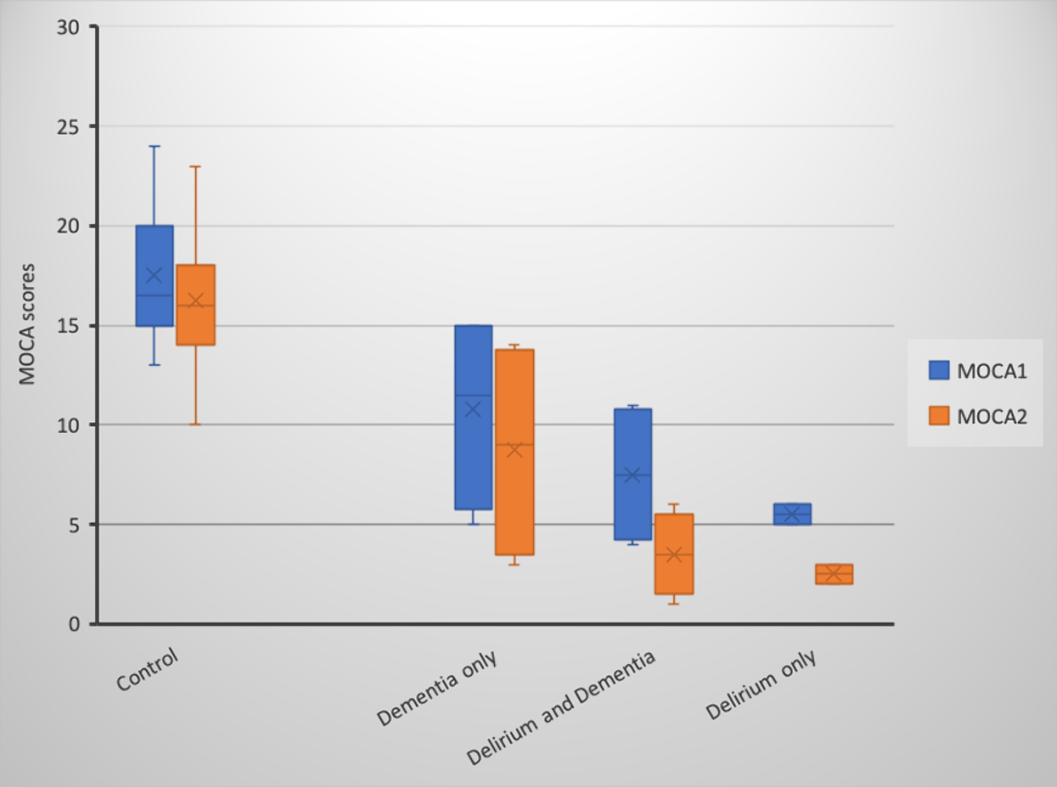
From a total of 22 patients (12 C, 4 Dem, 2 D, and 4 DD) delirium (D and DD groups) was associated with a worse score in MOCA of 3-points (p<.02) and 2.5-points (p<.03), respectively, at one year, follow up. Dementia patients without delirium had a decrease of 2-point (p=.04) while cognitively healthy patients had a decrease in 1.08 points (p=.05) (Graph1). MOCA and NPI scores during hospitalization correlated significantly with cognitive decline in the four groups (r=.658, p<.01 and r=.439, p=.02, respectively.)
Results
From a total of 22 patients (12 C, 4 Dem, 2 D and 4 DD) delirium (D and DD groups) was associated with a worse score in MOCA of 3-points (p<.02) and 2.5-points (p<.03), respectively, at one year follow up. Dementia patients without delirium had a of 2-point (p=.04) while cognitively healthy patients had a decrease in 1.08 points (p=.05) (Graph1). MOCA and NPI scores during hospitalization correlated significantly with cognitive decline in the four groups (r=.658, p<.01 and r=.439, p=.02, respectively.)
Conclusions
Individuals developing delirium while recovering from infection have higher rates of cognitive decline after one year, but the cognitive decline is also present to a lower extent for individuals with infections that did not develop delirium.
Autism spectrum disorder (ASD) is a multi-factorial disease characterized by impairments in social interaction, communication and repetitive behaviors. The necessity of developing an adequate treatment for ASD is essential. There is an increase in clinical studies assessing the positive effects of vitamins in ASD children. Vitamin C (vit. C) is implicated in biosynthesis of neurotransmitters and in protein metabolism.
Objectives
This study evaluated the possible effect of vit. C on zebrafish sociability after a single insecticide mixture administration as inductor for ASD.
Methods
A single dose of insecticide mixture (600 μg L-1 fipronil and 600 μg L-1 pyriproxyfen) was administrated to zebrafish juvenile. Vit. C (25 μg L−1) was daily administrated during 14 days. A control group simulated the administration of insecticide mixture and vitamin. Each animal was tested in the experimental tank designed for the social interaction test. The trials were recorded and analysed using EthoVision XT 11 (NOLDUS, Netherlands). The locomotor activity parameters and the time spent next to the group were measured. Each trial had 4 minutes duration.
Results
We have found no significant differences in the average levels between pre-treatment and treatment days (P< 0.05 ANOVA) regarding the locomotor activity parameters. Significant changes in sociability were observed for the group exposed to insecticide mixture and for vit. C group (P > 0.05 ANOVA). It was also found that 14 days vitamin administration can lead to sociability improvements after a single administration of mixture insecticide.
Conclusions
The results of the current study bring some positive insights for the future of ASD therapy.
Conflict of interest
This work was co-funded by the European Social Fund, through Operational Programme Human Capital 2014-2020, project number POCU/380/6/13/123623, project title
Attention deficit and hyperactivity disorder (ADHD) is a common neurodevelopmental disorder in children. Its primary clinical features include symptoms of inattention and hyperactivity/impulsivity, although young people often present with emotional dysregulation, excessive mind-wandering and executive dysfunction. Symptoms of ADHD often persist into adulthood together with high rates of comorbidity and significant psychosocial impairment across the lifespan. Berry, Shaywitz and Shaywitz proposed over 30 years ago that girls with ADHD form a ‘silent minority’ with greater internalized behavior which leads them to be under-identified. Even when referred for clinical assessment, their ADHD symptoms are missed or misdiagnosed for other conditions such as anxiety, depression and personality disorder. This means they will not receive the treatment they need. Compared with controls, they may be especially vulnerable to childhood adversities and health problems and they may cope with these difficulties with dysfunctional strategies (eg. with substance misuse and/or deliberate self-harming behaviours). If we are to enhance long-term outcomes in girls and women with ADHD, healthcare practitioners need to better understand the presentation of ADHD in females, improve detection and assessment of ADHD in order that they may access appropriate treatment. This workshop will focus on the differences in presentation and outcomes between males and females with ADHD.
Psychological work with cognitive beliefs were shown to be beneficial for patients with somatoform disorders and unexplained somatic complaints (Liu et al., 2019). There is still a question of whether these results are specific or common for different kind of interventions including psychoanalytic psychotherapy (Kaplan, 2014).
Objectives
The aim was to reveal dynamics of illness perception after group analysis psychotherapy comparing to psychoeducation in patients with somatoform disorders.
Methods
100 patients with somatoform disorders were randomized to psychoeducation intervention (48 patients; 15 males and 33 females) and to the group analysis psychotherapy (52 patients; 15 males and 37 females). Before and after treatment they filled Screening for somatoforms symptoms (Rief, Hiller, 2003) and Illness Perception Questionnaire - Revised (Moss-Morris et al., 2002).
Results
2 (Groups) × 2 (Time: Before / After) ANOVA with repeated measures revealed major effect of time with both groups demonstrated equal decrease in somatoform symptoms during treatment (F=101.42, p<.01, η²=.52). Patients from both groups after treatment appraised their illnesses as having shorter duration without cycles, less severe consequences on their lives, reported increase in treatment control, understanding of their illness and decrease in emotional reactions (F=7.13-30.62, p<.01, η²=.07-.24). In group analysis condition only patients demonstrated increased beliefs that psychological and risk factors could impact their illness (interaction: F=4.58-7.24, p<.05, η²=.05-.07).
Conclusions
Patients with somatoform disorders almost equally benefitted from both psychoeducation and group analysis but group analysis psychotherapy led to better awareness of psychological and risk factors of their illness.
Post-traumatic stress disorder affects emotional, social and professional functioning. It can also affect physical and sexual health.
Objectives
The aim of this study is to write down the prevalence of sexual dysfunction in men with PTSD and to economize on potential predictors of sexual dysfunction.
Methods
A total of 30 male patients with PTSD were included in this study. We collected socio-demographic and clinical data and we used Post-Traumatic Stress Disorder (PCLS) and International Erectile Function Index (IIEF15) scales.
Results
The mean PTSD severity score was 65.43 ± 2.95. The mean score for revitalization, avoidance, cognitive and mood alteration, and hypervigilance were 15.80 ± 1.44, respectively; 8 ± 0; 24.07 ± 1.20 and 17.57 ± 2.95. The mean IIEF-15 score was 51.16 ± 6.82. The mean sub-scores were 3.93 ± 0.52 for sexual desire; 18.80 ± 5.68 for erectile function; 8.93 ± 8.97 for orgasmic function; 5.13 ± 1.10 for satisfaction with intercourses and 4.13 ± 1.16 for overall satisfaction. The IIEF15-EF score was negatively correlated with the presence of a personal medical history (p = 0.02) and the impairment cognitions and mood score (p = 0.023). The IIEF-OF score was significantly associated with reviviscence, hypervigilance, cognition and mood alterations (p = 0.015; 0.041; 0.045). The IIEF-15 SD score was negatively correlated with altered cognition and mood (p = 0.007).
Conclusions
Our study focused on the importance of assessing sexual function in men followed for PTSD and helps to understand the association of PTSD with different types of sexual dysfunction.
Due to its mood-stabilizing properties, clozapine is known for reducing symptom severity in manic episodes of treatment-resistant bipolar disorder as well as in treatment-resistant schizophrenia. However, its use may be hindered by potential adverse effects, including hematologic ones, such as non-dose-dependent eosinophilia. The mechanism of the underlying process probably involves a type-I hypersensitivity reaction, which can manifest as either transient asymptomatic eosinophilia or as eosinophilia with multiorgan dysfunction.
Objectives
We present the case of a patient diagnosed with manic episode of schizoaffective disorder who developed eosinophilia, with severe systemic manifestations, in response to clozapine therapy. A review of literature will be conducted in order to provide further insight into the phenomenon.
Methods
Case report and literature review.
Results
The incidence of eosinophilia reported in literature ranges between 0.2% and 62%, with its appearance about three weeks after clozapine initiation. Although clozapine is an antipsychotic that normally requires frequent monitoring due to the potential side effect of agranulocytosis, we would like to place emphasis on the possible risk of eosinophilia, in connection with potential fatal complications. As described in this report, eosinophilia could long remain unrecognized due to subsequent multiorgan involvement, including lymphadenopathy, leukocytosis, lymphopenia, anemia, liver enzyme elevations, as well as pleural effusion, all of which were described in our patient.
Conclusions
Clozapine-associated eosinophilia may be used as an early marker of possible clozapine-induced systemic complications and it may warrant prompt discontinuation of the causing drug, as suggested by the literature.
The recurrence of bipolar disorder due to poor treatment adherence can be explained by different factors.The poor awareness of the disorder seems to be the major cause.
Objectives
To evaluate insight in patients followed for euthymic bipolar disorders and determine the factors correlated with it,mainly the self-esteem.
Methods
A cross-sectional descriptive and analytical study of 33 euthymic subjects with bipolar I and II disorders (DSM 5) and followed up at the psychiatric consultation in Hédi Chaker university Hospital of Sfax.Data collection was performed using a sheet exploring socio-demographic and clinical data. We used Birchwood insight scale to assess the quality of insight and Rosenberg’s Self-Esteem scale.
Results
The average age of our patients was 44,52±12,99 years old.The sex ratio =0.32.Patients were followed for bipolar I disorder(60.6%).The first episode of the disease was depressive in(51.5%) of cases.The average number of depressive episodes was1.97±1.87.The last episode was depressive in(57.6%) or manic in(42.4%).There were no psychotic characteristics in(42.4%) of cases.The patients had good insight in(54.5%).The average of self-esteem score was27±7.85and it was low in 51.5% of cases.Factors correlated with good insight were bipolar II disorder(p=0.001), high number of depressive episodes(p=0.013) and absence of psychotic characteristics(p=0.003) during the last episode.In addition,good insight was significantly associated with low self-esteem(p=0.023).
Conclusions
Our study shows that a poor insight depends mainly on the clinical characteristics of bipolar disorders. Moreover,low self-esteem seems to be linked to it. For this reason, our attention should be focused on psychoeducation to improve insight, especially during episodes, in order to facilitate integration and increase patients’ self-esteem.
Fear associated to infectious diseases is directly related with their transmission rate, morbidity and mortality. High levels of fear associated with COVID-19 can affect people’s ability to act and think rationally. In a time of pandemics, it is essential to understand individual factors that might be associated to higher vulnerability to stress and fear.
Objectives
To analyse: a)correlations between Fear of Covid-19 and clinical and sociodemographic characteristics; b)the mediator role of repetitive negative thinking on the relationship between personality traits and Fear of Covid-19.
Methods
234 adults (75.6% women; mean age=29.53±12.51) completed an on-line survey with the Portuguese version of the Fear of Covid-19 Scale (FCV-19S) and other questionnaires to evaluate clinical and sociodemographic characteristics (years of education, perceived physical and mental health and infection by Covid-19), Personality (NEO-FFI-20) and Repetitive negative thinking (PTQ-15). SPSS and Process Macro (Hays, 2020) were used.
Results
FCV-19 mean scores were significantly higher in women and significantly correlated with years of education (r=-.14) (p<.05). History of previous/current Covid-19 infection did not significantly distinguish FCV-19 scores and they did not correlate with perceived health. FCV-19 correlated significantly with neuroticism and PTQ total and dimensional scores (r>.20, p<.01). Both Repetitive thinking and Cognitive interference were mediators of the relationship between neuroticism and fear of COVID, even after controlling for gender and education.
Conclusions
This study provides preliminary evidence on individual factors that might be associated to the emotional response to the Covid-19 pandemics, aiming to facilitate public health initiatives to ease people’s fears in a near future.
Many people think that people with mental disorders might be dangerous or unpredictable. These patients face various sources of disadvantages and experience discrimination in job interviews, in education, and housing. Mental health-related stigma occurs not only within the public community, it is a growing issue among professionals as well. Our study is the first that investigates the stigmatising attitude of psychiatrists across Europe.
Objectives
We designed a cross-sectional, observational, multi-centre, international study of 33 European countries to investigate the attitude towards patients among medical specialists and trainees in the field of general adult and child and adolescent psychiatry.
Methods
An internet-based, anonymous survey will measure the stigmatising attitude by using the local version of the Opening Minds Stigma Scale for Health Care Providers. Data gathering started in July this year and will continue until December 2020.
Results
This study will be the first to describe the stigmatising attitude of psychiatric practitioners across Europe from their perspectives.
Conclusions
The study will contribute to knowledge of gaps in stigmatising attitude towards people with mental health problems and will provide with new directions in anti-stigma interventions.
Challenging behavior is a common reason for referral to psychiatric service. Psychotropic medications widely used to modify behaviors, even when no evidence of diagnosable mental illness. However, literature show little evidence that benefits outweigh the risks in their prescription. Monitoring using International guidelines may help improving the outcomes. We audit current practice against known standards.
Objectives
- To assess adherence within the Qatar Mental Health Services to National guidelines on using medication to manage behavior problems in adults with a learning disability. - To identify strengths and weaknesses in current practice. - To Make recommendations to improve LD patient care
Methods
Patients with LD attending psychiatric clinic screened using selection and exclusion criteria and data collected and analyzed using format from the International standards.
Results
102 patients screened, 85 selected and 17 cases excluded Age range 18 to 50 years. 27% mild, 29% moderate and 44% severe LD, Autism 40% Psychiatric Diagnosis 55% Challenging behavior 45% Antipsychotic prescribing: 79% Rationale documented in 74%, Capacity assessment in 81%, Review of side effects in 53% Safety of medication in 61%, Medication discontinuation in 66%, Reasons for discontinuation in 36%
Conclusions
Antipsychotics use (79%) is high with several combinations of IM and oral or more than 2 drugs. There is need for improvement across all standards. Rationalising the prescribing for LD patients to improve the outcomes for the safety of these patients. The audit indicate need for specialist service to monitor prescribing and apply standards of care in clinical service.
Starting in December 2019, the coronavirus SARS-CoV-2 emerged and soon acquired a pandemic dimension. The evidence that 1 in 3 patients presented neuropsychiatric symptoms highlighted SARS-CoV-2 neurotropic properties. The involvement of the Central Nervous System (CNS) seems to be associated with poor prognosis, and it can occur independently of the respiratory system.
Objectives
To assess neuropsychiatric symptoms in SARS-CoV-2 patients and possible mechanisms of CNS invasion; to reflect on what changes should be made in order to avoid short and long-term complications.
Methods
A non-systematic literature review was performed, including publications between January and August 2020.
Results
The most frequent CNS presentations included fatigue (38-75%), headache (6,5-34%), nausea or vomiting (1-13,7%). Regarding PNS involvement, three kinds of hypoesthesia (hyposmia, hypogeusia, and hypopsia) were commonly present. Additionally, cases of neurological syndromes associated with SARS-CoV2 were reported, being related to a poor prognosis in cases such as brainstem infiltration. Another major concern regarding CNS involvement is the possibility of permanent neurological disabilities. Importantly there are reports of patients who tested positive for SARS-CoV-2 in CFS, without samples from nasopharyngeal swabs. Different hypothesis are postulated to explain possible mechanisms through which SARS-CoV-2 affects CNS, including: direct invasion through the olfactory nerve, hematogenous route through ACE-2 (angiotensin-converting enzyme) receptor expressed in blood-brain-barrier; or indirect mechanisms.
Conclusions
Here we discuss the neuropsychiatric manifestations of SARS-CoV-2 infection and the potential mechanisms by which they occur at an early stage. Awareness, prevention and early treatment of potential neuropsychiatric symptoms of COVID-19 should not be overlooked, especially because they seem to predict a worse prognosis.