Contents
Number Theory
Deformation theory for prismatic G-displays
- Part of:
-
- Published online by Cambridge University Press:
- 21 March 2025, e61
-
- Article
-
- You have access
- Open access
- HTML
- Export citation
-
For a smooth affine group scheme G over the ring of p-adic integers and a cocharacter
 $\mu $ of G, we develop the deformation theory for G-
 $\mu $-displays over the prismatic site of Bhatt–Scholze, and discuss how our deformation theory can be interpreted in terms of prismatic F-gauges introduced by Drinfeld and Bhatt–Lurie. As an application, we prove the local representability and the formal smoothness of integral local Shimura varieties with hyperspecial level structure. We also revisit and extend some classification results of p-divisible groups.


Algebraic and Complex Geometry
Peterson-Lam-Shimozono’s theorem is an affine analogue of quantum Chevalley formula
- Part of:
-
- Published online by Cambridge University Press:
- 24 March 2025, e62
-
- Article
-
- You have access
- Open access
- HTML
- Export citation
-
We give a new proof of an unpublished result of Dale Peterson, proved by Lam and Shimozono, which identifies explicitly the structure constants, with respect to the quantum Schubert basis, for the T-equivariant quantum cohomology
 $QH^{\bullet }_T(G/P)$ of any flag variety
 $G/P$ with the structure constants, with respect to the affine Schubert basis, for the T-equivariant Pontryagin homology
 $H^T_{\bullet }(\mathcal {G}r)$ of the affine Grassmannian
 $\mathcal {G}r$ of G, where G is any simple simply-connected complex algebraic group.
Our approach is to construct an
 $H_T^{\bullet }(pt)$-algebra homomorphism by Gromov-Witten theory and show that it is equal to Peterson’s map. More precisely, the map is defined via Savelyev’s generalized Seidel representations, which can be interpreted as certain Gromov-Witten invariants with input
 $H^T_{\bullet }(\mathcal {G}r)\otimes QH_T^{\bullet }(G/P)$. We determine these invariants completely, in a way similar to how Fulton and Woodward did in their proof of the quantum Chevalley formula.


Algebra
Koszul homomorphisms and universal resolutions in local algebra
- Part of:
-
- Published online by Cambridge University Press:
- 28 March 2025, e63
-
- Article
-
- You have access
- Open access
- HTML
- Export citation
-
We define a local homomorphism
 $(Q,k)\to (R,\ell )$ to be Koszul if its derived fiber
 $R\otimes ^{\mathsf {L}}_Q k$ is formal, and if
 $\operatorname {Tor}^{Q}(R,k)$ is Koszul in the classical sense. This recovers the classical definition when Q is a field, and more generally includes all flat deformations of Koszul algebras. The non-flat case is significantly more interesting, and there is no need for examples to be quadratic: all complete intersection and all Golod quotients are Koszul homomorphisms. We show that the class of Koszul homomorphisms enjoys excellent homological properties, and we give many more examples, especially various monomial and Gorenstein examples. We then study Koszul homomorphisms from the perspective of
 $\mathrm {A}_{\infty }$-structures on resolutions. We use this machinery to construct universal free resolutions of R-modules by generalizing a classical construction of Priddy. The resulting (infinite) free resolution of an R-module M is often minimal and can be described by a finite amount of data whenever M and R have finite projective dimension over Q. Our construction simultaneously recovers the resolutions of Shamash and Eisenbud over a complete intersection ring, and the bar resolutions of Iyengar and Burke over a Golod ring, and produces analogous resolutions for various other classes of local rings.


Foundations
Tree-like graphings, wallings, and median graphings of equivalence relations
- Part of:
-
- Published online by Cambridge University Press:
- 26 March 2025, e64
-
- Article
-
- You have access
- Open access
- HTML
- Export citation
Analysis
On the extension of positive maps to Haagerup noncommutative
 $L^p$-spaces
- Part of:
-
- Published online by Cambridge University Press:
- 28 March 2025, e65
-
- Article
-
- You have access
- Open access
- HTML
- Export citation
-
Let M be a von Neumann algebra, let
 $\varphi $ be a normal faithful state on M and let
 $L^p(M,\varphi )$ be the associated Haagerup noncommutative
 $L^p$-spaces, for
 $1\leq p\leq \infty $. Let
 $D\in L^1(M,\varphi )$ be the density of
 $\varphi $. Given a positive map
 $T\colon M\to M$ such that
 $\varphi \circ T\leq C_1\varphi $ for some
 $C_1\geq 0$, we study the boundedness of the
 $L^p$-extension
 $T_{p,\theta }\colon D^{\frac {1-\theta }{p}} MD^{\frac {\theta }{p}}\to L^p(M,\varphi )$ which maps
 $D^{\frac {1-\theta }{p}} x D^{\frac {\theta }{p}}$ to
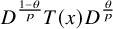 $D^{\frac {1-\theta }{p}} T(x) D^{\frac {\theta }{p}}$ for all
 $x\in M$. Haagerup–Junge–Xu showed that
 $T_{p,{\frac {1}{2}}}$ is always bounded and left open the question whether
 $T_{p,\theta }$ is bounded for
 $\theta \not ={\frac {1}{2}}$. We show that for any
 $1\leq p<2$ and any
 $\theta \in [0, 2^{-1}(1-\sqrt {p-1})]\cup [2^{-1}(1+\sqrt {p-1}), 1]$, there exists a completely positive T such that
 $T_{p,\theta }$ is unbounded. We also show that if T is
 $2$-positive, then
 $T_{p,\theta }$ is bounded provided that
 $p\geq 2$ or
 $1\leq p<2$ and
 $\theta \in [1-p/2,p/2]$.


Corrigendum
Vines and MAT-labeled graphs – CORRIGENDUM
-
- Published online by Cambridge University Press:
- 31 March 2025, e66
-
- Article
-
- You have access
- Open access
- HTML
- Export citation
Bounding geometrically integral del Pezzo surfaces – CORRIGENDUM
-
- Published online by Cambridge University Press:
- 31 March 2025, e67
-
- Article
-
- You have access
- Open access
- HTML
- Export citation
Differential Equations
Invariant divisors and equivariant line bundles
- Part of:
-
- Published online by Cambridge University Press:
- 03 April 2025, e68
-
- Article
-
- You have access
- Open access
- HTML
- Export citation
-
Scalar relative invariants play an important role in the theory of group actions on a manifold as their zero sets are invariant hypersurfaces. Relative invariants are central in many applications, where they often are treated locally since an invariant hypersurface may not be a locus of a single function. Our aim is to establish a global theory of relative invariants.
For a Lie algebra
 ${\mathfrak g}$ of holomorphic vector fields on a complex manifold M, any holomorphic
 ${\mathfrak g}$-invariant hypersurface is given in terms of a
 ${\mathfrak g}$-invariant divisor. This generalizes the classical notion of scalar relative
 ${\mathfrak g}$-invariant. Any
 ${\mathfrak g}$-invariant divisor gives rise to a
 ${\mathfrak g}$-equivariant line bundle, and a large part of this paper is therefore devoted to the investigation of the group
 $\mathrm {Pic}_{\mathfrak g}(M)$ of
 ${\mathfrak g}$-equivariant line bundles. We give a cohomological description of
 $\mathrm {Pic}_{\mathfrak g}(M)$ in terms of a double complex interpolating the Chevalley-Eilenberg complex for
 ${\mathfrak g}$ with the Čech complex of the sheaf of holomorphic functions on M.
We also obtain results about polynomial divisors on affine bundles and jet bundles. This has applications to the theory of differential invariants. Those were actively studied in relation to invariant differential equations, but the description of multipliers (or weights) of relative differential invariants was an open problem. We derive a characterization of them with our general theory. Examples, including projective geometry of curves and second-order ODEs, not only illustrate the developed machinery but also give another approach and rigorously justify some classical computations. At the end, we briefly discuss generalizations of this theory.


Number Theory
Canonical integral models for Shimura varieties of abelian type
- Part of:
-
- Published online by Cambridge University Press:
- 07 April 2025, e69
-
- Article
-
- You have access
- Open access
- HTML
- Export citation
-
We prove a conjecture of Pappas and Rapoport for all Shimura varieties of abelian type with parahoric level structure when
 $p>2$ by showing that the Kisin–Pappas–Zhou integral models of Shimura varieties of abelian type are canonical. In particular, this shows that these models are independent of the choices made during their construction, and that they satisfy functoriality with respect to morphisms of Shimura data.

Probability
Length spectrum of large genus random metric maps
- Part of:
-
- Published online by Cambridge University Press:
- 10 April 2025, e70
-
- Article
-
- You have access
- Open access
- HTML
- Export citation
Mathematical Physics
Enhanced superconductivity at a corner for the linear BCS equation
- Part of:
-
- Published online by Cambridge University Press:
- 14 April 2025, e71
-
- Article
-
- You have access
- Open access
- HTML
- Export citation
-
We consider the critical temperature for superconductivity, defined via the linear BCS equation. We prove that at weak coupling the critical temperature for a sample confined to a quadrant in two dimensions is strictly larger than the one for a half-space, which in turn is strictly larger than the one for
 $\mathbb {R}^2$. Furthermore, we prove that the relative difference of the critical temperatures vanishes in the weak coupling limit.

A mirror theorem for Gromov-Witten theory without convexity
- Part of:
-
- Published online by Cambridge University Press:
- 14 April 2025, e72
-
- Article
-
- You have access
- Open access
- HTML
- Export citation
Algebra
Quasi-polynomial representations of double affine Hecke algebras
- Part of:
-
- Published online by Cambridge University Press:
- 16 April 2025, e73
-
- Article
-
- You have access
- Open access
- HTML
- Export citation
-
We introduce an explicit family of representations of the double affine Hecke algebra
 $\mathbb {H}$ acting on spaces of quasi-polynomials, defined in terms of truncated Demazure-Lusztig type operators. We show that these quasi-polynomial representations provide concrete realisations of a natural family of cyclic Y-parabolically induced
 $\mathbb {H}$-representations. We recover Cherednik’s well-known polynomial representation as a special case.
The quasi-polynomial representation gives rise to a family of commuting operators acting on spaces of quasi-polynomials. These generalize the Cherednik operators, which are fundamental in the study of Macdonald polynomials. We provide a detailed study of their joint eigenfunctions, which may be regarded as quasi-polynomial, multi-parametric generalisations of nonsymmetric Macdonald polynomials. We also introduce generalizations of symmetric Macdonald polynomials, which are invariant under a multi-parametric generalization of the standard Weyl group action.
We connect our results to the representation theory of metaplectic covers of reductive groups over non-archimedean local fields. We introduce root system generalizations of the metaplectic polynomials from our previous work by taking a suitable restriction and reparametrization of the quasi-polynomial generalizations of Macdonald polynomials. We show that metaplectic Iwahori-Whittaker functions can be recovered by taking the Whittaker limit of these metaplectic polynomials.


A categorical action of the shifted
 $0$-affine algebra
- Part of:
-
- Published online by Cambridge University Press:
- 15 April 2025, e74
-
- Article
-
- You have access
- Open access
- HTML
- Export citation
-
We introduce a new algebra
 $\mathcal {U}=\dot {\mathrm {\mathbf{U}}}_{0,N}(L\mathfrak {sl}_n)$ called the shifted
 $0$-affine algebra, which emerges naturally from studying coherent sheaves on n-step partial flag varieties through natural correspondences. This algebra
 $\mathcal {U}$ has a similar presentation to the shifted quantum affine algebra defined by Finkelberg-Tsymbaliuk. Then, we construct a categorical
 $\mathcal {U}$-action on a certain 2-category arising from derived categories of coherent sheaves on n-step partial flag varieties. As an application, we construct a categorical action of the affine
 $0$-Hecke algebra on the bounded derived category of coherent sheaves on the full flag variety.


Algebraic and Complex Geometry
Topological Noetherianity of the infinite half-spin representations
- Part of:
-
- Published online by Cambridge University Press:
- 21 April 2025, e75
-
- Article
-
- You have access
- Open access
- HTML
- Export citation
Mathematical Physics
Open WDVV equations and Frobenius structures for toric Calabi-Yau 3-folds
- Part of:
-
- Published online by Cambridge University Press:
- 21 April 2025, e76
-
- Article
-
- You have access
- Open access
- HTML
- Export citation
-
Let X be a toric Calabi-Yau 3-fold and let
 $L\subset X$ be an Aganagic-Vafa outer brane. We prove two versions of open WDVV equations for the open Gromov-Witten theory of
 $(X,L)$. The first version of the open WDVV equation leads to the construction of a semi-simple (formal) Frobenius manifold, and the second version leads to the construction of a flat (formal) F-manifold.


Algebraic and Complex Geometry
Global F-regularity for weak del Pezzo surfaces
- Part of:
-
- Published online by Cambridge University Press:
- 22 April 2025, e77
-
- Article
-
- You have access
- Open access
- HTML
- Export citation
-
Let k be an algebraically closed field of characteristic
 $p>0$. Let X be a normal projective surface over k with canonical singularities whose anticanonical divisor is nef and big. We prove that X is globally F-regular except for the following cases: (1)
 $K_X^2=4$ and
 $p=2$, (2)
 $K_X^2=3$ and
 $p \in \{2, 3\}$, (3)
 $K_X^2=2$ and
 $p \in \{2, 3\}$, (4)
 $K_X^2=1$ and
 $p \in \{2, 3, 5\}$. For each degree
 $K_X^2$, the assumption of p is optimal.


Discrete Mathematics
Generalized Ramsey–Turán density for cliques
- Part of:
-
- Published online by Cambridge University Press:
- 22 April 2025, e78
-
- Article
-
- You have access
- Open access
- HTML
- Export citation
-
We study the generalized Ramsey–Turán function
 $\mathrm {RT}(n,K_s,K_t,o(n))$, which is the maximum possible number of copies of
 $K_s$ in an n-vertex
 $K_t$-free graph with independence number
 $o(n)$. The case when
 $s=2$ was settled by Erdős, Sós, Bollobás, Hajnal, and Szemerédi in the 1980s. We combinatorially resolve the general case for all
 $s\ge 3$, showing that the (asymptotic) extremal graphs for this problem have simple (bounded) structures. In particular, it implies that the extremal structures follow a periodic pattern when t is much larger than s. Our results disprove a conjecture of Balogh, Liu, and Sharifzadeh and show that a relaxed version does hold.


Cycle Partitions in Dense Regular Digraphs and Oriented Graphs
- Part of:
-
- Published online by Cambridge University Press:
- 28 April 2025, e79
-
- Article
-
- You have access
- Open access
- HTML
- Export citation
-
A conjecture of Jackson from 1981 states that every d-regular oriented graph on n vertices with
 $n\leq 4d+1$ is Hamiltonian. We prove this conjecture for sufficiently large n. In fact we prove a more general result that for all
 $\alpha>0$, there exists
 $n_0=n_0(\alpha )$ such that every d-regular digraph on
 $n\geq n_0$ vertices with
 $d \ge \alpha n $ can be covered by at most
 $n/(d+1)$ vertex-disjoint cycles, and moreover that if G is an oriented graph, then at most
 $n/(2d+1)$ cycles suffice.


Algebraic and Complex Geometry
On the irreducibility of Hessian loci of cubic hypersurfaces
- Part of:
-
- Published online by Cambridge University Press:
- 28 April 2025, e80
-
- Article
-
- You have access
- Open access
- HTML
- Export citation
-
We study the problem of the irreducibility of the Hessian variety
 ${\mathcal {H}}_f$ associated with a smooth cubic hypersurface
 $V(f)\subset {\mathbb {P}}^n$. We prove that when
 $n\leq 5$,
 ${\mathcal {H}}_f$ is normal and irreducible if and only if f is not of Thom-Sebastiani type (i.e., if one cannot separate its variables by changing coordinates). This also generalizes a result of Beniamino Segre dealing with the case of cubic surfaces. The geometric approach is based on the study of the singular locus of the Hessian variety and on infinitesimal computations arising from a particular description of these singularities.


