Contents
Research Article
CHARACTERIZATIONS OF STRICTLY SINGULAR AND STRICTLY COSINGULAR OPERATORS BY PERTURBATION CLASSES
-
- Published online by Cambridge University Press:
- 02 August 2011, pp. 87-96
-
- Article
-
- You have access
- Export citation
-
We consider a class of operators that contains the strictly singular operators


DERIVED SUBGROUPS OF FIXED POINTS IN PROFINITE GROUPS
-
- Published online by Cambridge University Press:
- 02 August 2011, pp. 97-105
-
- Article
-
- You have access
- Export citation
PARA-BLASCHKE ISOPARAMETRIC HYPERSURFACES IN A UNIT SPHERE Sn + 1(1)*
-
- Published online by Cambridge University Press:
- 30 March 2012, pp. 579-597
-
- Article
-
- You have access
- Export citation
FACTORIZATION NUMBERS OF SOME FINITE GROUPS
-
- Published online by Cambridge University Press:
- 12 December 2011, pp. 345-354
-
- Article
-
- You have access
- Export citation
SIGN CHANGES OF FOURIER COEFFICIENTS OF ENTIRE MODULAR INTEGRALS
-
- Published online by Cambridge University Press:
- 29 March 2012, pp. 355-358
-
- Article
-
- You have access
- Export citation
-
Let f be a non-zero cusp form with real Fourier coefficients a(n) (n ≥ 1) of positive real weight k and a unitary multiplier system v on a subgroup Γ ⊂ SL2(ℝ) that is finitely generated and of Fuchsian type of the first kind. Then, it is known that the sequence (a(n))(n ≥ 1) has infinitely many sign changes. In this short note, we generalise the above result to the case of entire modular integrals of non-positive integral weight k on the group Γ0*(N) (N ∈ ℕ) generated by the Hecke congruence subgroup Γ0(N) and the Fricke involution
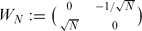 provided that the associated period functions are polynomials.
 provided that the associated period functions are polynomials.
KERNELS OF REPRESENTATIONS AND COIDEAL SUBALGEBRAS OF HOPF ALGEBRAS
-
- Published online by Cambridge University Press:
- 02 August 2011, pp. 107-119
-
- Article
-
- You have access
- Export citation
ON KELLOGG'S THEOREM FOR QUASICONFORMAL MAPPINGS
-
- Published online by Cambridge University Press:
- 30 March 2012, pp. 599-603
-
- Article
-
- You have access
- Export citation
NOTE ON q-DEDEKIND-TYPE SUMS RELATED TO q-EULER POLYNOMIALS
-
- Published online by Cambridge University Press:
- 09 December 2011, pp. 121-125
-
- Article
-
- You have access
- Export citation
ON STABLE QUADRATIC POLYNOMIALS
-
- Published online by Cambridge University Press:
- 29 March 2012, pp. 359-369
-
- Article
-
- You have access
- Export citation
RINGS WHOSE CYCLIC MODULES ARE DIRECT SUMS OF EXTENDING MODULES
-
- Published online by Cambridge University Press:
- 30 March 2012, pp. 605-617
-
- Article
-
- You have access
- Export citation
ON THE SPECTRA OF PISOT NUMBERS
-
- Published online by Cambridge University Press:
- 09 December 2011, pp. 127-132
-
- Article
-
- You have access
- Export citation
-
Let θ be a real number greater than 1, and let (()) be the fractional part function. Then, θ is said to be a Z-number if there is a non-zero real number λ such that ((λθn)) <

 . Also, the following characterisation of Pisot numbers among real numbers greater than 1 is shown: θ is a Pisot number ⇔ ∃ λ ≠ 0 such that
 for all
 an ∈ {0,1}, N ∈ ℕ}, where ‖λα‖ = min{((λα)), 1 − ((λα))}.

 . Also, the following characterisation of Pisot numbers among real numbers greater than 1 is shown: θ is a Pisot number ⇔ ∃ λ ≠ 0 such that
 for all
 a
THE HOMOTOPY TYPE OF THE SPACE OF GRADIENT VECTOR FIELDS ON THE TWO-DIMENSIONAL DISC
-
- Published online by Cambridge University Press:
- 30 March 2012, pp. 619-626
-
- Article
-
- You have access
- Export citation
EXTENSION OF AUTOMORPHISMS OF SUBGROUPS
-
- Published online by Cambridge University Press:
- 29 March 2012, pp. 371-380
-
- Article
-
- You have access
- Export citation
ON THE DISTRIBUTION OF
 -FREE NUMBERS AND NON-VANISHING FOURIER COEFFICIENTS OF CUSP FORMS
-
- Published online by Cambridge University Press:
- 29 March 2012, pp. 381-397
-
- Article
-
- You have access
- Export citation
-
We study properties of

 -FREE NUMBERS AND NON-VANISHING FOURIER COEFFICIENTS OF CUSP FORMS

EXPLICIT REPRESENTATIONS OF THE INTEGRAL CONTAINING THE ERROR TERM IN THE DIVISOR PROBLEM II
-
- Published online by Cambridge University Press:
- 09 December 2011, pp. 133-147
-
- Article
-
- You have access
- Export citation
-
In our previous paper [2], we derived an explicit representation of the integral ∫1∞t−θΔ(t)logjtdt by differentiation under the integral sign. Here, j is a fixed natural number, θ is a complex number with 1 <


ANOTHER LAW FOR 3-METABELIAN GROUPS
-
- Published online by Cambridge University Press:
- 30 March 2012, pp. 627-628
-
- Article
-
- You have access
- Export citation
THE DIVISIBILITY OF THE CLASS NUMBER OF THE IMAGINARY QUADRATIC FIELD

-
- Published online by Cambridge University Press:
- 09 December 2011, pp. 149-154
-
- Article
-
- You have access
- Export citation
-
Let hK denote the class number of the imaginary quadratic field
, where m and n are positive integers, k is an odd integer with k > 1 and 22m < kn. In this paper we prove that if either 3 ∣ n and 22m − kn ≡ 5(mod 8) or n = 3 and k = (22m+2 −1)/3, then 

ORBITS OF SEMIGROUPS OF TRUNCATED CONVOLUTION OPERATORS
-
- Published online by Cambridge University Press:
- 29 March 2012, pp. 399-414
-
- Article
-
- You have access
- Export citation
ON THE GEOMETRY OF ORBIT CLOSURES FOR REPRESENTATION-INFINITE ALGEBRAS
-
- Published online by Cambridge University Press:
- 30 March 2012, pp. 629-636
-
- Article
-
- You have access
- Export citation
A NEW QUANTITY IN RIEMANN-FINSLER GEOMETRY*
-
- Published online by Cambridge University Press:
- 30 March 2012, pp. 637-645
-
- Article
-
- You have access
- Export citation