We partner with a secure submission system to handle manuscript submissions.
Please note:
You will need an account for the submission system, which is separate to your Cambridge Core account. For login and submission support, please visit the
submission and support pages.
Please review this journal's author instructions, particularly the
preparing your materials
page, before submitting your manuscript.
Click Proceed to submission system to continue to our partner's website.
To save this undefined to your undefined account, please select one or more formats and confirm that you agree to abide by our usage policies. If this is the first time you used this feature, you will be asked to authorise Cambridge Core to connect with your undefined account.
Find out more about saving content to .
To send this article to your Kindle, first ensure no-reply@cambridge.org is added to your Approved Personal Document E-mail List under your Personal Document Settings on the Manage Your Content and Devices page of your Amazon account. Then enter the ‘name’ part of your Kindle email address below. Find out more about sending to your Kindle.
Find out more about saving to your Kindle.
Note you can select to save to either the @free.kindle.com or @kindle.com variations. ‘@free.kindle.com’ emails are free but can only be saved to your device when it is connected to wi-fi. ‘@kindle.com’ emails can be delivered even when you are not connected to wi-fi, but note that service fees apply.
This note gives the rate for a Wasserstein distance between the distribution of a Bernoulli process on discrete time and that of a Poisson process, using Stein's method and Palm theory. The result here highlights the possibility that the logarithmic factor involved in the upper bounds established by Barbour and Brown (1992) and Barbour et al. (1995) may be superfluous in the true Wasserstein distance between the distributions of a point process and a Poisson process.
In this paper we study a Volterra integral equation of the second kind, including two arbitrary continuous functions, in order to determine first-passage-time probability density functions through time-dependent boundaries for time-non-homogeneous one-dimensional diffusion processes with natural boundaries. These results generalize those which were obtained for time-homogeneous diffusion processes by Giorno et al. [3], and for some particular classes of time-non-homogeneous diffusion processes by Gutiérrez et al. [4], [5].
An explicit formula for the probability that a Brownian motion crosses a piecewise linear boundary in a finite time interval is derived. This formula is used to obtain approximations to the crossing probabilities for general boundaries which are the uniform limits of piecewise linear functions. The rules for assessing the accuracies of the approximations are given. The calculations of the crossing probabilities are easily carried out through Monte Carlo methods. Some numerical examples are provided.
We consider a percolation model on the d-dimensional Euclidean space which consists of spheres centred at the points of a Poisson point process of intensity ?. The radii of the spheres are random and are chosen independently and identically according to a distribution of a positive random variable. We show that the percolation function is continuous everywhere except perhaps at the critical point. Further, we show that the percolation functions converge to the appropriate percolation function except at the critical point when the radius random variables are uniformly bounded and converge weakly to another bounded random variable.
This paper is a study of the error in approximating the global maximum of a Brownian motion on the unit interval by observing the value at randomly chosen points. One point of view is to look at the error from random sampling for a given fixed Brownian sample path; another is to look at the error with both the path and observations random. In the first case we show that for almost all Brownian paths the error, normalized by multiplying by the square root of the number of observations, does not converge in distribution, while in the second case the normalized error does converge in distribution. We derive the limiting distribution of the normalized error averaged over all paths.
In this paper, multivariate strict sense stationary stochastic processes are considered. It is shown that there exists a universal function by means of which the conditional expectation of any stationary process with respect to its past can be represented. This requires no ergodicity assumptions. The important implications of this result in the evaluation of the achievable performance in certain dynamic estimation problems with incomplete statistical information are also discussed.
The solution is presented to all optimal stopping problems of the form supτE(G(|Β τ |) – cτ), where is standard Brownian motion and the supremum is taken over all stopping times τ for B with finite expectation, while the map G : ℝ+ → ℝ satisfies for some being given and fixed. The optimal stopping time is shown to be the hitting time by the reflecting Brownian motion of the set of all (approximate) maximum points of the map . The method of proof relies upon Wald's identity for Brownian motion and simple real analysis arguments. A simple proof of the Dubins–Jacka–Schwarz–Shepp–Shiryaev (square root of two) maximal inequality for randomly stopped Brownian motion is given as an application.


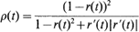
Let ξ (t); t ≧ 0 be a normalized continuous mean square differentiable stationary normal process with covariance function r(t). Further, letand set . We give bounds which are roughly of order Τ –δ for the rate of convergence of the distribution of the maximum and of the number of upcrossings of a high level by ξ (t) in the interval [0, T]. The results assume that r(t) and r′(t) decay polynomially at infinity and that r″ (t) is suitably bounded. For the number of upcrossings it is in addition assumed that r(t) is non-negative.
This paper compares the convergence rate properties of three storage models (dams) driven by time-homogeneous jump process input: the infinitely high dam, the finite dam, and the infinitely deep dam. We show that the convergence rate of the infinitely high dam depends on the moment properties of the input process, the finite dam always approaches its limiting distribution exponentially fast, and the infinitely deep dam approaches its limiting distribution exponentially fast under very general conditions. Our methods make use of rate results for regenerative processes and several sample path orderings.
Extreme value results for a class of shot noise processes with heavy tailed amplitudes are considered. For a process of the form, , where {τ k} are the points of a renewal process and {Ak} are i.i.d. with d.f. having a regularly varying tail, the limiting behavior of the maximum is determined. The extremal index is computed and any value in (0, 1) is possible. Two-dimensional point processes of the form are shown to converge to a compound Poisson point process limit. As a corollary to this result, the joint limiting distribution of high local maxima is obtained.

Assume a given sequence of events to be strongly mixing at a polynomial or exponential rate. We show that the conclusion of the second Borel-Cantelli lemma holds if the series of the probabilities of the events diverges at a certain rate depending on the mixing rate of the events. An application to necessary moment conditions for the strong law of large numbers is given.
In this paper we consider a position–velocity Ornstein-Uhlenbeck process in an external gradient force field pushing it toward a smoothly imbedded submanifold of . The force is chosen so that is asymptotically stable for the associated deterministic flow. We examine the asymptotic behavior of the system when the force intensity diverges together with the diffusion and the damping coefficients, with appropriate speed. We prove that, under some natural conditions on the initial data, the sequence of position processes is relatively compact, any limit process is constrained on , and satisfies an explicit stochastic differential equation which, for compact , has a unique solution.
The theory of majorization is applied to investigate the effects of heterogeneity in a class of epidemics. In particular, the heterogeneity of the components of the contact vector of a given susceptible is studied. It is shown that if the heterogeneity can be partially ordered through majorization, then the probability functions of escaping infection can be similarly ordered. The results can be applied to AIDS research on the spread of the HIV virus.
Vinogradov (1973) used the Laplace transform to characterize the IFR class of life distributions and later Block and Savits (1980) extended the characterization to the main reliability classes. Here we use the same transform again to characterize the continuous time renewal equation and some properties of its solution.
Long-range dependence has usually been defined in terms of covariance properties relevant only to second-order stationary processes. Here we provide new definitions, almost equivalent to the original ones in that domain of applicability, which are useful for processes which may not be second-order stationary, or indeed have infinite variances. The ready applicability of this formulation for categorizing the behaviour for various infinite variance models is shown.
It is becoming increasingly recognized that some long series of data can be adequately and parsimoniously modelled by stationary processes with long-range dependence. Some new discrete-time models for long-range dependence or slow decay, defined by their correlation structures, are discussed. The exact power-law correlation structure is examined in detail.
The purpose of this paper is to study two notions of stochastic comparisons of non-negative random variables via ratios that are determined by their Laplace transforms. Some interpretations of the new orders are given, and various properties of them are derived. The relationships to other stochastic orders are also studied. Finally, some applications in reliability theory are described.
In this paper the integrated three-valued telegraph process is examined. In particular, the third-order equations governing the distributions , (where N(t) denotes the number of changes of the telegraph process up to time t) are derived and recurrence relationships for them are obtained by solving suitable initial-value problems. These recurrence formulas are related to the Fourier transform of the conditional distributions and are used to obtain explicit results for small values of k. The conditional mean values (where V(0) denotes the initial velocity of motions) are obtained and discussed.


It is demonstrated that for each n ≧ 2 there exists a minimal universal constant, cn, such that, for any sequence of independent random variables {Xr, r ≧ 1} with finite variances, , where the supremum is over all stopping times Τ, 1 ≦ Τ ≦ n. Furthermore, cn ≦ 1/2 and lim infn→ ∞cn ≧ 0.439485 · ··.

In a system modelled by a time-discrete deterministic model, predictions of the distribution of the members over the different classes do not result automatically in an integer valued vector. In this paper, for a constant size system, we discuss how to associate with the calculated vector an integer valued vector. Furthermore we examine whether the evolution of the calculated vectors on the one hand, and the evolution of the associated integer valued vectors on the other hand, have the same properties.
