Most cited
This page lists all time most cited articles for this title. Please use the publication date filters on the left if you would like to restrict this list to recently published content, for example to articles published in the last three years. The number of times each article was cited is displayed to the right of its title and can be clicked to access a list of all titles this article has been cited by.
Contents
- Cited by 82
Turbulent rotating disk flow with inward throughflow
-
- Published online by Cambridge University Press:
- 13 January 2005, pp. 253-262
-
- Article
-
- You have access
- Export citation
- Cited by 82
Chaotic rotation of triaxial ellipsoids in simple shear flow
-
- Published online by Cambridge University Press:
- 10 June 1997, pp. 83-100
-
- Article
-
- You have access
- Export citation
- Cited by 82
Segregation-induced fingering instabilities in granular free-surface flows
-
- Published online by Cambridge University Press:
- 21 August 2012, pp. 543-580
-
- Article
-
- You have access
- Export citation
- Cited by 82
An experiment on boundary mixing: mean circulation and transport rates
-
- Published online by Cambridge University Press:
- 21 April 2006, pp. 473-499
-
- Article
- Export citation
- Cited by 82
A lubrication model of coating flows over a curved substrate in space
-
- Published online by Cambridge University Press:
- 25 March 2002, pp. 235-261
-
- Article
-
- You have access
- Export citation
- Cited by 82
The internal gravity wave field emitted by a stably stratified turbulent wake
-
- Published online by Cambridge University Press:
- 27 February 2013, pp. 104-139
-
- Article
-
- You have access
- Export citation
-
The internal gravity wave (IGW) field emitted by a stably stratified, initially turbulent, wake of a towed sphere in a linearly stratified fluid is studied using fully nonlinear numerical simulations. A wide range of Reynolds numbers,
 $\mathit{Re}= UD/ \nu \in [5\times 1{0}^{3} , 1{0}^{5} ] $ and internal Froude numbers,
 $\mathit{Fr}= 2U/ (ND)\in [4, 16, 64] $ (
 $U$ ,
 $D$ are characteristic body velocity and length scales, and
 $N$ is the buoyancy frequency) is examined. At the higher
 $\mathit{Re}$ examined, secondary Kelvin–Helmholtz instabilities and the resulting turbulent events, directly linked to a prolonged non-equilibrium (NEQ) regime in wake evolution, are responsible for IGW emission that persists up to
 $Nt\approx 100$ . In contrast, IGW emission at the lower
 $\mathit{Re}$ investigated does not continue beyond
 $Nt\approx 50$ for the three
 $\mathit{Fr}$ values considered. The horizontal wavelengths of the most energetic IGWs, obtained by continuous wavelet transforms, increase with
 $\mathit{Fr}$ and appear to be smaller at the higher
 $\mathit{Re}$ , especially at late times. The initial value of these wavelengths is set by the wake height at the beginning of the NEQ regime. At the lower
 $\mathit{Re}$ , consistent with a recently proposed model, the waves propagate over a narrow range of angles that minimize viscous decay along their path. At the higher
 $\mathit{Re}$ , wave motion is much less affected by viscosity, at least initially, and early-time wave propagation angles extend over a broader range of values which are linked to increased efficiency in momentum extraction from the turbulent wake source.


- Cited by 82
Flow past a sphere moving vertically in a stratified diffusive fluid
-
- Published online by Cambridge University Press:
- 25 August 2000, pp. 211-236
-
- Article
-
- You have access
- Export citation
- Cited by 82
On flow visualization using reflective flakes
-
- Published online by Cambridge University Press:
- 20 April 2006, pp. 235-248
-
- Article
- Export citation
- Cited by 82
The unsteady motion of solid bodies in creeping flows
-
- Published online by Cambridge University Press:
- 26 April 2006, pp. 83-102
-
- Article
- Export citation
- Cited by 82
A study of the constant-temperature hot-wire anemometer
-
- Published online by Cambridge University Press:
- 29 March 2006, pp. 577-599
-
- Article
- Export citation
- Cited by 82
Velocity measurements close to rippled beds in oscillatory flow
-
- Published online by Cambridge University Press:
- 20 April 2006, pp. 71-96
-
- Article
- Export citation
- Cited by 82
Marine ice sheet stability
-
- Published online by Cambridge University Press:
- 15 March 2012, pp. 62-72
-
- Article
-
- You have access
- Export citation
- Cited by 82
An analytic model of sound production by raindrops
-
- Published online by Cambridge University Press:
- 26 April 2006, pp. 395-410
-
- Article
- Export citation
- Cited by 82
On the stability of circular Couette flow with radial heating
-
- Published online by Cambridge University Press:
- 26 April 2006, pp. 53-84
-
- Article
- Export citation
- Cited by 82
Discrete-vortex simulation of a turbulent separation bubble
-
- Published online by Cambridge University Press:
- 20 April 2006, pp. 219-244
-
- Article
- Export citation
- Cited by 82
Turbulent–laminar coexistence in wall flows with Coriolis, buoyancy or Lorentz forces
-
- Published online by Cambridge University Press:
- 02 July 2012, pp. 137-172
-
- Article
-
- You have access
- Export citation
-
Direct numerical simulations of subcritical rotating, stratified and magneto-hydrodynamic wall-bounded flows are performed in large computational domains, focusing on parameters where laminar and turbulent flow can stably coexist. In most cases, a regime of large-scale oblique laminar-turbulent patterns is identified at the onset of transition, as in the case of pure shear flows. The current study indicates that this oblique regime can be shifted up to large values of the Reynolds number
 by increasing the damping by the Coriolis, buoyancy or Lorentz force. We show evidence for this phenomenon in three distinct flow cases: plane Couette flow with spanwise cyclonic rotation, plane magnetohydrodynamic channel flow with a spanwise or wall-normal magnetic field, and open channel flow under stable stratification. Near-wall turbulence structures inside the turbulent patterns are invariably found to scale in terms of viscous wall units as in the fully turbulent case, while the patterns themselves remain large-scale with a trend towards shorter wavelength for increasing
 . Two distinct regimes are identified: at low Reynolds numbers the patterns extend from one wall to the other, while at large Reynolds number they are confined to the near-wall regions and the patterns on both channel sides are uncorrelated, the core of the flow being highly turbulent without any dominant large-scale structure.
- Cited by 82
Normal stresses and microstructure in bounded sheared suspensions via Stokesian Dynamics simulations
-
- Published online by Cambridge University Press:
- 10 June 2000, pp. 279-301
-
- Article
-
- You have access
- Export citation
- Cited by 82
Experimental investigation of the structure of large- and very-large-scale motions in turbulent pipe flow
-
- Published online by Cambridge University Press:
- 24 March 2010, pp. 339-356
-
- Article
-
- You have access
- Export citation
- Cited by 82
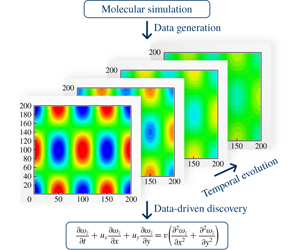
Data-driven discovery of governing equations for fluid dynamics based on molecular simulation
-
- Published online by Cambridge University Press:
- 31 March 2020, A5
-
- Article
-
- You have access
- HTML
- Export citation
- Cited by 82
Turbulent flows over superhydrophobic surfaces: flow-induced capillary waves, and robustness of air–water interfaces
-
- Published online by Cambridge University Press:
- 27 November 2017, pp. 45-85
-
- Article
-
- You have access
- HTML
- Export citation
