Most cited
This page lists all time most cited articles for this title. Please use the publication date filters on the left if you would like to restrict this list to recently published content, for example to articles published in the last three years. The number of times each article was cited is displayed to the right of its title and can be clicked to access a list of all titles this article has been cited by.
Contents
- Cited by 1

Redescription of Alloceraea cretacea (Acari: Ixodida) with an additional nymphal fossil added to this species: novel insights into the evolution of the Haematobothrion
-
- Published online by Cambridge University Press:
- 05 March 2026, pp. 625-632
-
- Article
-
- You have access
- Open access
- HTML
- Export citation
- Cited by 1
Patrick Alfred Buxton 1892–1955
-
- Published online by Cambridge University Press:
- 06 April 2009, pp. 1-15
-
- Article
-
- You have access
- Export citation
- Cited by 1
On a New Gregarine, Gregarina segmentata n.sp., an Intestinal Parasite of Cis bidentatus Olivier (Coleoptera)
-
- Published online by Cambridge University Press:
- 06 April 2009, pp. 296-302
-
- Article
- Export citation
- Cited by 1
Repetitive DNA and hybridization patterns demonstrate extensive variability between the sibling species Globodera rostochiensis and G. pallida
-
- Published online by Cambridge University Press:
- 06 April 2009, pp. 133-138
-
- Article
- Export citation
- Cited by 1
A dipterous parasite of mycetophilids
-
- Published online by Cambridge University Press:
- 06 April 2009, pp. 176-180
-
- Article
- Export citation
- Cited by 1
Medical Entomology for Students 3rd Edn. By M. W. Service, pp. 285. Cambridge University Press UK, 2004. ISBN 0 521 54775 X. £27.00. (US $48.00)
-
- Published online by Cambridge University Press:
- 16 August 2005, p. 436
-
- Article
-
- You have access
- HTML
- Export citation
- Cited by 1
Viruses–exploiters or dependants of the host?
-
- Published online by Cambridge University Press:
- 06 April 2009, pp. 189-216
-
- Article
- Export citation
- Cited by 1

Temperature and salinity as key drivers of eggs hatching success in sibling species of the Contracaecum rudolphii (s.l.) complex from European waters
-
- Published online by Cambridge University Press:
- 30 October 2025, pp. 140-147
-
- Article
-
- You have access
- Open access
- HTML
- Export citation
- Cited by 1
The relationship of endotoxaemia to peripheral and central nervous system inflammatory responses in Human African Trypanosomiasis
-
- Published online by Cambridge University Press:
- 29 November 2016, pp. 557-562
-
- Article
-
- You have access
- Open access
- HTML
- Export citation
- Cited by 1
Tricotyledonia genypteri n.g., n.sp, a three-suckered trematode from the red ling, Genypterus blacodes Block & Schn
-
- Published online by Cambridge University Press:
- 06 April 2009, pp. 325-328
-
- Article
- Export citation
- Cited by 1
On the occurrence of Herpetomonads(?) in Gerbils
-
- Published online by Cambridge University Press:
- 06 April 2009, pp. 260-261
-
- Article
- Export citation
- Cited by 1
Notes on three species of Pterygosoma (Acarina: Pterygosomidae) from Gerrhosaurid lizards
-
- Published online by Cambridge University Press:
- 06 April 2009, pp. 89-95
-
- Article
- Export citation
- Cited by 1
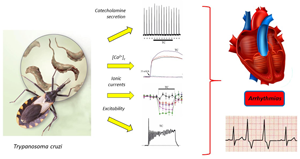
Pro-arrhythmogenic effects of Trypanosoma cruzi conditioned medium proteins in a model of bovine chromaffin cells
-
- Published online by Cambridge University Press:
- 13 August 2021, pp. 1612-1623
-
- Article
-
- You have access
- HTML
- Export citation
- Cited by 1
The Genera Charopinus and Lernaeopodina (Copepoda) as represented by the Collection in the British Museum
-
- Published online by Cambridge University Press:
- 06 April 2009, pp. 273-279
-
- Article
- Export citation
- Cited by 1
Development of larval Echinococcus granulosus confronted with chicken heart tissue in vitro
-
- Published online by Cambridge University Press:
- 06 April 2009, pp. 453-458
-
- Article
- Export citation
- Cited by 1
Genetic and morphometric categorization of Taenia ovis from Sheep in Iran
-
- Published online by Cambridge University Press:
- 13 November 2018, pp. 563-568
-
- Article
-
- You have access
- HTML
- Export citation
- Cited by 1
A new paruterinid cestode, Lallum magniparuterina gen. et sp.nov. from the intestine of a common teal, Nettion crecca Linn.*
-
- Published online by Cambridge University Press:
- 06 April 2009, pp. 269-272
-
- Article
- Export citation
- Cited by 1
Note on the Occurrence of a Mermithid Worm in the Body of a Termite, Cornitermes orthocephalus, Silvestri
-
- Published online by Cambridge University Press:
- 06 April 2009, pp. 187-188
-
- Article
- Export citation
- Cited by 1
Editorial: Mathematical modelling of infectious diseases
-
- Published online by Cambridge University Press:
- 30 March 2016, pp. 801-804
-
- Article
-
- You have access
- HTML
- Export citation
- Cited by 1
Tri-radiate Taenia crassicollis Rud
-
- Published online by Cambridge University Press:
- 06 April 2009, pp. 279-282
-
- Article
- Export citation
