Contents
Original Articles
The influence of immigrant status and concentration on psychiatric disorder in Canada: a multi-level analysis
-
- Published online by Cambridge University Press:
- 25 February 2011, pp. 2221-2231
-
- Article
-
- You have access
- HTML
- Export citation
Book Review
Migration and Mental Health. Edited by D. Bhugra and S. Gupta. (Pp. 350; $95; ISBN 9780521190770 cloth.) Cambridge University Press: New York. 2011.
-
- Published online by Cambridge University Press:
- 29 July 2011, p. 2233
-
- Article
-
- You have access
- HTML
- Export citation
The Brain and Behavior: An Introduction to Behavioral Neuroanatomy, 3rd edn. By D. L. Clark, N. N. Boutros and F. Mendez. (Pp. 241; £40.00; ISBN 978-0-521-14229-8.) Cambridge University Press: Cambridge, 2010.
-
- Published online by Cambridge University Press:
- 29 July 2011, pp. 2233-2234
-
- Article
-
- You have access
- HTML
- Export citation
Correspondence
Letter to the Editor: How psychotic-like are unusual subjective experiences?
-
- Published online by Cambridge University Press:
- 15 June 2011, pp. 2235-2236
-
- Article
-
- You have access
- HTML
- Export citation
Letter to the Editor: Comments on ‘Bullying victimization in youths and mental health problems: much ado about nothing?’
-
- Published online by Cambridge University Press:
- 16 June 2011, pp. 2236-2237
-
- Article
-
- You have access
- HTML
- Export citation
Corrigendum
Major depression during and after the menopausal transition: Study of Women's Health Across the Nation (SWAN) – Corrigendum
-
- Published online by Cambridge University Press:
- 19 August 2011, p. 2238
-
- Article
-
- You have access
- HTML
- Export citation
Front Cover (OFC, IFC) and matter
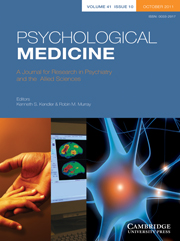
PSM volume 41 issue 10 Cover and Front matter
-
- Published online by Cambridge University Press:
- 25 August 2011, pp. f1-f2
-
- Article
-
- You have access
- Export citation
Back Cover (IBC, OBC) and matter
PSM volume 41 issue 10 Cover and Back matter
-
- Published online by Cambridge University Press:
- 25 August 2011, pp. b1-b2
-
- Article
-
- You have access
- Export citation