We partner with a secure submission system to handle manuscript submissions.
Please note:
You will need an account for the submission system, which is separate to your Cambridge Core account. For login and submission support, please visit the
submission and support pages.
Please review this journal's author instructions, particularly the
preparing your materials
page, before submitting your manuscript.
Click Proceed to submission system to continue to our partner's website.
To save this undefined to your undefined account, please select one or more formats and confirm that you agree to abide by our usage policies. If this is the first time you used this feature, you will be asked to authorise Cambridge Core to connect with your undefined account.
Find out more about saving content to .
To send this article to your Kindle, first ensure no-reply@cambridge.org is added to your Approved Personal Document E-mail List under your Personal Document Settings on the Manage Your Content and Devices page of your Amazon account. Then enter the ‘name’ part of your Kindle email address below. Find out more about sending to your Kindle.
Find out more about saving to your Kindle.
Note you can select to save to either the @free.kindle.com or @kindle.com variations. ‘@free.kindle.com’ emails are free but can only be saved to your device when it is connected to wi-fi. ‘@kindle.com’ emails can be delivered even when you are not connected to wi-fi, but note that service fees apply.
Dietary advice about the potential health risks of unhealthy foods or diets has historically been communicated in terms of nutrients. Recent evidence has shown that the processing of food itself is independently attributable to harmful outcomes, particularly a new category of foods described to be ‘ultra-processed’. Dietary guidelines (DG) are a key policy tool to translate and communicate nutrition research; however, there is little research exploring whether and how the harms of food processing are communicated and rationalised in dietary advice.
Design:
Nineteen publicly available DG were thematically analysed to explore: (1) the diversity of terms used to refer to processed foods and (2) the underlying explanations and rationales provided to reduce consumption of processed foods.
Setting:
International.
Participants:
Sample of national dietary guidelines.
Results:
Seventeen different descriptive terms were used to refer to processed foods, with many countries using a large variation of terms within their DG. Six rationales to reduce consumption of processed foods were identified, which were grouped into four overarching domains: harmful outcomes (disease risk, environmental risk); food quality (food quality, nutrient content); diet quality and food environment.
Conclusion:
The rationales provided to reduce the consumption of processed foods reflect upstream and downstream determinants of health. However, the persistence of nutrient-based rationales indicate that most DG do not apply an upstream understanding of the issues with ultra-processing. Further, the diversity of terms and foods referenced in DG suggest that the concept of ultra-processing is subject to multiple interpretations.
To evaluate the association between the age of cow milk introduction and childhood growth.
Design:
A secondary analysis of a prospective cohort study.
Setting:
Toronto, Canada.
Participants:
Healthy children <5 years of age enrolled in the TARGet Kids! practice-based research network. The primary exposure was the age of cow milk introduction. The primary outcome was height-for-age z-score. Secondary outcomes were volume of cow milk consumed (cups/d) and BMI z-score. Outcomes were measured at the last visit before 5 years of age. Multiple linear regression was used to examine these relationships.
Results:
Among 1981 children, introduction of cow milk at a younger age was associated with greater height by 3–5 years of age (P < 0·001). Each month earlier that cow milk was introduced was associated with 0·03 higher height-for-age z-score unit (95 % CI –0·05, –0·02) or 0·1 cm (95 % CI –0·15, –0·12 cm). At 4 years of age, the height difference between a child introduced to cow milk at 9 v. 12 months was 0·4 cm (95 % CI –0·45, –0·35 cm). There was no association between the timing of cow milk introduction and volume of cow milk consumed per day or BMI z-score.
Conclusions:
Earlier introduction of cow milk was associated with greater height but not with weight status in children aged 3–5 years. Further research is needed to understand the casual relationship between earlier cow milk consumption and childhood height. These findings may be important for paediatricians and parents when considering when to introduce cow milk.
We aimed to investigate whether dietary patterns were associated with the risk of type 2 diabetes mellitus (T2DM) or pre-diabetes in adults of rural area in Henan.
Design:
Cross-sectional study. Principal component analysis was used to identify dietary patterns, while multivariate logistic regression analysis and restricted cubic spline regression models were used to analyse the association between dietary patterns and both pre-diabetes and T2DM.
Setting:
Rural area of Henan province, China.
Participants:
A total of 38 779 adults aged 18–79 years were recruited from the Henan rural cohort study as the subjects.
Results:
The prevalence of pre-diabetes and T2DM in rural Henan was 6·8 % and 9·4 %, respectively. A total of three dietary patterns were assessed in the present study. Dietary pattern I with a high intake of red meat and white meat; dietary pattern II with a high intake of grains, nuts, milk and eggs and dietary pattern III with a high intake of vegetables, staple food and fruits. The highest quintile (Q5) of pattern III could reduce 32·7 % risk of pre-diabetes. The Q5 of pattern II showed a 15·5 % decreased risk of T2DM, in a U-shaped dose–response manner; meanwhile, the Q5 of pattern III was significantly associated with reduced risks of T2DM (OR: 0·582, 95 % CI (0·497, 0·682)).
Conclusions:
Pattern III is beneficial for reducing risk of pre-diabetes or T2DM. Though a higher consumption of ‘grains-nuts-egg’ may associate with a reduced risk of T2DM, excessive intakes should be avoided. This study may provide a reference for the prevention of diabetes on dietary precautions.
This study assesses the prevalence of childhood undernutrition from 2001 to 2016 and estimate projections of undernutrition for 2016–2030 in Nepal.
Design:
The study used data from four rounds of a cross-sectional survey of Nepal Demographic and Health Survey (NDHS) conducted in 2001, 2006, 2011 and 2016. Descriptive analyses were conducted to calculate prevalence, binary logistic regression was used to test the significance of trends over time and autoregressive integrated moving average model was used to forecast the prevalence of childhood undernutrition.
Settings:
The children and household member datasets from four NDHS were merged to assess the trends of childhood undernutrition in Nepal.
Participants:
A total of 16 613 children (8399 male and 8214 female) under 5 years of age were selected for anthropometric measurements using a stratified cluster random sampling method.
Results:
Overall results show a decline in prevalence of stunting from 57·2 % to 35·8 % (P < 0·001), underweight from 42·7 % to 27 % (P < 0·001) and wasting from 11·2 % to 9·7 % (P < 0·05) from 2001 to 2016. However, different population subgroups have a higher prevalence of undernutrition than national average. Further, the analyses show that the prevalence of stunting will decline to 14·3 % and wasting to 8·4 % by 2030.
Conclusion:
A remarkable decrease in the prevalence of stunting and underweight has been observed over the last 15 years. Nepal is likely to achieve the nutritional targets for stunting but not for wasting by 2030. Given large subpopulation variations, further improvement in undernutrition require more specific, targeted and localised programmes.
Inflammation has been suggested to play an important role in the development and progression of metabolic syndrome (MetS). Dietary inflammatory index (DII), a measurement of inflammatory potential in diets, was suggested to be associated with MetS. The aim of this systematic review and meta-analysis was to establish the associations of DII with MetS and its components based on available observational studies.
Design:
Systematic review and meta-analysis.
Setting:
A comprehensive literature search of studies that assessed the associations between DII and MetS was conducted in PubMed, Medline and Embase, using a combination of search terms relating to DII and MetS.
Participants:
Eighteen articles were eligible, of which fourteen were cross-sectional and four were cohort in design.
Results:
Results from the random effects meta-analysis showed significantly positive associations of higher DII (top v. bottom quartiles) with MetS (OR: 1·23 (95 % CI 1·10, 1·37)), abdominal obesity (OR: 1·15 (95 % CI 1·02, 1·29)), high blood pressure (OR: 1·17 (95 % CI 1·07, 1·29)), hyperglycaemia (OR: 1·18 (95 % CI 1·05, 1·33)) and hypertriacylglycerolaemia (OR: 1·17 (95 % CI 1·07, 1·28)). The effects of summary OR became stronger when analyses were restricted to cohorts, studies that adjudged for covariates (including BMI, physical activity and total energy intake).
Conclusions:
Higher DII, representing pro-inflammatory diet, is associated with higher odds of MetS and its components, except for low HDL-cholesterol. The findings prompt dietary interventions for preventing MetS from the aspect of inflammation.
To analyse trends of social inequality in breastfeeding and infant formula (IF) use in Latin America between 1990 and 2010 decades.
Design:
Time-series cross-sectional study with data from Demographic and Health Surveys. We described the prevalence of exclusive breastfeeding (EBF), breastfeeding between 6 and 12 months (BF6-12) and IF for infants under 6 months (IF < 6) and between 6 and 12 months (IF6-12). Social inequalities were assessed using the slope index of inequality (SII) and concentration index (CIX). Trends in the prevalence of breastfeeding, IF and index of social inequality were analysed by a linear regression model with weighted least squares variance.
Setting:
Bolivia, Colombia, Dominican Republic, Guatemala, Haiti and Peru.
Participants:
51·358 alive infants younger than 12 months.
Results:
Five countries showed an increasing trend for EBF and BF6-12, four increased for IF < 6 and six for IF6-12. Simultaneous decrease in IF < 6 (Colombia: −0·3/year; Haiti: −0·02/year) and increase in EBF (Colombia: +2·0/year; Haiti: +1·9/year) were observed only in two countries. EBF prevalence was high in the lowest income quintiles in five countries, and IF prevalence was high in the highest income quintiles in all countries and over the decades. For BF6-12, a decrease in inequality (prevalence increased in the highest quintile) was observed in Guatemala (SII1995 = −0·42; SII2015 = −0·28) and the Dominican Republic (SII1996 = −0·54; SII2013 = −0·26). Guatemala was the only country showing a decrease in inequality for BF (SII = −0·005; CIX = −0·0035) and an increase for IF (SII = 0·022; CIX = 0·01).
Conclusions:
The inequality in BF and IF remained over time. However, inequality in IF < 6 has decreased because low-income infants have increased use and high-income infants have decreased.
To assess the factors associated with overweight and obesity among women of childbearing age in Brazil.
Design:
Cross-sectional study.
Setting:
Using the National Health Survey (PNS) database, from the year 2013. The socio-economic and demographic factors analysed were age, race/skin colour, region, marital status, education level, employment and family income. Concerning health history, diagnoses of hypertension, diabetes mellitus, high cholesterol, heart attack, stroke, chronic kidney disease, menarche, parity and depression were evaluated. For lifestyle information, health status, alcoholic beverage consumption, smoking and physical activity were included. The outcomes were obesity and overweight. The association of excess weight with socio-economic and demographic factors, health history and lifestyle characteristics was investigated according to the appropriate theoretical–conceptual model for the topic.
Participants:
The sample size was 17 109 women aged 18–49 years.
Results:
The prevalence of women with excess weight was 55·20 %, with 33·26 % being overweight and 21·94 % with obesity. The factors associated with excess weight were age, non-white skin colour, having a partner, family income of up to two minimum wages, menarche before the age of 12, multiparity, diabetes mellitus, depression, hypertension, high cholesterol, stroke and heart attack.
Conclusion:
The results showed an association between excess weight and socio-demographic factors, both determinants of general and reproductive health history. Implementation of effective public health policies is necessary to prevent unfavourable outcomes related to the health of women of childbearing age with excess weight.
To investigate the role of potential shared mediators in the association of TV viewing and frequency of ultra-processed food consumption with anxiety-induced sleep disturbance.
Design:
Cross-sectional study.
Setting:
Data from the Adolescent School-Based Health Survey, a Brazilian nationally representative survey of ninth-grade adolescents conducted in 2015, were used.
Participants:
99 791 adolescents (52 015 girls) with a mean age of 14·3 years (range 11–19) participated. All variables were collected through a self-reported questionnaire based on the Global School-Based Student Health Survey. Anxiety-induced sleep disturbance was the outcome. Over 4 h/d of TV viewing and daily consumption of ultra-processed foods were the exposures. Body satisfaction, loneliness, self-rated health and eating while watching TV or studying were mediators. Age, ethnicity, food insecurity, type of city (capital or interior), country region and physical activity were covariates. Logistic regression and mediation models (Karlsson–Holm–Breen method) assessed associations.
Results:
Both daily ultra-processed food consumption (boys: OR 1·48, 95 % CI 1·30, 1·70; girls: OR 1·46, 95 % CI 1·34, 1·60) and TV viewing (boys: OR 1 24, 95 % CI 1·08, 1·43; girls: OR 1·09, 95 % CI 1·00, 1·19) were associated with higher odds for anxiety-induced sleep disturbance. Loneliness and eating while watching TV or studying (only among girls) consistently mediated the association of both daily ultra-processed food consumption (loneliness: boys 17·4 %, girls 23·4 %; eat while watching TV or studying: girls 6·8 %) and TV viewing (loneliness: boys 22·9 %, girls 45·8 %; eat while watching TV or studying: boys 6·7 %, girls 17·9 %) with anxiety-induced sleep disturbance.
Conclusions:
Daily ultra-processed food consumption and TV viewing share mediators and can act in synergic mechanisms in the association with anxiety-induced sleep disturbance. Therefore, future interventions should focus in the reduction of both behaviours in combination.
Iodine deficiency is a public health problem, especially in Peru, where it affects women of childbearing age and school-age children. The objective of the study was to conduct a household-level analysis of the factors associated with the consumption of table salt with inadequate amounts of iodine in Peru.
Design:
Analytical cross-sectional study using Peruvian household-level data from the Demographic and Family Health Survey. Table salt iodine concentrations were considered as the dependent variable (‘inadequate’ with iodine levels <30 PPM and ‘adequate’ with levels ≥30 PPM). The association between iodine concentrations in salt and independent variables was evaluated using crude and adjusted log-binomial regression models.
Setting:
Peru.
Participants:
A total of 25 007 households were included.
Results:
In Peru, 21·8 % households had inadequate table salt iodine concentrations. Belonging to the poorer and poorest wealth index, living in the Highlands natural region, and living with women of childbearing age with native mother tongue were identified as factors associated with inadequate iodine concentrations in table salt.
Conclusions:
There is an urgent need to ensure that table salt with adequate iodine concentrations is available for poor populations, residents of the Highlands and households with ethnic presence. Likewise, it is necessary to promote good storage practices, greater regulation/law enforcement and better monitoring of the companies that manufacture or sell this product. Furthermore, the population needs to be informed of the disorders associated with iodine deficiency.
To determine the temporal directionality of the association between food insecurity and maternal depression.
Design:
Food insecurity was measured at two time points using the eighteen-item USDA Food Security Scale. Maternal depression was measured at two time points using the fifteen-item Composite International Diagnostic Interview-Short Form. Two structural equation models were utilised to evaluate the impact of food insecurity on maternal depression (model 1) and the impact of maternal depression on food insecurity (model 2). Both models controlled for socio-demographic and parenting characteristics and child behaviour problems, along with prior measures of the dependent variable and concurrent measures of the independent variable.
Setting:
Fragile Families and Child Wellbeing (FFCW) study, twenty cities across the USA.
Participants:
4897 mothers who participated in two waves of the FFCW study.
Results:
On average, 17 % (time 1) and 15 % (time 2) of mothers experienced food insecurity and 21 % (time 1) and 17 % (time 2) of mothers experienced depression over time. Maternal depression at time 1 was associated with 53 % increased odds (OR = 1·53; B = 0·43; P < 0·001) of food insecurity at time 2, controlling for time 1 food insecurity, concurrent depression and covariates. Food insecurity at time 1 was associated with 36 % increased odds (OR = 1·36; B = 0·31; P < 0·001) of maternal depression at time 2, controlling for time 1 depression, concurrent food insecurity and covariates.
Conclusions:
We found a bidirectional relationship between food insecurity and maternal depression. A holistic approach that combines food assistance and mental health services may be an efficacious approach to reducing both depressive symptoms and food insecurity among low-income mothers.
To examine the difference in the rehabilitation rate from underweight by child age at enrolment in the Positive Deviance (PD)/Hearth programme.
Design:
This secondary data analysis used programme monitoring records of underweight children aged 6–60 months attending a 2-week PD/Hearth session and followed up for 6 months from September 2018 to March 2019. Data were analysed using multilevel mixed-effect regression and Poisson regression with robust variance.
Setting:
Rajshahi Division, Bangladesh.
Participants:
A total of 5227 underweight (weight-for-age Z-score (WAZ) <-2) children attended the PD/Hearth sessions.
Results:
From enrolment to 6 months follow-up, the mean WAZ improved from −2·80 to −2·09, and the percentage of underweight children decreased to 54·5 %. Compared to the enrolment age of 6–11 months, the estimated monthly change in WAZ at 6 months of follow-up were 0·05 lower for 12–23 months, 0·06 lower for 24–35 months, and 0·09 lower for 36–60 months of the enrolment age (all P < 0·001). The probability of rehabilitation at 6 months of follow-up were lower by 16·7 % for 12–23 months (RR = 0·83; 95 % CI 0·77, 0·91), 15·5 % for 24–35 months (RR = 0·84; 95 % CI 0·78, 0·92), and 34·9 % for 36–60 months of the enrolment age (RR = 0·65; 95 % CI 0·59, 0·72), compared to the enrolment age of 6–11 months.
Conclusions:
Enrolment in the PD/Hearth programme at a younger age had the advantage of greater rehabilitation from underweight than older age. Our findings provide a better understanding of the successes and failures of the PD/Hearth programme to achieve more sustainable and cost-effective impacts.
The aim of this study was to explore and analyse the actions implemented by civil society to contribute to food security in the context of the COVID-19 outbreak in Uruguay, a high-income country in South America.
Design:
An exploratory systematic approach was used to identify the contributions of civil society to food security through reports in news websites and Facebook posts. Data were analysed based on content analysis following a deductive–inductive approach.
Setting:
Uruguay, Latin America.
Results:
A total of 1220 civil society organisations were identified, which developed two main actions to increase access to food among the Uruguayan population: food baskets and ‘community pots’ (also known as ‘common pots’). Most of the initiatives targeted citizens under socioeconomic vulnerability in the face of COVID-19, without specifying any specific requirement or population segment. Actions were mainly led by spontaneously organised community groups, and, to a lesser extent, by consolidated organisations. Interactions between organisations were identified. The foods provided by the organisations were mostly aligned with national dietary guidelines. Social media posts evidenced that the main challenge faced by organisations was related to the lack of funds or supplies.
Conclusions:
Results from this work suggest that the lack of funds or supplies poses challenges to the medium- and long-term contributions of civil society to food security and stresses the need for comprehensive governmental measures to guarantee food security amongst Uruguayan citizens.
To describe US adults’ levels of support, neutrality and opposition to restricting junk food advertising to children on social media and explore associations with socio-demographic and health-related characteristics.
Design:
In 2020–2021, we used cross-sectional data from the National Cancer Institute’s 2020 Health Information National Trends Survey to estimate the prevalence of opinions towards advertising restrictions and correlates of neutrality and opposition using weighted multivariable logistic regression.
Setting:
United States.
Participants:
Adults aged 18+ years.
Results:
Among the analytic sample (n 2852), 54 % of adults were neutral or opposed to junk food advertising restrictions on social media. The odds of being neutral or opposed were higher among Non-Hispanic Black adults (v. non-Hispanic White; OR: 2·03 (95 % CI 1·26, 3·26)); those completing some college (OR: 1·68 (95 % CI 1·20, 2·34)) or high school or less (OR: 2·62 (95 % CI 1·74, 3·96)) (v. those with a college degree); those who were overweight (v. normal weight; OR: 1·42 (95 % CI: 1·05, 1·93)) and those reporting a moderate (OR: 1·45 (95 % CI 1·13, 1·88)) or conservative (OR: 1·71 (95 % CI 1·24, 2·35)) political viewpoint (v. liberal). Having strong (v. weaker) weight and diet-related cancer beliefs was associated with 53 % lower odds of being neutral or opposed to advertising restrictions (OR: 0·47 (95 % CI 0·36, 0·61)).
Conclusions:
The current study identified subgroups of US adults for whom targeted communication strategies may increase support for policies to improve children’s food environment.
Dietary indexes measure the adherence of individuals to a set of nutritional recommendations. However, the health gains associated with adherence to various dietary indexes may vary. Our objective was to compare the magnitude of estimated avoided deaths by chronic diseases obtained by improving diet quality in the French population, measured by a variety of dietary indexes.
Design:
Simulation study based on observational data.
Setting:
Weighted data from a French population-based cohort study.
Participants:
In participants from the NutriNet-Santé cohort, we computed dietary scores reflecting the adherence to various recommendations (Medi-Lite, Healthy Diet Indicator (HDI), Programme National Nutrition Santé/National Nutrition and Health Program – Guidelines Score, Diet Quality Index (DQI), Alternative Healthy Eating Index (AHEI) and the modified Food Standards Agency nutrient profiling system dietary index (FSAm-NPS DI)). Quintiles of the food groups’ consumption and dietary intakes were used as input in a simulation model (Preventable Risk Integrated ModEl (PRIME)), yielding the number of delayed or avoided deaths in nutrition-related non-communicable diseases, comparing between very high or very low nutritional quality of the diet and medium nutritional quality.
Results:
A modification of dietary intakes from medium quality to very low quality (i.e. from the middle quintile to the quintile with the lowest nutritional quality) was associated with an increased number of deaths ranging from 3485 (95 % uncertainty interval (CI) 4002, 2987) for HDI and 3379 (95 % CI 3881, 2894) for FSAm-NPS DI to 838 (95 % CI 1163, 523) for Medi-Lite. Conversely, a modification of dietary intakes from medium quality to very high quality was associated with a decrease in the number of deaths ranging from 1995 (95 % CI 1676, 2299) for Probability of Adequate Nutrient intake diet, 1986 (95 % CI 1565, 2361) for DQI-International, 1931 (95 % CI 1499, 2316) for FSAm-NPS DI and 858 (95 % CI 499, 1205) for HDI.
Conclusions:
Our results provide some insights as the potential impact of following various dietary guidelines to reduce mortality from nutrition-related diseases.
To evaluate the potential impact of sugar-sweetened beverage (SSB) taxes on overweight and obesity prevalence in countries of different income classifications.
Design:
Systematic review following Preferred Reporting Items for Systematic Reviews and Meta-Analyses (PRISMA) guidelines (PROSPERO number CRD42020161612). Five databases (Cochrane Library, Embase, LILACS (via Virtual Health Library) and MEDLINE (via PubMed), and Web of Science were searched, from January 2009 to December 2019. Articles that reported changes in purchases, sales, intake, body weight, BMI, overweight and/or obesity prevalence due to a tax on or price change in SSB were included.
Setting:
Studies conducted in countries of different income classifications.
Participants:
The search yielded 8349 articles of which 21 met inclusion criteria.
Results:
Among the sixteen studies selected, only two did not show that consumption, sales and purchase decreased as the price of SSB increased. In eight of the thirteen studies selected, a positive effect of an SSB tax on decreasing overweight and obesity prevalence was expected. It is estimated that a 20 % taxation on SSB would result in a greater decrease in the prevalence of overweight and obesity compared to a 10 % rate. Studies with no significant effect of taxing on sales, purchases, consumption and prevalence of obesity were from high-income countries, while significant effects of taxing on reducing purchase, consumption and/or obesity prevalence were found in studies from upper-middle- and middle-income countries.
Conclusion:
A high SSB tax might be an effective fiscal policy to decrease purchase and consumption of SSB and reduce overweight/obesity prevalence, especially if the tax were specific for beverage volume.
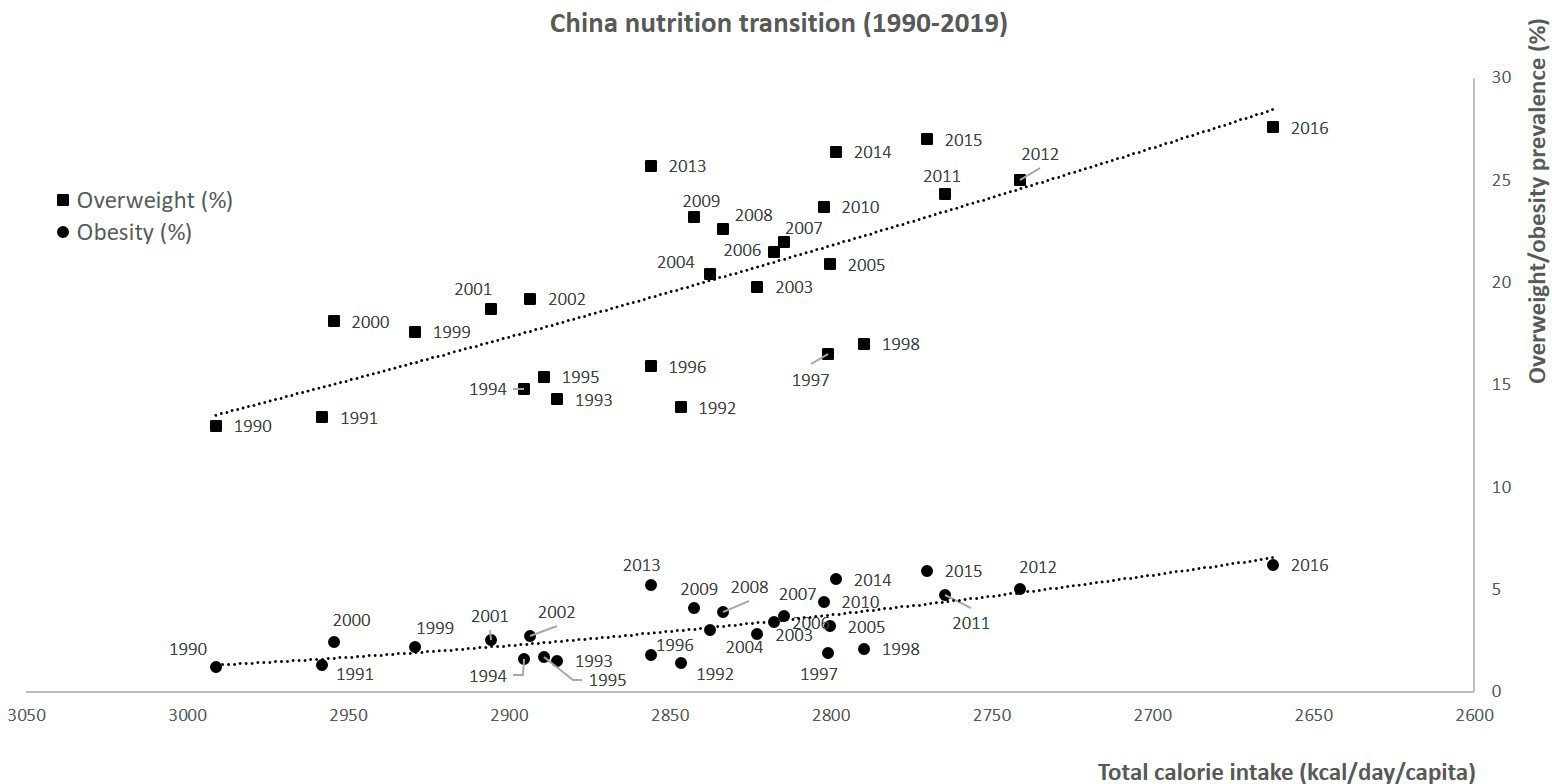
To extend analyses of nutrition transition in developed countries to China within the framework of the 3Vs rule considering degree of processing starting with plant/animal calorie ratio (Rule 1), industrially processed foods (IPFs, Rule 2), and food diversity through nutrient intakes (Rule 3).
Design:
Total and main food group (n 13) calorie intakes, percentages of animal and IPF calories, adequacy of the Dietary Reference Intake (DRI) and prevalence of chronic diseases were retrieved from scientific literature and international databases.
Setting:
China, 1990–2019.
Participants:
Overall population.
Results:
The total calorie intake decreased by 9 % over 30 years while the prevalence of chronic diseases substantially increased. Percentages of IPFs (Rule 1) and animal (Rule 2) calorie intake shifted from 9 to 30 % and 2 to 30 %, respectively. Meanwhile, the overall DRI adequacy (Rule 3) did not improve, with calcium and retinol deficiencies in 2019, and, although remaining above DRI, iron, copper, magnesium, and vitamins E, C and B1–B9 intakes regularly decreased. Notably, the prevalence of obesity increased five-fold, paralleling the exponential increase in IPF calorie intake. Both sources of calories were highly correlated with prevalence of main chronic diseases.
Conclusions:
Despite a slight decreased of total calorie consumption and small variations of adequacy with DRI, the farther the Chinese population moved away from the 3Vs rule during the 1990–2019 period, the more the prevalence of chronic diseases increased. Further analyses on foods’ transitions will be better assessed when advocating sources/quality of calories (Rules 1/2), rather than only nutrient composition (Rule 3).