We partner with a secure submission system to handle manuscript submissions.
Please note:
You will need an account for the submission system, which is separate to your Cambridge Core account. For login and submission support, please visit the
submission and support pages.
Please review this journal's author instructions, particularly the
preparing your materials
page, before submitting your manuscript.
Click Proceed to submission system to continue to our partner's website.
To save this undefined to your undefined account, please select one or more formats and confirm that you agree to abide by our usage policies. If this is the first time you used this feature, you will be asked to authorise Cambridge Core to connect with your undefined account.
Find out more about saving content to .
To send this article to your Kindle, first ensure no-reply@cambridge.org is added to your Approved Personal Document E-mail List under your Personal Document Settings on the Manage Your Content and Devices page of your Amazon account. Then enter the ‘name’ part of your Kindle email address below. Find out more about sending to your Kindle.
Find out more about saving to your Kindle.
Note you can select to save to either the @free.kindle.com or @kindle.com variations. ‘@free.kindle.com’ emails are free but can only be saved to your device when it is connected to wi-fi. ‘@kindle.com’ emails can be delivered even when you are not connected to wi-fi, but note that service fees apply.
Improved food availability and a growing economy in Tanzania may insufficiently decrease pre-existing nutritional deficiencies and simultaneously increase overweight within the same individual, household or population, causing a double burden of malnutrition (DBM). We investigated economic inequalities in DBM at the household level, expressed as a stunted child with a mother with overweight/obesity, and the moderating role of dietary diversity in these inequalities.
Design:
We used cross-sectional data from the 2015–2016 Tanzania Demographic and Health Survey.
Setting:
A nationally representative survey.
Participants:
Totally, 2867 children (aged 6–23 months) and their mothers (aged 15–49 years). The mother–child pairs were categorised into two groups based on dietary diversity score: achieving and not achieving minimum dietary diversity.
Results:
The prevalence of DBM was 5·6 % (sd = 0·6) and significantly varied by region (ranging from 0·6 % to 12·2 %). Significant interaction was observed between dietary diversity and household wealth index (Pfor interaction < 0·001). The prevalence of DBM monotonically increased with greater household wealth among mother–child pairs who did not achieve minimum dietary diversity (Pfor trend < 0·001; however, this association was attenuated in those who achieved minimum dietary diversity (Pfor trend = 0·16), particularly for the richest households (P = 0·44). Analysing household wealth index score as a continuous variable yielded similar results (OR (95 % CI): 2·10 (1·36, 3·25) for non-achievers of minimum dietary diversity, 1·38 (0·76, 2·54) for achievers).
Conclusions:
Greater household wealth was associated with higher odds of DBM in Tanzania; however, the negative impact of household economic status on DBM was mitigated by minimum dietary diversity.
To examine associations between three different plant-based diet quality indices, chronic kidney disease (CKD) prevalence and related risk factors in a nationally representative sample of the Australian population.
Design:
Cross-sectional analysis. Three plant-based diet scores were calculated using data from two 24-h recalls: an overall plant-based diet index (PDI), a healthy PDI (hPDI) and an unhealthy PDI (uPDI). Consumption of plant and animal ingredients from ‘core’ and ‘discretionary’ products was also differentiated. Associations between the three PDI scores and CKD prevalence, BMI, waist circumference (WC), blood pressure (BP) measures, blood cholesterol, apo B, fasting TAG, blood glucose levels (BGL) and HbA1c were examined.
Setting:
Australian Health Survey 2011–2013.
Participants:
n 2060 adults aged ≥ 18 years (males: n 928; females: n 1132).
Results:
A higher uPDI score was associated with a 3·7 % higher odds of moderate-severe CKD (OR: 1·037 (1·0057–1·0697); P = 0·021)). A higher uPDI score was also associated with increased TAG (P = 0·032) and BGL (P < 0·001), but lower total- and LDL-cholesterol (P = 0·035 and P = 0·009, respectively). In contrast, a higher overall PDI score was inversely associated with WC (P < 0·001) and systolic BP (P = 0·044), while higher scores for both the overall PDI and hPDI were inversely associated with BMI (P < 0·001 and P = 0·019, respectively).
Conclusions:
A higher uPDI score reflecting greater intakes of refined grains, salty plant-based foods and added sugars were associated with increased CKD prevalence, TAG and BGL. In the Australian population, attention to diet quality remains paramount, even in those with higher intakes of plant foods and who wish to reduce the risk of CKD.
This study aims at comparing two Italian case studies in relation to schoolchildren’s plate waste and its implications, in terms of nutritional loss, economic cost and carbon footprint.
Design:
Plate waste was collected through an aggregate selective weighting method for 39 d.
Setting:
Children from the first to the fifth grade from four primary schools, two in each case study (Parma and Lucca), were involved.
Results:
With respect to the served food, in Parma, the plate waste percentage was lower than in Lucca (P < 0·001). Fruit and side dishes were highly wasted, mostly in Lucca (>50 %). The energy loss of the lunch meals accounted for 26 % (Parma) and 36 % (Lucca). Among nutrients, dietary fibre, folate and vitamin C, Ca and K were lost at most (26–45 %). Overall, after adjusting for plate waste data, most of the lunch menus fell below the national recommendations for energy (50 %, Parma; 79 %, Lucca) and nutrients, particularly for fat (85 %, Parma; 89 %, Lucca). Plate waste was responsible for 19 % (Parma) and 28 % (Lucca) of the carbon footprint associated with the food supplied by the catering service, with starchy food being the most important contributor (52 %, Parma; 47 %, Lucca). Overall, the average cost of plate waste was 1·8 €/kg (Parma) and 2·7 €/kg (Lucca), accounting respectively for 4 % and 10 % of the meal full price.
Conclusion:
A re-planning of the school meals service organisation and priorities is needed to decrease the inefficiency of the current system and reduce food waste and its negative consequences.
To evaluate the trends in the healthiness of packaged food purchases of Australian consumers before and after the introduction of the Health Star Rating (HSR) nutrition labels.
Design:
Panel data analysis and difference-in-differences analysis.
Setting:
The Australian Government endorsed HSR nutrition labels for voluntary implementation on packaged foods in June 2014. We analyse the packaged food purchases of households across all major supermarkets before (January 2014 to June 2014) and after (June 2014–Dec 2018) the introduction of HSR.
Participants:
6284 members of a panel of households across Australia reporting their grocery purchases to a market research company (Nielsen Homescan panel).
Results:
The healthiness of household food purchases exhibited a U-shaped trend – decreasing from 2014 to 2017, and then increasing from 2018, corresponding to the time when a higher proportion of products were HSR-labelled. Households that purchased a higher proportion of HSR-labelled products had healthier household purchases overall. Further, the healthiness of households’ category-specific food purchases was positively associated with the proportion of HSR-labelled products in categories where HSR was adopted, relative to control categories where HSR was not adopted.
Conclusions:
In Australia, once a substantial number of packaged food products adopted the voluntary HSR summary indicator, we observed an increasing trend in the healthiness of household food purchases. Widespread adoption of a nutrition summary indicator, such as HSR, on packaged food is likely to be beneficial for population health.
To estimate the effect of income change on difficulty accessing food since the COVID-19 pandemic for South African youth and evaluate whether this effect was modified by receiving social grants.
Design:
A cross-sectional, online survey was conducted between December 2021 and May 2022. Primary outcome was increased difficulty accessing food since the COVID-19 pandemic. Income change was categorised as ‘Decreased a lot’, ‘Decreased slightly’ and ‘Unchanged or increased’. Multivariable logistic regressions were used, with an interaction term between social grant receipt and income change.
Setting:
eThekwini district, South Africa.
Participants:
Youth aged 16–24 years.
Results:
Among 1,620 participants, median age was 22 years (IQR 19–24); 861 (53 %) were women; 476 (29 %) reported increased difficulty accessing food; 297 (18 %) reported that income decreased a lot, of whom 149 (50 %) did not receive social grants. Experiencing a large income decrease was highly associated with increased difficulty accessing food during the COVID-19 pandemic (adjusted OR [aOR] 3·63, 95 % CI 2·70, 4·88). The aOR for the effect of a large income decrease on difficulty accessing food, compared to no income change, were 1·49 (95 % CI 0·98, 2·28) among participants receiving social grants, and 6·63 (95 % CI 4·39, 9·99) among participants not receiving social grants.
Conclusions:
While social grant support made a great difference in lowering the effect of income decrease on difficulty accessing food, it was insufficient to fully protect youth from those difficulties. In post-pandemic recovery efforts, there is a critical need to support youth through economic empowerment programming and food schemes.
To address the relationship between the proportions of carbohydrates and fat and hyperglycaemia in the Chinese population.
Design:
A cross-section research involving data from the China Health and Nutrition Survey in 2009, and nutritional status and health indicators were mainly focused.
Setting:
China.
Participants:
8197 Chinese individuals aged over 16 years, including 1345 subjects who had a low-carbohydrate and high-fat diet, 3951 individuals who had a medium proportion of carbohydrate and fat diet, 2660 participants who had a high-carbohydrate and low-fat diet and 241 people who had a very-high-carbohydrate and low-fat diet.
Results:
Subjects with the high-carbohydrate and low-fat diet were significantly associated with an increased risk of hyperglycaemia (OR: 1·142; 95 % CI: 1·022, 1·276) when compared with the individuals with the medium proportion of carbohydrate and fat diet. Meanwhile, people with a very-high-carbohydrate and low-fat diet had a higher risk of hyperglycaemia (OR: 1·829; 95 % CI: 1·377, 2·429). In contrast, the association between participants with a low-carbohydrate and high-fat diet and hyperglycaemia was NS (OR: 1·082; 95 % CI: 0·942, 1·243) with adjusting a series of confounding factors. Furthermore, people with a very-high-carbohydrate and low-fat diet were significantly associated with a higher risk of hyperglycaemia in the major energy levels and social characteristics subgroup.
Conclusions:
We found the high-carbohydrate and low-fat and very-high-carbohydrate and low-fat diets were significantly associated with a high risk of hyperglycaemia. And, the association between low-carbohydrate and high-fat diets and the risk of hyperglycaemia was NS.
Invasive colonial influences and continuing neoliberal policies have a detrimental impact on Land, health, food and culture for Indigenous Communities. Food security and sovereignty have significant impacts on Indigenous well-being and, specifically, oral health. Aspects relating to food security, such as availability of nutritious foods, are a common risk factor of oral diseases. This scoping review aimed to collate existing evidence regarding the relationship between food sovereignty and/or food security and oral health for Indigenous Communities, globally.
Design:
Four databases were searched using keywords related to ‘Food security’ or ‘Food sovereignty,’ ‘Indigenous Peoples’ and ‘Oral health.’ Duplicates were removed, and two independent reviewers screened the titles and abstracts to identify articles for full-text review. Extracted data were summarised narratively, presenting a conceptual model which illustrates the findings and relationships between food security and/or food sovereignty and oral health.
Results:
The search identified 369 articles, with forty-one suitable for full-text review and a final nine that met inclusion criteria. The impact of food security and food sovereignty on oral health was discussed across different populations and sample sizes, ranging from eighteen Kichwa families in Brazil to 533 First Nations and Metis households in Canada. Pathways of influence between food sovereignty and/or food security are explored clinically, quantitatively and qualitatively across oral health outcomes, including early childhood caries, dental caries and oral health-related quality of life for Indigenous Communities.
Conclusions:
Innovative strategies underpinned by concepts of Indigenous food sovereignty are needed to promote oral health equity for Indigenous Communities. The nexus between oral health and Indigenous food sovereignty remains largely unexplored, but has immense potential for empowering Indigenous rights to self-determination of health that honour Indigenous ways of knowing, being and doing.
The Comprehensive Feeding Practices Questionnaire (CFPQ) measures parental attitudes towards feeding practices that directly influence children’s eating habits. This study aims to determine the reliability and validity of the Turkish adaptation of the CFPQ developed by Musher-Eizenman et al.
Design:
Validity and reliability analyses were conducted for the Turkish version of the CFPQ (T-CFPQ). In addition to reliability analyses and partial correlations between scale dimensions, correlations between scale dimensions according to mothers’ BMI and children’s BMI z-scores were also examined.
Setting:
Parents with children aged 18 months to 8 years living in the community.
Participants:
The study sample consisted of 274 parents with children aged 18 months to 8 years who agreed to participate in the online survey.
Results:
In this study, forty-seven items and twelve-factor structure describing feeding practices were supported by the confirmatory factor analysis. Although most of the dimensions of the T-CFPQ showed significant correlations with each other, the highest correlation was found between the encourage balance/variety and the dimension of modelling and teaching nutrition (r = 0·53; 0·50) (P < 0·05). There was a negative correlation between the child’s BMI z-score and the pressure to eat dimension (r = –0·173; P < 0·01) and a positive correlation between the restriction for weight dimension (r = 0·339; P < 0·01). Maternal BMI was negatively associated with the involvement dimension (r = –0·121; P < 0·05) and positively associated with the restriction for weight dimension (r = 0·154; P < 0·01).
Conclusions:
The findings revealed that the T-CFPQ is a valid and reliable measurement tool that can be applied to obtain the necessary information for evaluating nutritional interactions between parent and child.
Research is available on improved coverage and practices from several large-scale maternal nutrition programmes, but not much is known on change in inequalities. This study analyses wealth and education inequality using Erreygers and Concentration indices for four indicators: adequate iron and folic acid (IFA) consumption, women’s dietary diversity, and counselling on IFA and dietary diversity.
Design:
A pre-test–post-test, control group design.
Setting:
Maternal nutrition intervention programmes conducted in Bangladesh, Burkina Faso and Ethiopia during 2015–2022.
Participants:
Recently delivered women (RDW) and pregnant women (PW).
Results:
Statistically significant reductions in education inequality were observed for adequate IFA consumption, counselling on IFA and dietary diversity in intervention areas of Bangladesh and for adequate IFA consumption in intervention areas of Burkina Faso.
A significant decrease in wealth inequality was observed for adequate IFA consumption in the intervention areas of Bangladesh, whereas a significant increase was observed in the non-intervention areas for counselling on IFA in Ethiopia and for dietary diversity in Burkina Faso.
Conclusion:
The results can be attributed to the extensive delivery system at community level in Bangladesh and being predominantly facility-based in Burkina Faso and Ethiopia. COVID-19 disruptions (in Burkina Faso and Ethiopia) and indicator choice also had a role in the results.
The main takeaways for nutrition programmes are as follows: (a) assessing inequality issues through formative studies during designing, (b) monitoring inequality indicators during implementation, (c) diligently addressing inequality through targeted interventions, setting aside resources and motivating frontline workers to reduce disparities and (d) making inequality analysis a routine part of impact evaluations.
To assess the nutritional status, growth parameters and lifestyle behaviours of children between 0·5 and 12 years in nationally representative samples in Malaysia, Indonesia, Thailand and Vietnam.
Design:
A cross-sectional study was conducted in the four countries, between May 2019 and April 2021. Data collected can be categorised into four categories: (1) Growth – anthropometry, body composition, development disorder, (2) nutrient intake and dietary habits – 24-h dietary recall, child food habits, breast-feeding and complementary feeding, (3) socio-economic status – food insecurity and child health status/environmental and (4) lifestyle behaviours – physical activity patterns, fitness, sunlight exposure, sleep patterns, body image and behavioural problems. Blood samples were also collected for biochemical and metabolomic analyses. With the pandemic emerging during the study, a COVID-19 questionnaire was developed and implemented.
Setting:
Both rural and urban areas in Malaysia, Indonesia, Thailand and Vietnam.
Participants:
Children who were well, with no physical disability or serious infections/injuries and between the age of 0·5 and 12 years old, were recruited.
Results:
The South East Asian Nutrition Surveys II recruited 13 933 children. Depending on the country, data collection from children was conducted in schools and commune health centres, or temples, or sub-district administrative organisations.
Conclusions:
The results will provide up-to-date insights into nutritional status and lifestyle behaviours of children in the four countries. Subsequently, these data will facilitate exploration of potential gaps in dietary intake among Southeast Asian children and enable local authorities to plan future nutrition and lifestyle intervention strategies.
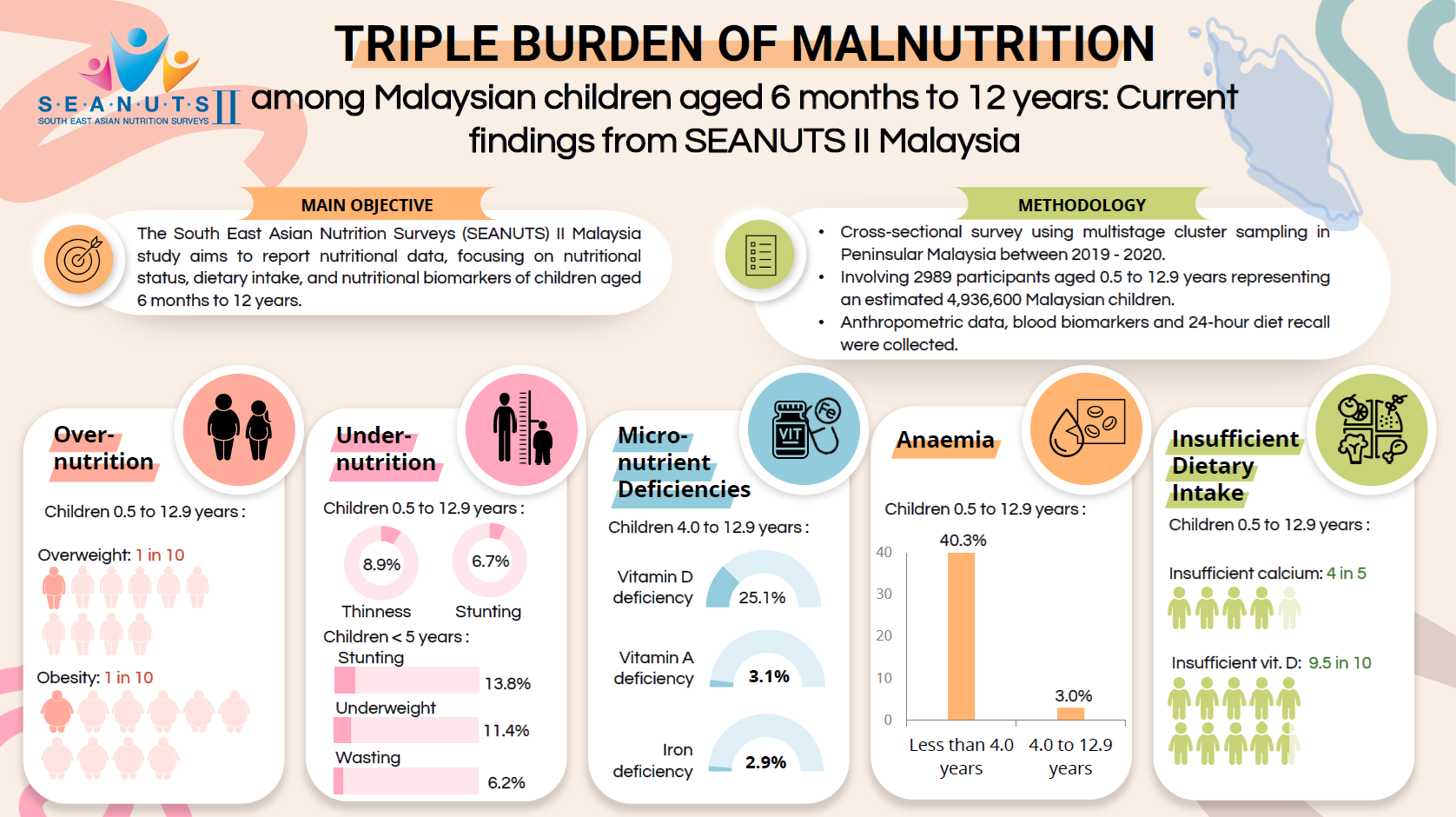
This paper aims to report South East Asian Nutrition Surveys (SEANUTS) II Malaysia data on nutritional status, dietary intake and nutritional biomarkers of children aged 6 months to 12 years.
Design:
Cross-sectional survey conducted in 2019–2020.
Setting:
Multistage cluster sampling conducted in Central, Northern, Southern and East Coast regions of Peninsular Malaysia.
Participants:
2989 children aged 0·5–12·9 years.
Results:
Prevalences of stunting, thinness, overweight and obesity among children aged 0·5–12·9 years were 8·9 %, 6·7 %, 9·2 % and 8·8 %, respectively. Among children below 5 years old, 11·4 % were underweight, 13·8 % had stunting and 6·2 % had wasting. Data on nutritional biomarkers showed that a small proportion of children aged 4–12 years had Fe (2·9 %) and vitamin A deficiencies (3·1 %). Prevalence of anaemia was distinctly different between children below 4 years old (40·3 %) and those aged 4 years and above (3·0 %). One-fourth of children (25·1 %) had vitamin D insufficiency, which was twice as prevalent in girls (35·2 % v. boys: 15·6 %). The majority of children did not meet the recommended dietary intake for Ca (79·4 %) and vitamin D (94·8 %).
Conclusions:
Data from SEANUTS II Malaysia confirmed that triple burden of malnutrition coexist among children in Peninsular Malaysia, with higher prevalence of overnutrition than undernutrition. Anaemia is highly prevalent among children below 4 years old, while vitamin D insufficiency is more prevalent among girls. Low intakes of dietary Ca and vitamin D are also of concern. These findings provide policymakers with useful and evidence-based data to formulate strategies that address the nutritional issues of Malaysian children.
This study assessed nutritional status among Thai children using anthropometry, dietary intakes and micronutrient status.
Design:
Cross-sectional survey with multi-stage cluster sampling. Body weight and height were measured in all children. Dietary intakes were assessed using 24-h dietary recall. Biochemical assessment was performed in one-third of the children.
Setting:
The study was conducted in Thailand’s four geographical regions and Bangkok.
Participants:
3478 Thai children aged 0·5–12·9 years.
Results:
Stunting showed a downward trend by age group and was most prevalent among infants and toddlers. Overweight and obesity showed a significant upward trend by age group, location and sex and were highest among children aged 7–12·9 years. Risks of inadequate micronutrient intakes (Ca, Fe, Zn, vitamins A, C and D) were high (53·2–93·6 %). Prevalence of Zn and mild vitamin A deficiencies were low; vitamin D and B12 deficiencies were nil. Vitamin D insufficiency was significantly higher in the urban area and among girls. Anaemia was very high in infants and toddlers (56·6 and 35·2 %) but showed a significant downward trend by age group. There was an overall high prevalence of Fe deficiency (25 %) v. Fe deficiency anaemia (4·2 %) among children aged 4–12·9 years old.
Conclusions:
The high prevalence of stunting and anaemia among children aged 0·5–3·9 years and overweight and obesity among children aged 7–12·9 years requires continued attention. While prevalence of biochemical micronutrient deficiencies was not high (except for Fe), high prevalence of dietary inadequacies for several micronutrients warrants further in-depth investigations.
Few studies have reported intakes of fermented foods with their clear definitions. This study aimed to identify fermented foods and beverages consumed in Japan based on international definitions and to estimate their intake and contribution to energy and nutrients.
Design:
Data from a 16-d (four non-consecutive days within each season at 3-month intervals) semi-weighted dietary records (DR) were used. To identify ‘entirely fermented foods’ and ‘partially fermented foods’, a literature search on food processing and ingredients was conducted for all foods that appeared in the DR. For ‘partially fermented foods’, only the weight of the fermented food component was included in the estimation of total fermented food intake.
Setting:
Four regions in Japan: Osaka, Nagano, Tottori and Okinawa.
Participants:
Two-hundred forty-two apparently healthy Japanese adults aged 31–81 years.
Results:
Of the 1396 kinds of unique foods that appeared in the DR, 101 were ‘entirely fermented foods’ and 104 were ‘partially fermented foods’. The mean intake of fermented foods was 438 g/d per person (17 % of the total weight). They were mainly derived from beer, coffee, bread and yogurt. The mean contribution of fermented foods to the total energy intake was 18 %. For nutrients, the contribution to total intake was high to Na (46 %), Mg (22 %) and Ca (20 %).
Conclusions:
Fermented foods account for approximately one-fifth of the total weight and energy of dietary intake and are important contributors to some nutrients in Japanese adults.
This study aimed to objectively evaluate the diet consumed in a workplace cafeteria to group Japanese workers according to vegetables and salt intake and estimate the association of these groups with changes in cardiometabolic measurements.
Design:
This longitudinal observational study estimated the food and nutrient intake of Japanese workers from data recorded in the cafeteria system of their workplace. The primary outcomes included cardiometabolic measures obtained via regular health check-ups conducted at the workplace. The participants were divided into four groups according to high or low vegetables and salt intake based on their respective medians, and the association of each group with cardiometabolic measurement changes was estimated using robust regression with MM-estimation.
Setting:
A Japanese automobile manufacturing factory.
Subjects:
The study included 1140 men and women workers with available cafeteria and health check-up data.
Results:
An inverse marginal association was observed between changes in TAG levels (mmol/L) and high vegetables and low salt intake (β: –0·11, 95 % CI: –0·23, 0·01, P: 0·065) with reference to low vegetables and high salt intake. This association was stronger in participants who used the cafeteria more frequently (>=71 d; β: –0·15, 95 % CI: –0·29, –0·02, P: 0·027).
Conclusions:
The participants in the higher vegetables and lower salt intake group were more likely to exhibit decreased TAG levels. These findings encourage using workplace cafeteria meals to promote the health of workers.
Limited research is available on how motivations to adopt plant-based diets and nutrition literacy influence diet quality. This study assessed diet quality, diet motives and nutrition literacy in vegans, vegetarians and semi-vegetarians and investigated predictors of dietary quality.
Design:
Cross-sectional study, participants completed an online survey about diet-related motives and nutrition literacy. Dietary intake was assessed with the Diet History Questionnaire III, and diet quality was calculated with the Healthy Eating Index (HEI)-2015. A one-way ANCOVA was used to compare diet quality, nutrition literacy and diet motives among diets. Hierarchical regression analysis was performed to identify significant predictors of diet quality.
Setting:
Online survey, participants were recruited through paid targeted social media (Facebook/Instagram) advertising.
Participants:
Adults following a plant-based diet, including 117 (52·5 %) vegans, 51 (22·9 %) vegetarians and 55 (24·6 %) semi-vegetarians.
Results:
Vegans had higher HEI-2015 scores (80·8 (sd 6·5), P < 0·001) compared to vegetarians (75·1 (sd 9·1)) and semi-vegetarians (76·8 (sd 7·5)). Most participants (74 %) had good nutrition literacy scores. Total nutrition literacy did not differ between groups, but vegans had higher vegetarian nutrition literacy than vegetarians and semi-vegetarians (P < 0·001). Ecological welfare, health and sensory appeal were highly important to all participants. Motives accounted for 12·8 % of the variance in diet quality scores. HEI-2015 scores were positively associated with motives of health and natural content, but negatively associated with weight control motivation (all P < 0·05).
Conclusions:
Individuals following plant-based dietary patterns have high diet quality and nutrition literacy. Messages valuing intrinsic over extrinsic factors may facilitate healthier dietary adherence in this population.
Suicidal behaviours among students pose a significant public health concern, with mental health problems being well-established risk factors. However, the association between food insecurity (FIS) and suicidal behaviours remains understudied, particularly in Bangladesh. This study aimed to investigate the relationship between FIS and suicidal behaviours among Bangladeshi university students.
Design:
A cross-sectional survey using convenience sampling was conducted between August 2022 and September 2022. Information related to socio-demographics, mental health problems, FIS and related events and suicidal behaviours were collected. Chi-squared tests and multivariable logistic regression models, both unadjusted and adjusted, were employed to examine the relationship between FIS and suicidal behaviour.
Setting:
Six public universities in Bangladesh.
Participants:
This study included 1480 students from diverse academic disciplines.
Results:
A substantial proportion of respondents experienced FIS, with 75·5 % reporting low or very low food security. Students experiencing FIS had a significantly higher prevalence of suicidal ideation, plans and attempts compared with food-secure students (18·6 % v. 2·8 %, 8·7 % v. 0·8 % and 5·4 % v. 0·3 %, respectively; all P < 0·001). In addition, students who have personal debt and participate in food assistance programmes had a higher risk of suicidal behaviours.
Conclusions:
This study highlights the association between FIS and suicidal behaviours among university students. Targeted mental health screening, evaluation and interventions within universities may be crucial for addressing the needs of high-risk students facing FIS.
This study aimed to analyse the spatial and temporal patterns of disease burden attributed to high BMI (DB-hBMI) from 1990 to 2019 in Belt and Road Initiative (BRI) countries, in light of increasing hBMI prevalence worldwide.
Design:
The study was a secondary analysis of Global Burden of Disease 2019 (GBD 2019) that analysed (using Joinpoint regression analysis) numbers and the age-standardised rate of mortality and disability-adjusted life years (DALY) of hBMI-induced diseases and their trends from 1990 to 2019 and in the final decade.
Setting:
GBD 2019 study data for BRI countries were categorised by country, age, gender and disease.
Participants:
GBD 2019 data were used to analyse DB-hBMI in BRI countries.
Results:
In 2019, China, India and Russia reported the highest mortality and DALY among BRI countries. From 1990 to 2019, the age-standardised DALY increased in Southeast Asia and South Asia, whereas many European countries saw declines. Notably, Bangladesh, Nepal and Vietnam showed the steepest increases, with average annual percentage change (AAPC) values of 4·42 %, 4·19 % and 4·28 %, respectively (all P < 0·05). In contrast, Israel, Slovenia and Poland experienced significant reductions, with AAPC values of –1·70 %, –1·63 % and –1·58 %, respectively (all P < 0·05). The most rapid increases among males were seen in Vietnam, Nepal and Bangladesh, while Jordan, Poland and Slovenia recorded the fastest declines among females. Across most BRI countries, the burden of diabetes and kidney diseases related to hBMI showed a significant uptrend.
Conclusion:
DB-hBMI varies significantly by region, age, gender and disease type across BRI countries. It can pose a substantial threat to public health.
To simulate the impact on calcium intake – effectiveness and safety – of fortifying wheat flour with 200, 400 and 500 mg of calcium per 100 g of flour.
Design:
Secondary analysis of cross-sectional data collected through repeated 24 h dietary recalls using the Iowa State University Intake Modelling, Assessment and Planning Program.
Setting:
Urban cities in the National Health and Nutrition Survey of Argentina (ENNyS 2018–2019).
Participants:
21 358 participants, including children, adolescents and adults.
Results:
Most individuals in all age groups reported consuming wheat flour. The prevalence of low calcium intake was above 80 % in individuals older than 9 years. Simulating the fortification of 500 mg of calcium per 100 g of wheat flour showed that the prevalence of low calcium intake could be reduced by more than 40 percentage points in girls and women aged 19 to less than 51 years and boys and men aged 4 to less than 71 years, while it remained above 65 % in older ages. The percentages above the upper intake level remained below 1·5 % in all age groups.
Conclusions:
Calcium flour fortification could be further explored to improve calcium intake. Subnational simulations could be performed to identify groups that might not be reached by this strategy that could be explored in Argentina. This analysis could be used to advocate for a strategy to fortify wheat flour.
Social determinants of health (SDoH), such as food and financial insecurity and food assistance, are potentially modifiable factors that may influence breastfeeding initiation and duration. Knowledge gaps exist regarding the relationship between these SDoH and infant feeding practices. We explored the relationships of food and financial insecurity and food assistance with the continuation of breastfeeding at four months postpartum among mothers and whether race and ethnicity modified these associations.
Design:
Mothers retrospectively reported food and financial insecurity and receipt of food assistance (e.g. Women, Infants and Children and Supplemental Nutrition Assistance Program) during pregnancy with their first child and infant feeding practices (exclusive/mostly breastfeeding v. exclusive/mostly formula feeding) following the birth of their first child. Sociodemographic-adjusted modified Poisson regressions estimated prevalence ratios and 95 % CI.
Setting:
Minneapolis-St. Paul, Minnesota.
Participants:
Mothers who participated in the Life-course Experiences And Pregnancy study (LEAP) (n 486).
Results:
Ten percent of mothers reported food insecurity, 43 % financial insecurity and 22 % food assistance during their pregnancies. At four months postpartum, 63 % exclusively/mostly breastfed and 37 % exclusively/mostly formula-fed. We found a lower adjusted prevalence of breastfeeding at four months postpartum for mothers who reported experiencing food insecurity (0·65; 0·43–0·98) and receiving food assistance (0·66; 0·94–0·88) relative to those who did not. For financial insecurity (aPR 0·92; 0·78, 1·08), adjusted estimates showed little evidence of an association.
Conclusions:
We found a lower level of breastfeeding among mothers experiencing food insecurity and using food assistance. Resources to support longer breastfeeding duration for mothers are needed. Moreover, facilitators, barriers and mechanisms of breastfeeding initiation and duration must be identified.