



R1. Ultimate function: Why do people produce and consume fictions with imaginary worlds?
We share with most commentators the idea that the cultural evolution of fiction is best explained using an evolutionary framework, by asking what are the proximate mechanisms and the ultimate function of the mechanisms which are involved in the cultural success of fictions. However, we discovered that several commentators favor the idea that the function of fiction is to get new information (through simulation or social learning). By contrast, our hypothesis states that the function of fiction is, for the producer, to entertain other people and, for the consumer, to get the social benefits of sharing entertainments with others. This hypothesis is central in our paper. It is, thus, necessary to explain it further before moving to the special case of imaginary worlds.
R1.1. The entertainment hypothesis
Using the standard framework of social evolution theory (Hamilton, Reference Hamilton1964), we first consider the point of view of the producers of fictions (the agent), before turning to the consumers of fictions (the recipient).
R1.1.1. What benefit for the producers?
As Lightner, Heckelsmiller, and Hagen (Lightner et al.) note, building an imaginary world is costly: it is time-consuming and brings along important opportunity costs. What then is the adaptive benefit, and thus the ultimate function of producing imaginary world? Today, it is widely agreed that the success of imaginary worlds is primarily driven by the entertainment industry (e.g., the book industry, the gaming industry, and the film industry). The entertainment industry gets benefits from advertisement, as well as through ticket sales and subscriptions. As Lightner et al. rightfully note, this is also the case for creators who get benefits from selling fictional stories as well as merchandising products derived from their stories.
We contend that this observation should be taken seriously. If, today, imaginary worlds give benefits to their creators because there is a benefit in entertaining people, then this could also be the case outside highly modern societies. In line with this idea, in every society, storytellers, singers, and writers enjoy some kinds of benefits. As Lightner et al. observe, a fictional storyteller can, thus, be considered as a specialist, just like healers, shamans, or tool makers, who “invest their life's work in cultivating high levels of expertise in some domain (e.g., medicine, astronomy)” and get the benefits associated with the service they provide. This explains why the producers' goal to entertain their audience lead them to target and include appealing fictional content features such as imaginary worlds: because that is the best way to attract a bigger audience and increase their fitness. We are not arguing that producers of fictions are just looking to become rich and famous. At the proximate level, we assume that they mostly want to create good, interesting, and enjoyable fictional stories. The ultimate level explains why this is the case: because grabbing others' attention leads to fitness benefits.
This may also explain why fans create video game mods or literary fanfictions: Just as the initial creators of the imaginary world, they may attract an audience and get the benefits of entertaining people (Rodríguez-Fuentes & Ulloa). It is important to note that we are not committed to the view that there is a specific adaptation to invest in entertaining, just as there is no adaptation to invest in car making, academic scholarship, or shamanistic practices. We are agnostic as to whether humans evolved an “adaptation to entertain others” in the way that some have hypothesized an adaptation to produce and consume music (Mehr, Krasnow, Bryant, & Hagen, Reference Mehr, Krasnow, Bryant and Hagen2020). We think that such an adaptation is not necessary to explain the existence of fictions. Humans are naturally endowed with capacities for language, mindreading, and simulation, that are recycled in creating fiction (as noted by Hogan; Moore & Hills; Oatley). They have also evolved cognitive capacities to evaluate the potential fitness benefits (e.g., in resources and in prestige) of various goal-oriented activities (Cosmides & Tooby, Reference Cosmides and Tooby2013; Singh, Reference Singh2020). In this perspective, it is straightforward that they use their cognitive skills (e.g., language, mindreading, and simulation) to invest in entertainment when the social context is favorable to this activity.
R1.1.2. What benefit for the consumers?
The benefit for the consumers might look more mysterious. Why loose time and resources in listening to stories? To understand the benefit of entertainment for the consumers, it might be useful to turn again to modern societies. As many noted by several commentators (Gabriel, Green, Naidu, & Paravati [Gabriel et al.]; Goldy & Piff; Wilbanks, Moon, Stewart, Gray, & Varnum [Wilbanks et al.]; Wolf; Wylie, Alto, & Gantman [Wylie et al.]), consuming entertaining cultural items can be advantageous for several social reasons. Consuming fictions can be used to signal preferences, competences, and wealth, as long noted by social scientists (Bourdieu, Reference Bourdieu1979; Veblen, Reference Veblen1899). Consuming fictions can also be used to coordinate with others: Discussing fictions in a diner and going to the theater allow individuals to have enjoyable interactions with others, leading to more beneficial interactions. (e.g., finding mates, strengthening friendship, building partnership, detecting potential allies; Dubourg, André, & Baumard, Reference Dubourg, André and Baumard2021a, Reference Dubourg, André and Baumard2021b; Dubourg & Baumard, Reference Dubourg and Baumardin press). All these fitness-enhancing activities are made easier when people are entertained.
Again, we are not committed to the idea that humans have evolved an adaptation to “like being entertained” so that they can signal their competences or have fun with friends. Rather we contend they have evolved cognitive abilities to detect situations, activities, and places that help them further their social life and advance their fitness goals “as they would (for) any other economic resource in a market setting” (Lightner et al.). This, obviously, is not specific to fictions, but to several cultural activities or productions such as sport, parties, or music. People engage in these activities because they perceive the potential benefits (e.g., meeting potential mates and meeting friends).
R1.2. Comparing the entertainment hypothesis and the information hypothesis
If fictions mostly exist because they entertain people (which brings benefits to both the producers and the consumers), then it means that the main causal factors of the contents of fiction are people's preferences. Here, the situation is very similar to the evolution of signaling in non-human animals (e.g., courtship parades, feathers, and nests). In non-human animals, the main causal factors of the content of signals are the sensory preferences of the receiver (Barrett, Reference Barrett2010; Enquist & Arak, Reference Enquist and Arak1994; Krebs & Dawkins, Reference Krebs and Dawkins1978; Lorenz, Reference Lorenz1966; Verpooten & Nelissen, Reference Verpooten and Nelissen2010). For instance, the female frog Physalaemus pustulosus had pre-existing preferences for lower-frequency chuck sounds, and then males evolved the ability to produce such sounds to exploit this sensory preference (Ryan, Fox, Wilczynski, & Rand, Reference Ryan, Fox, Wilczynski and Rand1990). In non-human animals, this recycling usually emerges by natural selection. In humans, it can emerge through cultural evolution: Producers target and refine stimuli that are already appealing to consumers. Thus, we completely agree with Lightner et al. that, when consumers have strong exploratory preferences, producers should consider investing time in the creation of imaginary worlds.
This hypothesis differs markedly with the informational hypothesis according to which fictions exist because consuming fictions leads to improving cognitive capacities, transmitting fitness-related information, or simulating real-life events (Gabora & Gomez; Goldy & Piff; Moore & Hills; Nissel & Woolley; Pianzola, Riva, Kukkonen, & Mantovani [Pianzola et al.]; Scrivner & Clasen; Scalise Sugyiama; Sitek & Konieczna; Wilbanks et al.; Wylie et al.). To take a concrete example retrieved from a commentary, Beck and Harris write that “when children read Harry Potter, they are learning about personal relationships and morality, as well as the rules of Quidditch.”
First, it seems to us that if the goal had been to teach things about personal relationships and morality, there would be more straightforward ways than inventing a whole imaginary world (and rules for an imaginary sport). More precisely, the information hypothesis fails to explain why producers of fictions invent and exaggerate stimuli to the point that they resemble less and less reality (more on the exaggeration of stimuli in sect. R2). For instance, while pedagogy may sometimes require simulations with exaggerated situations (e.g., a flight simulator should train the individuals to difficult but plausible flight situations), flying on broomsticks is a fictional feature that cannot be explained as a simulation device, because it does not train consumers to any possible situation. Yet, the existence and cultural success of Quidditch deserves a causal explanation. We argue more generally that the invention and exaggeration of stimuli in fictions can be evidence that fictions might not be suited to simulate the real world (Morin, Acerbi, & Sobchuk, Reference Morin, Acerbi and Sobchuk2019).
Second, the empirical results in favor of the information hypothesis are ambiguous. Sure, people who read fictions tend to have higher mindreading abilities, but the direction of causality is unclear: It could be that consuming fiction leads to developing mindreading abilities, which corresponds to the information hypothesis (Black & Barnes, Reference Black and Barnes2015; Castano, Reference Castano2021; Kidd & Castano, Reference Kidd and Castano2013; Zunshine, Reference Zunshine2006), or more parsimoniously, that people who are good in mindreading and like understanding other's lives are more entertained by fictional stories about the lives of fictional people, and thus are more likely to read fictions (Panero et al., Reference Panero, Weisberg, Black, Goldstein, Barnes, Brownell and Winner2016). The entertainment hypothesis makes the latter interpretation of such correlational results.
To take an example closer to our article, Scrivner, Johnson, Kjeldgaard-Christiansen, and Clasen's study (Reference Scrivner, Johnson, Kjeldgaard-Christiansen and Clasen2021) provided interesting evidence of correlations between consuming horror fictions and psychological resilience toward the COVID pandemic (Scrivner & Clasen; Wilbanks et al.). They conclude that consuming horror films benefits the consumers “through preparation and practice of both specific skills relevant to particular situations and more general skills associated with emotion regulation.” But there is another explanation, that is fully compatible with their results. It could be the case that people already more psychologically resilient to stress (e.g., because of genetic and ecological factors) would be fonder of horror movies.
To take yet another example, let's think of love stories: It seems much more parsimonious to state that more romantic people enjoy more reading romantic fictions than to hypothesize that consuming romantic fictions makes people more romantic. Therefore, we argue that, within this debate about causal effects, the burden of proof falls on those who advocate that consuming cultural artifacts has causal effects on other behavioral or cognitive traits (and not the other way around). And we argue that such causal evidence is as of now far from being convincing.
R1.3 Mixed products: Edutainment, religious myths, and folktales
So far, we have opposed the “entertainment hypothesis” and the “information hypothesis.” But they are not mutually incompatible. Several commentators observed that imaginary worlds are also present in works that are less fictional: oral traditions, folktales, myths, and religious narratives (Arnett; Dunk & Mar; Moore & Hills; Scalise Sugiyama; Sugiyama; Wiessner). We agree with them that oral traditions, folktales, myths, and religious narratives often include imaginary worlds. Yet we think that they are not produced and consumed for the same reasons, that is, to fulfill the same fitness-related goals.
For instance, religious beliefs about supernatural agents (e.g., gods, spirits, and ancestors) are probably produced by specialists (e.g., shamans) who gain in selling their services to people who believe in their supernatural capacity to communicate with supernatural agents (Boyer, Reference Boyer2020; Singh, Reference Singh2018). In the same way, religious myths about supernatural punishment are probably produced, transmitted, and supported by the members of the community because they evaluate that the threat of supernatural punishment can deter cheating and increase group solidarity (just as the same people would support a police force or a judicial system; Baumard & Chevallier, Reference Baumard and Chevallier2015; Fitouchi & Singh, Reference Fitouchi and Singh2021). Producers of fictions can also invent narratives to transmit some fitness-related information, leading to educational narratives (Scalise Sugiyama, Reference Scalise Sugiyama2011) or what is called today edutainment (Anikina & Yakimenko, Reference Anikina and Yakimenko2015; Singhal, Reference Singhal2004). Crucially, imaginary worlds invented to control others' cooperation, transmit some fitness-related information, and entertain people won't be successful for the same reasons and won't be composed of the same content features.
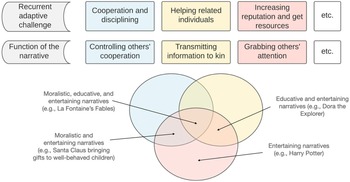
Of course, narratives which do not aim at entertaining can contain entertaining features, such as supernatural entities, because they make the narratives overall more attention-grabbing (Fig. R1). But the strategic incentives of the producers (e.g., to control other's cooperation) lead them to preferably include features that more specifically fulfill their goal (e.g., punishing deities; Fitouchi and Singh, Reference Fitouchi and Singh2021). By contrast, when the strategic goal of producers is to entertain other people, they preferably include features that tap into people's preferences.
Examples of functions of fictional narratives related to recurrent adaptive challenges, and their possible interactions. The red area represents purely entertaining fictions (even if, locally, there can be moralistic or educative features in Harry Potter). At the intersections, we observe mixed products. For instance, Santa Claus bringing gifts to well-behaved children is undoubtedly a moralistic fictional narrative, which ultimately aims at disciplining. As a matter of fact, in most oral narratives from early modern and modern Europe (in the Holy Roman Empire), Saint Nicholas was accompanied by a foil threatening to trash disobedient children (e.g., “Knecht Ruprecht” in Germany; “Krampus” in Austria; “Parkelj” in Slovenia, Croatia, and Hungary). Dora the Explorer is at the intersection of education and entertainment because Dora directly teaches children how to speak and count. Finally, some narratives can be moralistic, educative, and entertaining, as exemplified by La Fontaine's Fables.

To sum up, we believe that the “information hypothesis” alone does not explain why humans invent fictional narratives that depart from real facts, real social events, real persons, and real settings. If information transmission was the sole (or most important) goal of producers, they wouldn't incorporate fictional entertaining contents to their narratives. Scalise Sugiyama (Reference Sugiyama, Gottschall and Wilson2005, Reference Sugiyama2021) acknowledged this is a puzzle, and proposed that facts are mixed up with invented features because such features are (1) fully recognized as such (through the use of pragmatic cues observable across cultures and in small-scale societies) and (2) attention-grabbing and memorable (providing better learning opportunities). Our general framework, in fact, agrees with this view and asks the question why and how such specific features are attention-grabbing to the human mind.
R2. Proximate mechanisms: What are the psychological forces behind the specific features of imaginary worlds?
R2.1. Exploratory preferences explain the existence and the content of imaginary worlds
R2.1.1 Exploratory preferences explain the existence of imaginary worlds
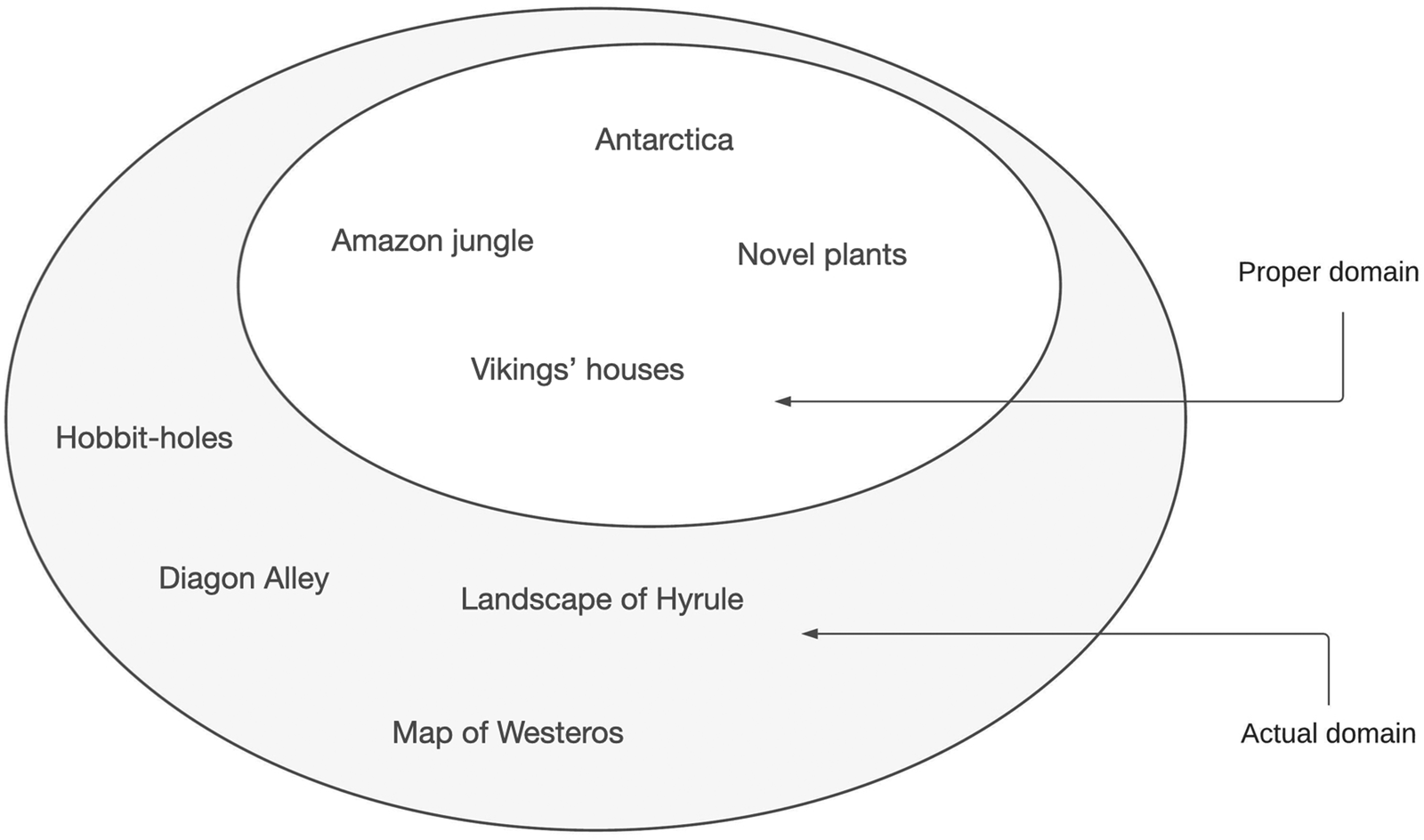
Some commentators argued that our definition of an imaginary world was somehow vague (Arnett; Llewellyn; Norman & Goldstein; Salmon & Burch; Shtulman; Sobchuk). This is not because we do not want to be analytical, it is because imaginary worlds are a product of the human mind: Our definition corresponds to the “actual domain” (Sperber & Hirschfeld, Reference Sperber and Hirschfeld2004) of exploratory preferences, that is, to all the settings that trigger them (Fig. R2). This preference for exploration has evolved in all humans because exploring the local environment leads to discover new resources, new mates, or new habitats, for example, and therefore brings about fitness benefits to the individuals. We hypothesized that this preference is activated by cues indicating that the environment is unknown and that these cues are exaggerated in fictions with imaginary worlds. Such cues include landscapes that are visually different from any landscape one knows (e.g., Hyrule's landscapes in Zelda), representations of a delimitation between the known and the unknown (e.g., the walls from Attack on Titan), new location names (e.g., Hogwarts in Harry Potter), and novel world-related information (e.g., the nine-headed phoenix from The Classic of Mountains and Seas). We contend that these cues (indicating to the consumers that the fictions they are consuming are taking place in an imaginary world) trigger exploratory preferences.
Exploratory preferences, with their proper domain (i.e., cues that an environment is unknown, e.g., unknown landscapes) and their actual domain (i.e., all stimuli mimicking cues that a setting is unknown, e.g., imaginary landscapes). Based on Sperber and Hirschfeld (Reference Sperber and Hirschfeld2004).

This makes the definition specific enough to distinguish imaginary worlds from other (sometimes related) stimuli. For instance, we believe that the world of Balzac is not an imaginary world. Balzac invented 3,000 characters, but his novels do not inspire the same degree of curiosity, because the world in which they take place (e.g., its geography, its functioning, and its rules) is already well known to the readers.
Note that this apparent problem of definition is not specific to imaginary worlds. We believe that the appeal of fictions all around the world is explained by the presence, in fictions, of a myriad of already appealing stimuli that producers use and exaggerate to enhance the attraction of the overall product. Such specific stimuli are appealing because they tap into specific preferences. The level of granularity of a fictional content feature (Sobchuk), therefore, depends on the specificity of the cognitive preference it is associated with. For instance, romance can be defined as a fiction based on a long-term relationship (Baumard, Huillery, & Zabro, Reference Baumard, Huillery and Zabroin press). What is a “long-term relationship”? This seems loose. It is not because it is based on the notion of pair-bonding, a specific adaptive behavior that evolved among monogamous species for which parental care is important (Fletcher, Simpson, Campbell, & Overall, Reference Fletcher, Simpson, Campbell and Overall2015).
R2.1.2. Exploratory preferences explain the content of imaginary worlds
Cues of imaginary worlds are included in fictions by producers because they are already attention-grabbing stimuli to the human mind. But it is important to bear in mind that producers also exaggerate such stimuli in fictions, making them even more attention-grabbing. This is what has been called superstimuli (Tinbergen, Reference Tinbergen1969) or supernormal stimuli (Nettle, Reference Nettle2005a, Reference Nettle, Gottschall and Wilson2005b). Cultural superstimuli are a specific case of cultural attractors which are successfully transmitted and stabilized in human cultures because they are intentionally made more attractive to the human mind (by human minds). While cultural products can be exaggerated in that way (e.g., diaries; Morin et al., Reference Morin, Acerbi and Sobchuk2019), we argue that fictions, being invented narratives, are specific: They can include virtually any superstimulus that one can think of, making it the ideal field to study superstimuli and cognitive preferences. We can, for instance, look at the direction of the exaggeration transforming a stimulus into a superstimulus, so as to infer the preference it taps into. For instance, Mickey is a highly popular protagonist. Across the last decade, his eyes have become more doting and his head larger. Why? We can explain this evolution of the shape of Mickey with our evolved baby-face detection system, which makes us like juvenile facial features. Proximally, this is a preference for “cuteness” (Glocker et al., Reference Glocker, Langleben, Ruparel, Loughead, Gur and Sachser2009a, Reference Glocker, Langleben, Ruparel, Loughead, Valdez, Griffin and Gur2009b). Therefore, because Mickey progressively became cuter and cuter, we can infer that Mickey's face is a superstimulus taping into our evolved preference for baby faces (Gould, Reference Gould2008; Hinde & Barden, Reference Hinde and Barden1985).
Superstimuli are different from normal stimuli, but this difference is a matter of degree. For instance, competent protagonists are appealing in fictions (Singh, Reference Singh2021). But highly competent protagonists are highly appealing. This is how we explain superpowers such as Superman's strength or ability to fly: it is a superstimulus of competence. If imaginary worlds tap into the human preference for spatial exploration, they can be viewed as superstimuli of explorable worlds. Actually, our theory predicts that fictions with non-imaginary foreign worlds, such as fictions being set in Asia for Western consumers, or fictions in distant history (Sobchuk), are also successful because of our exploratory preferences. Just as competent protagonists are also successful. Imaginary worlds are to explorable fictional worlds what superpowers are to competency. However, our theory does hypothesize that superstimuli (e.g., imaginary worlds and superpowers) are more appealing and entertaining compared to normal stimuli (e.g., unknown places and competency). This dimension of the hypothesis makes the prediction that there is a competition between both versions of the same stimulus (the normal stimulus and the superstimulus) because (1) the superstimulus (e.g., an imaginary world) has been cumulatively refine to better tap into the associated preference (e.g., exploratory preferences), and (2) both versions should be popular among the very same people (because they actually tap into the same preference). More specifically, here, we predict that fictions with imaginary words are becoming more and more successful, at the expense of historical fictions and fictions set in foreign countries.
R2.2 Exploratory preferences also predict the content features of imaginary worlds that are unrelated to exploratory preferences
Imaginary worlds are a difficult stimulus to isolate, in that respect: Producers can mix imaginary worlds with virtually any other content feature, making it even more difficult to disentangle them. Besides, some stimuli are often found associated together in fictions (more than chance would predict). For instance, imaginary worlds are often associated with dichotomic representation of good and evil. In our view, this does not mean that they constitute the same stimulus, or that they tap into the same cognitive preference. Rather, we hypothesize that some cognitive preferences are evoked by the same factors (e.g., ecological cues and the life stage), so that stimuli that activate such preferences are likely to be found in the same fictions. For instance, because adolescents are (1) reaching puberty (Del Giudice, Angeleri, & Manera, Reference Del Giudice, Angeleri and Manera2009), (2) more risk-taking (Bakerjr & Maner, Reference Bakerjr and Maner2008; Steinberg et al., Reference Steinberg, Icenogle, Shulman, Breiner, Chein, Bacchini and Takash2018), and (3) still highly explorative (Ciranka & van den Bos, Reference Ciranka and van den Bos2021), we predict that love-related stimuli, risk-related stimuli, and imaginary-world-related stimuli will tend to be associated in fictions (way more than chance would predict it), because a love story with a dangerous imaginary world would be a popular combination among a big potential audience (i.e., the adolescents). The evolutionary study of clustered features in fictions is a different research program which could be very promising in the near future. On that note, this is how we explain the bigger success of The Lord of the Rings over The Silmarillion (a puzzle rightfully highlighted by Pianzola et al.). While the “imaginary-world stimulus” may be stronger in The Silmarillion, The Lord of the Rings succeeds in combining a greater variety of appealing stimuli (e.g., Frodo's quest and Frodo's friendship with other protagonists).
R2.3 Fictions with imaginary worlds trigger several preferences, but only exploratory preferences are specific to imaginary worlds
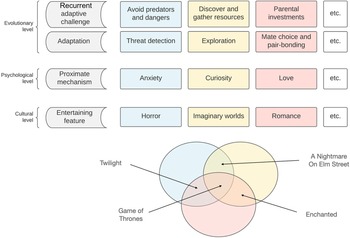
We do not deny that fictions with imaginary worlds also tap into other preferences (see Fig. R3), but we contend that fictions with imaginary worlds require the existence of exploratory preferences. Threat detection, romantic love, and social skills, for example, can lead to the invention of all kinds of fictions, but not to the full development of imaginary worlds.
Three examples of three entertaining features in fictions (cultural level) with the proximate mechanisms they co-opt (psychological level) and the ultimate functions of these mechanisms (evolutionary level), and their possible interactions.

R2.3.1. Imaginary worlds are not social worlds
Some commentators tried to support or challenge our hypothesis by mentioning the appeal for social exploration. For instance, commentators brought evidence that people like (1) to embody avatars that are different from themselves (Szolin & Griffiths), (2) to read about fictional characters who are morally ambiguous and deceive other people (Scalise Sugiyama; Wiessner), (3) or conversely to read about extremely good or evil characters (Wylie et al.), and (4) to read about the protagonists' internal thoughts (Pianzola et al.; Winner). We argue that these content features are not directly related to imaginary worlds, because they do not require an imaginary world to exist in a fiction. We believe that such stimuli are definitively worth studying within our framework, but as separate stimuli which would, therefore, tap into different evolved preferences (e.g., for detecting cheaters or potential good cooperative partners).
R2.3.2. Imaginary worlds are not minimally counterintuitive worlds
Some commentators rightfully mention that imaginary worlds are often filled up with strange content features which grab our attention, such as part-animal part-human protagonists (Wiessner), “talking animals, flying carpets, time-traveling wizards” (Shtulman), or human transformation into supernatural beings (Scalise Sugiyama). Such stimuli can be associated with our strict definition of an imaginary world by stating that they point to the consumers that the setting of the fiction may well be an imaginary world. But this is not necessarily the case. Let's think of fictions in which such features are described within a known location of the real world. For instance, Meyer's Twilight includes immortal vampires and is yet set in a real city (Fork, Washington), in the real world. Consistently, such stimuli do not strike us as necessarily feeding the human desire to explore their environment. As Shtulman explains it, such stimuli are appealing stimuli in themselves, because they violate core intuitions we have, for instance about biology (e.g., biological beings are mortal) and physics (e.g., objects don't fly or don't go through walls). These beliefs are so intuitive that fictional features that break them constitute highly entertaining stimuli even in a faithful representation of the real world (Banerjee, Haque, & Spelke, Reference Banerjee, Haque and Spelke2013; Boyer, Reference Boyer2001; Boyer & Ramble, Reference Boyer and Ramble2001; Norenzayan, Atran, Faulkner, & Schaller, Reference Norenzayan, Atran, Faulkner and Schaller2006; Stubbersfield & Tehrani, Reference Stubbersfield and Tehrani2013). In the same way, we argue that studies mentioned by developmental psychologists focus not on imaginary worlds (defined as cues that the fictional setting is unknown) but on minimally counterintuitive content features, such as characters walking through walls (Weisberg & Sobel), or invisible objects (Barnes, Bernstein, & Bloom, Reference Barnes, Bernstein and Bloom2015; Beck & Harris).
R2.3.3. Imaginary worlds are not (just) storyworlds
We agree with Pianzola et al. that the feeling of presence and the self-perception of skillful agency are appealing in fictions, and that this is highly related to imaginary worlds. For instance, the sequentiality of events in fictional narratives allows to describe protagonists moving through the imaginary settings and to provide consumers with progressive descriptions or visual depictions of space that make us feel agent of this unknown world. It activates a preference for controlling one's own actions and events (Haggard & Chambon, Reference Haggard and Chambon2012), in addition to the preference for exploration. As the commentators state it, although, this feeling of presence is not specific to imaginary worlds because it is a component of virtually all fictional storyworlds. Therefore, it cannot explain alone why imaginary worlds emerged and why they are so successful. That being said, we agree that such a feeling is enhanced in imaginary worlds. This is clearly observable in open-world video games taking place in large imaginary worlds: Consumers of such fictions are driven by the possibility to interact and move within the imaginary world, making it seem as they constitute the same appealing stimulus. We argue that it is important to disentangle them and study them apart in the first place, before considering studying them together.
R2.3.4. Imaginary worlds are not (just) frightening worlds
Scrivner and Clasen state from the beginning that morbid curiosity is an “additional factor” explaining the cultural evolution and success of imaginary worlds. We completely subscribe to their proposition that horror stimuli in fictions, such as dark places, monsters, or dangerous situations, activate our threat detection systems (while we are more skeptical that people read or watch horror fictions to be better prepared to face danger in the real world; see sect. R1.2.1). However, while horror stimuli are very often found in imaginary worlds, we do not think that they are specific to them. One can consume a fiction with a dark forest and a killer, find it entertaining, but not conclude that the fiction takes place in an imaginary world. Consistently, we have the intuition that such stimuli (e.g., a dark forest and a killer) don't fuel our lust of exploration, the way large unknown landscapes do. Of course, both features go along well: Middle-Earth is both an imaginary world and, sometimes, a frightening world filled with Orcs, so that it combines two powerful attractors. And there seems to be several other fictions after The Lord of the Rings which associated imaginary worlds and frightening stories. This is, we think, a combination that is worth exploring in future research.
R2.3.5. Imaginary worlds may well be organized worlds
This is a possibility which we only briefly mention in the Discussion of the Target Article, and which would have deserved more investigation. As such, we were pleased and interested to read Browning and Veit's commentary about autism and the preference for imaginary worlds. Actually, we agree that the drive to systemize (defined as a drive to “explore a system” by Baron-Cohen, Reference Baron-Cohen2003) may be very closely related to the preference for spatial exploration. We propose here a way to incorporate this explanation to our hypothesis, and, in doing so, to consistently explain why items in imaginary worlds such as lists of location names or maps, are likely to be considered as cues that the imaginary setting is worth exploring (and to activate our preference for exploration). The proposition is to bring together three theories of exploration and curiosity, by stating that exploration allows foraging new resources, important resources, and better ways to explore further (and discover new and important resources). This explains the curiosity for new things (i.e., novelty-based exploration; e.g., Berlyne, Reference Berlyne1950; FitzGibbon, Lau, & Murayama, Reference FitzGibbon, Lau and Murayama2020; Litman, Reference Litman2005; Wade & Kidd, Reference Wade and Kidd2019), the curiosity for important things (i.e., value-based exploration; Dubey & Griffiths, Reference Dubey and Griffiths2020; Dubey, Griffiths, & Lombrozo, Reference Dubey, Griffiths and Lombrozo2020; Spitzer & Kiesel, Reference Spitzer and Kiesel2021; Stojic, Analytis, Schulz, & Speekenbrink, Reference Stojic, Analytis, Schulz and Speekenbrink2020), and the curiosity for complex, yet-to-understand things (i.e., systemizing, defined as the drive to explore a system; Baron-Cohen, Reference Baron-Cohen2003, Reference Baron-Cohen2006, Reference Baron-Cohen2009; Greenberg, Warrier, Allison, & Baron-Cohen, Reference Greenberg, Warrier, Allison and Baron-Cohen2018). We are currently launching an experimental study to test several predictions that our hypothesis makes, and we will include in the paradigm the Systemizing-Quotient questionnaire (Ling, Burton, Salt, & Muncer, Reference Ling, Burton, Salt and Muncer2009; Veale & Williams, Reference Veale and Williams2017; Wakabayashi et al., Reference Wakabayashi, Baron-Cohen, Wheelwright, Goldenfeld, Delaney, Fine and Weil2006), to test Browning and Veit's prediction that people who systemize more are more attracted to imaginary worlds. Incidentally, we also predict that men are overall more attracted to imaginary worlds, because such worlds are likely to be highly explorable systems, as opposed to character-oriented stories which are more attractive to women (Browning & Veit; Salmon & Burch). As Salmon and Burch imply it, this could be tested by quantifying which feature each sex focuses on and extend or modify when writing fanfictions from canonic fictions with imaginary worlds. We predict that male consumers (or more systemizing people) will target more world-related features (e.g., extending the information about a location) whereas female consumers (or more empathizing people) will target more character-related features (e.g., modifying the relationships of the protagonists). This addition to the theory also leads to a prediction as to why people like to re-consume fictions with imaginary worlds (Dunk & Mar; Gabriel et al.): Because highly exploratory people are likely to be (hyper-)systemizers, so that they want to understand everything about the imaginary world (Browning & Veit).
R2.3.6. Conclusion: What is an imaginary world?
To conclude this sub-section, we argue that several stimuli that commentators mention are not constitutive of imaginary worlds. This does not mean that the explanations reported in this sub-section are not interesting and important. This does not mean that they are not fully compatible with our hypothesis either. However, according to us, this means that most explanations don't focus on the right features to explain the cultural evolution and success of imaginary worlds. They explore why fictions with imaginary worlds are successful with elements that are shared by both fictions with imaginary worlds and fictions with no imaginary world. That is, they don't explain how the specificity of imaginary settings contributes to the success of fictions with imaginary worlds, or why imaginary worlds appear at all in cultural history.
R3. Distribution: What explains the distribution of imaginary world across age, time, space, and social classes?
R3.1. Changes in consumers’ preferences, not producers’ skills
The line of argument in the previous sections clears up some misunderstandings about our general hypothesis. For instance, Wolf rightfully mentions that imaginary worlds have actually existed for a long time (see also Dunk & Mar; Moore & Hills; Scalise Sugiyama; Wiessner). Yet this observation does not contradict our general hypothesis that the appeal for imaginary worlds relies on exploratory preferences and that this appeal increased as people's exploratory preferences increased. Importantly, we never argued that producers “lacked the cognitive abilities to create elaborate and inventive imaginary worlds of substantial size and with considerable amounts of world data” (we agree with Wolf that they did not lack such abilities), but rather that consumers lacked strong exploratory preferences to find such imaginary worlds entertaining. We, therefore, argue that past literary authors could (and did) produce inventive imaginary worlds, but that such fictions were relatively fewer in number, and relatively poorer in details, than in modern societies, precisely because they were less popular given the preferences of the people at the time. Let's note also that what matters for our theoretical framework is the cultural success at the time the fictional work is released, not their later success or influence.
As a matter of fact, the question is: Who consumed such fiction with imaginary worlds from earlier times? In our article, we explained why and how, in most species (including humans), the strength of exploratory preferences is linked to the level and steadiness of resources in local ecologies. At the individual level, such ecologies differ within a given society, because economic and material resources greatly vary from one family to another, with the best proxy being their economic status. Our hypothesis makes the prediction that imaginary worlds could be culturally successful in past societies, but only with richer individuals (i.e., only with a small fraction of the potential audience). Of course, this prediction is hard to test because, until recently, richer people were the only ones who could both buy books and read, and therefore the only ones who consumed literary works (Kaestle, Reference Kaestle1985; Schofield, Reference Schofield1973; Stone, Reference Stone1969), so that we can't compare their consumption of fictions with the consumption of fictions of poorer people (as Winner rightfully suggests we should do). More precisely, there might not be enough variance in the economic status of readers from the past to test our hypothesis with historical data at the individual level. However, we can test that, at the population level, when a given society gets richer, people in this society express on average stronger exploratory preferences (because the overall environment is both more secure and more affluent), and eventually become fonder of imaginary worlds. This prediction is, therefore, fully consistent with the observations that imaginary worlds culturally emerged (1) before contemporary times, with the examples of More's Utopia and Defoe's Robinson Crusoe (mentioned by Wolf), and (2) outside Western countries, with the examples of the tales of Coyote's travels (mentioned by Wiessner) and the Chinese Classic of Mountains and Seas (fourth century BC).
Finally, while Buttrick and Oishi agree with our hypothesis that consumers' exploratory preferences explain the evolution and success of imaginary worlds, they challenge the hypothesis that the variability of such preferences can be ultimately explained with adaptive phenotypic and developmental plasticity. However, the disagreement does not seem that deep: We agree with the commentators that our drive to explore tracks proximate socio-ecological cues and adapt to them. And we agree that the motivation to go sightseeing and visiting foreign places should be correlated with the motivation to consume fictions with imaginary worlds (both behaviors being driven by exploratory preferences). However, we disagree with the hypothesis that the preference (or possibility) to move causes the preference for imaginary worlds. According to our theoretical framework, both are effects of a cognitive preference for spatial exploration, which adaptively varies according to ecological conditions. Both hypotheses make more or less similar diachronic predictions about correlations between different variables (e.g., the evolution of the rate of tourism and the evolution of the prevalence of imaginary worlds in fictions). However, our evolutionary hypothesis makes at least two predictions that their socioecological hypothesis doesn't: (1) that, synchronically, in the same society, people with higher socio-economic status are more exploratory and hence consume more fictions with imaginary worlds than people with lower socio-economic status, even if they don't travel more (a variable that can be controlled for); and (2) that children are more explorative and hence consume more fictions with imaginary worlds (even if they don't travel; see sect. R3.2). Only further empirical research about the variability of fiction consumption across modern population can settle this debate.
R3.2. Children's preferences, not their abilities
Now that our framework is better defined, we can address a point of divergence between our general hypothesis and commentaries from developmental psychologists (Beck & Harris; Norman & Goldstein; Nyhout & Lee; Weisberg & Sobel). According to us, this point of divergence stems from the same misunderstanding that we reviewed in the latter section: They consider (more or less explicitly) that children's skills should somehow drive the cultural evolution of children fictions. It is all the more important to clarify this point as we believe that developmental predictions derived from our framework could be both highly specific and straightforwardly testable. As we argue elsewhere (Dubourg & Baumard, Reference Dubourg and Baumardin press), this framework (bringing together cultural attraction theory and adaptive developmental plasticity) could explain the presence and absence of a myriad of content features in fictions, by considering the age of their targeted audience. Why? Each human life stage from infancy to old age, and including childhood, juvenility, adolescence, and adulthood, is endowed with age-specific preferences (Bjorklund & Pellegrini, Reference Bjorklund and Pellegrini2000; Del Giudice et al., Reference Del Giudice, Angeleri and Manera2009), because natural selection has favored individuals who are able to adopt an optimal scheduling of preferences (Gangestad & Kaplan, Reference Gangestad, Kaplan, Buss and Giudice2015; Hill, Reference Hill1993; Kaplan & Gangestad, Reference Kaplan, Gangestad and Buss2005). Because our general framework suggests that the cultural evolution of fictions is driven by the consumers' preferences, we can derive a series of predictions about the distribution of content features in fictional narratives by considering the age of the people who find them entertaining (Dubourg & Baumard, Reference Dubourg and Baumardin press).
Coming back to the specific case of the appeal for imaginary worlds, we maintain that our hypothesis doesn't make any prediction about “how children imagine” (Weisberg & Sobel) or about whether children are “imaginative” or not (Beck & Harris; Norman & Goldstein; Nyhout & Lee; Weisberg & Sobel). We don't claim that “children appear to be both highly exploratory and highly imaginative” (Beck & Harris) but rather that children appear to be highly exploratory and hence highly receptive to content features triggering exploratory preferences in fictions. This is why we make the prediction that, if imaginary worlds do co-opt exploratory preferences, they should be popular among children. Studies reported in the commentaries never test the specific predictions that children enjoy imaginary worlds more than adults do. For instance, Barnes, Berstein, and Bloom's (Reference Barnes, Bernstein and Bloom2015) seminal study and the following related studies (e.g., Taggart, Heise, & Lillard, Reference Taggart, Heise and Lillard2018) show that the attraction toward fiction varies with age, with younger people being less drawn to fictional over realistic narratives (or activities). This doesn't go against our theory, which would rather state that when children actually decide to consume fictions, their cognitive preferences (such as their exploratory preferences) drive what they like and want to consume. Nyhout and O'Neill’ (Reference Nyhout and O'Neill2017) study shows that following the characters' movements in a story can be difficult for children. Likewise, this is no evidence against our hypothesis because the study focuses on children's abilities, not children's preferences. This is, we argue, one major issue that prevents us from using results from such otherwise important studies to investigate children's specific preferences.
We could not agree more with the limitations highlighted in the commentaries with regard to the possible ways to empirically test developmental predictions derived from our hypothesis. Studying children's actual preferences with fictional content is difficult. Parents influence children's fiction consumption (Nyhout & Lee; Weisberg & Sobel), and further research should investigate to what extent before drawing any conclusion from the analysis of consumption data. Besides, market data (1) often don't include data on children's consumption (Nyhout & Lee), (2) never include indicators of success such as ratings by children, and (3) are hard to find in developing countries and in small-scale societies (Norman & Goldstein). Only laboratory research with children could allow studying actual children preferences, and to test more specifically the prediction that children are actually fond of imaginary worlds when they are consuming fictional stories.
R.4. Conclusion: More and better cultural databases
We couldn't agree more with Dunk and Mar that our theoretical model is not yet supported by enough empirical evidence, and that we need more and better data (Dunk & Mar; Winner) and better proxies (Dunk & Mar) to proceed. More importantly, we need better comparative cultural databases, the coding of which needs to be standardized, organized, and shared between researchers (Slingerland et al., Reference Slingerland, Atkinson, Ember, Sheehan, Muthukrishna, Bulbulia and Gray2020). To do that, we have started empirical projects on imaginary worlds, and more generally on superstimuli in fictions. First, we are about to launch an experimental study to collect data from participants, including their movie preferences, measures of their psychological traits (such as their exploratory preferences [with the curiosity and exploration inventory; Kashdan et al., Reference Kashdan, Gallagher, Silvia, Winterstein, Breen, Terhar and Steger2009], their Big Five personality traits, and their systemizing quotient) and their socio-demographic information. Second, we will very soon launch an online platform designed to collect and aggregate metadata about fictions (and specific content features) from around the world: the inventory of fictions. Hopefully, it will make it possible to empirically test specific predictions about the cultural evolution of fictions with standardized cross-cultural data, coming from experts of fictions worldwide. We are very grateful to all the commentators for their highly valuable contributions to the understandings of the cultural evolution and success of imaginary worlds which are, as virtually all commentators agreed upon, a fascinating content feature to study.



Target article
Why imaginary worlds? The psychological foundations and cultural evolution of fictions with imaginary worlds
Related commentaries (32)
All non-real worlds provide exploration: Evidence from developmental psychology
Am I present in imaginary worlds? Intentions, actions, and flow in mediated experiences and fiction
Autism and the preference for imaginary worlds
Brave new world: Imaginative fictions offer simulated safety and actual benefits
Cognitive exploration drives engagement and re-engagement with imaginary worlds, but not spatial exploration as predicted by evolutionary theory
Determining the markers of a preference for imaginary worlds fiction calls for comparisons across kinds of fiction readers and forms of exploration
Does progressive aphantasia exist? The hypothetical role of aphantasia in the diagnosis of neurodegenerative diseases
Exploration and arrangement in physical and social worlds
How granular should our explanations of fantastic fiction be?
Imaginary worlds are awesome: Awe provides a key to understanding the individual and social functions of imaginary worlds
Imaginary worlds are attractive because they simulate multiple adaptive problems and encode real-world information
Imaginary worlds pervade forager oral tradition
Imaginative processes in children are not particularly imaginative
Imagining our moral values in the present and future
Influences on the development of imaginary worlds
It's not fiction if you believe it: How imaginary worlds are derived from imaginary realities
Middle-earth wasn't built in a day: How do we explain the costs of creating a world?
Not just a hijack: Imaginary worlds can enhance individual and group-level fitness
Simulation, stories, and fictional worlds
Socioecology and fiction
The allure of the unknown in a tamed, mapped, and homogenized world
The call of the final frontier?
The deep history of imaginary worlds
The development of the imagination and imaginary worlds
The evolution of imagination and the adaptive value of imaginary worlds
The familiar appeal of imaginary worlds
Using imaginary worlds for real social benefits
Why do people create imaginary worlds? The case of Fanfiction
Why frightening imaginary worlds? Morbid curiosity and the learning potential of horror
Why imaginary worlds? The role of self-exploration within online gaming worlds
Young children are not driven to explore imaginary worlds
“Never Land”: Where do imaginary worlds come from?
Author response
Imaginary worlds through the evolutionary lens: Ultimate functions, proximate mechanisms, cultural distribution