Dubourg and Baumard's (D&B) main assumption is that a certain kind of fictional works (“world-dominant fictions”) are mainly consumed because their imaginary worlds are attractive. Moreover, they assume that the exploration of imaginary worlds is similar to the exploration of a real physical space: “Humans would find imaginary worlds very attractive for the very same reasons, and under the same circumstances, as they are lured by unfamiliar environments in real life.” The main issue with this assumption is that it ignores that our engagement with world-dominant fiction is a mediated experience, shaped by the way an author (or production team) decided to present a certain imaginary world to their audience. When engaging with stories, the sequentiality of the events presented and the narrative design (e.g., impersonal description or first-person perspective) are always guiding the exploration of the story world (Kukkonen, Reference Kukkonen2020). An example showing this – and disproving D&B's hypothesis about the cultural preference for imaginary worlds – is the unequal success of the two books The Lord of the Rings and The Silmarillion by J. R. R. Tolkien. Both books tell stories about the same imaginary world, but the narrative organization of The Lord of the Rings makes it more attractive than the richness of spatial information provided in The Silmarillion (e.g., 4.5 vs. 3.9 stars on the book reviews website Goodreads). Abstracting general patterns in cultural preferences for fiction will require more empirical investigations of how fictional stories spread and become popular.
Rather than the mere opportunity for exploration, a more plausible link between real and imaginary worlds lies potentially in the feeling of “presence” we can experience in both of them. Presence is the self-perception of skillful agency: we feel present when we are able to correctly and intuitively enact our embodied predictions. And humans are attracted to imaginary worlds and characters because stories allow them to accumulate evidence to find the best explanation for their sensations (Friston, Rosch, Parr, Price, & Bowman, Reference Friston, Rosch, Parr, Price and Bowman2017; Pianzola, Riva, Kukkonen, & Mantovani, Reference Pianzola, Riva, Kukkonen and Mantovani2021). Narrative is a training ground for the development of our ability to predict the causes of signals coming from the environment and from our inner states (Friston, Reference Friston2010; Seth & Friston, Reference Seth and Friston2016) because it provides “alternate hypotheses that generalize and therefore preclude overfitting (sensory) data” (Bouizegarene, Ramstead, Constant, Friston, & Kirmayer, Reference Bouizegarene, Ramstead, Constant, Friston and Kirmayer2020). By engaging with stories, humans become more skillful agents; they become better at adapting to and interacting with the environment and others.
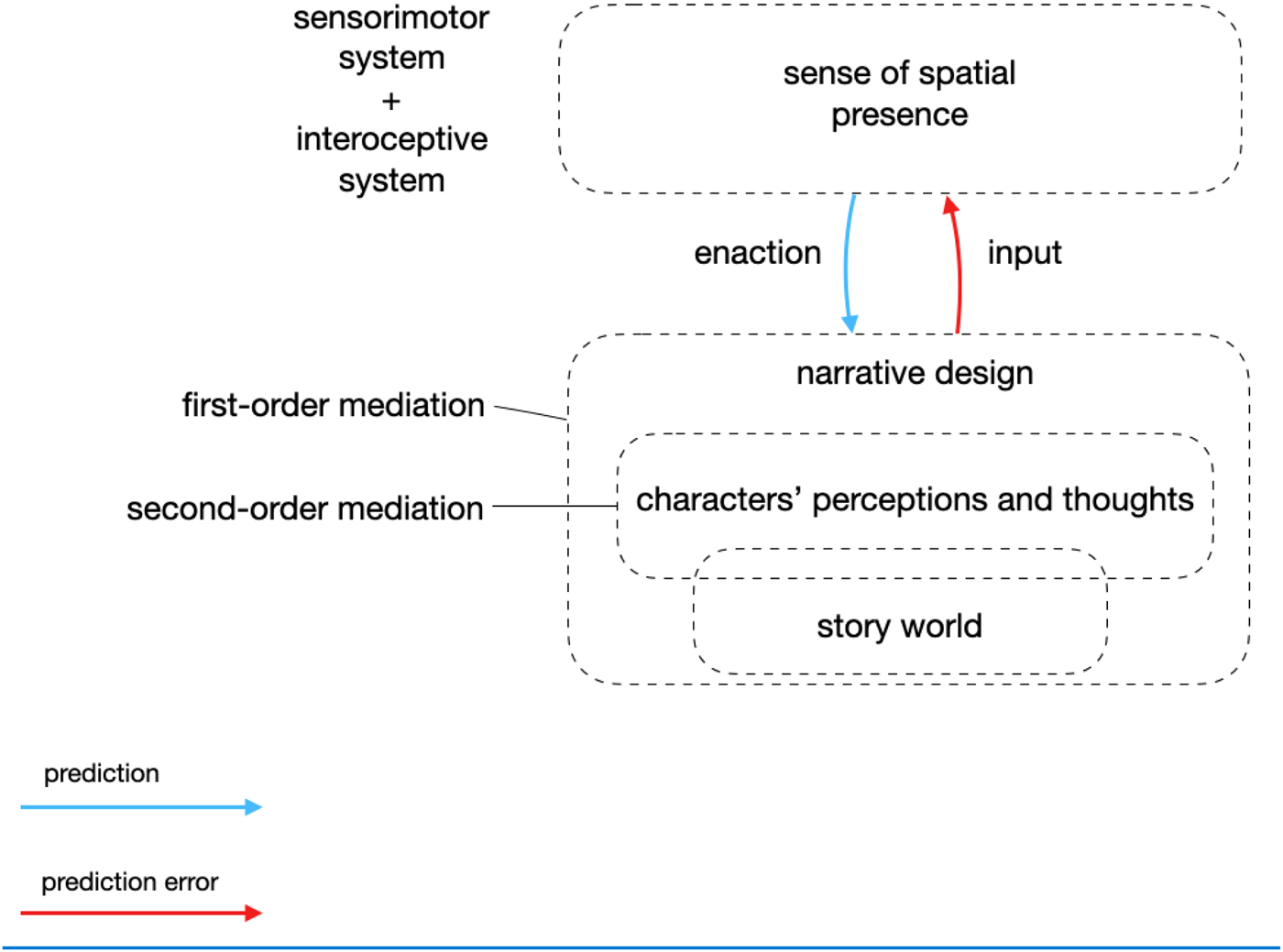
We are able to generalize from imaginary worlds to the real world because both explorations are guided by the sense of presence induced by the correct enaction of our embodied predictions and intentions. However, every time we pick up a book or turn on a screen, we know that we cannot explore imaginary worlds in the same way as we do in the real world, therefore we cannot be attracted to world-dominant fictions “for the very same reasons, and under the same circumstances.” We know that engaging with a fiction world is a mediated experience (Fig. 1), shaped by the choices that someone made in creating a story (first-order mediation) and by the fictional characters that inhabit it, because we often perceive the world from their perspective (second-order mediation), enacting their consciousness (Caracciolo, Reference Caracciolo2014).
The double mediation and the scaffolding of readers' engagement with fictional worlds through narrative design point to another problematic omission in D&B's discussion.
They do not clarify whether humans have a specific preference for the exploration of space or they tend to explore new situations in general. If it is a general bias (as it seems from the evidence they quote from developmental psychology), the popularity of imaginary worlds versus other genres cannot be explained in terms of desire for exploration of story space in the authors' terms. After all, even stories with poorly-defined imaginary worlds invite an exploration of characters' minds, experiences, and their relations to other characters, which can all be understood as “situations.” Indeed, the evidence for “openness to experience” in readers cited by the authors suggests that also the appreciation of genres where non-spatial situations are dominant correlates with this personality trait. The model of mediation and presence, on the other hand, applies to both spatial and interpersonal situations.
D&B highlight that cognition is fundamental to how culture develops. We agree, but we suggest that there is a feedback loop: cultural and media forms shape cognition throughout history. The more a medium or cultural artefact (e.g., narrative) is able to support the correct enactment of an individual's predictions and to clarify the intentions of others, the stronger is the sense of presence experienced with the medium or cultural artefact. In conclusion, an optimal balance between predictions and prediction errors (flow) facilitates the emergence of a sense of presence in both real and fictional worlds. This common embodied cognitive process is what allows us to generalize from imaginary worlds to the real world, even though we use different skills and cognitive and cultural schemata when exploring fiction.







Dubourg and Baumard's (D&B) main assumption is that a certain kind of fictional works (“world-dominant fictions”) are mainly consumed because their imaginary worlds are attractive. Moreover, they assume that the exploration of imaginary worlds is similar to the exploration of a real physical space: “Humans would find imaginary worlds very attractive for the very same reasons, and under the same circumstances, as they are lured by unfamiliar environments in real life.” The main issue with this assumption is that it ignores that our engagement with world-dominant fiction is a mediated experience, shaped by the way an author (or production team) decided to present a certain imaginary world to their audience. When engaging with stories, the sequentiality of the events presented and the narrative design (e.g., impersonal description or first-person perspective) are always guiding the exploration of the story world (Kukkonen, Reference Kukkonen2020). An example showing this – and disproving D&B's hypothesis about the cultural preference for imaginary worlds – is the unequal success of the two books The Lord of the Rings and The Silmarillion by J. R. R. Tolkien. Both books tell stories about the same imaginary world, but the narrative organization of The Lord of the Rings makes it more attractive than the richness of spatial information provided in The Silmarillion (e.g., 4.5 vs. 3.9 stars on the book reviews website Goodreads). Abstracting general patterns in cultural preferences for fiction will require more empirical investigations of how fictional stories spread and become popular.
Rather than the mere opportunity for exploration, a more plausible link between real and imaginary worlds lies potentially in the feeling of “presence” we can experience in both of them. Presence is the self-perception of skillful agency: we feel present when we are able to correctly and intuitively enact our embodied predictions. And humans are attracted to imaginary worlds and characters because stories allow them to accumulate evidence to find the best explanation for their sensations (Friston, Rosch, Parr, Price, & Bowman, Reference Friston, Rosch, Parr, Price and Bowman2017; Pianzola, Riva, Kukkonen, & Mantovani, Reference Pianzola, Riva, Kukkonen and Mantovani2021). Narrative is a training ground for the development of our ability to predict the causes of signals coming from the environment and from our inner states (Friston, Reference Friston2010; Seth & Friston, Reference Seth and Friston2016) because it provides “alternate hypotheses that generalize and therefore preclude overfitting (sensory) data” (Bouizegarene, Ramstead, Constant, Friston, & Kirmayer, Reference Bouizegarene, Ramstead, Constant, Friston and Kirmayer2020). By engaging with stories, humans become more skillful agents; they become better at adapting to and interacting with the environment and others.
We are able to generalize from imaginary worlds to the real world because both explorations are guided by the sense of presence induced by the correct enaction of our embodied predictions and intentions. However, every time we pick up a book or turn on a screen, we know that we cannot explore imaginary worlds in the same way as we do in the real world, therefore we cannot be attracted to world-dominant fictions “for the very same reasons, and under the same circumstances.” We know that engaging with a fiction world is a mediated experience (Fig. 1), shaped by the choices that someone made in creating a story (first-order mediation) and by the fictional characters that inhabit it, because we often perceive the world from their perspective (second-order mediation), enacting their consciousness (Caracciolo, Reference Caracciolo2014).
Double mediation process of the cognitive access to story worlds (cf. Pianzola et al., Reference Pianzola, Riva, Kukkonen and Mantovani2021).
The double mediation and the scaffolding of readers' engagement with fictional worlds through narrative design point to another problematic omission in D&B's discussion.
They do not clarify whether humans have a specific preference for the exploration of space or they tend to explore new situations in general. If it is a general bias (as it seems from the evidence they quote from developmental psychology), the popularity of imaginary worlds versus other genres cannot be explained in terms of desire for exploration of story space in the authors' terms. After all, even stories with poorly-defined imaginary worlds invite an exploration of characters' minds, experiences, and their relations to other characters, which can all be understood as “situations.” Indeed, the evidence for “openness to experience” in readers cited by the authors suggests that also the appreciation of genres where non-spatial situations are dominant correlates with this personality trait. The model of mediation and presence, on the other hand, applies to both spatial and interpersonal situations.
D&B highlight that cognition is fundamental to how culture develops. We agree, but we suggest that there is a feedback loop: cultural and media forms shape cognition throughout history. The more a medium or cultural artefact (e.g., narrative) is able to support the correct enactment of an individual's predictions and to clarify the intentions of others, the stronger is the sense of presence experienced with the medium or cultural artefact. In conclusion, an optimal balance between predictions and prediction errors (flow) facilitates the emergence of a sense of presence in both real and fictional worlds. This common embodied cognitive process is what allows us to generalize from imaginary worlds to the real world, even though we use different skills and cognitive and cultural schemata when exploring fiction.
Funding
FP was financially supported by the European Union's Horizon 2020 research and innovation program under the grant agreement No 792849 (project READIT).
Conflict of interest
None.