





No CrossRef data available.
Article contents
Not by intuitions alone: Institutions shape our ownership behaviour
Published online by Cambridge University Press: 10 October 2023
Abstract
Every day, people make decisions about who owns what. What cognitive processes produce this? The target article emphasises the role of biologically evolved intuitions about competition and cooperation. We elaborate the role of cultural evolutionary processes for solving coordination problems. A model based fully on biological evolution misses important insights for explaining the arbitrariness and historical contingency in ownership beliefs.
Information
- Type
- Open Peer Commentary
- Information
- Copyright
- Copyright © The Author(s), 2023. Published by Cambridge University Press
References
Berge, E., Kambewa, D., Munthali, A., & Wiig, H. (2014). Lineage and land reforms in Malawi: Do matrilineal and patrilineal landholding systems represent a problem for land reforms in Malawi? Land Use Policy, 41, 61–69. https://doi.org/10.1016/j.landusepol.2014.05.003.CrossRefGoogle Scholar
Binmore, K., & Samuelson, L. (1997). Muddling through: Noisy equilibrium selection. Journal of Economic Theory, 74(2), 235–265. https://doi.org/10.1006/jeth.1996.2255.CrossRefGoogle Scholar
Chimhowu, A. (2019). The “new” African customary land tenure. Characteristic, features and policy implications of a new paradigm. Land Use Policy, 81, 897–903. https://doi.org/10.1016/j.landusepol.2018.04.014.CrossRefGoogle Scholar
Clarke, C. (2017). Francesco Guala’s understanding institutions (book review). BJPS Review of Books. https://www.thebsps.org/reviewofbooks/francesco-guala-understanding-institutions/.Google Scholar
Crittenden, A. N., & Zes, D. A. (2015). Food sharing among Hadza hunter-gatherer children. PLoS ONE, 10(7), e0131996. https://doi.org/doi:10.1371/journal. pone.0131996.CrossRefGoogle ScholarPubMed
Fabbri, M., Rizzolli, M., & Maruotti, A. (2021). Possession is nine-tenths of the law: Possession, property, and coordination in a Hawk–Dove experiment. Journal of Institutional Economics, 17, 267–288. https://doi.org/doi:10.1017/S1744137420000442.CrossRefGoogle Scholar
Friedman, O. (2008). First possession: An assumption guiding inferences about who owns what. Psychonomic Bulletin & Review, 15(2), 290–295. https://doi.org/10.3758/PBR.15.2.290.CrossRefGoogle Scholar
Friedman, O., & Neary, K. (2009). First possession beyond the law: Adults’ and young children's intuitions about ownership. Tulane Law Review, 83, 1–12. https://heinonline.org/HOL/Page?handle=hein.journals/tulr83&div=26&g_sent=1&casa_token=&collection=journals.Google Scholar
Guala, F. (2016). Understanding institutions: The science and philosophy of living together. Princeton University Press.Google Scholar
Heintz, C. (2014). Scaffolding on core cognition. In Caporael, L. R., Griesemer, J. R., & Wimsatt, W. C. (Eds.), Developing scaffold in evolution, culture, and cognition (pp. 209–228). The MIT Press.Google Scholar
Hindriks, F., & Guala, F. (2015). Institutions, rules, and equilibria: A unified theory. Journal of Institutional Economics, 11(3), 459–480. https://doi.org/10.1017/S1744137414000496.CrossRefGoogle Scholar
Kovács, Z., & Herfert, G. (2012). Development pathways of large housing estates in post-socialist cities: An international comparison. Housing Studies, 27(3), 324–342. https://doi.org/10.1080/02673037.2012.651105.CrossRefGoogle Scholar
Lightner, A. D., Pisor, A. C., & Hagen, E. H. (2022). In need-based sharing, sharing is more important than need. Preprint. https://psyarxiv.com/cm3ap.Google Scholar
Martinovic, B., & Verkuyten, M. (2013). “We were here first, so we determine the rules of the game”: Autochthony and prejudice towards out-groups. European Journal of Social Psychology, 43(7), 637–647. https://doi.org/10.1002/ejsp.1980.CrossRefGoogle Scholar
Nancekivell, S. E., Friedman, O., & Gelman, S. A. (2019). Ownership matters: People possess a naïve theory of ownership. Trends in Cognitive Sciences, 23(2), 102–113. https://doi.org/10.1016/j.tics.2018.11.008.CrossRefGoogle ScholarPubMed
Rose, C. M. (1985). Possession as the origin of property. University of Chicago Law Review, 52(1), 73–88. https://chicagounbound.uchicago.edu/uclrev/vol52/iss1/2.CrossRefGoogle Scholar
Savas, E. S. (1992). Privatization in post-socialist countries. Public Administration Review, 52(6), 573–581. https://doi.org/10.2307/977167.CrossRefGoogle Scholar
Tooby, J., & Cosmides, L. (1992). The psychological foundations of culture. In Barkow, J. H., Cosmides, L., & Tooby, J. (Eds.), The adapted mind: Evolutionary psychology and the generation of culture (pp. 19–136). Oxford University Press.Google Scholar
Verdery, K. (1998). Transnationalism, nationalism, citizenship, and property: Eastern Europe since 1989. American Ethnologist, 25(2), 291–306. https://anthrosource.onlinelibrary.wiley.com/doi/epdf/10.1525/ae.1998.25.2.291.CrossRefGoogle Scholar
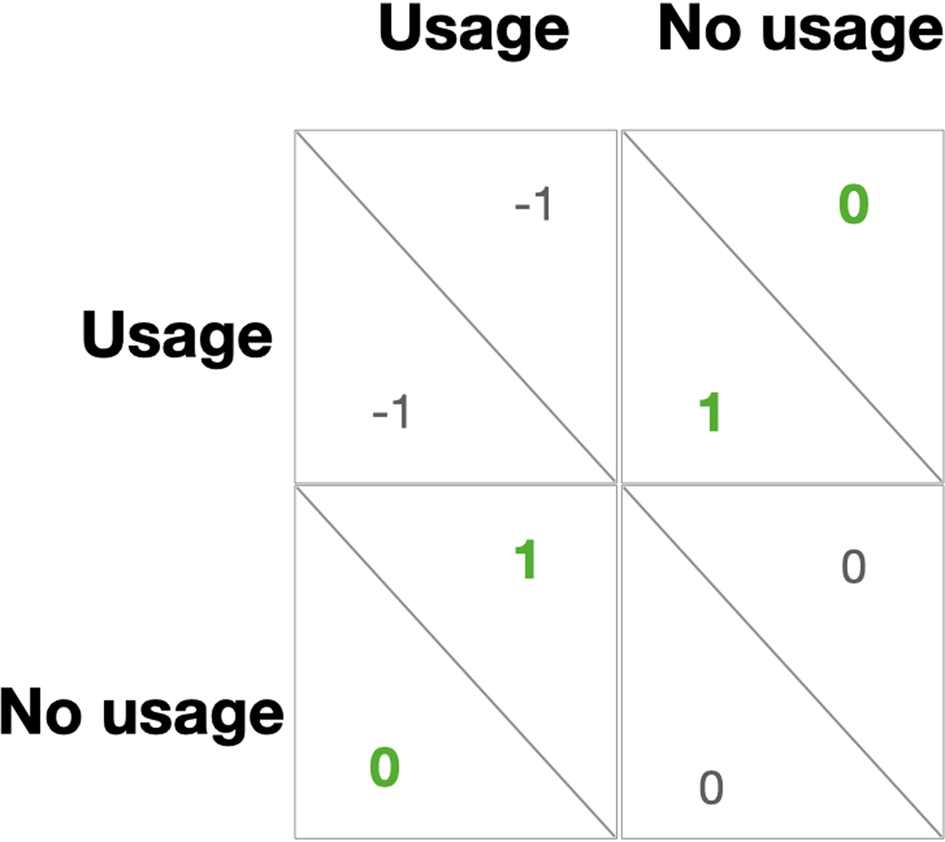
Figure 1. Payoff matrix for the game of ownership. If both agents try to use the same resource simultaneously, they both incur costs by fighting each other (Usage; Usage). If neither agents use the resource, they miss out on the benefits the resource will bring to them (No usage; No usage). Thus, the best outcome for both is either agent A uses the resource and agent B does not (Usage; No usage), or agent A does not use the resource and agent B does (No usage; Usage). This prevents incurring the costs of conflict, and it increases the probability of future mutually beneficial relationships by signalling that one is able and willing to cooperate.
Target article
Related commentaries (31)
Beyond personal ownership: Examining the complexities of ownership in culture
No single notion of cooperation explains when we respect ownership
Not by intuitions alone: Institutions shape our ownership behaviour
Psychological ownership: Actors' and observers' perspectives
 You have
Access
Boyer's target article investigates the evolved cognitive mechanisms that produce beliefs about ownership. Agents who want to use the same scarce resource, he points out, have conflicting interests: They want to obtain the resource and at the same, they want to avoid incurring the cost of fighting others for the resource. The target article argues that intuitions about competition and cooperation interact to eventually assign ownership. We enrich the target article in two ways. First, we describe in detail the problem of scarce resource use in terms of a coordination game. We note that agents rely not only on core intuitions but on cultural beliefs and institutions too, to solve the coordination game. Second, we advocate studying biologically evolved intuitions and culturally evolved institutions in beliefs about ownership together.
Ownership attribution has the payoff matrix of a complementary coordination game (Hindriks & Guala, Reference Hindriks and Guala2015). In such games, agents earn a better payoff when they select a course of action that is different from their partner's. In the game of ownership attribution, one is better off with an exclusive access to a resource (“usage” in Fig. 1). If another agent claims this exclusive access, then one is better off avoiding conflict and respecting their exclusive access (“no usage”). This is because conflicts come with several costs: Fight, punishment and reputation costs in the community. With this payoff matrix in mind, how do agents choose between “usage” and “no usage”? How do they manage to coordinate on who owns what?
Payoff matrix for the game of ownership. If both agents try to use the same resource simultaneously, they both incur costs by fighting each other (Usage; Usage). If neither agents use the resource, they miss out on the benefits the resource will bring to them (No usage; No usage). Thus, the best outcome for both is either agent A uses the resource and agent B does not (Usage; No usage), or agent A does not use the resource and agent B does (No usage; Usage). This prevents incurring the costs of conflict, and it increases the probability of future mutually beneficial relationships by signalling that one is able and willing to cooperate.
Correlation devices can help agents choose between “usage” and “no usage” (Hindriks & Guala, Reference Hindriks and Guala2015). A correlation device is any mechanism or procedure that reliably signals to the agents which equilibrium strategy to choose in the game. For instance, a traffic light is a correlation device that drivers use to decide whether to stop or to go ahead. The exact content of the correlation device (such as the colour of the traffic light) can be arbitrary. However, the rules prescribed by the coordination device must be followed by a high enough number of agents for successful coordination. If this condition is met, then the coordination device can become an institution (Clarke, Reference Clarke2017; Guala, Reference Guala2016).
Beliefs about ownership help decide how to allocate exclusive right of usage. When shared by many within a cultural group, they act as correlation devices. A common belief is the first possession assumption: The first person known or seen to handle an item owns the item (Fabbri, Rizzolli, & Maruotti, Reference Fabbri, Rizzolli and Maruotti2021; Friedman, Reference Friedman2008; Friedman & Neary, Reference Friedman and Neary2009). This assumption has formed the basis of rulings in property law (classically, Pierson v. Post, 1805; Rose, Reference Rose1985) and claims to territory (Martinovic & Verkuyten, Reference Martinovic and Verkuyten2013; Verdery, Reference Verdery1998). The first possession assumption is likely to have origins in biologically evolved cognition (Nancekivell, Friedman, & Gelman, Reference Nancekivell, Friedman and Gelman2019). However, it has limits and therefore cannot be applied to every situation. There is, in fact, a rich and culturally diverse set of beliefs and principles that act as correlation devices in the game of ownership attribution. In other words, there are rich and diverse institutions of ownership.
A great deal of cultural and historical diversity can be observed in who ends up with exclusive right of usage and under what circumstances. For example, inheritance rights may depend on whether a society is patrilineal or matrilineal (Chimhowu, Reference Chimhowu2019; for a comparison between Malawi and Norway, see Berge, Kambewa, Munthali, & Wiig, Reference Berge, Kambewa, Munthali and Wiig2014). There is abundant ethnographic evidence about culture-specific norms of giving and sharing (Crittenden & Zes, Reference Crittenden and Zes2015; Lightner, Pisor, & Hagen, Reference Lightner, Pisor and Hagen2022). These norms prescribe how ownership may be transferred and consequently, they shape beliefs about ownership. Major historical changes in society may generate changes in attitudes towards ownership. For instance, during the transition period of post-socialist countries, former state-owned property became private property, which gave considerable freedom as well as responsibility to new owners (Kovács & Herfert, Reference Kovács and Herfert2012; Savas, Reference Savas1992). The historical and cultural diversity and the arbitrariness of ownership institutions suggest that a model based solely on intuitions of cooperation and competition does not fully explain how people decide who owns what.
Both biologically evolved intuitions and culturally evolved institutions play a crucial causal role in shaping how people decide who owns what. Therefore, a model based fully on one or the other is bound to miss important insights. While Boyer does acknowledge that beliefs about ownership are sensitive to contextual cues (target article, sect. 2.1.5), the observed cultural diversity in ownership institutions is explained in terms of evoked cultural phenomena (Tooby & Cosmides, Reference Tooby, Cosmides, Barkow, Cosmides and Tooby1992). This model does not account for the arbitrariness in beliefs, historical contingency and path dependence.
Another account of the evolution of ownership intuitions implies that they emerge through the internalisation of culturally evolved social norms. The relevant social norms of ownership evolve as correlation devices for solving the coordination game (Binmore & Samuelson, Reference Binmore and Samuelson1997; Hindriks & Guala, Reference Hindriks and Guala2015). Within this account, Guala (Reference Guala2016) uses a hypothetical example to illustrate the path dependency of institutions. Imagine that two communities happen to occupy the land on opposite sides of a river. It is not possible to cross the river, so the communities have no choice but to graze their cattle on the side of the river they first occupied. The river eventually dries up. The next generation of the two communities could now choose another territory, but they continue to stick with their respective sides out of convention. While this model accounts for historical contingency, it is limited because it does not consider the role of evolved intuitions. Indeed, Boyer's target article shows that several evolved cognitive capacities influence how institutions of ownership culturally evolve.
In view of these arguments, institutions of ownership might be better analysed as the result of a cultural evolutionary process that recruits biologically evolved intuitions (Heintz, Reference Heintz, Caporael, Griesemer and Wimsatt2014). Such an account would combine insights from economics and cognitive and evolutionary psychology. We contend that it has better explanatory power for the analysis of ownership institutions as well as their psychological foundations.
Acknowledgements
We thank Denis Tatone for his useful feedback on our conceptual framework and Thom Scott-Phillips for his comments on an earlier draft.
Financial support
This research received no specific grant from any funding agency, commercial, or not-for-profit sectors.
Competing interest
None.