





No CrossRef data available.
Article contents
Hold it! Where do we put the body?
Published online by Cambridge University Press: 10 October 2023
Abstract
Boyer's formulation neglects that humans are embodied agents. It is a biological imperative to distinguish self from other. Ownership of ideas, bodies, objects, and locations is an inevitable extension of this. We argue that (1) the body's capability influences the inputs that guide future actions, and (2) bodies in action influence all of cognition, from perception to decision making.
Information
- Type
- Open Peer Commentary
- Information
- Copyright
- Copyright © The Author(s), 2023. Published by Cambridge University Press
References
Andersen, R. A., & Mountcastle, V. B. (1983). The influence of the angle of gaze upon the excitability of the light-sensitive neurons of the posterior parietal cortex. Journal of Neuroscience, 3(3), 532–548.CrossRefGoogle ScholarPubMed
Barton, S. L., Matthis, J. S., & Fajen, B. R. (2017). Visual regulation of gait: Zeroing in on a solution to the complex terrain problem. Journal of Experimental Psychology: Human Perception and Performance, 43(10), 1773.Google Scholar
Belk, R. W. (1988). Possessions and the extended self. Journal of Consumer Research, 15(2), 139–168.CrossRefGoogle Scholar
Boyer, P. (2022). Ownership psychology as a cognitive adaptation: A minimalist model. Behavioral and Brain Sciences, 1–35. doi: 10.1017/S0140525X22002527CrossRefGoogle ScholarPubMed
Chapman, C. S., Gallivan, J. P., & Enns, J. T. (2015). Separating value from selection frequency in rapid reaching biases to visual targets. Visual Cognition, 23(1–2), 249–271.CrossRefGoogle Scholar
De Vito, D., & Fenske, M. J. (2018). Affective evidence that inhibition is involved in separating accessory representations from active representations in visual working memory. Visual Cognition, 26(8), 583–600.CrossRefGoogle Scholar
Dudarev, V., Manaligod, M. G., Enns, J. T., & Todd, R. M. (2022). In the hands of the beholder: Wearing a COVID-19 mask is associated with its attractiveness. Quarterly Journal of Experimental Psychology, 75(4), 598–615.CrossRefGoogle Scholar
Fenske, M. J., & Raymond, J. E. (2006). Affective influences of selective attention. Current Directions in Psychological Science, 15(6), 312–316.CrossRefGoogle Scholar
Foglia, L., & Wilson, R. A. (2013). Embodied cognition. Wiley Interdisciplinary Reviews: Cognitive Science, 4(3), 319–325.Google ScholarPubMed
Gale, D. J., Areshenkoff, C. N., Honda, C., Johnsrude, I. S., Flanagan, J. R., & Gallivan, J. P. (2021). Motor planning modulates neural activity patterns in early human auditory cortex. Cerebral Cortex, 31(6), 2952–2967.CrossRefGoogle ScholarPubMed
Gallivan, J. P., Cavina-Pratesi, C., & Culham, J. C. (2009). Is that within reach? fMRI reveals that the human superior parieto-occipital cortex encodes objects reachable by the hand. Journal of Neuroscience, 29(14), 4381–4391.CrossRefGoogle ScholarPubMed
Gallivan, J. P., Chapman, C. S., Gale, D. J., Flanagan, J. R., & Culham, J. C. (2019). Selective modulation of early visual cortical activity by movement intention. Cerebral Cortex, 29(11), 4662–4678.CrossRefGoogle ScholarPubMed
Griffiths, O., & Mitchell, C. J. (2008). Negative priming reduces affective ratings. Cognition and Emotion, 22(6), 1119–1129.CrossRefGoogle Scholar
Kiss, M., Goolsby, B. A., Raymond, J. E., Shapiro, K. L., Silvert, L., Nobre, A. C., … Eimer, M. (2007). Efficient attentional selection predicts distractor devaluation: Event-related potential evidence for a direct link between attention and emotion. Journal of Cognitive Neuroscience, 19(8), 1316–1322.CrossRefGoogle ScholarPubMed
Lee, D. N., Lishman, J. R., & Thomson, J. A. (1982). Regulation of gait in long jumping. Journal of Experimental Psychology: Human Perception and Performance, 8(3), 448.Google Scholar
Mukherjee, S. (2022). The song of the cell: An exploration of medicine and the new human. Simon and Schuster.Google Scholar
Nakayama, K., Moher, J., & Song, J. H. (2023). Rethinking vision and action. Annual Review of Psychology, 74, 59–86.CrossRefGoogle ScholarPubMed
Peck, J., & Shu, S. B. (2009). The effect of mere touch on perceived ownership. Journal of Consumer Research, 36(3), 434–447.CrossRefGoogle Scholar
Perry, C. J., Amarasooriya, P., & Fallah, M. (2016). An eye in the palm of your hand: Alterations in visual processing near the hand, a mini-review. Frontiers in Computational Neuroscience, 10, 37.CrossRefGoogle ScholarPubMed
Raymond, J. E., Fenske, M. J., & Westoby, N. (2005). Emotional devaluation of distracting patterns and faces: A consequence of attentional inhibition during visual search? Journal of Experimental Psychology: Human Perception and Performance, 31(6), 1404.Google ScholarPubMed
Reed, C. L., Grubb, J. D., & Steele, C. (2006). Hands up: Attentional prioritization of space near the hand. Journal of Experimental Psychology: Human Perception and Performance, 32(1), 166–177.Google ScholarPubMed
Rizzolatti, G., Fogassi, L., & Gallese, V. (2001). Neurophysiological mechanisms underlying the understanding and imitation of action. Nature Reviews Neuroscience, 2(9), 661–670.CrossRefGoogle ScholarPubMed
Sarpeshkar, V., Abernethy, B., & Mann, D. L. (2017). Visual strategies underpinning the development of visual–motor expertise when hitting a ball. Journal of Experimental Psychology: Human Perception and Performance, 43(10), 1744.Google ScholarPubMed
Savelsbergh, G. J., Whiting, H. T., & Bootsma, R. J. (1991). Grasping tau. Journal of Experimental Psychology: Human Perception and Performance, 17(2), 315.Google ScholarPubMed
Silver, A. M., Stahl, A. E., Loiotile, R., Smith-Flores, A. S., & Feigenson, L. (2020). When not choosing leads to not liking: Choice-induced preference in infancy. Psychological Science, 31(11), 1422–1429.CrossRefGoogle ScholarPubMed
Snyder, L. H. (2000). Coordinate transformations for eye and arm movements in the brain. Current Opinion in Neurobiology, 10(6): 747–754.CrossRefGoogle ScholarPubMed
Sommer, R. (2002). Personal space in a digital age. In Bechtel, R. B. & Churchman, A. (Eds.), Handbook of environmental psychology (pp. 647–660). Wiley.Google Scholar
Tanaka, J. W., & Philibert, V. (2022). The expertise of perception: How experience changes the way we see the world. Elements in Perception.CrossRefGoogle Scholar
Todd, J. T. (1981). Visual information about moving objects. Journal of Experimental Psychology: Human Perception and Performance, 7(4), 795.Google ScholarPubMed
Truong, G., Chapman, C. S., Chisholm, J. D., Enns, J. T., & Handy, T. C. (2016). Mine in motion: How physical actions impact the psychological sense of object ownership. Journal of Experimental Psychology: Human Perception and Performance, 42(3), 375.Google ScholarPubMed
Wispinski, N. J., Gallivan, J. P., & Chapman, C. S. (2020). Models, movements, and minds: Bridging the gap between decision making and action. Annals of the New York Academy of Sciences, 1464(1), 30–51.CrossRefGoogle ScholarPubMed
Wispinski, N. J., Lin, S., Enns, J. T., & Chapman, C. S. (2021). Selective attention to real-world objects drives their emotional appraisal. Attention, Perception, & Psychophysics, 83(1), 122–132.CrossRefGoogle ScholarPubMed
Witt, J. K. (2011). Action's effect on perception. Current Directions in Psychological Science, 20(3), 201–206.CrossRefGoogle Scholar
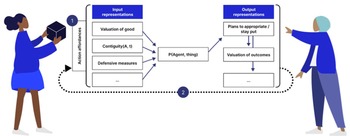
Figure 1. Boyer's framework requires at least two extensions to be consistent with a current understanding of embodied cognition (Foglia & Wilson, 2013) and the extended self (Belk, 1988). (1) The capabilities of a person's body have a direct influence on the inputs that govern their actions. (2) The actions taken by a body have direct influence on all of cognition, including perception, emotional appraisal, and decision making.
Target article
Related commentaries (31)
Beyond personal ownership: Examining the complexities of ownership in culture
No single notion of cooperation explains when we respect ownership
Not by intuitions alone: Institutions shape our ownership behaviour
Psychological ownership: Actors' and observers' perspectives
 You have
Access
Biological entities from single cells to organs and organisms all have boundaries. Yet these boundaries are semi-permeable, allowing fuel to enter, waste products to leave, and mechanisms for cooperation and competition with neighboring entities. Boundary permeability therefore requires some means of recognition, allowing cells and organisms to distinguish between self and other, mine and not-mine (Mukherjee, Reference Mukherjee2022).
Decades of human behavioral research has documented that the psychological self extends to the ideas of one's mind, the parts of one's body, and the physical possessions and locations associated with one's body (Belk, Reference Belk1988; Sommer, Reference Sommer, Bechtel and Churchman2002). The “implicit rules of ownership” referenced by Boyer (Reference Boyer2022) very much follow the implicit rules for possessing one's own body parts. An everyday example is road rage, where perceived infractions of an automobile's intentions are treated as direct bodily violations.
Boyer's framework for ownership proposes a unidirectional flow from inputs to outputs (Boyer, Reference Boyer2022), thus ignoring two critical features of humans as embodied agents. Our first point is that the specific capabilities of a body influence the inputs to the system. We privilege the inputs that correspond to the actions we are capable of performing, tending to ignore inputs for which we have no action possibilities. Our second point is that an agent's actions change the state of the body and its relation to the environment. This means that our actions directly contribute to our appraisal of the objects we encounter and what we consider as “ours” or “theirs” (Fig. 1).
Boyer's framework requires at least two extensions to be consistent with a current understanding of embodied cognition (Foglia & Wilson, Reference Foglia and Wilson2013) and the extended self (Belk, Reference Belk1988). (1) The capabilities of a person's body have a direct influence on the inputs that govern their actions. (2) The actions taken by a body have direct influence on all of cognition, including perception, emotional appraisal, and decision making.
Action capabilities directly influence perceptual inputs
Boyer (Reference Boyer2022) describes contiguity as a relevant cue that facilitates ownership intuitions. But he fails to point out that many other relations between agent and object have a powerful influence on the input channels that eventually lead to actions. For instance, experts in a given perceptual domain such as rock climbers, bird watchers, and automotive enthusiasts, all see and act on objects in their domain at a finer level of detail than novices (Tanaka & Philibert, Reference Tanaka and Philibert2022). This corresponds to what Gibson (Reference Gibson1977) referred to as action affordances. How one is capable of acting on their world fundamentally changes perceptual inputs. It is not merely sharing space or time with an object that is vital to privileging its perception, it is the capacity to act on that object that fundamentally changes how we represent and feel about it. When objects are within reach, action-related areas of human cortex respond more vigorously than when they are out of reach (Gallivan, Cavina-Pratesi, & Culham, Reference Gallivan, Cavina-Pratesi and Culham2009). People are able to respond more quickly to perceptual input that is near one's hand (Perry, Amarasooriya, & Fallah, Reference Perry, Amarasooriya and Fallah2016; Reed, Grubb, & Steele, Reference Reed, Grubb and Steele2006), and to locations that are the target of actions (Andersen & Mountcastle, Reference Andersen and Mountcastle1983; Snyder, Reference Snyder2000). These influences on the way we perceive an object then have a direct influence on the actions we plan and initiate (Barton, Matthis, & Fajen, Reference Barton, Matthis and Fajen2017; Lee, Lishman, & Thomson, Reference Lee, Lishman and Thomson1982; Sarpeshkar, Abernethy, & Mann, Reference Sarpeshkar, Abernethy and Mann2017; Savelsbergh, Whiting, & Bootsma, Reference Savelsbergh, Whiting and Bootsma1991; Todd, Reference Todd1981; Witt, Reference Witt2011). These and other studies strongly support the expansion of Boyer's input space to include the important role that humans acting on, and having the capacity to act on objects, has in determining ownership intuitions.
Actions influence the emotional and cognitive appraisal of objects
A wealth of research shows a much more intimate coupling between action and perception than the sequential stages of see −> decide −> act (Nakayama, Moher, & Song, Reference Nakayama, Moher and Song2023). Neurons in the premotor and motor regions of the brain implicated in self-action also respond when observing others perform the same actions (Rizzolatti, Fogassi, & Gallese, Reference Rizzolatti, Fogassi and Gallese2001). Merely planning a movement increases the neural activity in human early visual and auditory cortices (Gale et al., Reference Gale, Areshenkoff, Honda, Johnsrude, Flanagan and Gallivan2021; Gallivan, Chapman, Gale, Flanagan, & Culham, Reference Gallivan, Chapman, Gale, Flanagan and Culham2019). When we act on an emotionally neutral object, our actions enhance that object's appeal in subsequent evaluations (Chapman, Gallivan, & Enns, Reference Chapman, Gallivan and Enns2015; Peck & Shu, Reference Peck and Shu2009; Wispinski, Lin, Enns, & Chapman, Reference Wispinski, Lin, Enns and Chapman2021). Conversely, ignoring some objects in order to act selectively on others decreases their subsequent emotional appeal (De Vito & Fenske, Reference De Vito and Fenske2018; Fenske & Raymond, Reference Fenske and Raymond2006; Griffiths & Mitchell, Reference Griffiths and Mitchell2008; Kiss et al., Reference Kiss, Goolsby, Raymond, Shapiro, Silvert, Nobre and Eimer2007; Raymond, Fenske, & Westoby, Reference Raymond, Fenske and Westoby2005; Silver, Stahl, Loiotile, Smith-Flores, & Feigenson, Reference Silver, Stahl, Loiotile, Smith-Flores and Feigenson2020). Even regular involuntary interaction with objects that are initially appraised as negative contributes to their increased emotional appeal over time (Dudarev, Manaligod, Enns, & Todd, Reference Dudarev, Manaligod, Enns and Todd2022). Arbitrarily assigning some objects as “mine” and then moving them toward one's body leads to subsequent improved memory of those objects, compared to objects assigned as “yours” and/or moved away from one's body (Truong, Chapman, Chisholm, Enns, & Handy, Reference Truong, Chapman, Chisholm, Enns and Handy2016). All of these studies indicate that the actions we plan and take contribute to updating our perceptual states, which in turn make new objects and experiences available to us, and the cycle continues.
Conclusion
Humans are embodied agents and ownership intuitions follow directly from the extended self of every individual. First, we argue that our capabilities as active agents directly alter the perceptual inputs that give rise to ownership intuitions. Second, we argue that rather than modeling the extended self with the sequential stages of perceive −> decide −> act, we should consider a fully dynamical system, where the actions we take are as influential in determining the decisions we make as the perceptual inputs to those decisions (Nakayama et al., Reference Nakayama, Moher and Song2023; Wispinski, Gallivan, & Chapman, Reference Wispinski, Gallivan and Chapman2020). From this perspective, we may not only be the recipients of intuitive notions of ownership via the shared evolutionary history of all humans, but we have the capacity to shape and even alter those intuitions, through the actions we take today and the decisions we make for the future.
Acknowledgements
We would like to thank Veronica Dudarev for insightful comments on this commentary.
Financial support
J. T. E. is supported by a Natural Sciences and Engineering Research Council of Canada Discovery Grant (RPB-12R80005-2017). C. S. C. is supported by a Natural Sciences and Engineering Research Council of Canada Discovery Grant (RGPIN-2020-05396).
Competing interest
None.