




No CrossRef data available.
Article contents
Prejudice reduction, collective action, and then what?
Published online by Cambridge University Press: 20 November 2012
Abstract
Despite downsides, it must, on balance, be good to reduce prejudice. Despite upsides, collective action can also have destructive outcomes. Improving intergroup relations requires multiple levels of analysis involving a broader approach to prejudice reduction, awareness of potential conflict escalation, development of intergroup understanding, and promotion of a wider human rights perspective.
Information
- Type
- Open Peer Commentary
- Information
- Copyright
- Copyright © Cambridge University Press 2012
References
Abrams, D. (2010) Processes of prejudice: Theory, evidence and intervention. Equality and Human Rights Commission. Research Report 56. EHRC. Retrieved from http://www.equalityhumanrights.com/uploaded_files/research/56_processes_of_prejudice.pdf.Google Scholar
Abrams, D. & Grant, P. R. (2011) Testing the social identity relative deprivation (SIRD) model of social change: The political rise of Scottish nationalism. British Journal of Social Psychology. DOI: 10.1111/j.2044-8309.2011.02032.x.Google Scholar
Abrams, D. & Hogg, M. A. (2004) Metatheory: Lessons from social identity research. Personality and Social Psychology Review
8:98–106. DOI: 10.1207/s15327957pspr0802_2.Google Scholar
Abrams, D. & Houston, D. M. (2006) Equality, diversity and prejudice in Britain: Results from the 2005 national survey. The Equalities Review. Cabinet Office. Retrieved from http://webarchive.nationalarchives.gov.uk/20100807034701/http://archive.cabinetoffice.gov.uk/equalitiesreview/upload/assets/www.theequalitiesreview.org.uk/kentequality.pdf.Google Scholar
Bar-Tal, D. (2007) Sociopsychological foundations of intractable conflicts. American Behavioral Scientist
50:1430–53. DOI: 10.1177/0002764207302462.CrossRefGoogle Scholar
Brown, R. & Hewstone, M. (2005) An integrative theory of intergroup contact. In: Advances in experimental social psychology, vol. 37, ed. Zanna, M. P., pp. 255–343. Elsevier Academic Press.Google Scholar
Crisp, R. J. & Hewstone, M. (2007) Multiple social categorization. In: Advances in experimental social psychology, vol. 39, ed. Zanna, M. P., pp. 163–254, Academic Press. Retrieved from http://dx.doi.org/10.1016/S0065-2601(06)39004-1.Google Scholar
Crisp, R. J. & Turner, R. N. (2011) Cognitive adaptation to the experience of social and cultural diversity. Psychological Bulletin
137:242–66. DOI: 10.1037/a0021840.Google Scholar
Doise, W. (1998) Social psychology and human rights. European Review
6:341–47. DOI: 10.1017/S1062798700003380.Google Scholar
EHRC (2010) How fair is Britain? Equality, human rights and good relations: The first triennial review. Equality and Human Rights Commission. Retrieved from http://www.equalityhumanrights.com/key-projects/how-fair-is-britain/.Google Scholar
Mallett, R. K., Huntsinger, J. R., Sinclair, S. & Swim, J. K. (2008) Seeing through their eyes: When majority group members take collective action on behalf of an outgroup. Group Processes and Intergroup Relations
11:451–70. DOI: 10.1177/1368430208095400.CrossRefGoogle Scholar
Roccas, S. & Brewer, M. B. (2002) Social identity complexity. Personality and Social Psychology Review
6:88–106. DOI: 10.1207/S15327957PSPR0602_01.Google Scholar
Tajfel, H. & Turner, J. C. (1979) An integrative theory of intergroup conflict. In: The social psychology of intergroup relations, ed. Austin, W. G. & Worchel, S., pp. 33–47. Brooks/Cole.Google Scholar
Vasiljevic, M. & Crisp, R. J. (2010) Thinking about surprising social pairings reduces discrimination and increases tolerance between social groups. Paper presented at the International Conference on Discrimination and Tolerance in Intergroup Relations, Jena, Germany, June 30–July 3.Google Scholar
Zimmermann, A., Abrams, D., Doosje, B. & Manstead, A. (2011) Causal and moral responsibility: Antecedents and consequences of group-based guilt. European Journal of Social Psychology
41:825–39. DOI: 10.1002/ejsp.826.Google Scholar
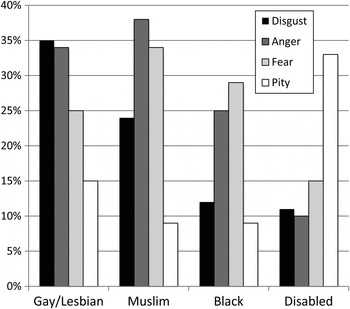
Figure 1. Proportion perceiving different groups as evoking emotions “very much” or “extremely” (Adapted from Abrams & Houston 2006).
Dixon et al. contrast promotion of cross-group liking (prejudice reduction – PR) with collective action (CA) to promote structural change. This important point echoes social identity theory's distinction between social mobility and social change belief structures, the latter involving “antagonism between dominant and subordinate groups provided that the latter group rejects its previously accepted and consensually negative image, and with it the status quo” (Tajfel & Turner Reference Tajfel, Turner, Austin and Worchel1979, p. 38). PR and CA are both important but are neither mutually exclusive nor exhaustive options. A more extensive conceptual framework is needed to deal with prejudice and intergroup relations because no single approach to PR is likely to work across all intergroup relationships (Abrams Reference Abrams2010).
The benefits of “getting people to like each other” should not be underestimated. Modifying prejudices, particularly those held by members of powerful groups, can surely only be helpful. Even if use of social cognitive techniques to override categorical simplicity in social perception reduces pressure on the status quo, it can also create room for greater harmony in society by facilitating reconceptualization of relationships (Crisp & Hewstone Reference Crisp, Hewstone and Zanna2007; Crisp & Turner Reference Crisp and Turner2011; Roccas & Brewer Reference Roccas and Brewer2002), perspective taking, empathy, and reciprocity (Brown & Hewstone Reference Brown, Hewstone and Zanna2005).
A further approach for improving intergroup relations is to develop better intergroup understanding. A shared intergroup reality involving consensual understanding of differences between groups can be a vehicle for facilitating communication, recognising inequality, and addressing it. PR may therefore actually highlight differences, such as inequality, and it may promote CA by members of either group to redress such inequality. For example, slavery and apartheid would not have been abolished without recognition by members of the advantaged groups that their group's perspective was incomplete and invalid. Wilberforce was a crucial advocate for the abolition of slavery, male members of parliament voted for universal suffrage, and English MPs voted to devolve power to Scotland and Wales (cf. Mallett et al. Reference Mallett, Huntsinger, Sinclair and Swim2008).
We agree that intergroup inequalities and differences need to be tangible in order for them to be addressed. CA can highlight a group's consensual opposition to the status quo. However, CA need not entail violence and aggressive conflict. Collectives can represent themselves in multiple ways, including political mobilization and voting (Abrams & Grant Reference Abrams and Grant2011). A just-so story can always be developed to argue that collective protest was a catalyst for eventual change. However, direct conflict and mass action may not offer the best, or only, means of eliminating paternalistic oppression. First, there are many examples of mass protests, strikes, or riots that have not resulted in successful outcomes for the protesters (e.g., in the United Kingdom: the miners' strike; opposition to the Iraq war; opposition to tuition fee increases). Second, members of a dominant group may respond to challenges by reasserting the status quo more vigorously, resulting in deeper and more dangerous conflict that may become entrenched (Bar-Tal Reference Bar-Tal2007). Third, perpetual conflict based on a single intergroup axis is potentially dangerous, both because it can destabilise a social system and because it can overwhelm pressing needs that affect other groups and individuals (for example, organisations may lose productivity, communities may descend into anarchy). Finally, even if some disadvantaged groups see no prospect of improving their situation through conventional forms of protest and action, some forms of action are simply societally unacceptable in terms of the indiscriminate threat they pose to life (e.g., terrorism), and therefore it is incumbent upon social scientists and society to develop other means of resolving differences.
Dixon et al. focus on gender and white/black relations in the context of slavery. However, societies involve multiple groups in multiple cross-cutting relationships, organized both horizontally and hierarchically, resulting in multiple group memberships (Simmel Reference Simmel1955). It is important to sustain multiple levels of analysis to tackle multiple levels of social exclusion and disadvantage (Abrams & Hogg Reference Abrams and Hogg2004). Prejudices are manifested and held differently for different groups within the same society. For example, among a representative sample of nearly 3,000 people in the United Kingdom a higher percentage perceived that societal feelings towards Muslims involved fear and anger rather than disgust or pity, whereas relatively higher percentages perceived societal fear of black people, disgust towards homosexual people, and pity towards disabled people (Abrams & Houston Reference Abrams and Houston2006; see Fig. 1). These emotions might result in very different societal responses to CA by each of these types of groups.
Proportion perceiving different groups as evoking emotions “very much” or “extremely” (Adapted from Abrams & Houston Reference Abrams and Houston2006).
Moreover, proximal effects of PR and CA seem likely to bear on different (but connected) levels of outcome: social cognition and behaviour on the one hand, and legal and political structures on the other. In sum, rather than treating PR and CA as alternatives, it may be wise to consider effects of PR and CA separately, allowing conceptualisation of mutual influence, and outcomes at different levels of specificity.
The challenge is not just one of firefighting specific prejudices against specific groups, but fire prevention by promoting principles of justice and fairness while recognizing diversity across society (Vasiljevic & Crisp Reference Vasiljevic and Crisp2010). The critical issue is how a society moves to a situation in which relationships are constructive and in which justice and fairness both among individuals and between groups are maximised (EHRC 2010). Engaging groups in conflict does not seem an optimal means of moving towards such a state. Propelling both groups and individuals towards a shared vision of human rights (Doise Reference Doise1998) and moral responsibility (Zimmermann et al. Reference Zimmermann, Abrams, Doosje and Manstead2011) offers a better prospect. This may well involve groups or systems beyond the groups in conflict. Improvement in many conflictual intergroup relationships has involved the influence or intervention by external agents, sanctions, and diplomatic and political pressure, often backed by wider consensus (e.g., promoted by the United Nations or non-governmental organizations [NGOs]) that legitimised progressive social change. Examples include Yugoslavia, Northern Ireland, the ending of apartheid, and slavery in the United States.
The situation of an isolated disadvantaged versus advantaged group is perhaps unusual. Prejudice and conflict are common problems in intergroup relations, regardless of whether the groups are unequal or not. To conclude, PR and CA are aspects of intergroup relations but are only part of a picture involving structural complexity, historical relationships, and the wider sociopolitical context.