We disagree with Dixon et al. by maintaining that prejudice is primarily rooted in avoidant reactions toward out-group members. However, the conventional assumption (reiterated in the target article) that prejudice stems from certain negative (pejoratively described) personality characteristics, such as trait bigotry of majority-group members, is also misleading. This assumption commits the fundamental attribution error in and of itself, attributing others' behaviors to personal, rather than situational, factors. It is also erroneous to assume that prejudice reflects biologically irrelevant or maladaptive attitudinal decisions, which implies some degree of cognitive, emotional, and/or sociopolitical deficiencies. Clearly, the tendency to selectively interact with conspecifics (e.g., mate discrimination) is a normative and evolutionarily adaptive component of social development. On the basis of these points, we agree with Dixon et al. that many current models of the causes of prejudice are ineffective and probably counterproductive for guiding strategies for reducing societal discrimination. Describing prejudice instead in terms of normative cognitive processes may reduce defensiveness and increase receptivity to interventions that seek to reduce the harmful effects of prejudice.
A more objective and potentially parsimonious conceptualization of the causes of prejudice can be framed within the concept of homophily, which is the ubiquitous tendency for individuals to show attraction toward, and to desire to affiliate with, other people who share similar personal characteristics. Homophilic peer preferences play a predominant role in shaping the information that individuals receive, the attitudes they form, and the interactions they experience within families, peer networks, and isomorphic societal positions (McPherson et al. Reference McPherson, Smith-Lovin and Cook2001). People exhibit the strongest homophilic peer preferences for attributes that indicate personal agency, or one's capacity to reciprocate with others, such as physical appearance (a biosocial proxy for healthiness), intelligence, and financial resources. Peers who are perceived as possessing significantly higher or significantly lower levels of these traits as compared to the individual are less preferred than are peers with similar, if not slightly higher, trait levels as the individual (Vigil Reference Vigil2007). This pattern makes sense from the standpoint that humans possess the implicit motivation to interact with social affiliates who have the most equipotential and hence incentive to reciprocate with the individual.
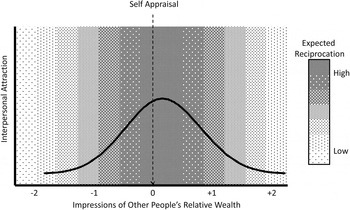
A conceptual representation of this hypothesis as it pertains to economic-based discrimination is shown in Figure 1. People are most attracted to peers who are perceived to possess slightly higher economic resources than oneself, and people are averse to interacting with peers who either possess much lower (e.g., destitute affiliates) or much higher (e.g., prosperous affiliates) economic resources (see Vigil Reference Vigil2007). Homophilic preferences for peers with slightly higher financial potential enables the individual to procure a net gain across his or her reciprocal interchanges with others, within the parameters that provide the highest probability of receiving said reciprocation.
Figure 1.
Interpersonal affinity as a function of homophilic economic potential and implicit expectation of reciprocation.
This model explains the tendency for superordinates to discriminate against subordinates, as well as the reverse pattern, for subordinates to discount affinity for people with higher social status. For example, experimental research shows that people are incentivized to pay a cost to reduce the rewards provisioned to both high-wage (token) earners, as well as low-wage contributors (Johnson et al. Reference Johnson, Dawes, Fowler, McElreath and Smirnov2009). Other research shows that when participants receive either significantly higher or significantly lower rewards relative to others, they are less likely to invest in public goods provisions (Anderson et al. Reference Anderson, Mellor and Milyo2008). These findings are typically interpreted as the tendency for people to punish free riders; however, an alternative hypothesis is that people are averse toward peers who possess disparate capacity resources. Phenotypic homophily for capacity-endowment attributes in others may also help explain the reciprocal expression of racial discrimination (e.g., anti-white biases among blacks; Lecci & Johnson Reference Lecci and Johnson2008) and gender discrimination (e.g., anti-male biases in family courts). That is, some intergroup biases are probably the result of historically low exposure to, or to low prevalence of, the stereotype that outgroup members in fact possess varying competency levels (e.g., low rates of exposure to specific ethnic groups and genders in certain societal and/or domestic roles).
Another concept that influences intra- and interindividual perceptions of personal competencies is stereotype threat. Stereotype threat stems from a classic study showing that test instructions influence performance on cognitive tasks (Steele & Aronson Reference Steele and Aronson1995). When students were told that a task was not diagnostic of intelligence, black and white students performed similarly; however, when students were told they were taking an intelligence test, the black students performed worse than did the white students. The assumption is that instructional cues about intelligence triggered the prevalent erroneous stereotype that black people are not as smart as white people and negatively impacted performance. Repeated experiences of stereotype threat and poorer performance may influence the process of internalized racism whereby a person begins to believe that he or she is not as competent as someone of the dominant group, ultimately resulting in a self-fulfilling prophecy.
Dixon et al. highlight the “ironic” and troubling outcomes of many prejudice reduction interventions as maintaining social inequality. One way to reduce prejudice and social inequality may be to focus on decreasing stereotype threat. Individual-based interventions may include encouraging self-affirmations, emphasizing the strengths of the individual, communicating confidence in individuals' ability to achieve high standards, and providing external attributions for social anxiety (Burgess et al. Reference Burgess, Warren, Phelan, Davidio and van Ryn2010; Cohen et al. Reference Cohen, Garcia, Apfel and Master2006; Martens et al. Reference Martens, Johns, Greenberg and Schimel2006). From the perspective of providers (e.g., teachers, evaluators, clinicians), interventions may include managing cues that could trigger stereotype threat (e.g., altering the test instructions, deemphasizing race or ethnicity, and placing demographics at the end of a test), focusing on the strengths of the individual, and providing external attributions for anxiety expressed by diverse individuals (e.g., Burgess et al. Reference Burgess, Warren, Phelan, Davidio and van Ryn2010; Johns et al. Reference Johns, Schmader and Martens2005). This would help decrease what Dixon et al. refer to as the “indirect violence of structural inequality” (sect. 4.1.3, para. 3). Maintaining the status quo of unequal access to institutional resources, power differentials continue to exist in our society. Unfortunately, disrupting these disparities are likely to present a continuous challenge given that the cognitive biases (e.g., homophily, stereotype threat) that contribute to discrimination are likely canalized at early stages in social development.





We disagree with Dixon et al. by maintaining that prejudice is primarily rooted in avoidant reactions toward out-group members. However, the conventional assumption (reiterated in the target article) that prejudice stems from certain negative (pejoratively described) personality characteristics, such as trait bigotry of majority-group members, is also misleading. This assumption commits the fundamental attribution error in and of itself, attributing others' behaviors to personal, rather than situational, factors. It is also erroneous to assume that prejudice reflects biologically irrelevant or maladaptive attitudinal decisions, which implies some degree of cognitive, emotional, and/or sociopolitical deficiencies. Clearly, the tendency to selectively interact with conspecifics (e.g., mate discrimination) is a normative and evolutionarily adaptive component of social development. On the basis of these points, we agree with Dixon et al. that many current models of the causes of prejudice are ineffective and probably counterproductive for guiding strategies for reducing societal discrimination. Describing prejudice instead in terms of normative cognitive processes may reduce defensiveness and increase receptivity to interventions that seek to reduce the harmful effects of prejudice.
A more objective and potentially parsimonious conceptualization of the causes of prejudice can be framed within the concept of homophily, which is the ubiquitous tendency for individuals to show attraction toward, and to desire to affiliate with, other people who share similar personal characteristics. Homophilic peer preferences play a predominant role in shaping the information that individuals receive, the attitudes they form, and the interactions they experience within families, peer networks, and isomorphic societal positions (McPherson et al. Reference McPherson, Smith-Lovin and Cook2001). People exhibit the strongest homophilic peer preferences for attributes that indicate personal agency, or one's capacity to reciprocate with others, such as physical appearance (a biosocial proxy for healthiness), intelligence, and financial resources. Peers who are perceived as possessing significantly higher or significantly lower levels of these traits as compared to the individual are less preferred than are peers with similar, if not slightly higher, trait levels as the individual (Vigil Reference Vigil2007). This pattern makes sense from the standpoint that humans possess the implicit motivation to interact with social affiliates who have the most equipotential and hence incentive to reciprocate with the individual.
A conceptual representation of this hypothesis as it pertains to economic-based discrimination is shown in Figure 1. People are most attracted to peers who are perceived to possess slightly higher economic resources than oneself, and people are averse to interacting with peers who either possess much lower (e.g., destitute affiliates) or much higher (e.g., prosperous affiliates) economic resources (see Vigil Reference Vigil2007). Homophilic preferences for peers with slightly higher financial potential enables the individual to procure a net gain across his or her reciprocal interchanges with others, within the parameters that provide the highest probability of receiving said reciprocation.
Interpersonal affinity as a function of homophilic economic potential and implicit expectation of reciprocation.
This model explains the tendency for superordinates to discriminate against subordinates, as well as the reverse pattern, for subordinates to discount affinity for people with higher social status. For example, experimental research shows that people are incentivized to pay a cost to reduce the rewards provisioned to both high-wage (token) earners, as well as low-wage contributors (Johnson et al. Reference Johnson, Dawes, Fowler, McElreath and Smirnov2009). Other research shows that when participants receive either significantly higher or significantly lower rewards relative to others, they are less likely to invest in public goods provisions (Anderson et al. Reference Anderson, Mellor and Milyo2008). These findings are typically interpreted as the tendency for people to punish free riders; however, an alternative hypothesis is that people are averse toward peers who possess disparate capacity resources. Phenotypic homophily for capacity-endowment attributes in others may also help explain the reciprocal expression of racial discrimination (e.g., anti-white biases among blacks; Lecci & Johnson Reference Lecci and Johnson2008) and gender discrimination (e.g., anti-male biases in family courts). That is, some intergroup biases are probably the result of historically low exposure to, or to low prevalence of, the stereotype that outgroup members in fact possess varying competency levels (e.g., low rates of exposure to specific ethnic groups and genders in certain societal and/or domestic roles).
Another concept that influences intra- and interindividual perceptions of personal competencies is stereotype threat. Stereotype threat stems from a classic study showing that test instructions influence performance on cognitive tasks (Steele & Aronson Reference Steele and Aronson1995). When students were told that a task was not diagnostic of intelligence, black and white students performed similarly; however, when students were told they were taking an intelligence test, the black students performed worse than did the white students. The assumption is that instructional cues about intelligence triggered the prevalent erroneous stereotype that black people are not as smart as white people and negatively impacted performance. Repeated experiences of stereotype threat and poorer performance may influence the process of internalized racism whereby a person begins to believe that he or she is not as competent as someone of the dominant group, ultimately resulting in a self-fulfilling prophecy.
Dixon et al. highlight the “ironic” and troubling outcomes of many prejudice reduction interventions as maintaining social inequality. One way to reduce prejudice and social inequality may be to focus on decreasing stereotype threat. Individual-based interventions may include encouraging self-affirmations, emphasizing the strengths of the individual, communicating confidence in individuals' ability to achieve high standards, and providing external attributions for social anxiety (Burgess et al. Reference Burgess, Warren, Phelan, Davidio and van Ryn2010; Cohen et al. Reference Cohen, Garcia, Apfel and Master2006; Martens et al. Reference Martens, Johns, Greenberg and Schimel2006). From the perspective of providers (e.g., teachers, evaluators, clinicians), interventions may include managing cues that could trigger stereotype threat (e.g., altering the test instructions, deemphasizing race or ethnicity, and placing demographics at the end of a test), focusing on the strengths of the individual, and providing external attributions for anxiety expressed by diverse individuals (e.g., Burgess et al. Reference Burgess, Warren, Phelan, Davidio and van Ryn2010; Johns et al. Reference Johns, Schmader and Martens2005). This would help decrease what Dixon et al. refer to as the “indirect violence of structural inequality” (sect. 4.1.3, para. 3). Maintaining the status quo of unequal access to institutional resources, power differentials continue to exist in our society. Unfortunately, disrupting these disparities are likely to present a continuous challenge given that the cognitive biases (e.g., homophily, stereotype threat) that contribute to discrimination are likely canalized at early stages in social development.