





No CrossRef data available.
Article contents
The need for a unified framework: How Tulving's framework of memory systems, memory processes, and the SPI-model can guide and sharpen the understanding of déjà vu and involuntary autobiographical memories and add to conceptual clarity
Published online by Cambridge University Press: 14 November 2023
Abstract
Barzykowski and Moulin link déjà vu and involuntary autobiographical memories to the process of retrieval. They make no reference to Tulving's SPI-model. In this, it is proposed that information is acquired serially (S), stored in parallel (P), and retrieved independently (I). This model offers an alternative, elegant, view of involuntary autobiographical memory retrieval, as well as of déjà vus.
Information
- Type
- Open Peer Commentary
- Information
- Copyright
- Copyright © The Author(s), 2023. Published by Cambridge University Press
References
Borsutzky, S., Fujiwara, E., Brand, M., & Markowitsch, H. J. (2010). Susceptibility to false memories in patients with ACoA aneurysm. Neuropsychologia, 48, 2811–2823.CrossRefGoogle ScholarPubMed
Dew, I. T. Z., & Cabeza, R. (2011). The porous boundaries between explicit and implicit memory: Behavioral and neural evidence. Annals of the New York Academy of Sciences, 1224, 174–190.CrossRefGoogle ScholarPubMed
Fehr, T., Staniloiu, A., Markowitsch, H. J., Erhard, P., & Herrmann, M. (2018). Neural correlates of free recall of “famous faces” in a “hypermnestic” individual as compared to an age- and education-matched reference group. BMC Neuroscience, 19, Art. 35, 1–12. https://doi.org/10.1186/s12868-018-0435-yCrossRefGoogle Scholar
Henke, K. A. (2010). A model for memory systems based on processing modes rather than consciousness. Nature Reviews Neuroscience, 11, 523–532.CrossRefGoogle Scholar
Mishkin, M., & Petri, H. L. (1984). Memories and habits: Some implications for the analysis of learning and retention. In Squire, L. R. & Butters, N. (Eds.), Neuropsychology of memory (pp. 287–296). Guilford Press.Google Scholar
Nelson, K., & Fivush, R. (2004). The emergence of autobiographical memory: A social cultural developmental theory. Psychological Review, 111, 486–511.CrossRefGoogle ScholarPubMed
O'Connor, A. R., Wells, C., & Moulin, C. J. A. (2021). Déjà vu and other dissociative states in memory. Memory, 29, 835–842.CrossRefGoogle ScholarPubMed
Risius, U.-M., Staniloiu, A., Piefke, M., Maderwald, S., Schulte, F., Brand, M., & Markowitsch, H. J. (2013). Retrieval, monitoring and control processes: A 7 Tesla fMRI approach to memory accuracy. Frontiers in Behavioral Neuroscience, 7, Art. 24, 1–21. https://doi.org/10.3389/fnbeh.2013.00024CrossRefGoogle ScholarPubMed
Schacter, D., & Tulving, E. (1994). What are the memory systems of 1994? In Schacter, D. & Tulving, E. (Eds.), Memory systems 1994 (pp. 1–38). MIT Press.CrossRefGoogle Scholar
Schacter, D. L., Wagner, A. D., & Buckner, R. L. (2000). Memory systems of 1999. In Tulving, E. & Craik, F. I. M. (Eds.), The Oxford handbook of memory (pp. 627–644). Oxford University Press.CrossRefGoogle Scholar
Squire, L. R. (2004) Memory systems of the brain: A brief history and current perspective. Neurobiology of Learning and Memory, 82, 171–177.CrossRefGoogle Scholar
Staniloiu, A., Kordon, A., & Markowitsch, H. J. (2020). Quo vadis episodic memory – past, present, perspective. Neuropsychologia, 141, Art. 10736, 1–8. https://doi.org/10.1016/j.neuropsychologia.2020.107362CrossRefGoogle Scholar
Staniloiu, A., & Markowitsch, H. J. (2012). The remains of the day in dissociative amnesia. Brain Sciences, 2, 101–129.CrossRefGoogle Scholar
Tulving, E. (1972). Episodic and semantic memory. In Tulving, E. & Donaldson, W. (Eds.), Organization of memory (pp. 381–403). Academic Press.Google Scholar
Tulving, E. (1995). Organization of memory: Quo vadis? In Gazzaniga, M. S. (Ed.), The cognitive neurosciences (pp. 839–847). MIT Press.Google Scholar
Tulving, E. (2005). Episodic memory and autonoesis: Uniquely human? In Terrace, H. & Metcalfe, J. (Eds.), The missing link in cognition: Evolution of self-knowing consciousness (pp. 3–56). Oxford University Press.Google Scholar
Tulving, E., & Markowitsch, H. J. (1998). Episodic and declarative memory: Role of the hippocampus. Hippocampus, 8, 198–204.3.0.CO;2-G>CrossRefGoogle ScholarPubMed
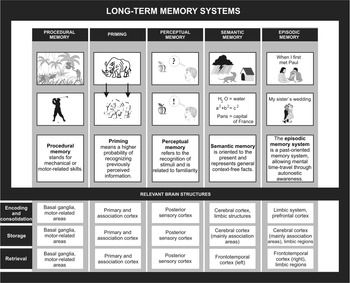
Figure 1. The five long-term memory systems. Procedural memory is principally motor-based, but includes also sensory and cognitive skills and routines. Priming refers to a higher likeliness of re-identifying previously perceived information. Perceptual memory allows distinguishing and retrieving an item, an object, or a person based on distinct features. Semantic memory is context-free and refers to general facts; it encompasses general knowledge of the world. The episodic-autobiographical memory (EAM) system is context-specific with respect to time and place. It allows mental time travel and is based on self-reflection (autonoesis). Examples are events such as a meeting with friends last week or the last celebration of New Year. The five systems develop phylogenetically and ontogenetically from left to right. With respect to dimensions of consciousness, Tulving (2005) considered the first two memory systems as being anoetic, the next two as noetic, and the EAM to be autonoetic (“self-conscious”). A version of this sketch was created together with Endel Tulving.

Figure 2. Tulving's SPI-model (Tulving, 1995; Tulving & Markowitsch, 1998), exemplified for the semantic and episodic (or episodic-autobiographical) memory systems. Information can be encoded into semantic memory independently of episodic(-autobiographical) memory, but must be encoded into episodic(-autobiographical) memory “through” semantic memory (This was proven as well for ontogenetic learning of children; see Nelson & Fivush, 2004.) Encoded and stored information is potentially available for retrieval from one of the two systems, or from both of them (or – in generalizing – from all five of them, mentioned in Fig. 1). (Composed after Fig. 1 from Tulving & Markowitsch, 1998.)
Target article
Related commentaries (27)
Accounting for the strangeness, infrequency, and suddenness of déjà vu
Déjà vu: A botched memory operation, illegitimate to start with
Involuntary autobiographical memories and déjà vu: When and why attention makes a difference
Memory entails encoding, consolidating, storage, and retrieving information. These are named processing stages of information and they rely on complex networks in the brain (Tulving & Markowitsch, Reference Tulving and Markowitsch1998). Distinct from memory processes are the memory systems which have been proposed since the 1970s (e.g., Mishkin & Petri, Reference Mishkin, Petri, Squire and Butters1984; Squire, Reference Squire2004; Tulving, Reference Tulving, Tulving and Donaldson1972) and refined over time (e.g., Schacter & Tulving, Reference Schacter, Tulving, Schacter and Tulving1994; Schacter, Wagner, & Buckner, Reference Schacter, Wagner, Buckner, Tulving and Craik2000; Staniloiu, Kordon, & Markowitsch, Reference Staniloiu, Kordon and Markowitsch2020). A sketch of memory systems is given in Figure 1.
The five long-term memory systems. Procedural memory is principally motor-based, but includes also sensory and cognitive skills and routines. Priming refers to a higher likeliness of re-identifying previously perceived information. Perceptual memory allows distinguishing and retrieving an item, an object, or a person based on distinct features. Semantic memory is context-free and refers to general facts; it encompasses general knowledge of the world. The episodic-autobiographical memory (EAM) system is context-specific with respect to time and place. It allows mental time travel and is based on self-reflection (autonoesis). Examples are events such as a meeting with friends last week or the last celebration of New Year. The five systems develop phylogenetically and ontogenetically from left to right. With respect to dimensions of consciousness, Tulving (Reference Tulving, Terrace and Metcalfe2005) considered the first two memory systems as being anoetic, the next two as noetic, and the EAM to be autonoetic (“self-conscious”). A version of this sketch was created together with Endel Tulving.
Long-term memory systems have been partitioned into episodic-autobiographical memory (memory for personal events or experiences), semantic memory (conscious knowledge of facts, including factual self-knowledge), perceptual memory (conscious familiarity judgments), procedural memory (mechanical, motor-related skills), and priming memory (higher likelihood of re-identifying previously perceived stimuli) systems.
The “perceptual memory system” was identified and described as a legitimate distinct long-term memory system later than the other four long-term memory (Tulving & Markowitsch, Reference Tulving and Markowitsch1998). In contrast to the priming and procedural memory systems, this system acts “consciously” (noetically), but on a presemantic level and relies on familiarity judgments. An example is the conscious (noetic) identification of an apple without hesitation, no matter what color it has or whether it is already half eaten or not. Patients with semantic dementia may therefore still be able to distinguish, for example, an apple from a peach or pear by accessing perceptual representations of information via the perceptual memory system (despite losing capabilities for language and semantic memory).
In 1995, Tulving proposed his SPI-model which states that encoding of information follows a regular sequence – that means it is serial in that way that first simple, implicitly functioning, memory systems are engaged and only at the end of the series explicit, episodic encoding occurs. Information then is stored in parallel memory systems in the brain, and, most importantly it can be retrieved independently from the systems used for the encoding process (SPI = Serial, Parallel, Independent) (Tulving & Markowitsch, Reference Tulving and Markowitsch1998, Fig. 2).
Tulving's SPI-model (Tulving, Reference Tulving and Gazzaniga1995; Tulving & Markowitsch, Reference Tulving and Markowitsch1998), exemplified for the semantic and episodic (or episodic-autobiographical) memory systems. Information can be encoded into semantic memory independently of episodic(-autobiographical) memory, but must be encoded into episodic(-autobiographical) memory “through” semantic memory (This was proven as well for ontogenetic learning of children; see Nelson & Fivush, Reference Nelson and Fivush2004.) Encoded and stored information is potentially available for retrieval from one of the two systems, or from both of them (or – in generalizing – from all five of them, mentioned in Fig. 1). (Composed after Fig. 1 from Tulving & Markowitsch, Reference Tulving and Markowitsch1998.)
Seen in the light of the partitioning given in Figure 1, “involuntary autobiographical memories,” as described in the target article, belong to the episodic-autobiographical memory system (EAM), as they are, according to the authors, “recollections of the personal past”; on the other hand, they are retrieved automatically (“spontaneously,” as the authors write), without conscious effort, and therefore we argue that the retrieval of such personal past information recruits additional implicit/priming memory system resources (priming system) (Dew & Cabeza, Reference Dew and Cabeza2011; Fehr, Staniloiu, Markowitsch, Erhard, & Herrmann, Reference Fehr, Staniloiu, Markowitsch, Erhard and Herrmann2018; Henke, Reference Henke2010). This recruitment of the priming memory resources may be facilitated at the neural level by a certain common neural mechanism that underpins implicit and explicit retrieval (Henke, Reference Henke2010).
“Déjà vus” are described as “brief experiences of familiarity.” In another paper, one of the present authors writes that for déjà vu “the experi[m]ent is aware of a conflict in mental evaluations” (O'Connor, Wells, & Moulin, Reference O'Connor, Wells and Moulin2021, p. 835). We propose that in déjà vus, the conscious experience of familiarity that arises in the absence of corroboration from the semantic or episodic-autobiographical systems (recollection-familiarity) is due to a faulty/false retrieval/recognition in the conscious (noetic) perceptual memory system plus or minus priming system. Along this line, we provided evidence that false memories (false recognitions) do not only occur in semantic and EAM systems, but may also occur in other memory systems, such as the procedural memory system (see Borsutzky, Fujiwara, Brand, & Markowitsch, Reference Borsutzky, Fujiwara, Brand and Markowitsch2010).
We furthermore propose that information that is independently retrieved from the semantic or EAM systems according to the SPI-model along with sufficient intact metacognitive processes involved in monitoring and controlling retrieval (Risius et al., Reference Risius, Staniloiu, Piefke, Maderwald, Schulte, Brand and Markowitsch2013) can decrease the strength of the feeling of familiarity, the confidence in the perceptual memory-based recognition judgments, and favor the interpretation that the conscious familiarity experience (false recognition) in déjà vus is false or impossible.
In line with the SPI-model, we (Staniloiu & Markowitsch, Reference Staniloiu and Markowitsch2012) have pointed to the potential relationship between familiarity-based recognition, which perceptual memory (noetic, conscious) is intimately linked to, and familiarity linked to anoetic memory systems (priming, unconscious). Hereby, we argue that, reflecting the “porous boundaries” or dynamic exchange that exists between diverse memory systems at both the behavioral and neural levels (Dew & Cabeza, Reference Dew and Cabeza2011), the SPI-model offers support for the view that the retrieval of IAMs and déjà vus engages an interplay between the (anoetic) priming memory system and autonoetic and noetic memory systems (see Fig. 2).
Financial support
There was no funding of this contribution.
Competing interest
None.