Freud (Reference Freud1901) had already noted that déjà vu involves memory retrieval: “the uncanny feeling we have, in certain situations, of having had exactly the same experience once before, or of having once before been exactly in the same place, though our efforts never succeed in remembering the previous occasion that announces itself this way.”
Barzykowski and Moulin's (B&M's) analytical effort conceptualizes déjà vu as one possible output of a continuum (although structured as a discrete decision tree in Fig. 1 of their article) of spontaneous memory retrieval phenomena: While involuntary memories would be the unexpected retrieval of content, déjà vu would be that of an unjustified feeling of familiarity (not accompanied by a particular memory in mind). Déjà vu, indeed, soon reveals itself as the phantom of a memory, one we do not belong to, a “feeling of retrieval” to say it with the authors, but one that people describe as disquieting, eerie, awkward (Brown, Reference Brown2003).
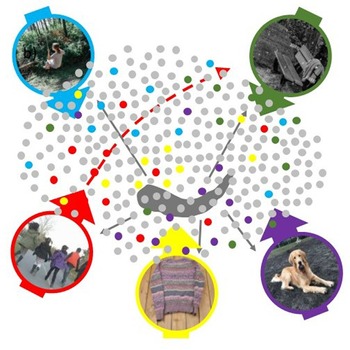
Figure 1.The hippocampus activates all the five items constituting the real event “my dog hid my friend's sweater in the park” (straight gray arrows). The activation of two highly familiar items in the absence of hippocampal input may result in déjà vu (fragmented red arrows). Each item has a sparse distributed but partially localized representation over the cortex.
What exactly happens during déjà vu that disorients us? How can a spontaneous retrieval process go awry? According to the authors, déjà vu happens when there is a feeling of familiarity that does not pass a plausibility check (Fig. 1 of their article), and it is on the neural mechanism of this feeling of familiarity and the question of its implausibility (memory absence) that our commentary is focused.
Many times we experience familiarity of unclear origin without having a déjà vu. The butcher-on-the-bus phenomenon, where someone feels familiar but it is not clear from where, is one such case, but it is not disquieting an experience. On the other hand, sometimes déjà vu occurs in familiar places or involves familiar people, where feelings of familiarity would be plausible and justified. Moreover, it is not clear how the dichotomous (explicit?) plausibility signal in Figure 1 can be computed in the absence of access to content.
We think that the feeling of familiarity that accompanies the experience of déjà vu (troubles us because it) is fundamentally different from other instances of familiarity mentioned in the paper: It is not relative to a single item, but to a composition of items, to an experience, albeit fragmented: The place, who was there, some words we uttered, something that will happen next. Hence, we expect the ensuing recollection of the corresponding event that instead does not happen. Perhaps that feels implausible: To have forgotten an entire event that we are currently reliving.
Our recent modeling study (Ryom, Stendardi, Ciaramelli, & Treves, Reference Ryom, Stendardi, Ciaramelli and Treves2022) offers a computational explanation of associative retrieval failures. These are in fact very frequent, especially if retrieval is triggered by the activation of partial cues in the neocortex, rather than by hippocampal activity indexing memory. Our model network is comprised of “Potts units,” which represent patches of cortex, interacting through long-range connections (Fig. 1). A compositional memory, such as the memory for a complex event (e.g., my dog hid my friend's sweater in the park), is conceived as composed of several items, each of which has a pre-established neocortical representation (dog, park, sweater). Storing this new memory only involves acquiring the novel connections among participating items. Memory retrieval could be triggered either by the activation of a partial cue in the cortex, which is a variable fraction of the units active in the memory (e.g., sweater + friend), or by a hippocampal input that sustainedly cues all the memory units simultaneously, working as an index to the compressed representation of the entire memory (see Fig. 1). One main finding of our study is that the cortical storage capacity for compositional memories is much lower than previously calculated for unitary representations (Treves & Rolls, Reference Treves and Rolls1994). The reason is that while the hippocampus is thought to store newly assembled compressed representations of each episode in memory, the neocortex has to make do with reusing pre-established representations of the various components of the episode (Ciaramelli, Lauro-Grotto, & Treves, Reference Ciaramelli, Lauro-Grotto and Treves2006). The ability of the neocortical network to retrieve compositional memories from partial cues, in the absence of hippocampal input, is shown, analytically and with computer simulations, to be severely limited, plagued by the interference from competing representations (Ryom et al., Reference Ryom, Stendardi, Ciaramelli and Treves2022).
On this view, déjà vu could be characterized as an “incomplete” memory state where some familiar items from a compositional memory (or from several distinct memories) get activated in neocortex (e.g., kids + bench; Fig. 1), in the absence of hippocampal input. This activation is sufficient to trigger familiarity for an experience, but not the reinstatement of a full-fledged memory (assuming one exists). The ensuing feeling of familiarity may be particularly uncanny if the partial cue activates self-relevant items or schemata in the neocortex (Stendardi, Biscotto, Bertossi, & Ciaramelli, Reference Stendardi, Biscotto, Bertossi and Ciaramelli2021), conferring self-relevance to a memory that might potentially be false, and should last until activated memory fragments are enough to finally trigger monitoring mechanisms that explicitly refute the participation of the self; or, we suggest, the (false) memory can be abandoned based on an implicit network signal that automatically reads out high levels of simultaneous activity in the neocortex that in the absence of hippocampal activity are more compatible with imagination than with memory. By contrast, the protracted failure of memory monitoring may lead to confabulation, the false memory for unhappened events (Gilboa et al., Reference Gilboa, Alain, Stuss, Melo, Miller and Moscovitch2006; see also Moulin, Reference Moulin2013). Similar to déjà vu, confabulation entails fragments of memory traces, and is mostly self-related (Gilboa et al., Reference Gilboa, Alain, Stuss, Melo, Miller and Moscovitch2006; see also Moulin, Reference Moulin2013). Unlike déjà vu, confabulation is not abandoned but endorsed confidently. Interestingly, confabulation is triggered by familiar stimuli (Ciaramelli, Reference Ciaramelli2008), and dampened by reducing the cognitive resources available for assembling (wrongly) memory elements (Ciaramelli, Ghetti, & Borsotti, Reference Ciaramelli, Ghetti and Borsotti2009).
Does the activation of multiple (self-relevant) memory fragments make déjà vu so unique and distinguishable from other illusory familiarity phenomena? Is the estranging feeling associated with déjà vu the by-product of a just foiled risk of confabulation? Future studies should test this hypothesis, for example, studying whether déjà vu is associated with the activation of ventral prefrontal cortex regions, and the computational conditions conducive to memory or confabulatory signals.







Freud (Reference Freud1901) had already noted that déjà vu involves memory retrieval: “the uncanny feeling we have, in certain situations, of having had exactly the same experience once before, or of having once before been exactly in the same place, though our efforts never succeed in remembering the previous occasion that announces itself this way.”
Barzykowski and Moulin's (B&M's) analytical effort conceptualizes déjà vu as one possible output of a continuum (although structured as a discrete decision tree in Fig. 1 of their article) of spontaneous memory retrieval phenomena: While involuntary memories would be the unexpected retrieval of content, déjà vu would be that of an unjustified feeling of familiarity (not accompanied by a particular memory in mind). Déjà vu, indeed, soon reveals itself as the phantom of a memory, one we do not belong to, a “feeling of retrieval” to say it with the authors, but one that people describe as disquieting, eerie, awkward (Brown, Reference Brown2003).
The hippocampus activates all the five items constituting the real event “my dog hid my friend's sweater in the park” (straight gray arrows). The activation of two highly familiar items in the absence of hippocampal input may result in déjà vu (fragmented red arrows). Each item has a sparse distributed but partially localized representation over the cortex.
What exactly happens during déjà vu that disorients us? How can a spontaneous retrieval process go awry? According to the authors, déjà vu happens when there is a feeling of familiarity that does not pass a plausibility check (Fig. 1 of their article), and it is on the neural mechanism of this feeling of familiarity and the question of its implausibility (memory absence) that our commentary is focused.
Many times we experience familiarity of unclear origin without having a déjà vu. The butcher-on-the-bus phenomenon, where someone feels familiar but it is not clear from where, is one such case, but it is not disquieting an experience. On the other hand, sometimes déjà vu occurs in familiar places or involves familiar people, where feelings of familiarity would be plausible and justified. Moreover, it is not clear how the dichotomous (explicit?) plausibility signal in Figure 1 can be computed in the absence of access to content.
We think that the feeling of familiarity that accompanies the experience of déjà vu (troubles us because it) is fundamentally different from other instances of familiarity mentioned in the paper: It is not relative to a single item, but to a composition of items, to an experience, albeit fragmented: The place, who was there, some words we uttered, something that will happen next. Hence, we expect the ensuing recollection of the corresponding event that instead does not happen. Perhaps that feels implausible: To have forgotten an entire event that we are currently reliving.
Our recent modeling study (Ryom, Stendardi, Ciaramelli, & Treves, Reference Ryom, Stendardi, Ciaramelli and Treves2022) offers a computational explanation of associative retrieval failures. These are in fact very frequent, especially if retrieval is triggered by the activation of partial cues in the neocortex, rather than by hippocampal activity indexing memory. Our model network is comprised of “Potts units,” which represent patches of cortex, interacting through long-range connections (Fig. 1). A compositional memory, such as the memory for a complex event (e.g., my dog hid my friend's sweater in the park), is conceived as composed of several items, each of which has a pre-established neocortical representation (dog, park, sweater). Storing this new memory only involves acquiring the novel connections among participating items. Memory retrieval could be triggered either by the activation of a partial cue in the cortex, which is a variable fraction of the units active in the memory (e.g., sweater + friend), or by a hippocampal input that sustainedly cues all the memory units simultaneously, working as an index to the compressed representation of the entire memory (see Fig. 1). One main finding of our study is that the cortical storage capacity for compositional memories is much lower than previously calculated for unitary representations (Treves & Rolls, Reference Treves and Rolls1994). The reason is that while the hippocampus is thought to store newly assembled compressed representations of each episode in memory, the neocortex has to make do with reusing pre-established representations of the various components of the episode (Ciaramelli, Lauro-Grotto, & Treves, Reference Ciaramelli, Lauro-Grotto and Treves2006). The ability of the neocortical network to retrieve compositional memories from partial cues, in the absence of hippocampal input, is shown, analytically and with computer simulations, to be severely limited, plagued by the interference from competing representations (Ryom et al., Reference Ryom, Stendardi, Ciaramelli and Treves2022).
On this view, déjà vu could be characterized as an “incomplete” memory state where some familiar items from a compositional memory (or from several distinct memories) get activated in neocortex (e.g., kids + bench; Fig. 1), in the absence of hippocampal input. This activation is sufficient to trigger familiarity for an experience, but not the reinstatement of a full-fledged memory (assuming one exists). The ensuing feeling of familiarity may be particularly uncanny if the partial cue activates self-relevant items or schemata in the neocortex (Stendardi, Biscotto, Bertossi, & Ciaramelli, Reference Stendardi, Biscotto, Bertossi and Ciaramelli2021), conferring self-relevance to a memory that might potentially be false, and should last until activated memory fragments are enough to finally trigger monitoring mechanisms that explicitly refute the participation of the self; or, we suggest, the (false) memory can be abandoned based on an implicit network signal that automatically reads out high levels of simultaneous activity in the neocortex that in the absence of hippocampal activity are more compatible with imagination than with memory. By contrast, the protracted failure of memory monitoring may lead to confabulation, the false memory for unhappened events (Gilboa et al., Reference Gilboa, Alain, Stuss, Melo, Miller and Moscovitch2006; see also Moulin, Reference Moulin2013). Similar to déjà vu, confabulation entails fragments of memory traces, and is mostly self-related (Gilboa et al., Reference Gilboa, Alain, Stuss, Melo, Miller and Moscovitch2006; see also Moulin, Reference Moulin2013). Unlike déjà vu, confabulation is not abandoned but endorsed confidently. Interestingly, confabulation is triggered by familiar stimuli (Ciaramelli, Reference Ciaramelli2008), and dampened by reducing the cognitive resources available for assembling (wrongly) memory elements (Ciaramelli, Ghetti, & Borsotti, Reference Ciaramelli, Ghetti and Borsotti2009).
Does the activation of multiple (self-relevant) memory fragments make déjà vu so unique and distinguishable from other illusory familiarity phenomena? Is the estranging feeling associated with déjà vu the by-product of a just foiled risk of confabulation? Future studies should test this hypothesis, for example, studying whether déjà vu is associated with the activation of ventral prefrontal cortex regions, and the computational conditions conducive to memory or confabulatory signals.
Financial support
The authors acknowledge the support of a PRIN grant from the Italian Ministry of Education, University, and Research to E. C. and A. T. (PRIN #20174TPEFJ).
Competing interest
None.