Frost analyzes how reading is affected by the linguistic demands of written languages and concludes that letter position insensitivity results from reading strategies and is not a general characteristic of brain computation. Here, we propose that reading strategies are also influenced by perceptual limitations inherent in the visual system.
Text legibility depends more on letter size than might be expected based on acuity for single-letter identification. In psychophysical studies, reading rate is defined as the number of words read in a minute and is often measured by presenting a rapid sequence of words at the same spatial location (rapid serial visual presentation [RSVP]). Presentation time is adjusted to the time needed to obtain an accuracy criterion (e.g., 90%; Legge et al. Reference Legge, Ahn, Klitz and Luebker1997). Reading rate increases up to a critical print size (CPS), levels off at intermediate sizes, and drops again with larger text sizes. CPS measures about 0.2 degrees and the flat plateau extends to about 2 degrees (e.g., Legge et al. Reference Legge, Mansfield and Chung2001). Over the centuries, books have been printed to meet visual demands, and font size is always in the plateau range, usually close to the CPS (Legge & Bigelow Reference Legge and Bigelow2011).
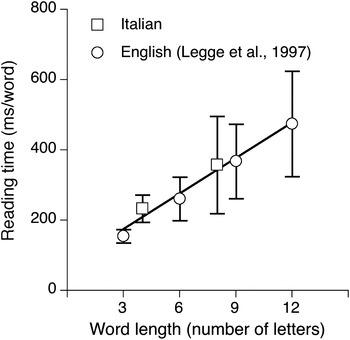
How can we explain the reading rate curve? Reading rate is inversely proportional to the size of visual span (Legge et al. Reference Legge, Mansfield and Chung2001), that is, the number of adjacent letters that can be recognized without moving the eyes. Visual span and reading rate depend to the same degree on several variables, including size, contrast, and eccentricity (e.g., Legge et al. Reference Legge, Mansfield and Chung2001). Legge et al. (Reference Legge, Mansfield and Chung2001) introduced a psychophysical method for measuring the size of the visual span using random letter triplets. According to these authors, however, this can also be estimated from the relationship between reading time and word length. Figure 1 shows that when Italian and English readers are compared, reading time varies with word length. Stimuli in the two languages differ for uncontrolled linguistic variables (see Fig. 1 caption); nonetheless, all data points lie on the same regression line (with a slope of 33 msec per letter), indicating similar dependency on length across the two languages. Visual span can be estimated from these data. Knowing that reading involves a series of fixations of about 250 msec each (Rayner & McConkie Reference Rayner and McConkie1976), the number of letters identified in a glance can be estimated from the reciprocal of the slope of the regression line times 250 msec; that is, a span of about 7.5 characters. Note that the visual span profile is not homogeneous (Legge et al. Reference Legge, Mansfield and Chung2001): Performance for letters at the CPS (or in the optimal range) is perfect in the fovea but drops off eccentrically to reach the criterion level (typically 80% correct). Overall, we expect higher reading speeds in languages in which mean word length is shorter than the visual span, compared to languages characterized by generally longer words.
Figure 1.
Reading time (ms) as a function of word length for Italian (data collected by the authors) and English readers (replotted from Legge et al. Reference Legge, Ahn, Klitz and Luebker1997). Reading time was measured with the rapid serial visual presentation (RSVP) procedure: Words were presented one at a time in a four-word trial in the same central location with no interword time delay. For the Italian sample, 40 trials (160 words) were conducted to estimate the word duration necessary to keep performance at around 80% of correct naming (ranging from 75% to 94% for English). Words were high contrast; letter size (i.e., the height of the letter “x”) was 0.83 degrees and 0.8 degrees in the English and Italian samples, respectively. Both data sets are collected on lists of words matched in frequency. Data are averaged across four adult observers for each word length in each language group. Standard errors are shown.
Pelli et al. (Reference Pelli, Tillman, Freeman, Su, Berger and Majaj2007) proposed that the visual span is limited by crowding, a phenomenon in which letter identification is impaired by the presence of neighboring letters. Crowding depends on center-to-center letter spacing, not on letter size. (Note that the two factors covary in standard printed texts.) The crowding range (or critical spacing [CS]) is defined as the distance between adjacent letters needed to restore recognition. CS scales with a proportionality of 0.5 to target eccentricity (i.e., at 4 degrees CS must be at least 2 degrees for a stimulus to be recognized) and is independent of stimulus size (e.g., Pelli et al. Reference Pelli, Palomares and Majaj2004). CS is about the size of the CPS in the fovea; below the CPS, letters fall within the CS, the visual span shrinks, and reading slows down rapidly. Above the CPS, the central letters are available for identification, but at a certain eccentricity (determined by letter distance) the letters farther away from fixation have smaller spacing than the CS and cannot be identified.
Crowding indicates faulty integration of features within an integration field. Therefore, it must be distinguished from a more peripheral phenomenon, that is, masking, in which the mask makes the signal disappear; or rather, the crowded letter is visible but unidentifiable (Pelli et al. Reference Pelli, Palomares and Majaj2004). Within the crowding range, features belonging to different objects are combined through compulsory pooling or averaging of signals (Parkes et al. Reference Parkes, Lund, Angelucci, Solomon and Morgan2001), and observers erroneously attribute features at the distractor location to the target (Nandy & Tjan Reference Nandy and Tjan2007). Popple and Levi (Reference Popple and Levi2005) presented letter strings of variable length and asked observers to identify letters. Increasing the spacing (i.e., reducing crowding) decreased the number of letters reported without permutations. Thus, within the crowding range, letter/feature position uncertainty influences the perceived spatial order of characters. Scrambling the letters in words (so the substitutions are undetectable in crowding conditions) disrupts the text and accounts for variance in reading rate more than modifying word shape (case alternation) or scrambling word order (Pelli & Tillman Reference Pelli and Tillman2007).
Written alphabets differ dramatically but share the same visual parts (Changizi et al. Reference Changizi, Zhang, Ye and Shimojo2006); hence, visual integration limits may affect them similarly. In particular, crowding constrains the size of the visual span and is presumably invariant across languages, thus posing visual constraints on the orthographic code. Therefore, we propose that crowding should be considered in general models of orthographic decoding in addition to and in interaction with the linguistic environment identified by Frost. Consequently, smaller effects of length and letter transposition should be found in some European languages (such as English and French). Conversely, length may be particularly disruptive in words longer than the visual span in languages such as Hebrew that do not allow for letter position insensitivity. Indeed, the omission of vowels in written Hebrew might be interpreted as a means of overcoming the intrinsic position uncertainty arising from the bottleneck of increasing word length/eccentricity (which in Hebrew would be particularly disruptive because of its linguistic structure). This is consistent with Legge and Bigelow's (2011) proposal that scripts have been optimized for the visual requirements of reading, not the motor demands of writing.





 You have
Access
Frost analyzes how reading is affected by the linguistic demands of written languages and concludes that letter position insensitivity results from reading strategies and is not a general characteristic of brain computation. Here, we propose that reading strategies are also influenced by perceptual limitations inherent in the visual system.
Text legibility depends more on letter size than might be expected based on acuity for single-letter identification. In psychophysical studies, reading rate is defined as the number of words read in a minute and is often measured by presenting a rapid sequence of words at the same spatial location (rapid serial visual presentation [RSVP]). Presentation time is adjusted to the time needed to obtain an accuracy criterion (e.g., 90%; Legge et al. Reference Legge, Ahn, Klitz and Luebker1997). Reading rate increases up to a critical print size (CPS), levels off at intermediate sizes, and drops again with larger text sizes. CPS measures about 0.2 degrees and the flat plateau extends to about 2 degrees (e.g., Legge et al. Reference Legge, Mansfield and Chung2001). Over the centuries, books have been printed to meet visual demands, and font size is always in the plateau range, usually close to the CPS (Legge & Bigelow Reference Legge and Bigelow2011).
How can we explain the reading rate curve? Reading rate is inversely proportional to the size of visual span (Legge et al. Reference Legge, Mansfield and Chung2001), that is, the number of adjacent letters that can be recognized without moving the eyes. Visual span and reading rate depend to the same degree on several variables, including size, contrast, and eccentricity (e.g., Legge et al. Reference Legge, Mansfield and Chung2001). Legge et al. (Reference Legge, Mansfield and Chung2001) introduced a psychophysical method for measuring the size of the visual span using random letter triplets. According to these authors, however, this can also be estimated from the relationship between reading time and word length. Figure 1 shows that when Italian and English readers are compared, reading time varies with word length. Stimuli in the two languages differ for uncontrolled linguistic variables (see Fig. 1 caption); nonetheless, all data points lie on the same regression line (with a slope of 33 msec per letter), indicating similar dependency on length across the two languages. Visual span can be estimated from these data. Knowing that reading involves a series of fixations of about 250 msec each (Rayner & McConkie Reference Rayner and McConkie1976), the number of letters identified in a glance can be estimated from the reciprocal of the slope of the regression line times 250 msec; that is, a span of about 7.5 characters. Note that the visual span profile is not homogeneous (Legge et al. Reference Legge, Mansfield and Chung2001): Performance for letters at the CPS (or in the optimal range) is perfect in the fovea but drops off eccentrically to reach the criterion level (typically 80% correct). Overall, we expect higher reading speeds in languages in which mean word length is shorter than the visual span, compared to languages characterized by generally longer words.
Reading time (ms) as a function of word length for Italian (data collected by the authors) and English readers (replotted from Legge et al. Reference Legge, Ahn, Klitz and Luebker1997). Reading time was measured with the rapid serial visual presentation (RSVP) procedure: Words were presented one at a time in a four-word trial in the same central location with no interword time delay. For the Italian sample, 40 trials (160 words) were conducted to estimate the word duration necessary to keep performance at around 80% of correct naming (ranging from 75% to 94% for English). Words were high contrast; letter size (i.e., the height of the letter “x”) was 0.83 degrees and 0.8 degrees in the English and Italian samples, respectively. Both data sets are collected on lists of words matched in frequency. Data are averaged across four adult observers for each word length in each language group. Standard errors are shown.
Pelli et al. (Reference Pelli, Tillman, Freeman, Su, Berger and Majaj2007) proposed that the visual span is limited by crowding, a phenomenon in which letter identification is impaired by the presence of neighboring letters. Crowding depends on center-to-center letter spacing, not on letter size. (Note that the two factors covary in standard printed texts.) The crowding range (or critical spacing [CS]) is defined as the distance between adjacent letters needed to restore recognition. CS scales with a proportionality of 0.5 to target eccentricity (i.e., at 4 degrees CS must be at least 2 degrees for a stimulus to be recognized) and is independent of stimulus size (e.g., Pelli et al. Reference Pelli, Palomares and Majaj2004). CS is about the size of the CPS in the fovea; below the CPS, letters fall within the CS, the visual span shrinks, and reading slows down rapidly. Above the CPS, the central letters are available for identification, but at a certain eccentricity (determined by letter distance) the letters farther away from fixation have smaller spacing than the CS and cannot be identified.
Crowding indicates faulty integration of features within an integration field. Therefore, it must be distinguished from a more peripheral phenomenon, that is, masking, in which the mask makes the signal disappear; or rather, the crowded letter is visible but unidentifiable (Pelli et al. Reference Pelli, Palomares and Majaj2004). Within the crowding range, features belonging to different objects are combined through compulsory pooling or averaging of signals (Parkes et al. Reference Parkes, Lund, Angelucci, Solomon and Morgan2001), and observers erroneously attribute features at the distractor location to the target (Nandy & Tjan Reference Nandy and Tjan2007). Popple and Levi (Reference Popple and Levi2005) presented letter strings of variable length and asked observers to identify letters. Increasing the spacing (i.e., reducing crowding) decreased the number of letters reported without permutations. Thus, within the crowding range, letter/feature position uncertainty influences the perceived spatial order of characters. Scrambling the letters in words (so the substitutions are undetectable in crowding conditions) disrupts the text and accounts for variance in reading rate more than modifying word shape (case alternation) or scrambling word order (Pelli & Tillman Reference Pelli and Tillman2007).
Written alphabets differ dramatically but share the same visual parts (Changizi et al. Reference Changizi, Zhang, Ye and Shimojo2006); hence, visual integration limits may affect them similarly. In particular, crowding constrains the size of the visual span and is presumably invariant across languages, thus posing visual constraints on the orthographic code. Therefore, we propose that crowding should be considered in general models of orthographic decoding in addition to and in interaction with the linguistic environment identified by Frost. Consequently, smaller effects of length and letter transposition should be found in some European languages (such as English and French). Conversely, length may be particularly disruptive in words longer than the visual span in languages such as Hebrew that do not allow for letter position insensitivity. Indeed, the omission of vowels in written Hebrew might be interpreted as a means of overcoming the intrinsic position uncertainty arising from the bottleneck of increasing word length/eccentricity (which in Hebrew would be particularly disruptive because of its linguistic structure). This is consistent with Legge and Bigelow's (2011) proposal that scripts have been optimized for the visual requirements of reading, not the motor demands of writing.