In the target article, Frost contends that current-day approaches over-emphasize purely orthographic features (specifically letter position) in modeling visual word recognition. A truly universal model of word recognition, he argues, should instead consider phonological, orthographic, morphological, and semantic linguistic features in toto.
Although transposed letter (TL) experiments overall support flexible orthographic encoding of relative letter position within words, evidence suggests that phonology and morphology constrain TL effects. Of relevance here, TL priming is sensitive to lexical morphological structure: Transposed letters within (GAREDN–GARDEN) but not across morpheme boundaries (WAREDN–WARDEN) elicit TL priming (Christianson et al. Reference Christianson, Johnson and Rayner2005; Duñabeitia et al. Reference Duñabeitia, Perea and Carreiras2007). Nevertheless, mainstream models of orthographic processing in word recognition are yet to incorporate the role of morphology (Grainger Reference Grainger2008).
Despite representing an orthographic confluence, alphasyllabaries are not included in Frost's critique, probably because of the paucity of evidence on orthographic processing in these languages. We provide here a brief description of Hindi alphasyllabary (henceforth, Devanagari), one of the Indic languages written in the Devanagari script, along with recent experimental evidence that highlights the role of morphological structure in orthographic processing in Devanagari.
Also called abugida, the alphasyllabary is a segmental writing system wherein consonant–vowel (CV) sequences are combined within character units: Akin to alphabets, alphasyllabaries distinguish vowels and consonants, but as in a syllabary, each alphasyllabic character or akṣara (pronounced /ʌkʃʌrʌ/) maps onto a CV syllable.
Devanagari has highly transparent sound-to-spelling mapping, in consonance with its origins in Brahmi, the ancient Indian orthography designed especially to encode the finer articulatory details of Vedic chants. Accordingly, the Devanagari akṣaramāla (alphabet) has a phonetic layout: vowels and diphthongs are followed by consonants classified by place of articulation. Unlike Hebrew, where vowel information is underspecified, Devanagari employs obligatory vowel diacritics that substitute the inherent schwa (/ʌ/) of consonant characters wherever necessary (for a detailed description, see Vaid & Gupta Reference Vaid and Gupta2002). The use of vowel diacritics and ligatured consonants renders Devanagari orthography visually nonlinear and spatially complex.
The limited data available suggest that the neural underpinnings of Devanagari word recognition are appreciably influenced by its structural hybridity (Das et al. Reference Das, Padakannaya, Pugh and Singh2011), engaging brain regions involved in phonemic, syllabic, as well as complex visuospatial processing. An insightful behavioral study by Vaid and Gupta (Reference Vaid and Gupta2002) demonstrated that readers of Devanagari are sensitive to both syllabic and phonemic level features during orthographic processing.
In addition to a hybrid orthography, Hindi/Devanagari possesses a rich, productive morphology with extensive inflectional marking of semantic and syntactic concepts like gender, number, and tense (Kachru Reference Kachru, Kachru, Kachru and Sridhar2008; Masica Reference Masica1991). Following Frost's discussion, we present recent evidence that orthographic processing in Hindi/Devanagari is also constrained by lexical morphology: Akṣara transposition (henceforth termed TL per convention) effects in Hindi/Devanagari are evident in morphologically simple (monomorphemic) but not morphologically complex (bimorphemic) words.
Transposed akṣara (TL) priming in Devanagari
Forty proficient, right-handed native readers of Hindi made dominant-hand lexical decisions to a list of 80 four-akṣara Hindi targets which were preceded by one of four prime types: identity (ID), orthographic nonword (NW: मजलब–मतलब, <majlab>Footnote
1
–<matlab>), transposed akṣara (TL: मलतब–मतलब, <maltab>–<matlab>), or unrelated word primes (WD: मनसब–मतलब, <mansab>–<matlab>, district–meaning). Forty targets were morphologically simple (analogous to GARDEN), while 40 were complex (analogous to WARDEN, for example कसरत <kasrat>, exercise, from कसर <kasar>, effort). An informal poll was used to ensure familiarity of target and unrelated word primes to native readers. Targets comprised only basic consonant akṣaras and had no nonlinear diacritics, while primes had minimal diacritics; none of the stimuli had ligatured consonants. TL primes involved the transposition of medial (second and third) akṣaras of targets, while NW primes were created by replacing the second akṣara, and WD primes were selected to share the first and last (wherever possible) akṣaras with respective targets. The orthotactic legality of all nonword bigrams was carefully checked. Forty nonword as well as twenty filler word targets were similarly compiled, with matching primes in all four categories. A practice block of ten words and nonwords each preceded the main task. Per trial, a forward mask (########) of 500 msec was followed by a 67-msec prime in white akṣaras, which was immediately replaced on screen by the target in yellow akṣaras (as Hindi/Devanagari makes no case distinction)
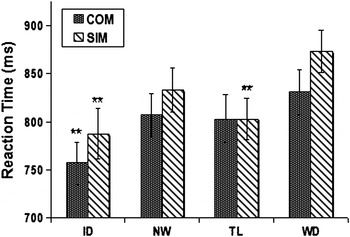
Across both simple and complex words, participants' target recognition in the identity priming condition was significantly faster (74 msec and 85 msec, both p ≤ ..004) with respect to the unrelated word (control) condition. For morphologically simple words, facilitation by TL primes (<maltab>–<matlab>, comparable to GADREN–GARDEN, 70 msec, p < .001) was equivalent to that by identity primes, while orthographic nonword primes (<majlab>–<matlab>, GALDEN–GARDEN) did not facilitate targets significantly (40 msec, p > .02). By contrast, recognition of morphologically complex words was not facilitated (p > .10) by either TL (<karsat>–<kasrat>, WADREN–WARDEN, 28 msec) or NW primes (<kabrat>–<kasrat>, WABDEN–WARDEN, 24 msec), although a numerical advantage over control primes was discernible (see Fig. 1).
Figure 1.
Lexical decision latencies to morphologically simple (SIM) and complex (COM) four-ak?ara Hindi/Devanagari words preceded by identity (ID), nonword (NW), transposed letter (TL), and unrelated word (WD) primes (n = 40). Significant priming (Bonferroni-adjusted α = .004) relative to control (WD) indicated by asterisks.
Discussion
The preliminary evidence supports a robust transposed akṣara (TL) priming effect in the alphasyllabic orthography of Devanagari, although TL primes facilitate recognition of only morphologically simple words. By contrast, TL primes fail to facilitate identification of morphologically complex Hindi/Devanagari words, similarly to previous reports on English and Spanish (Christianson et al. Reference Christianson, Johnson and Rayner2005; Duñabeitia et al. Reference Duñabeitia, Perea and Carreiras2007).
It is noteworthy that, unlike previous studies wherein primes violated morpheme boundaries (e.g., WAREDN), two-fifths of the TL primes of morphologically complex words in our experiment preserved morphemic boundaries (e.g., WADREN). The present results suggest that initial orthographic processing in Hindi/Devanagari is critically modulated by the morpho-orthographic structure of written words (Gold & Rastle Reference Gold and Rastle2007).
To conclude, our data offer support for Frost's claim, showing that orthographic feature encoding in Hindi/Devanagari is modulated by morphological context. The current results underline the need for revising word recognition models to extend their universality to encompass alphasyllabaries. Based on these results, we also propose the syllabic CV akṣara as the probable input unit for orthographic encoding in Hindi/Devanagari, similarly to syllabic–moraic Kana in Japanese (Perea & Perez Reference Perea and Perez2009).





In the target article, Frost contends that current-day approaches over-emphasize purely orthographic features (specifically letter position) in modeling visual word recognition. A truly universal model of word recognition, he argues, should instead consider phonological, orthographic, morphological, and semantic linguistic features in toto.
Although transposed letter (TL) experiments overall support flexible orthographic encoding of relative letter position within words, evidence suggests that phonology and morphology constrain TL effects. Of relevance here, TL priming is sensitive to lexical morphological structure: Transposed letters within (GAREDN–GARDEN) but not across morpheme boundaries (WAREDN–WARDEN) elicit TL priming (Christianson et al. Reference Christianson, Johnson and Rayner2005; Duñabeitia et al. Reference Duñabeitia, Perea and Carreiras2007). Nevertheless, mainstream models of orthographic processing in word recognition are yet to incorporate the role of morphology (Grainger Reference Grainger2008).
Despite representing an orthographic confluence, alphasyllabaries are not included in Frost's critique, probably because of the paucity of evidence on orthographic processing in these languages. We provide here a brief description of Hindi alphasyllabary (henceforth, Devanagari), one of the Indic languages written in the Devanagari script, along with recent experimental evidence that highlights the role of morphological structure in orthographic processing in Devanagari.
Also called abugida, the alphasyllabary is a segmental writing system wherein consonant–vowel (CV) sequences are combined within character units: Akin to alphabets, alphasyllabaries distinguish vowels and consonants, but as in a syllabary, each alphasyllabic character or akṣara (pronounced /ʌkʃʌrʌ/) maps onto a CV syllable.
Devanagari has highly transparent sound-to-spelling mapping, in consonance with its origins in Brahmi, the ancient Indian orthography designed especially to encode the finer articulatory details of Vedic chants. Accordingly, the Devanagari akṣaramāla (alphabet) has a phonetic layout: vowels and diphthongs are followed by consonants classified by place of articulation. Unlike Hebrew, where vowel information is underspecified, Devanagari employs obligatory vowel diacritics that substitute the inherent schwa (/ʌ/) of consonant characters wherever necessary (for a detailed description, see Vaid & Gupta Reference Vaid and Gupta2002). The use of vowel diacritics and ligatured consonants renders Devanagari orthography visually nonlinear and spatially complex.
The limited data available suggest that the neural underpinnings of Devanagari word recognition are appreciably influenced by its structural hybridity (Das et al. Reference Das, Padakannaya, Pugh and Singh2011), engaging brain regions involved in phonemic, syllabic, as well as complex visuospatial processing. An insightful behavioral study by Vaid and Gupta (Reference Vaid and Gupta2002) demonstrated that readers of Devanagari are sensitive to both syllabic and phonemic level features during orthographic processing.
In addition to a hybrid orthography, Hindi/Devanagari possesses a rich, productive morphology with extensive inflectional marking of semantic and syntactic concepts like gender, number, and tense (Kachru Reference Kachru, Kachru, Kachru and Sridhar2008; Masica Reference Masica1991). Following Frost's discussion, we present recent evidence that orthographic processing in Hindi/Devanagari is also constrained by lexical morphology: Akṣara transposition (henceforth termed TL per convention) effects in Hindi/Devanagari are evident in morphologically simple (monomorphemic) but not morphologically complex (bimorphemic) words.
Transposed akṣara (TL) priming in Devanagari
Forty proficient, right-handed native readers of Hindi made dominant-hand lexical decisions to a list of 80 four-akṣara Hindi targets which were preceded by one of four prime types: identity (ID), orthographic nonword (NW: मजलब–मतलब, <majlab>Footnote 1 –<matlab>), transposed akṣara (TL: मलतब–मतलब, <maltab>–<matlab>), or unrelated word primes (WD: मनसब–मतलब, <mansab>–<matlab>, district–meaning). Forty targets were morphologically simple (analogous to GARDEN), while 40 were complex (analogous to WARDEN, for example कसरत <kasrat>, exercise, from कसर <kasar>, effort). An informal poll was used to ensure familiarity of target and unrelated word primes to native readers. Targets comprised only basic consonant akṣaras and had no nonlinear diacritics, while primes had minimal diacritics; none of the stimuli had ligatured consonants. TL primes involved the transposition of medial (second and third) akṣaras of targets, while NW primes were created by replacing the second akṣara, and WD primes were selected to share the first and last (wherever possible) akṣaras with respective targets. The orthotactic legality of all nonword bigrams was carefully checked. Forty nonword as well as twenty filler word targets were similarly compiled, with matching primes in all four categories. A practice block of ten words and nonwords each preceded the main task. Per trial, a forward mask (########) of 500 msec was followed by a 67-msec prime in white akṣaras, which was immediately replaced on screen by the target in yellow akṣaras (as Hindi/Devanagari makes no case distinction)
Across both simple and complex words, participants' target recognition in the identity priming condition was significantly faster (74 msec and 85 msec, both p ≤ ..004) with respect to the unrelated word (control) condition. For morphologically simple words, facilitation by TL primes (<maltab>–<matlab>, comparable to GADREN–GARDEN, 70 msec, p < .001) was equivalent to that by identity primes, while orthographic nonword primes (<majlab>–<matlab>, GALDEN–GARDEN) did not facilitate targets significantly (40 msec, p > .02). By contrast, recognition of morphologically complex words was not facilitated (p > .10) by either TL (<karsat>–<kasrat>, WADREN–WARDEN, 28 msec) or NW primes (<kabrat>–<kasrat>, WABDEN–WARDEN, 24 msec), although a numerical advantage over control primes was discernible (see Fig. 1).
Lexical decision latencies to morphologically simple (SIM) and complex (COM) four-ak?ara Hindi/Devanagari words preceded by identity (ID), nonword (NW), transposed letter (TL), and unrelated word (WD) primes (n = 40). Significant priming (Bonferroni-adjusted α = .004) relative to control (WD) indicated by asterisks.
Discussion
The preliminary evidence supports a robust transposed akṣara (TL) priming effect in the alphasyllabic orthography of Devanagari, although TL primes facilitate recognition of only morphologically simple words. By contrast, TL primes fail to facilitate identification of morphologically complex Hindi/Devanagari words, similarly to previous reports on English and Spanish (Christianson et al. Reference Christianson, Johnson and Rayner2005; Duñabeitia et al. Reference Duñabeitia, Perea and Carreiras2007).
It is noteworthy that, unlike previous studies wherein primes violated morpheme boundaries (e.g., WAREDN), two-fifths of the TL primes of morphologically complex words in our experiment preserved morphemic boundaries (e.g., WADREN). The present results suggest that initial orthographic processing in Hindi/Devanagari is critically modulated by the morpho-orthographic structure of written words (Gold & Rastle Reference Gold and Rastle2007).
To conclude, our data offer support for Frost's claim, showing that orthographic feature encoding in Hindi/Devanagari is modulated by morphological context. The current results underline the need for revising word recognition models to extend their universality to encompass alphasyllabaries. Based on these results, we also propose the syllabic CV akṣara as the probable input unit for orthographic encoding in Hindi/Devanagari, similarly to syllabic–moraic Kana in Japanese (Perea & Perez Reference Perea and Perez2009).