Brain networks do not have a single, unique function
Human neuroimaging work, with its clean activation maps showing a few isolated peaks, has been an important contributor to a quasi-phrenological view of the brain. It certainly does not help that many review papers, when summarizing varied results, often include dreaded arrows indicating where some function putatively resides – say, self-referential processing in the medial prefrontal cortex.
Nevertheless, with the explosion of network-related developments in the sciences in general, neuroimaging has finally shifted away from the region-centric approach to one that embraces networks. Hence, network analysis of human neuroimaging data has contributed to a view of brain function that focuses on how groups of brain regions participate in mental functions, and less on how particular regions operate in isolation. But what are networks? How should we understand and study them?
Functional MRI data during the so-called resting-state have been extensively investigated in order to characterize network structure. A central finding is that, at rest, brain regions can be grouped into a relatively small number of stable communities, also called clusters (or simply networks). For example, Yeo and colleagues (Reference Yeo, Krienen, Sepulcre, Sabuncu, Lashkari, Hollinshead, Roffman, Smoller, Zollei, Polimeni, Fischl, Liu and Buckner2011) described a seven-community parcellation of cortical areas that was based on a very large sample of participants. Based on anatomical and functional considerations, the communities were given labels such as “visual,” “frontoparietal,” “default,” and so on.
The large body of work employing modern network methods to study brain community structure and other network measures makes a fundamental assumption that appears reasonable at first: The set of nodes (i.e., brain regions) should be partitioned into a disjoint set of clusters, such that each node belongs to one and exactly one community. Unfortunately, this assumption, which is adopted frequently in network science (Newman Reference Newman2010) more generally, too, is problematic. Why should brain regions belong to only a single network?
The first reason is methodological. The ready availability of disjoint community-detection algorithms has certainly been a driving force behind this trend. But the methodological aspect as the sole explanation misses a key conceptual point.
I contend that the choice of using disjoint communities to understand brain networks is, in part, linked to the idea that brain regions perform specific functions; that is, the structure-function mapping is, more or less, one-to-one (Pessoa Reference Pessoa2014). In this view, a given brain region, which has a specific function, belongs to a single network. Importantly, a network is viewed as having a single, though more general, function, too. For example, Menon and Uddin (Reference Menon and Uddin2010) have described a “salience network,” whose nodes include the anterior insula and anterior cingulate cortex. The “salience network” is suggested to detect salient events and initiate switches between networks involved in self-related, internally oriented processing and those involved in goal-directed, externally oriented processing. But how can the idea that networks implement a single, coherent function be validated beyond that of a suggestion? Bressler and Menon (Reference Bressler and Menon2010, p. 285) admit that “to determine whether this network indeed specifically performs this function will require testing and validation of a sequence of putative network mechanisms.”
But there are good reasons to believe that the mapping between networks and functions is not a simple one-to-one relationship. I suggest that the attempt to map structure to function in a one-to-one manner in terms of networks will be fraught, as is the one based on brain regions – the problem is simply passed along to a higher level. Hence, two distinct networks may generate similar behavioral profiles (many-to-one); and a given network will also participate in several functions (one-to-many). Broadly speaking, a network's operation will depend on several more global variables – namely, an extended context that includes the state of several neurotransmitter systems, arousal, slow wave potentials, and so forth. In other words, a network that is solely defined as a collection of regions is insufficient to eliminate the one-to-many problem. What if we extend the concept of a network with these additional variables? For example, Cacioppo and Tassinary (Reference Cacioppo and Tassinary1990) suggest that psychological events can be mapped to physiological ones in a more regular manner by considering a spatiotemporal pattern of physiological events. The notion of a network is hence extended to incorporate other physiological events – for example, the state of a given neurotransmitter. How extensive does this state need to be? Clearly, the usefulness of this strategy in reducing the difficulties entailed by many-to-many mappings will depend on how broad the context must be.
In sum, an implicit motivation for the idea of disjoint networks – that networks have stable, unique functions – does not stand scrutiny.
Overlapping brain networks
Let us return to the issue of disjoint versus overlapping networks more specifically. Based on studies of perception, cognition, emotion, and motivation, I have proposed that brain networks are highly interdigitated (Pessoa Reference Pessoa2013; Reference Pessoa2014). At the broadest level, cognition and emotion are not instantiated by separate brain regions; regions important for cognition participate in many emotional processes and vice versa. In a nutshell, cognition and emotion rely on interdigitated networks.
Consider this idea from the point of view of a single brain region, such as the amygdala. Even a rather simplified view of its anatomical connectivity shows that, minimally, it belongs to three networks. The first is a “visual network”; the amygdala receives fibers from anterior parts of the temporal cortex and influences visual processing via a set of projections that reach most of the ventral occipitotemporal cortex. The second is the well-known “autonomic network,” and via connections with the hypothalamus and periaqueductal gray (among many others), the amygdala participates in the coordination of many complex autonomic mechanisms. The third is a “value network,” as evidenced by its connectivity with orbitofrontal cortex and medial PFC. Hence, the amygdala affiliates with different sets of regions (“networks”) in a highly flexible and context-dependent manner.
I propose that brain networks should be considered as highly overlapping; the example of the amygdala being a simple case of three networks overlapping at this structure. In having overlapping networks, the brain is not special. For example, in early work on overlapping community structure, Palla and colleagues (Reference Palla, Derenyi, Farkas and Vicsek2005, p. 814) suggest that, in all likelihood, “actual networks are made of the interwoven sets of overlapping communities.” More generally, the importance of understanding and characterizing overlapping structure has been discussed by sociologists, as well as biologists, for some time. For example, in a large-scale analysis of the yeast proteome, Gavin and colleagues (Reference Gavin, Bösche, Krause, Grandi, Marzioch, Bauer, Schultz, Rick, Michon and Cruciat2002) showed that a considerable proportion of the proteins studied belonged to multiple networks.
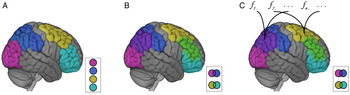
Overall, very little is known about the overlapping community structure of brain networks (but see Mesulam Reference Mesulam1998; Yeo et al. Reference Yeo, Krienen, Chee and Buckner2014) (Fig. 1). But, as in the case of proteins, a large fraction of brain regions may belong to several neural circuits simultaneously (see Cocchi et al. Reference Cocchi, Zalesky, Fornito and Mattingley2013; Cole et al. Reference Cole, Reynolds, Power, Repovs, Anticevic and Braver2013; Hilgetag et al. Reference Hilgetag, O'Neill and Young1996; Pessoa Reference Pessoa2014). It is hence likely that the focus on disjoint clusters has precluded the discovery of important structure in large-scale brain networks (Fig. 1C).
Figure 1.
Brain networks. (A) Standard networks are disjoint (inset: colors indicate separate communities). (B) Overlapping networks are interdigitated, such that brain regions belong to multiple communities (inset: community overlap indicated by mixed colors). (C) Networks (same as in panel B) do not have single, unique functions, but instead participate in multiple functions, f.
The “flexible hub theory” by Cole and colleagues (Reference Cole, Reynolds, Power, Repovs, Anticevic and Braver2013) supports the idea that brain networks are interdigitated. The framework predicts that “some brain regions flexibly shift their functional connectivity patterns with multiple brain networks across a wide variety of tasks” (Cole et al. Reference Cole, Reynolds, Power, Repovs, Anticevic and Braver2013, p. 1). The “dynamic cooperation and competition” framework by Cocchi and colleagues (Reference Cocchi, Zalesky, Fornito and Mattingley2013) also speaks to the issues at hand. They argue against the idea of segregated systems supporting cognitive control and suggest, instead, that complex control functions are supported by anatomically distributed brain networks that share information in a dynamic manner.
Taken together, time has come to study the overlapping structure of brain networks.
Tasks reconfigure brain networks found during rest
Whereas the large-scale structure of brain networks has been studied extensively at rest, less is known about the large-scale structure during task performance. The central question in this regard is the following: Is the structure seen at rest the same observed during tasks? In particular, are the seven or so networks observed at rest (labeled “visual,” “somatosensory,” “default,” etc.) also present during tasks? Or Buckner and colleagues (Reference Buckner, Krienen and Yeo2013) ask: Do networks studied during the resting state capture fundamental units of organization or should “rest” be considered just another arbitrary task state? Some have argued strongly that functional connectivity (and hence, network structure) at rest is affected in minor ways by tasks (Cole et al. Reference Cole, Bassett, Power, Braver and Petersen2014). In this view, the activity covariation at rest forms a “backbone” that is only mildly influenced by task execution. An alternative proposal is that tasks alter patterns of functional connectivity more substantially (e.g., Buckner et al. Reference Buckner, Krienen and Yeo2013).
The claim that networks are largely the same during rest and tasks brings us back to the idea that networks are relatively fixed units of brain function. I suggest that considerable reorganization is observed during specific tasks, and that it is therefore better to consider “rest” as a particular task state. Functional MRI is a particularly suitable technique to investigate activity covariation among brain parts that are broadly distributed in space; in other words, functional connectivity patterns which, by definition, are independent of direct (and strong) anatomical connections. And, as revealed in the literature, functional interactions can be strong even when strong anatomical connectivity is absent.
We know that the functional connectivity between two regions can increase or decrease as a function of several variables, including task performance (Rissman et al. Reference Rissman, Gazzaley and D'Esposito2004), motivation (Padmala & Pessoa Reference Padmala and Pessoa2011), and emotion (Pessoa et al. Reference Pessoa, McKenna, Gutierrez and Ungerleider2002). In one study, the functional connectivity pattern between early visual areas was investigated during affective and neutral contexts (Damaraju et al. Reference Damaraju, Huang, Barrett and Pessoa2009). During the affective context, participants viewed faces that were surrounded by a ring whose color signaled the possibility of mild shock. During the neutral context, faces appeared surrounded by a ring whose color signaled safety. A measure of functional connectivity was strengthened during the affective relative to a neutral context. Hence, the affective context not only changed the magnitude of evoked responses, but also altered the pattern of responses across early visual cortex (and beyond).
The dual competition model (Pessoa Reference Pessoa2009) proposes that the effects of reward during perception and cognition depend in part on interactions between valuation regions and frontoparietal regions important for attention and executive control. Such interactions lead to the up-regulation of control and improve behavioral performance during challenging task conditions (and higher likelihood of reward) (Padmala & Pessoa Reference Padmala and Pessoa2011). Notably, in one study, comparison of the pattern of connectivity between reward and no-reward contexts revealed increases during the former (Kinnison et al. Reference Kinnison, Padmala, Choi and Pessoa2012). The increases were observed mostly between two communities of brain regions, reflecting increased integration with reward. In particular, the caudate and the nucleus accumbens showed increases in functional connectivity to nearly all cortical regions that were driven by reward.
Large-scale changes in functional connectivity were also found during an emotional manipulation in which a cue indicating the possibility of a mild shock was shown prior to a response-conflict task (Choi et al. Reference Choi, Padmala and Pessoa2012). In this case, we observed enhanced functional integration between subcortical regions (such as the bed nucleus of the stria terminalis and thalamus) and cortical regions (including the insula and medial PFC) (Kinnison et al. Reference Kinnison, Padmala, Choi and Pessoa2012). Whereas in the case of reward, functional connectivity increased within cortex, in the case of threat, functional connectivity decreased within cortex for several pairs of regions.
Together, our findings revealed several ways in which both emotional and motivational processing altered functional connectivity, including increased global efficiency and reduced decomposability (Kinnison et al. Reference Kinnison, Padmala, Choi and Pessoa2012). In all, I therefore suggest that network structure is dynamically reconfigured by task states, as also advanced by Cocchi and colleagues (Reference Cocchi, Zalesky, Fornito and Mattingley2013) and Cole and colleagues (Reference Cole, Reynolds, Power, Repovs, Anticevic and Braver2013).
In conclusion, I believe that the ideas described above are in close alignment with those advanced by Anderson (Reference Anderson2014) and, hopefully, will help us advance the field of brain research “after phrenology.”





In After Phrenology, Anderson (Reference Anderson2014) argues persuasively against modular frameworks of brain function. The book has much to offer on how distributed brain networks provide a much richer framework to clarify the mind-brain. Here, I would like to provide additional thoughts concerning the organization of brain networks.
Brain networks do not have a single, unique function
Human neuroimaging work, with its clean activation maps showing a few isolated peaks, has been an important contributor to a quasi-phrenological view of the brain. It certainly does not help that many review papers, when summarizing varied results, often include dreaded arrows indicating where some function putatively resides – say, self-referential processing in the medial prefrontal cortex.
Nevertheless, with the explosion of network-related developments in the sciences in general, neuroimaging has finally shifted away from the region-centric approach to one that embraces networks. Hence, network analysis of human neuroimaging data has contributed to a view of brain function that focuses on how groups of brain regions participate in mental functions, and less on how particular regions operate in isolation. But what are networks? How should we understand and study them?
Functional MRI data during the so-called resting-state have been extensively investigated in order to characterize network structure. A central finding is that, at rest, brain regions can be grouped into a relatively small number of stable communities, also called clusters (or simply networks). For example, Yeo and colleagues (Reference Yeo, Krienen, Sepulcre, Sabuncu, Lashkari, Hollinshead, Roffman, Smoller, Zollei, Polimeni, Fischl, Liu and Buckner2011) described a seven-community parcellation of cortical areas that was based on a very large sample of participants. Based on anatomical and functional considerations, the communities were given labels such as “visual,” “frontoparietal,” “default,” and so on.
The large body of work employing modern network methods to study brain community structure and other network measures makes a fundamental assumption that appears reasonable at first: The set of nodes (i.e., brain regions) should be partitioned into a disjoint set of clusters, such that each node belongs to one and exactly one community. Unfortunately, this assumption, which is adopted frequently in network science (Newman Reference Newman2010) more generally, too, is problematic. Why should brain regions belong to only a single network?
The first reason is methodological. The ready availability of disjoint community-detection algorithms has certainly been a driving force behind this trend. But the methodological aspect as the sole explanation misses a key conceptual point.
I contend that the choice of using disjoint communities to understand brain networks is, in part, linked to the idea that brain regions perform specific functions; that is, the structure-function mapping is, more or less, one-to-one (Pessoa Reference Pessoa2014). In this view, a given brain region, which has a specific function, belongs to a single network. Importantly, a network is viewed as having a single, though more general, function, too. For example, Menon and Uddin (Reference Menon and Uddin2010) have described a “salience network,” whose nodes include the anterior insula and anterior cingulate cortex. The “salience network” is suggested to detect salient events and initiate switches between networks involved in self-related, internally oriented processing and those involved in goal-directed, externally oriented processing. But how can the idea that networks implement a single, coherent function be validated beyond that of a suggestion? Bressler and Menon (Reference Bressler and Menon2010, p. 285) admit that “to determine whether this network indeed specifically performs this function will require testing and validation of a sequence of putative network mechanisms.”
But there are good reasons to believe that the mapping between networks and functions is not a simple one-to-one relationship. I suggest that the attempt to map structure to function in a one-to-one manner in terms of networks will be fraught, as is the one based on brain regions – the problem is simply passed along to a higher level. Hence, two distinct networks may generate similar behavioral profiles (many-to-one); and a given network will also participate in several functions (one-to-many). Broadly speaking, a network's operation will depend on several more global variables – namely, an extended context that includes the state of several neurotransmitter systems, arousal, slow wave potentials, and so forth. In other words, a network that is solely defined as a collection of regions is insufficient to eliminate the one-to-many problem. What if we extend the concept of a network with these additional variables? For example, Cacioppo and Tassinary (Reference Cacioppo and Tassinary1990) suggest that psychological events can be mapped to physiological ones in a more regular manner by considering a spatiotemporal pattern of physiological events. The notion of a network is hence extended to incorporate other physiological events – for example, the state of a given neurotransmitter. How extensive does this state need to be? Clearly, the usefulness of this strategy in reducing the difficulties entailed by many-to-many mappings will depend on how broad the context must be.
In sum, an implicit motivation for the idea of disjoint networks – that networks have stable, unique functions – does not stand scrutiny.
Overlapping brain networks
Let us return to the issue of disjoint versus overlapping networks more specifically. Based on studies of perception, cognition, emotion, and motivation, I have proposed that brain networks are highly interdigitated (Pessoa Reference Pessoa2013; Reference Pessoa2014). At the broadest level, cognition and emotion are not instantiated by separate brain regions; regions important for cognition participate in many emotional processes and vice versa. In a nutshell, cognition and emotion rely on interdigitated networks.
Consider this idea from the point of view of a single brain region, such as the amygdala. Even a rather simplified view of its anatomical connectivity shows that, minimally, it belongs to three networks. The first is a “visual network”; the amygdala receives fibers from anterior parts of the temporal cortex and influences visual processing via a set of projections that reach most of the ventral occipitotemporal cortex. The second is the well-known “autonomic network,” and via connections with the hypothalamus and periaqueductal gray (among many others), the amygdala participates in the coordination of many complex autonomic mechanisms. The third is a “value network,” as evidenced by its connectivity with orbitofrontal cortex and medial PFC. Hence, the amygdala affiliates with different sets of regions (“networks”) in a highly flexible and context-dependent manner.
I propose that brain networks should be considered as highly overlapping; the example of the amygdala being a simple case of three networks overlapping at this structure. In having overlapping networks, the brain is not special. For example, in early work on overlapping community structure, Palla and colleagues (Reference Palla, Derenyi, Farkas and Vicsek2005, p. 814) suggest that, in all likelihood, “actual networks are made of the interwoven sets of overlapping communities.” More generally, the importance of understanding and characterizing overlapping structure has been discussed by sociologists, as well as biologists, for some time. For example, in a large-scale analysis of the yeast proteome, Gavin and colleagues (Reference Gavin, Bösche, Krause, Grandi, Marzioch, Bauer, Schultz, Rick, Michon and Cruciat2002) showed that a considerable proportion of the proteins studied belonged to multiple networks.
Overall, very little is known about the overlapping community structure of brain networks (but see Mesulam Reference Mesulam1998; Yeo et al. Reference Yeo, Krienen, Chee and Buckner2014) (Fig. 1). But, as in the case of proteins, a large fraction of brain regions may belong to several neural circuits simultaneously (see Cocchi et al. Reference Cocchi, Zalesky, Fornito and Mattingley2013; Cole et al. Reference Cole, Reynolds, Power, Repovs, Anticevic and Braver2013; Hilgetag et al. Reference Hilgetag, O'Neill and Young1996; Pessoa Reference Pessoa2014). It is hence likely that the focus on disjoint clusters has precluded the discovery of important structure in large-scale brain networks (Fig. 1C).
Brain networks. (A) Standard networks are disjoint (inset: colors indicate separate communities). (B) Overlapping networks are interdigitated, such that brain regions belong to multiple communities (inset: community overlap indicated by mixed colors). (C) Networks (same as in panel B) do not have single, unique functions, but instead participate in multiple functions, f.
The “flexible hub theory” by Cole and colleagues (Reference Cole, Reynolds, Power, Repovs, Anticevic and Braver2013) supports the idea that brain networks are interdigitated. The framework predicts that “some brain regions flexibly shift their functional connectivity patterns with multiple brain networks across a wide variety of tasks” (Cole et al. Reference Cole, Reynolds, Power, Repovs, Anticevic and Braver2013, p. 1). The “dynamic cooperation and competition” framework by Cocchi and colleagues (Reference Cocchi, Zalesky, Fornito and Mattingley2013) also speaks to the issues at hand. They argue against the idea of segregated systems supporting cognitive control and suggest, instead, that complex control functions are supported by anatomically distributed brain networks that share information in a dynamic manner.
Taken together, time has come to study the overlapping structure of brain networks.
Tasks reconfigure brain networks found during rest
Whereas the large-scale structure of brain networks has been studied extensively at rest, less is known about the large-scale structure during task performance. The central question in this regard is the following: Is the structure seen at rest the same observed during tasks? In particular, are the seven or so networks observed at rest (labeled “visual,” “somatosensory,” “default,” etc.) also present during tasks? Or Buckner and colleagues (Reference Buckner, Krienen and Yeo2013) ask: Do networks studied during the resting state capture fundamental units of organization or should “rest” be considered just another arbitrary task state? Some have argued strongly that functional connectivity (and hence, network structure) at rest is affected in minor ways by tasks (Cole et al. Reference Cole, Bassett, Power, Braver and Petersen2014). In this view, the activity covariation at rest forms a “backbone” that is only mildly influenced by task execution. An alternative proposal is that tasks alter patterns of functional connectivity more substantially (e.g., Buckner et al. Reference Buckner, Krienen and Yeo2013).
The claim that networks are largely the same during rest and tasks brings us back to the idea that networks are relatively fixed units of brain function. I suggest that considerable reorganization is observed during specific tasks, and that it is therefore better to consider “rest” as a particular task state. Functional MRI is a particularly suitable technique to investigate activity covariation among brain parts that are broadly distributed in space; in other words, functional connectivity patterns which, by definition, are independent of direct (and strong) anatomical connections. And, as revealed in the literature, functional interactions can be strong even when strong anatomical connectivity is absent.
We know that the functional connectivity between two regions can increase or decrease as a function of several variables, including task performance (Rissman et al. Reference Rissman, Gazzaley and D'Esposito2004), motivation (Padmala & Pessoa Reference Padmala and Pessoa2011), and emotion (Pessoa et al. Reference Pessoa, McKenna, Gutierrez and Ungerleider2002). In one study, the functional connectivity pattern between early visual areas was investigated during affective and neutral contexts (Damaraju et al. Reference Damaraju, Huang, Barrett and Pessoa2009). During the affective context, participants viewed faces that were surrounded by a ring whose color signaled the possibility of mild shock. During the neutral context, faces appeared surrounded by a ring whose color signaled safety. A measure of functional connectivity was strengthened during the affective relative to a neutral context. Hence, the affective context not only changed the magnitude of evoked responses, but also altered the pattern of responses across early visual cortex (and beyond).
The dual competition model (Pessoa Reference Pessoa2009) proposes that the effects of reward during perception and cognition depend in part on interactions between valuation regions and frontoparietal regions important for attention and executive control. Such interactions lead to the up-regulation of control and improve behavioral performance during challenging task conditions (and higher likelihood of reward) (Padmala & Pessoa Reference Padmala and Pessoa2011). Notably, in one study, comparison of the pattern of connectivity between reward and no-reward contexts revealed increases during the former (Kinnison et al. Reference Kinnison, Padmala, Choi and Pessoa2012). The increases were observed mostly between two communities of brain regions, reflecting increased integration with reward. In particular, the caudate and the nucleus accumbens showed increases in functional connectivity to nearly all cortical regions that were driven by reward.
Large-scale changes in functional connectivity were also found during an emotional manipulation in which a cue indicating the possibility of a mild shock was shown prior to a response-conflict task (Choi et al. Reference Choi, Padmala and Pessoa2012). In this case, we observed enhanced functional integration between subcortical regions (such as the bed nucleus of the stria terminalis and thalamus) and cortical regions (including the insula and medial PFC) (Kinnison et al. Reference Kinnison, Padmala, Choi and Pessoa2012). Whereas in the case of reward, functional connectivity increased within cortex, in the case of threat, functional connectivity decreased within cortex for several pairs of regions.
Together, our findings revealed several ways in which both emotional and motivational processing altered functional connectivity, including increased global efficiency and reduced decomposability (Kinnison et al. Reference Kinnison, Padmala, Choi and Pessoa2012). In all, I therefore suggest that network structure is dynamically reconfigured by task states, as also advanced by Cocchi and colleagues (Reference Cocchi, Zalesky, Fornito and Mattingley2013) and Cole and colleagues (Reference Cole, Reynolds, Power, Repovs, Anticevic and Braver2013).
In conclusion, I believe that the ideas described above are in close alignment with those advanced by Anderson (Reference Anderson2014) and, hopefully, will help us advance the field of brain research “after phrenology.”