In After Phrenology: Neural Reuse and the Interactive Brain, Anderson (Reference Anderson2014) offers a valuable framework for understanding neural (re)organization and its relationship to cognitive functioning. This framework, neural reuse, maintains that most regions of the brain are involved in multiple and diverse cognitive tasks, and that the brain is capable of achieving functional flexibility precisely because it can redeploy the same neural structures for a variety of purposes (p. 5). This neurofunctional architecture allegedly stands in stark contrast against a modular view of the brain. However, in our view, recently developed, data-driven modularity algorithms in network science (modularitynet), which make use of mathematical formalisms from graph theory, remain consistent with Anderson's view while providing a set of rigorous methods to engage in Anderson's research program.
Modularitynet algorithms are computed on networks, which are formally described using graph theory (Newman Reference Newman2006). All networks are composed of differentiable elements of the system (nodes) and pairwise relationships between those elements (edges). In the context of human functional brain networks, each node represents a discrete parcellation of brain tissue, and edges represent measured functional interactions (connectivity) between pairs of nodes (Bullmore & Sporns Reference Bullmore and Sporns2009; Rubinov & Sporns Reference Rubinov and Sporns2010). Modularitynet algorithms can be used to identify nodes that form tightly interconnected subgroups of interacting brain regions functionally cooperating to subserve certain tasks. These modularitynet algorithms provide valuable information about (1) the extent to which the entire system can be (partially) decomposed into modulesnet, (2) the extent to which the nodes within each modulenet are preferentially cooperating with nodes within their own modulenet versus nodes in other modulesnet in the system, and (3) the different functional roles of specific nodes within each modulenet (Stanley et al. Reference Stanley, Dagenbach, Lyday, Burdette and Laurienti2014; Telesford et al. Reference Telesford, Simpson, Burdette, Hayasaka and Laurienti2011). As such, modularitynet constitutes an alternative to dimensionality reduction approaches discussed by Anderson (e.g., diversity variability, Dice's coefficient), while providing more information about the properties of these functionally cooperating groups of regions subserving different tasks. Although modulesnet are not isolated, autonomous, encapsulated processing units – as demanded by more traditional formulations of “modularity” – they do still perform particular, specialized functions during certain tasks via the interactions between brain regions within each modulenet itself. Specific modulesnet are thought to perform specific functions, even though each modulenet remains interconnected, or integrated, with all other modulesnet in the system by a complex set of inter-modulenet connections (Fig. 1). Thus understood, modularitynet safeguards a conception of specialized, segregated functioning, which is central to more traditional views of modularity. Indeed, it has been shown that a modularnet architecture both exists in functional brain networks and is advantageous because it increases the robustness, flexibility, and stability of the system (Barabasi & Oltvai Reference Barabasi and Oltvai2004; Valencia et al. Reference Valencia, Pastor, Fernández-Seara, Artieda, Martinerie and Chavez2009).
Figure 1.
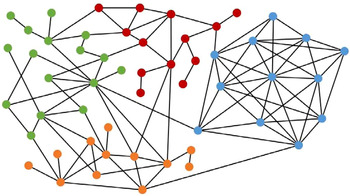
Provides an illustration of possible properties of a network's modularnet organization. Suppose each individual node (circle) represents some discrete, predefined portion of the brain, and the links between nodes represent functional interactions between nodes. Node color represents the modulenet to which that node belongs. Notice that the nodes composing the blue modulenet are very densely interconnected among themselves, suggesting that those nodes are cooperating to achieve some function, despite remaining interconnected to all other nodes in the system via direct and/or indirect connections. In contrast, the nodes composing the red, orange, and green modulesnet are not nearly as densely interconnected or clearly defined. The kind of modular structure exhibited by the group of blue nodes allows researchers to maintain the position that modules exist and are responsible for specialized, segregated functions while remaining consistent with Anderson's overarching framework that militates against purely decomposable, strictly domain-specific, encapsulated, and isolated modules.
In what follows, we briefly identify the fundamental principles of neural reuse and show that modularitynet is consistent with it. We also suggest that modularitynet provides the best set of methods for investigating neural reuse, while preserving attractive features traditionally ascribed to a modular view of the brain.
The first claim Anderson makes about neural reuse provides the foundation for his framework: Brain regions should be used and reused for diverse purposes in various task domains (p. 9). In using modularitynet algorithms to investigate neural reuse, we assume that (1) subgroups of nodes (brain regions) identified as highly interconnected during a task consistently across persons are being used for that task, and (2) nodes can change in modulenet allegiance between any two conditions. If, in fact, nodes change in their functional properties to be part of different interconnected, functionally cooperating groupings (modulesnet) from task A to task B, then the modularitynet algorithm will be able to identify this shift. Because modularitynet algorithms are data-driven, the quantity of nodes forming any given modulenet, the spatial locations of nodes within any given modulenet, the consistency of modularnet organization across a set of persons, and the extent of interconnectedness of nodes comprising each modulenet are determined by the very nature of the functional brain network, and not by the experimenter. Furthermore, modularitynet algorithms are designed to admit the possibility that there are no clear, distinct modulesnet in the network. Consequently, modularitynet serves as both a validation of neural reuse between different tasks and as a way to identify those functionally cooperating groups of brain regions subserving any task of interest. Modularitynet makes no a priori assumptions about the selectivity of local neural structures for specific task(s). If, in fact, local neural structures are not highly selective and typically contribute to multiple tasks across domain boundaries, then modularitynet will show how neural structures (nodes) change modular allegiance by reorganizing their connections for any set of tasks.
Recent work has demonstrated that human functional brain networks exhibit a modularnet architecture, but that architecture is neither temporally static nor anatomically fixed. Instead, nodes alter their interactions with other nodes in the network to form new modulesnet depending upon the demands on the system (Bassett et al. Reference Bassett, Wymbs, Porter, Mucha, Carlson and Grafton2011; Cao et al. Reference Cao, Plichta, Schäfer, Haddad, Grimm, Schneider and Tost2014; Meunier et al. Reference Meunier, Fonlupt, Saive, Plailly, Ravel and Royet2014; Moussa et al. Reference Moussa, Vechlekar, Burdette, Steen, Hugenschmidt and Laurienti2011; Reference Moussa, Wesley, Porrino, Hayasaka, Bechara, Burdette and Laurienti2014; Stanley et al. Reference Stanley, Dagenbach, Lyday, Burdette and Laurienti2014). For example, Stanley et al. (Reference Stanley, Dagenbach, Lyday, Burdette and Laurienti2014) demonstrated that the nodes within the modulenet mostly composed of default-mode brain regions maintained a highly consistent, densely interconnected, functionally cooperating modulenet during a minimally demanding working memory task. However, when more attentional and working memory resources were required, the previously observed default-mode modulenet dissolved. During this more difficult working memory task, a different set of brain regions, many of which have traditionally been considered to be involved in working memory processes, became densely interconnected, forming a new, consistent modulenet across persons. Changes in modularnet organization within individual persons have been shown to facilitate behavioral adaptation during simple tasks, further emphasizing the constantly changing, dynamic nature of modulesnet (Bassett et al. Reference Bassett, Wymbs, Porter, Mucha, Carlson and Grafton2011).
The second claim Anderson makes about neural reuse concerns the importance of interactions between different neural elements: Functional differences between task domains are critically reflected in the different patterns of interaction between many of the same elements forming the right neural team for a job (pp. 9, 46). Modularitynet is computed by detecting certain patterns in the interactions between all brain regions comprising the network simultaneously. That is, modularitynet takes into account all interactions between each and every brain region and subsequently identifies the subsets of brain regions that tend to be more densely interconnected (i.e., interacting more strongly) among themselves than the rest of the network. The functional groupings of highly interconnected brain regions observed during task A that appear consistently across subjects are thought to actually subserve the cognitive process(es) associated with task A. Although modularitynet does still provide relevant information about the spatial locations of nodes comprising each modulenet in the brain, modularitynet provides more important information regarding how certain regions are functionally cooperating during any given task, the extent to which regions are densely interconnected, how that interconnectedness changes across tasks, and the relative importance of specific nodes within modulesnet for facilitating integrated and segregated neural functioning.
Critically, however, if one grants that achieving a task is really about putting together the right “neural team” (i.e., modulenet), then that modulenet is engaged in specialized processing for that specific task. Different components of that neural team might be serving different subfunctions, but the components of the team are all working to serve the particular function carried out by the modulenet itself. So, in investigating the neural basis of cognitive processes, one cannot merely be concerned with integration between modulesnet, as Anderson suggests (p. 42). Modularitynet algorithms recognize the importance and mutually dependent necessity of both segregation (specialization) within a particular modulenet and integration between modulesnet. Understood in this way, segregation and integration of function are not wholly separable. But, nodes in modulesnet still densely interconnect to form functionally cooperating groups engaging in specialized functioning during specific tasks. By recognizing the importance and mutual necessity of both segregated and integrated functioning, modularitynet seems to preserve the one truly valuable tenet of more traditional views of modularity – that is, that there is, in fact, segregated, specialized functioning in the brain that is necessary for cognitive functioning.
The third claim Anderson makes about neural reuse implicates evolutionary assumptions: Later emerging behaviors/abilities should be supported by more disparate neural structures (p. 9). Modularitynet makes no a priori assumptions about which behaviors/abilities are supported by the most scattered set of structures in the brain. Importantly, modulesnet need not be spatially contiguous in the brain, because edges in functional brain networks are defined as statistical dependencies in neural signal between nodes. Because the size, consistency, and spatial scatter of modulesnet are determined by the nature of the functional network itself, modularitynet actually provides the ideal way to empirically test whether later emerging behaviors/abilities are supported by a highly interconnected, consistent modulenet comprising a greater proportion of different structures broadly scattered throughout the brain. So, if Anderson's third claim is right, then the data-driven modularitynet algorithm should identify the functional groupings of nodes representing the latest developing modulesnet (during the relevant tasks) as those that exhibit the most noncontiguous and densely interconnected, yet spatially consistent (across persons), spatial scatter throughout the brain.
The fourth claim Anderson makes maintains that neural reuse is a guiding functional principle across many different spatial scales: Neural reuse does not go away, no matter how small the brain region (pp. 29–30). By using modularitynet algorithms, it is possible to investigate neural reuse on many different spatial scales. Even among the existing network analyses of fMRI data alone, researchers have reported results from 70-node to 140,000-node whole brain networks (Stanley et al. Reference Stanley, Moussa, Paolini, Lyday, Burdette and Laurienti2013). Assuming adequate computational power, modularitynet can be computed on networks at any of these spatial scales, and different kinds of information can be extracted from the modularnet architecture (or lack thereof) observed at each scale. Recent work has also led to the development of hierarchical modularitynet algorithms (Arenas et al. Reference Arenas, Fernandez and Gomez2008; Meunier et al. Reference Meunier, Lambiotte, Fornito, Ersche and Bullmore2009; Sales-Pardo et al. Reference Sales-Pardo, Guimera, Moreira and Amaral2007), where each modulenet obtained at the partition of the highest level can further be decomposed into submodulesnet, which in turn can be decomposed into subsubmodulesnet, and so on. This makes it possible to rigorously compare modularnet organization at many different spatial scales in order to capture reuse at different levels of organization within the same brain during the same task.
The fifth critical claim Anderson makes about neural reuse concerns separate modifiability and decomposability: Neural reuse does indeed militate against separate modifiability; the brain is not a nearly decomposable system consisting of separately modifiable parts (pp. 39, 40). To understand the compatibility between Anderson's fifth claim and modularitynet, it is necessary to distinguish between strong and weak versions of decomposability. Decomposabilitystrong refers to a fully separable system in which any element can be removed or altered without significantly impacting the remaining elements of the system (e.g., a massive modularity view). Decomposabilityweak refers to a system that has parts that tend to group together to perform specific functions, but in which each part remains connected to the rest of the system through a complex pattern of interactions, such that no functional group can be changed without changing the system as a whole. Although more traditional formulations of modularity operate under the assumption of decomposabilitystrong that further assumes separate modifiability, modularitynet only assumes decomposabilityweak, which does not allow for separate modifiability. Functional brain networks are investigated as fully interconnected, interdependent, nonlinear systems. This means that no modulenet can be modified in practice without also changing the modularnet architecture of the system as a whole. By accepting decomposabilityweak but not decomposabilitystrong, modularitynet is able to maintain a particular notion of segregated, specialized functioning while still remaining consistent with neural reuse.
Neural reuse holds tremendous promise as a framework with which to understand and investigate the neural bases of cognitive processes. We have argued that recent developments in network neuroscience offer a particular view of modularity – modularitynet – that is consistent with the fundamental tenets of neural reuse. Additionally, we have suggested that these modularitynet algorithms constitute an excellent tool for empirically investigating neural reuse, even for researchers reluctant to relinquish the idea of specialized modules altogether.





In After Phrenology: Neural Reuse and the Interactive Brain, Anderson (Reference Anderson2014) offers a valuable framework for understanding neural (re)organization and its relationship to cognitive functioning. This framework, neural reuse, maintains that most regions of the brain are involved in multiple and diverse cognitive tasks, and that the brain is capable of achieving functional flexibility precisely because it can redeploy the same neural structures for a variety of purposes (p. 5). This neurofunctional architecture allegedly stands in stark contrast against a modular view of the brain. However, in our view, recently developed, data-driven modularity algorithms in network science (modularitynet), which make use of mathematical formalisms from graph theory, remain consistent with Anderson's view while providing a set of rigorous methods to engage in Anderson's research program.
Modularitynet algorithms are computed on networks, which are formally described using graph theory (Newman Reference Newman2006). All networks are composed of differentiable elements of the system (nodes) and pairwise relationships between those elements (edges). In the context of human functional brain networks, each node represents a discrete parcellation of brain tissue, and edges represent measured functional interactions (connectivity) between pairs of nodes (Bullmore & Sporns Reference Bullmore and Sporns2009; Rubinov & Sporns Reference Rubinov and Sporns2010). Modularitynet algorithms can be used to identify nodes that form tightly interconnected subgroups of interacting brain regions functionally cooperating to subserve certain tasks. These modularitynet algorithms provide valuable information about (1) the extent to which the entire system can be (partially) decomposed into modulesnet, (2) the extent to which the nodes within each modulenet are preferentially cooperating with nodes within their own modulenet versus nodes in other modulesnet in the system, and (3) the different functional roles of specific nodes within each modulenet (Stanley et al. Reference Stanley, Dagenbach, Lyday, Burdette and Laurienti2014; Telesford et al. Reference Telesford, Simpson, Burdette, Hayasaka and Laurienti2011). As such, modularitynet constitutes an alternative to dimensionality reduction approaches discussed by Anderson (e.g., diversity variability, Dice's coefficient), while providing more information about the properties of these functionally cooperating groups of regions subserving different tasks. Although modulesnet are not isolated, autonomous, encapsulated processing units – as demanded by more traditional formulations of “modularity” – they do still perform particular, specialized functions during certain tasks via the interactions between brain regions within each modulenet itself. Specific modulesnet are thought to perform specific functions, even though each modulenet remains interconnected, or integrated, with all other modulesnet in the system by a complex set of inter-modulenet connections (Fig. 1). Thus understood, modularitynet safeguards a conception of specialized, segregated functioning, which is central to more traditional views of modularity. Indeed, it has been shown that a modularnet architecture both exists in functional brain networks and is advantageous because it increases the robustness, flexibility, and stability of the system (Barabasi & Oltvai Reference Barabasi and Oltvai2004; Valencia et al. Reference Valencia, Pastor, Fernández-Seara, Artieda, Martinerie and Chavez2009).
Provides an illustration of possible properties of a network's modularnet organization. Suppose each individual node (circle) represents some discrete, predefined portion of the brain, and the links between nodes represent functional interactions between nodes. Node color represents the modulenet to which that node belongs. Notice that the nodes composing the blue modulenet are very densely interconnected among themselves, suggesting that those nodes are cooperating to achieve some function, despite remaining interconnected to all other nodes in the system via direct and/or indirect connections. In contrast, the nodes composing the red, orange, and green modulesnet are not nearly as densely interconnected or clearly defined. The kind of modular structure exhibited by the group of blue nodes allows researchers to maintain the position that modules exist and are responsible for specialized, segregated functions while remaining consistent with Anderson's overarching framework that militates against purely decomposable, strictly domain-specific, encapsulated, and isolated modules.
In what follows, we briefly identify the fundamental principles of neural reuse and show that modularitynet is consistent with it. We also suggest that modularitynet provides the best set of methods for investigating neural reuse, while preserving attractive features traditionally ascribed to a modular view of the brain.
The first claim Anderson makes about neural reuse provides the foundation for his framework: Brain regions should be used and reused for diverse purposes in various task domains (p. 9). In using modularitynet algorithms to investigate neural reuse, we assume that (1) subgroups of nodes (brain regions) identified as highly interconnected during a task consistently across persons are being used for that task, and (2) nodes can change in modulenet allegiance between any two conditions. If, in fact, nodes change in their functional properties to be part of different interconnected, functionally cooperating groupings (modulesnet) from task A to task B, then the modularitynet algorithm will be able to identify this shift. Because modularitynet algorithms are data-driven, the quantity of nodes forming any given modulenet, the spatial locations of nodes within any given modulenet, the consistency of modularnet organization across a set of persons, and the extent of interconnectedness of nodes comprising each modulenet are determined by the very nature of the functional brain network, and not by the experimenter. Furthermore, modularitynet algorithms are designed to admit the possibility that there are no clear, distinct modulesnet in the network. Consequently, modularitynet serves as both a validation of neural reuse between different tasks and as a way to identify those functionally cooperating groups of brain regions subserving any task of interest. Modularitynet makes no a priori assumptions about the selectivity of local neural structures for specific task(s). If, in fact, local neural structures are not highly selective and typically contribute to multiple tasks across domain boundaries, then modularitynet will show how neural structures (nodes) change modular allegiance by reorganizing their connections for any set of tasks.
Recent work has demonstrated that human functional brain networks exhibit a modularnet architecture, but that architecture is neither temporally static nor anatomically fixed. Instead, nodes alter their interactions with other nodes in the network to form new modulesnet depending upon the demands on the system (Bassett et al. Reference Bassett, Wymbs, Porter, Mucha, Carlson and Grafton2011; Cao et al. Reference Cao, Plichta, Schäfer, Haddad, Grimm, Schneider and Tost2014; Meunier et al. Reference Meunier, Fonlupt, Saive, Plailly, Ravel and Royet2014; Moussa et al. Reference Moussa, Vechlekar, Burdette, Steen, Hugenschmidt and Laurienti2011; Reference Moussa, Wesley, Porrino, Hayasaka, Bechara, Burdette and Laurienti2014; Stanley et al. Reference Stanley, Dagenbach, Lyday, Burdette and Laurienti2014). For example, Stanley et al. (Reference Stanley, Dagenbach, Lyday, Burdette and Laurienti2014) demonstrated that the nodes within the modulenet mostly composed of default-mode brain regions maintained a highly consistent, densely interconnected, functionally cooperating modulenet during a minimally demanding working memory task. However, when more attentional and working memory resources were required, the previously observed default-mode modulenet dissolved. During this more difficult working memory task, a different set of brain regions, many of which have traditionally been considered to be involved in working memory processes, became densely interconnected, forming a new, consistent modulenet across persons. Changes in modularnet organization within individual persons have been shown to facilitate behavioral adaptation during simple tasks, further emphasizing the constantly changing, dynamic nature of modulesnet (Bassett et al. Reference Bassett, Wymbs, Porter, Mucha, Carlson and Grafton2011).
The second claim Anderson makes about neural reuse concerns the importance of interactions between different neural elements: Functional differences between task domains are critically reflected in the different patterns of interaction between many of the same elements forming the right neural team for a job (pp. 9, 46). Modularitynet is computed by detecting certain patterns in the interactions between all brain regions comprising the network simultaneously. That is, modularitynet takes into account all interactions between each and every brain region and subsequently identifies the subsets of brain regions that tend to be more densely interconnected (i.e., interacting more strongly) among themselves than the rest of the network. The functional groupings of highly interconnected brain regions observed during task A that appear consistently across subjects are thought to actually subserve the cognitive process(es) associated with task A. Although modularitynet does still provide relevant information about the spatial locations of nodes comprising each modulenet in the brain, modularitynet provides more important information regarding how certain regions are functionally cooperating during any given task, the extent to which regions are densely interconnected, how that interconnectedness changes across tasks, and the relative importance of specific nodes within modulesnet for facilitating integrated and segregated neural functioning.
Critically, however, if one grants that achieving a task is really about putting together the right “neural team” (i.e., modulenet), then that modulenet is engaged in specialized processing for that specific task. Different components of that neural team might be serving different subfunctions, but the components of the team are all working to serve the particular function carried out by the modulenet itself. So, in investigating the neural basis of cognitive processes, one cannot merely be concerned with integration between modulesnet, as Anderson suggests (p. 42). Modularitynet algorithms recognize the importance and mutually dependent necessity of both segregation (specialization) within a particular modulenet and integration between modulesnet. Understood in this way, segregation and integration of function are not wholly separable. But, nodes in modulesnet still densely interconnect to form functionally cooperating groups engaging in specialized functioning during specific tasks. By recognizing the importance and mutual necessity of both segregated and integrated functioning, modularitynet seems to preserve the one truly valuable tenet of more traditional views of modularity – that is, that there is, in fact, segregated, specialized functioning in the brain that is necessary for cognitive functioning.
The third claim Anderson makes about neural reuse implicates evolutionary assumptions: Later emerging behaviors/abilities should be supported by more disparate neural structures (p. 9). Modularitynet makes no a priori assumptions about which behaviors/abilities are supported by the most scattered set of structures in the brain. Importantly, modulesnet need not be spatially contiguous in the brain, because edges in functional brain networks are defined as statistical dependencies in neural signal between nodes. Because the size, consistency, and spatial scatter of modulesnet are determined by the nature of the functional network itself, modularitynet actually provides the ideal way to empirically test whether later emerging behaviors/abilities are supported by a highly interconnected, consistent modulenet comprising a greater proportion of different structures broadly scattered throughout the brain. So, if Anderson's third claim is right, then the data-driven modularitynet algorithm should identify the functional groupings of nodes representing the latest developing modulesnet (during the relevant tasks) as those that exhibit the most noncontiguous and densely interconnected, yet spatially consistent (across persons), spatial scatter throughout the brain.
The fourth claim Anderson makes maintains that neural reuse is a guiding functional principle across many different spatial scales: Neural reuse does not go away, no matter how small the brain region (pp. 29–30). By using modularitynet algorithms, it is possible to investigate neural reuse on many different spatial scales. Even among the existing network analyses of fMRI data alone, researchers have reported results from 70-node to 140,000-node whole brain networks (Stanley et al. Reference Stanley, Moussa, Paolini, Lyday, Burdette and Laurienti2013). Assuming adequate computational power, modularitynet can be computed on networks at any of these spatial scales, and different kinds of information can be extracted from the modularnet architecture (or lack thereof) observed at each scale. Recent work has also led to the development of hierarchical modularitynet algorithms (Arenas et al. Reference Arenas, Fernandez and Gomez2008; Meunier et al. Reference Meunier, Lambiotte, Fornito, Ersche and Bullmore2009; Sales-Pardo et al. Reference Sales-Pardo, Guimera, Moreira and Amaral2007), where each modulenet obtained at the partition of the highest level can further be decomposed into submodulesnet, which in turn can be decomposed into subsubmodulesnet, and so on. This makes it possible to rigorously compare modularnet organization at many different spatial scales in order to capture reuse at different levels of organization within the same brain during the same task.
The fifth critical claim Anderson makes about neural reuse concerns separate modifiability and decomposability: Neural reuse does indeed militate against separate modifiability; the brain is not a nearly decomposable system consisting of separately modifiable parts (pp. 39, 40). To understand the compatibility between Anderson's fifth claim and modularitynet, it is necessary to distinguish between strong and weak versions of decomposability. Decomposabilitystrong refers to a fully separable system in which any element can be removed or altered without significantly impacting the remaining elements of the system (e.g., a massive modularity view). Decomposabilityweak refers to a system that has parts that tend to group together to perform specific functions, but in which each part remains connected to the rest of the system through a complex pattern of interactions, such that no functional group can be changed without changing the system as a whole. Although more traditional formulations of modularity operate under the assumption of decomposabilitystrong that further assumes separate modifiability, modularitynet only assumes decomposabilityweak, which does not allow for separate modifiability. Functional brain networks are investigated as fully interconnected, interdependent, nonlinear systems. This means that no modulenet can be modified in practice without also changing the modularnet architecture of the system as a whole. By accepting decomposabilityweak but not decomposabilitystrong, modularitynet is able to maintain a particular notion of segregated, specialized functioning while still remaining consistent with neural reuse.
Neural reuse holds tremendous promise as a framework with which to understand and investigate the neural bases of cognitive processes. We have argued that recent developments in network neuroscience offer a particular view of modularity – modularitynet – that is consistent with the fundamental tenets of neural reuse. Additionally, we have suggested that these modularitynet algorithms constitute an excellent tool for empirically investigating neural reuse, even for researchers reluctant to relinquish the idea of specialized modules altogether.