


R1. Introduction
When ancient Greeks got a new scientific insight, they visited the Agora to discuss their idea with other thinkers. As our twenty-first-century Agora with statements, comments, and responses, Behavioral and Brain Sciences serves essentially the same function. I feel fortunate and encouraged now that 49 scholars from wide-ranging disciplines are so actively and interestedly participating in the debate concerning climato-economic conditions under which fundamental human needs are being transformed into culture.
Let me structure our discussion using a plausible point of departure. In common with all theories and methodologies, the climato-economic paradigm has a white domain, where it does apply, a gray domain, where it may or may not apply, and a black domain, where it does not apply at all. This outline of the scientific landscape offers a crude ordering of topics as belonging to white (R2), gray (R3), or black (R4) areas of discussion. The commentators pay considerably more attention to the limited areas of applicability of the theory than to the seemingly endless areas where climato-economic thinking has little or no value attached to it, resulting in an overrepresentation of white topics.
R2. White domain
R2.1. Moving beyond climatic determinism
Allik & Realo reproach me for drawing a deterministic picture in which almost everything in human nature and society is explained by the impact of cold winters and hot summers. This criticism is far from the truth for three reasons. First, after starting with traditional research into main effects of climate on culture (Van de Vliert & Van Yperen Reference Van de Vliert and Van Yperen1996; Van de Vliert et al. Reference Van de Vliert, Schwartz, Huismans, Hofstede and Daan1999; 2000), I have consistently rejected single-factor explanations of human functioning, including climatic determinism (e.g., target article, sects. 4.4 and 6.1). Second, as enunciated in sections 2.2 and 4.6, my central axiom is that climatic demands cannot meaningfully predict variation in shared culture as long as income conditions are left out of consideration. Third and foremost, extensive testing of the moderating effect of money perhaps represents the most systemic attack on climatic determinism ever since the ancient Greeks started to discuss the climate-culture conundrum.
For more than twenty-five centuries, climatic determinism has been mostly characterized by main effects of annual mean temperature on psychobehavioral functioning, main effects that are not expected to be altered by nonthermal conditions. Essentially in the same vein, Allik & Realo are of the opinion that the target article should have paid more attention to unqualified main effects of annual mean temperature on national character stereotypes (e.g., McCrae et al. 2007; Pennebaker et al. Reference Pennebaker, Rime and Blankenship1996; Terracciano et al. Reference Terracciano, Abdel-Khalek, Adam, Adamovova, Ahn, Ahn and McCrae2005), personality traits (e.g., Allik & McCrae Reference Allik and McCrae2004), and individual intelligence (e.g., Lynn & Vanhanen Reference Lynn and Vanhanen2006). My single most important reason for trying to get away from those and similar attempts to exclusively tie climate to personality is to move beyond the myopic single-factor explanation offered by climatic determinism.
R2.2. Demands: Cold climate versus hot climate
Climates are considered more demanding to the extent that their winters are colder than 22°C and their summers are hotter than 22°C. Chang, Chen, & Lu (Chang et al.) find this an inaccurate operationalization as ancestral living conditions in Africa suggest that cold climates are more demanding than hot climates, not least because flora and fauna resources increase in hotter climes. In contrast with this argument, most plants and creatures, notably including humans and parasites, are spontaneously moving away from not only arctics but also deserts. The bottom line is that all living species on earth can easily be either frozen or burned to death. In consequence, only a bipolar measure of climatic demands can capture the fundamental fact that extreme cold and extreme heat both pose existential problems for humans.
Self-evidently, the bipolar structure of colder-than-temperate and hotter-than-temperate climates is not necessarily a symmetrical structure. On the contrary, it is unlikely that climatic demands, measured in degrees Celsius as absolute deviations from 22°C, are approximately the same on the cold side and the hot side. De Oliveira Chen & Kitayama rightly observe that winters on this planet are generally more problematic than summers. Winter demands range from an absolute deviation of 1 on the Marshall Islands to a relatively high peak of 87 in Mongolia, whereas summer demands range from 2 in Colombia to a relatively low peak of 44 in Sudan (Van de Vliert Reference Van de Vliert2009). The smaller range of summer demands is caused by more direct and more concentrated sun rays, as well as by more sun exposure because of longer daylight hours. As one notable consequence, in the hottest summer month, high-latitude Mongolians and low-latitude Sudanese have to cope with very different lowest temperatures (−6°C and 40°C, respectively) but very similar highest temperatures (36°C and 48°C, respectively).
The restriction of range in summer demands leads Terracciano & Wayne to call into question the face validity of the summer part of the climate index used in the target article. They appear to put their finger on the problem that some populations are coping with cold demands in summer (e.g., Estonians, Finns, Mongolians, North Koreans, and Russians). To be sure, this does not influence any of the results reported in the target article, which are based on summed total demands. But further research on the differential effects of cold and heat should use indices for cold demands (r = .99 with winter demands) and heat demands (r = .76 with summer demands). To this end, Table R1 lists cold demands, heat demands, and total climatic demands for 232 independent countries and dependent territories around the planet.
Cold demands, heat demands, and total climatic demands for 232 independent countries and dependent territories, followed by computational notesa, b, c and examplesc1, c2, c3.

a Cold demands are the sum of the absolute downward deviations from 22°C for the average lowest temperature in the coldest month, the average highest temperature in the coldest month, the average lowest temperature in the hottest month, and the average highest temperature in the hottest month.
b Heat demands are the sum of the absolute upward deviations from 22°C for the average lowest temperature in the coldest month, the average highest temperature in the coldest month, the average lowest temperature in the hottest month, and the average highest temperature in the hottest month.
c Total climatic demands is the sum of cold demands and heat demands. Three prototypical examples of computations follow.
c1 The most extreme case on the cold side: In Mongolia, the lowest and highest temperatures in the coldest month are –44°C and 1°C; the lowest and highest temperatures in the hottest month are –6°C and 36°C. The climatic demands are │−44°C–22°C│+│1°C–22°C│ +│−6°C–22°C│+│36°C–22°C│ = 129.
c2 A prototypical case on the temperate side: In Burundi, the lowest and highest temperatures in the coldest month are 17°C and 20°C; the lowest and highest temperatures in the hottest month are 28°C and 31°C. The climatic demands are │17°C −22°C│+│20°C–22°C│ +│28°C–22°C│+│31°C–22°C │ = 22.
c3 The most extreme case on the hot side: In Sudan, the lowest and highest temperatures in the coldest month are 5°C and 19°C; the lowest and highest temperatures in the hottest month are 40°C and 48°C. The climatic demands are │5°C–22°C│+│19°C–22°C│ +│40°C–22°C│+│48°C–22°C│ = 64.
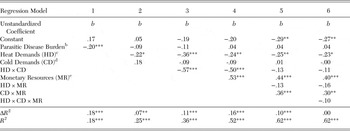
Murray approaches the cold-hot asymmetry from yet another angle. Threats posed by hot climates, so his argument runs, are mediated by higher prevalence of infectious diseases, whereas cold climates pose more direct threats to survival. This is an intriguing and easily testable hypothesis. In a stepwise regression analysis, I used parasitic disease burden (source: Fincher & Thornhill Reference Fincher and Thornhill2012), heat and cold demands from Table R1, and monetary resources from section 3.3 as standardized predictors of the freedom index for 2012 set forth in Electronic Supplement 4.B. Across 104 countries, Model 1 in Table R2 replicates the well-documented negative impact of the prevalence of nonzoonotic diseases on overall freedom (Fincher & Thornhill Reference Fincher and Thornhill2012; Van de Vliert & Postmes Reference Van de Vliert and Postmes2012). The next steps show that parasitic disease burden (bs ≤ −.11, ps ≥ .07) does not mediate the link between heat demands and repression of freedom (Model 2), especially not in continental climates where heat demands reinforce cold demands (Model 3).
Joint effects of parasitic disease burden, heat demands, cold demands, and monetary resources on overall freedoma (n=104 countries; see footnotes for measures used)

*p < .05, **p < .01, ***p < .001. There was no multicollinearity (VIFs < 4.17), and there were no outliers (Cook's Ds < .28).
a Overall freedom is the standardized average of freedom from press repression, from positive ingroup discrimination, and from political autocracy. Detailed information about the construction of this index for freedom in 2012 is provided in section 5.2.1 of the target article and in Electronic Supplement 4.B.
b Parasitic disease burden is the prevalence of human-to-human transmitted nonzoonotic diseases (source: Fincher & Thornhill Reference Fincher and Thornhill2012).
c HD=Heat demands taken from Table R1.
d CD=Cold demands taken from Table R1.
e MR=Income per head as described in section 3.3 of the target article.
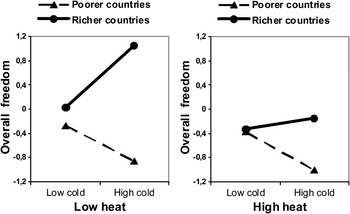
Models 4 through 6 further reveal that parasitic disease burden does neither mediate the main effect nor the interactive effects of monetary resources. In addition to the direct explanatory path from heat demands to overall freedom, increases in monetary resources are accompanied by greater freedom (Model 4), especially in populations coping with colder winters (Model 5). The visualization of Model 6 in Figure R1 may be compared with Figure 2 in the target article. This comparison uncovers that the present results supplement the target article by showing that the theory predicts freedom better in habitats with low heat demands (left picture) than in habitats with high heat demands (right picture).
Joint effects of heat demands, cold demands, and monetary resources on overall freedom while controlling for parasitic disease burden.

Within Figure R1, the contrast between the upper slope at the left (b = .51, p < .01) and the upper slope at the right (b = .09, p = .77) suggests that richer countries make the difference. For richer populations, it seems easier to achieve freedom in habitats where cooler summers make colder winters more challenging (left picture: low heat, high cold) than in habitats where hotter summers make colder winters more threatening (right picture: high heat, high cold). This finding is compatible with climato-economic theorizing because continental climates with hot summers and cold winters are generally more demanding than climates with at least one temperate season. It is very well thinkable that those really harsh climates reach the point where even richer populations appraise their habitats as more threatening than challenging and start to voluntarily curtail their freedom.
Recall from Electronic Supplement 3 that overall freedom in 2012 is a common denominator that is closely related with its components of freedom from press repression (r = .94), freedom from positive ingroup discrimination (r = .83), and freedom from political autocracy (r = .95). As a logical consequence, and contradicting Murray, who predicts otherwise, the results reported in Table R2 and Figure R1 are almost equally applicable to freedom from press repression, ingroup discrimination, and political autocracy. Apparently, the differential effects of climatic cold and heat affect the three distinct components of overall freedom similarly rather than differently.
R2.3. Resources: Possible roles of money
Six commentators profess that climate helps generate both economic development and cultural change, although Ainslie and Chang et al. think that wealth precedes culture whereas de Oliveira Chen & Kitayama think that culture precedes wealth. Both beliefs seem to ignore that climatic demands do not plausibly account for income per head, neither in their main effects (sect. 3.3), nor in their interaction effects with geographic resources (Electronic Supplement 5.A), land and marine resources (Electronic Supplement 5.B), and natural security resources (Electronic Supplement 5.C). Perhaps even more important, both beliefs are blind to the fact that it is a strength rather than a weakness that the climato-economic theory of culture parsimoniously and accurately explains how climatic demands and monetary resources interact to create culture (white domain) and does not sidetrack into main effects of climatic demands on monetary resources (black domain).
Notwithstanding this advance in establishing theoretical boundaries, Fischer makes it clear that the monetary part of the theory is still in its infancy. He asks pertinent questions about the specific cultural impacts of collective versus individual income, absolute versus relative income, and alternative investments of these incomes in health and child care versus educational resources. By contrast, progress has been made on Iyer, Motyl, & Graham's (Iyer et al.) dilemmatic question of whether wealth or freedom comes first. Given that climate does come first, it is a telling finding that climatic demands do interact with national wealth in predicting freedom but do not or hardly interact with freedom in predicting national wealth (Electronic Supplement 5.D; Van de Vliert Reference Van de Vliert2007; 2009; 2011b). This consistent finding supports the economy-drives–culture camp (e.g., Bell Reference Bell1973; Inglehart & Welzel Reference Inglehart and Welzel2005; Marx Reference Marx1973; Sen Reference Sen1999) in the continuing debates with the culture-drives-economy camp (e.g., Fukuyama Reference Fukuyama1995; Harrison & Huntington Reference Harrison and Huntington2000; Weber Reference Weber1904/1958).
R2.4. Needs as origins of culture
According to Locke & Flanagan, the target article overemphasizes environmental causes while underemphasizing the active operation of psychological needs as origins of culture. They gain support from Pahlavan & Amirrezvani, who contend that the climato-economic contextualization completely overshadows the social-psychological contextualization of freedom. Unfortunately, these are misrepresentations of the theory. In fact, climatic demands and monetary resources are seen as inanimate contexts; only real people can bring them to life through meaning, emotion, and movement. Climato-economic environments as passive conditional origins cannot replace fundamental needs as active ultimate origins of culture. In agreement with Locke & Flanagan, the target article proposes that existence needs, social needs, and growth needs are continuously accessible and waiting for activation by exogenous cues. The main idea, introduced up front in section 1, is that needs shape stresses and choices, but do so differently within concentric contexts of the immediate social-psychological setting and the remote habitational environment.
There may, of course, be several causal steps in between contextualized needs and ultimate adaptations. If one link in the chain is missing, anthropologists such as Hrotic, often coping with fragmentary evidence, “do not necessarily discard everything that follows” (in Hrotic's words, para. 2). Sociologists and psychologists tend to be more reluctant to theoretically jump across a gap between a before and an after. One causal path is that contextualized needs shape societal institutions, values, and practices, which in turn shape individual inhabitants (as Güss would have it), but it is no less possible that contextualized needs shape individuals, which in turn shape societal cultures (as Baumeister, Park, & Ainsworth [Baumeister et al.], Fischer, and Loughnan, Bratanova, & Kuppens [Loughnan et al.] would have it). To complicate matters further, the causal path is not likely the same for each freedom predicted. Allik & Realo and Fischer convincingly argue that the commonality of the fundamental freedoms is too weak to treat them holistically and that specification of the mediating variables could increase explanatory strength. Similarly, Iyer et al. point to the heterogeneity and mutual incompatibility of freedoms ranging from gaining something to not losing something, which makes a catch-all explanation inaccurate at best and impossible at worst.
By stressing the importance of contextualized needs as origins of culture, climato-economic theorizing sheds new light also on processes of globalization brought up by Pahlavan & Amirrezvani. Globalization as the evolvement of a syndrome of universally endorsed values, beliefs, and practices seems to have its limits because climate-based demands and wealth-based resources in concert help shape unique needs-based local cultures (Van de Vliert et al. Reference Van de Vliert, Einarsen, Euwema and Janssen2009). Global warming will make many African habitats more threatening, many Asian habitats less threatening, and many European and North American habitats less challenging (sects. 5.3 and 6.3; Electronic Supplement 6). Economic ups and downs will continue to have local winners and losers, most likely with peaking overpayment of poor populations in temperate climates (Van de Vliert Reference Van de Vliert2003). Given these climato-economic dynamics and corresponding changes in needs, globaphobes and globaphiles may have too unrealistic nightmares and daydreams about the sameness of cultures around the globe in times to come.
R2.5. Individual functioning
Fischer suggests extensions of climato-economic theorizing from the population level to the personal level (from eco-logic to psycho-logic in Leung & Cheng's terminology), and substantiates that climatic demands interact with both societal wealth and individual wealth in producing individual happiness. However, results are less convincing for greater personal valuation of protecting freedom of speech and giving people more say in important government decisions, and lesser personal valuation of fighting rising prices and maintaining order in the nation. These so-called post-materialist values (Inglehart et al. Reference Inglehart, Basáñez, Díez-Medrano, Halman and Luijkx2004, p. 410) are driven more by demanding climates in interaction with societal income rather than individual income. Now taking shape is the sensible hypothesis that household income is more important for family-oriented coping with demanding winters and summers, whereas national income is more important for society-oriented coping with such seasons.
With a view to the assessment of whether people experience their habitats as threatening, comforting, or challenging, Fischer makes the mind-broadening observation that shared appraisals of stresses are themselves rooted in physiological and neurocognitive processes worthy of ecological study. Not only do I agree with this recommendation, Reinold Gans, Mike De Jongste, and I (Van de Vliert et al., under review) have recently investigated whether or not inhabitants' blood pressure is higher in habitats with lower climato-economic livability. Across 120 countries, we were able to demonstrate that systolic blood pressures are highest in poor countries with cold winters and hot summers (too threatening) and in rich countries with warm winters and cool summers (too unchallenging).
R2.6. Collective functioning
Fischer further notices that demands-resources theories at the personal level are used to underpin climato-economic studies at the population level, leaving a conceptual gap between explanations of individual and collective processes. On closer scrutiny, this is an imaginary gap. Bandura (Reference Bandura1997) argues at length that greater demands in interaction with sufficient resources to meet the demands increase both self-efficacy at the individual level and collective efficacy at the level of families, institutions, communities, and even nations. Besides, it is a strength rather than a weakness if one takes hypotheses from the individual realm and confirms them for collectives in order to generalize insights across levels of understanding (Smith Reference Smith2004; Van de Vliert & Janssen Reference Van de Vliert and Janssen2002).
Against this background, it is important to note that some anthropological narratives seem to support climato-economic theorizing. Concentrating on the history of religions and the emergence of state-level hierarchies in the ancient Near East, Hrotic confirms that inhabitants of threatened habitats evolved autocratic and doctrinal adaptations to survive. During the fourth millennium BCE, poor populations in cooling and drying habitats located alongside main rivers (e.g., Tigris, Nile, and Indus) restrained their freedoms by tightly organizing agricultural labor and centralizing power in the hands of kings and priests. Five millennia later, when the Little Ice Age replaced the Medieval Warm Period, essentially the same adaptational processes of formalization and centralization following climato-economic deterioration seem to have pushed Norse communities in medieval Greenland on a slippery slope toward extinction (Van de Vliert Reference Van de Vliert, Gelfand, Chiu and Hong2013).
Baumeister et al. entertain the notion that even the Renaissance in Europe may be seen as a cultural adaptation of rich societies coping with demanding climates. It may indeed be no coincidence that the Medieval Warm Period was followed by centuries characterized by a challenging palette of global cooling, economic growth, and greater freedom (politically, religiously, scientifically, and artistically), culminating in, for example, the Golden Age of the Netherlands. In the words of Baumeister et al., the sixteenth and seventeenth century saw “the emergence of the individualistic form of selfhood that promotes inner exploration of the single person and allows people to choose and define who they are” (para. 2).
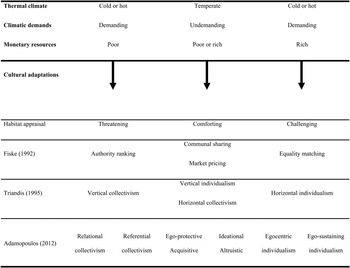
Zooming in on how exactly collectives shape culture, Adamopoulos (Reference Adamopoulos, Adamopoulos and Kashima1999; Reference Adamopoulos, Törnblom and Kazemi2012) has integrated the social resource theory (Foa & Foa Reference Foa and Foa1974), the taxonomy of sociality (Fiske Reference Fiske1991), and Triandis's (1995) typology of collectivism and individualism. Using exchanges of material resources (money, goods, and services) and symbolic resources (love, status, and information) as integrating tools, Adamopoulos has mapped out eight branches of collectivism and individualism. His present commentary adds that freedoms can be understood as involving the acquisition and exchange of the six major classes of material and symbolic resources. As an attractive consequence, climato-economic theorizing might then help explain the eight resource-based branches of collectivism and individualism.
The left arrow in Figure R2 predicts that authority ranking and branches of vertical collectivism are most prevalent in threatening climato-economic habitats. The right arrow predicts that equality matching and branches of horizontal individualism are most prevalent in challenging climato-economic habitats. The middle arrow is much less accurate in its predictions of culture because no distinction is made yet between poor and rich populations residing in comforting habitats. It is here that Adamopoulos's differentiation of culture-common facets of social exchanges exposes ambiguities in the current version of the climato-economic theory of culture. It is here where research could blaze new trails in order to enhance our understanding of collectivism and individualism as cultural adaptations to local environments. For example, one might expect altruistic collectivism to be common among rich populations in temperate climates where “there is an overabundance of resources and life is viewed as a non-zero-sum game” (Adamopoulos Reference Adamopoulos, Adamopoulos and Kashima1999, p. 71).
Collectivist versus individualist adaptations to three types of climato-economic habitats.

According to Karwowski & Lebuda, creativity can be either threat-based (cf. left arrow in Fig. R2) or challenge-based (cf. right arrow in Fig. R2), but their research leads to a more nuanced picture of collective creative achievements. Relatively uncreative inhabitants of poorer countries tend to be somewhat more creative under harsher climatic conditions. Relatively creative inhabitants of richer countries tend to be most creative under optimal rather than too demanding or too comfortable climatic conditions. These results are difficult to reconcile with the aforementioned peaks of elevated blood pressure. They are reminiscent, though, of effects of colder winters and hotter summers on subjective well-being. In poorer countries, more demanding climates appear to decrease health and happiness. But in richer countries, subjective well-being is optimal if there is one really challenging season: too much stress of cold winters and hot summers, as well as too little stress of warm winters and cool summers, reduce health and happiness (Van de Vliert Reference Van de Vliert2009; Van de Vliert et al. Reference Van de Vliert, Huang and Parker2004). Is creativity similarly optimal in rich countries with optimal seasonal challenges?
R2.7. Supplementary explanations
It would be rather naïve to claim that climato-economic conditions are the most important, let alone the only, antecedents of culture. This section therefore appreciably discusses limited growing seasons, frontier migration, political history, income inequality, social capital, and bargaining power as complementary and subsidiary explanations of collective functioning. With regard to limited growing seasons, Ainslie highlights the hypothesis that a too cold climate to grow crops for part of the year punishes lack of foresight and rewards intertemporal self-control and preparation – consequences that denizens of warm climates can afford to ignore. This presumption denies that a hot desert climate also is unkind to crops, as is evidenced by the lower agricultural output in both colder-than-temperate and hotter-than-temperate climates (Cline Reference Cline2007). But even if reasoning is extended to include the motivational and cultural consequences of limited growing seasons in too hot climates, this single-factor explanation still runs the risk of climatic determinism (cf. R2.1).
De Oliveira Chen & Kitayama explore theoretically whether migration to rugged lands of frontier could possibly explain individualist culture better than climato-economic conditions do. Their arguments in favor of that explanation are that (a) Americans and Japanese who historically settled in ecologically harsh, sparsely populated, and socially primitive regions evolved a stronger ethos of independence, and (b) Chinese in provinces with more demanding climates have higher divorce rates. Arguments against the frontier explanation are that it cannot account for why historical migration out of Africa and into more threatening colder regions resulted in (a) individualist Kenyans at low latitudes but collectivist Mongolians at high latitudes (Van de Vliert Reference Van de Vliert2011b), (b) individualist Europeans but collectivist Asians at comparable latitudes, and (c) more individualist Chinese in provinces with less demanding climates (sect. 4.4.2; Van de Vliert et al. Reference Van de Vliert, Yang, Wang and Ren2013b). Further research should determine whether the frontier-migration explanation can fruitfully supplement or refine the climato-economic explanation of cultural individualism versus collectivism.
Güss has confidence that a country's political history is a more important driver of cultural freedoms than climatic and economic histories are. Calling up the salient transitions from the democratic Weimar Republic through the totalitarian Hitler era to the federal parliamentary republic of Western Germany, Güss makes it clear that climato-economic theorizing provides a partial explanation of cultural freedoms at best. A complicating consideration is that climato-economic habitats covary with both political freedoms (sect. 4.5) and nonpolitical freedoms, including press freedom (sect. 4.2). This poses the following puzzle for future research: Are political freedoms mediating between climato-economic habitats and nonpolitical freedoms? Are nonpolitical freedoms mediating between climato-economic habitats and political freedoms? Or is it better to drop the issue of mediation by viewing all freedoms as distinct yet closely interrelated fruits from the same climato-economic tree (see Electronic Supplement 3)?
Sparks, Mishra, & Barclay (Sparks et al.) caution that income inequality may be a rival predictor of culture. However, a large body of research evidence has established that this is not a very serious danger. Income inequality does not affect or negligibly affects climato-economic imprints on employee harassment (sect. 4.2), press repression (sect. 4.2), survival versus self-expression culture (Van de Vliert Reference Van de Vliert2007), selfish versus cooperative enculturation of children (Van de Vliert et al. Reference Van de Vliert, Einarsen, Euwema and Janssen2009), and ingroup favoritism in the form of nepotism (Van de Vliert Reference Van de Vliert2009). Additionally, when the regression analysis from Table R2 was repeated with both parasitic disease burden and income inequality controlled for, income inequality did not reach significance in any of the six regression equations.
Locke & Flanagan build a compelling case for human and social capital as resources that can replace monetary resources to meet fundamental needs. It would make the case even more interesting if they were to make a distinction between ingroup capital and outgroup capital. Collectivists in threatening habitats tend to invest and build social capital in ingroup members at the expense of outgroup members; individualists in challenging habitats tend to invest and build social capital in individual others no matter whether they are members of ingroups or outgroups (sects. 2.4.4 and 4.4). Because every world citizen has a world full of outgroup members and very few ingroup members, individualists seem to be in a much better position to accumulate social capital than collectivists are. Indeed, human capital (sects. 2.4.2 and 4.5) and social capital (sects. 4.4.1 and 4.5) both tend to increase in more challenging habitats. For example, inhabitants of challenging habitats have invested a lot in two of Coleman's (Reference Coleman1990) cornerstones of social capital: generalized trust in others (Kong Reference Kong2013) and cooperative attitudes at work (Van de Vliert Reference Van de Vliert2009).
Rather than thinking in terms of social capital and trust, Sparks et al. believe it makes much difference that inhabitants of more challenging habitats have more means to escape the situation. Poor people in extreme climates have little choice but to bargain in tight hierarchical groups to meet shared needs. By contrast, rich people in extreme climates have the option of avoiding climatic stress by relocating elsewhere, of bargaining with home groups, host groups, or both. In other words, inhabitants of more challenging habitats have more bargaining power and leeway to create freedom. This will certainly work at the individual level but it remains to be empirically verified whether this is a viable explanation at the level of entire communities as well.
R2.8. Research methods
De Oliveira Chen & Kitayama fear that Huadong Yang, Yongli Wang, Xiao-peng Ren, and I (Van de Vliert et al. Reference Van de Vliert, Yang, Wang and Ren2013b) have made a mistake by comparing incomparable self-report measures of collectivism gathered from inhabitants of 15 Chinese provinces. However, we have tried to minimize that risk in several ways. First, we sampled only Han Chinese in order to standardize ethnicity. Second, we sampled only employees of medium-sized enterprises in smaller towns to also standardize the employment situation. Third, we randomly chose the population of Gansu as a reference group and compared the factor loadings of Gansu with those of the populations in the other provinces. Reflecting factorial similarity and construct equivalence across provinces, Tucker's φ ranged from .85 in Hebei to .97 in Shanxi (M φ = .91). Finally, we interpreted it as a sign of comparative construct validity that the positive climate-discrimination link across poor countries also holds across predominantly poor provinces within China.
In striking contrast to the self-report measures of Chinese collectivism, Vandello and Cohen (Reference Vandello and Cohen1999) employed eight unobtrusive estimates of collectivism to study cultural differences within the United States. The target article adopted their collectivism index as a proxy for positive ingroup discrimination, but Terracciano & Wayne doubt whether the unobtrusive state rankings are a valid representation of discrimination between ingroups and outgroups. Vandello and Cohen (Reference Vandello and Cohen1999) had the same concern, reasoned that states with larger numbers of ethnic minorities should be generally more collectivist, and made certain that there is a strong link between percentage of minorities and a state's collectivism score (r = .75, p < .001). Conway et al. (Reference Conway, Sexton and Tweed2006) later argued that collectivism promotes the adoption of restrictive laws and then showed that legislative restrictions in 50 United States and the District of Columbia are positively associated with Vandello-Cohen collectivism (r = .47, p < .001). Both correlations attest to the validity of the collectivism index used.
Loughnan et al. would like to see more multi-level tests of the climato-economic theory, despite the multi-level finding, reported in section 4.4.2, that culture building in climato-economic habitats is a collective rather than an individual process, at least in China today. Earlier in this issue, also using multi-level modeling, Fischer reports that individual inhabitants of challenging climato-economic habitats are happier and place more value on freedom of speech and political participation rather than fighting rising prices and maintaining order in the nation. But more multi-level research would certainly be most welcome, especially to estimate the relative weight of collective and individual pushing and pulling toward shared needs, stress appraisals, and fundamental freedoms in threatening, comforting, and challenging habitats.
Several commentators (Arantes, Grace, & Kemp [Arantes et al.]; Iyer et al.; Leung & Cheng; Loughnan et al.) see merit in using more longitudinal analyses. Arantes et al. specifically encourage a replication study using climatic demands and monetary resources in the past as predictors of freedom at present. Richard Tol and I (Van de Vliert & Tol Reference Van de Vliert and Tol2012) have recently done just that. In a 147-nation study, we showed that the initial level of democratic freedom in 1978, climatic demands in 1978, national wealth in 1978, and economic growth between 1979 and 2008 accounted for 49% of the changes in democracy between 1979 and 2008. Increases in democratic freedom were minimal in countries with lower economic development if they were more democratic initially and situated in more demanding climates (e.g., Turkey), and maximal in countries with higher economic development if they were more autocratic initially and situated in more demanding climates (e.g., Poland).
In addition to placing emphasis on longitudinal designs, Leung & Cheng put forward a number of intellectually stimulating ideas to further develop climato-economic theory, most notably including the use of cities and families as lower-level units of analysis and the tracking of families who move from one area of residence to another. Leung & Chen also join Gelfand & Lun, Iyer et al., and Loughnan et al. in advocating for the necessity of experimental tests at the individual level. Though this plea for bringing climato-economic research into the laboratory opens up the promising opportunity for proving causation, there is also the danger of erroneously interpreting individual-level reactions as informative representations of population-level processes of culture building. More on the usefulness of experimental investigations of climato-economic habitats follows in R4.2.
R2.9. Practical interventions
The target article sprang from my firm belief that valid theoretical explanations are necessary conditions of effective practical interventions (Van de Vliert Reference Van de Vliert1977; Reference Van de Vliert1985; Reference Van de Vliert1997; see also Loughnan et al.). It started with human-rights and human-development objectives to meet human needs, continued with a stepwise examination of climato-economic covariations of fundamental freedoms, and ended at the horizon of scientific engineering of freedom. Against this backdrop, the commentary that comes closest to the gist of the target article is the contribution on sustainable development of mental health by Desseilles, Duclos, Flohimont, & Desseilles (Desseilles et al.).
With a keen eye for the multiplexity of causes of mental disorders (e.g., climate, diet, and lifestyle), Desseilles et al. are convinced of the importance of climatotherapy as an “adaptive approach aiming to restore balance among the economic, social and ecological realms of human societies” (abstract). Hence, they would like to receive more information about the climato-economics of mental ill-being and the implied need for intervention, also with a view to the links between global warming and sustainability of mental well-being. So far, our research stream has identified only a few pieces of diagnostic and prognostic information that might be useful for intervention scholars and practitioners alike.
One clinically relevant observation pertains to a diagnostic discrepancy between the ecological prevalences of suicides and mental disorders. In support of climato-economic theorizing, suicides are most prevalent in stressful threatening and stressful challenging habitats and least prevalent in relatively stressless and comforting habitats (Van de Vliert Reference Van de Vliert2009). By contrast, but still in support of climatic-economic theorizing, burnout, depression, anxiety, perceived ill health, and unhappiness are most prevalent in threatening habitats, intermediately prevalent in comforting habitats, and least prevalent in challenging habitats (sect. 2.4.2; Fischer & Van de Vliert Reference Fischer and Van de Vliert2011). Thus, or so it seems, the greater obsession with survival of threatening habitats produces both more suicidal behavior and more mental illness, whereas the greater obsession with self-expression within challenging habitats produces more suicidal behavior but less mental illness.
Put differently, unlike suicide rates that are unrelated to overall freedom (r = .20, n = 49, p = .33), mental disorders tend to mirror the global distribution of freedom (r = −.63, n = 35, p < .001). As a consequence, section 6.3 of the target article may be cautiously read as providing information about scientific engineering from mental illness to mental health. For example, if concerted implementation of climate protection and poverty reduction fails, climatotherapy might be expected to become especially relevant for the African and Asian communities clustered at the bottom of Figure 4 (see target article). Also, Electronic Supplement 6 allows the tentative forecast that unarrested global warming later this century would likely tend to harm climatic livability and related mental health in northern Brazil and southern India unless local economic growth prevents this from happening.
Yet another clinically relevant interaction effect of climatic demands and monetary resources that may be of interest to Desseilles et al. was briefly mentioned in section 4.2 and reported in detail elsewhere (Van de Vliert et al. Reference Van de Vliert, Einarsen and Nielsen2013a). Extremely aggressive and persistent employee harassment is most prevalent in threatening habitats, intermediately prevalent in comforting habitats, and least prevalent in challenging habitats. Workplaces have thus more to gain from preventive strategies than from curative strategies in threatening habitats with high employee harassment, which we found to be predominantly concentrated in North-West Asia, East Europe, and Africa. However, in challenging habitats with low employee harassment, as were found to be predominantly concentrated in South and North-West Europe, and in North and South America, preventive organizational strategies may fail to have much of an impact on reducing the problem still further. Instead, tailor-made clinical interventions may be more fruitful.
Coming back to the golden link between valid theoretical explanations and effective practical interventions, and its application to the paradigm at hand, is almost inevitably coming back to the consequential crux of demands and resources. Owing to systematic theorizing and replicative testing of interactive effects of climatic demands and monetary resources, the target article has a solid rule of thumb on offer: climatotherapy and other climato-economic interventions are most effective in stressful threatening habitats, moderately effective in stressful challenging habitats, and least effective in relatively stressless and comforting habitats.
R3. Gray domain
R3.1. Caution: Work in progress
Güss correctly criticizes the target article as resting on too limited operationalizations of needs and freedoms, explicitly warning to be cautious and mindful when generalizing the findings. One cannot be sure yet whether climato-economic theorizing is or is not applicable to, for example, affordable housing and health care, personal and group security, general social inclusion, or mutual respect for diversity and personal growth. Also, it is too early to posit that climato-economic conditions produce free will at the individual level through freedom at the collective level, as Baumeister et al. seem to propose. Or, to pick another example, more work is needed before we can confidently translate Pahlavan & Amirrezvani's concerns about globalization into a viable hypothesis such as this one: poor and rich populations in undemanding climates manifest more cultural convergence than poor and rich populations in demanding climates where localization is more critical for satisfying fundamental needs.
Granted, we have learned that Montesquieu (Reference Montesquieu, Cohler, Miller and Stone1748/1989) might have been right all along in insisting that basically people solve livability problems and establish culture when exchanging money for goods and services that satisfy climate-related needs. But we are still struggling with how precisely to measure climatic demands (R2.2), monetary resources (R2.3), and ecological stresses (R2.5), and how precisely to draw the causal path from habitats to adaptations (R2.4). Clearly, this is work in progress whereby replicative climato-economic research of culture and prudence in interpretation are called for.
R3.2. Personality traits
Terracciano & Wayne review evidence for relations between climato-economic conditions and personality traits such as open-mindedness, risk-taking, and hot temperament. However, they searched in vain for significant interaction effects of climatic demands and monetary resources on these reported or attributed traits (for similar insignificant effects on IQ, see R4.4). These expectable findings are in agreement with the definition of personality traits as being invariant over time and across situations (John & Gosling Reference John, Gosling and Kazdin2000). Yet, it may be premature to conclude that all personality traits are insensitive to climato-economic habitats, also because section 4.4 implies that threatening habitats are home to allocentric personalities whereas challenging habitats are home to idiocentric personalities. Allocentrics think, feel, believe, and act as people typically do in collectivist cultures; idiocentrics think, feel, believe, and act as people typically do in individualist cultures (Triandis Reference Triandis1995; Triandis et al. Reference Triandis, Leung, Villareal and Clack1985).
R3.3. Creativity
In addition to the results discussed above under R2.6, Karwowski & Lebuda report that climato-economic theorizing is applicable to country-level creativity reflected in the number of Nobel Prizes in Science and Peace, the number of published papers, and the scholarly H-index. However, this finding may be indicative of some chance capitalization as well because of the multiple analyses conducted. In addition, climatic demands and monetary resources were unable to interactively predict several other indicators of creativity such as a nation's innovation potential and creative achievements in the arts. Therefore, as yet, general creativity is best conceived as belonging to the gray area where the theory may or may not apply.
R4. Black domain
R4.1. Alternative environments
As observed in the introductory section, the black domain where the climato-economic theory does not apply is vastly larger than the overrepresentation of white-domain topics suggests. Building on work by Boyd and Richerson (Reference Boyd and Richerson2005), Chang et al. hypothesize that environmental variability instead of thermo-economic livability drives cultural adaptation. Seasonal variations in climate, daytime length, and solar radiation, as well as long-term variations in temperature and precipitation, are thought to (a) decrease social learning by collectively copying existing solutions to problems, (b) increase individual learning by personally solving new problems, and (c) promote self-expression, individualism, democracy, and freedom as likely consequences. The results presented in the two panels of Figure R1 do not corroborate this offshoot of climatic determinism. Compared with seasonal switches between low heat and low cold (left side of left panel), seasonal switches between high heat and high cold (right side of right panel) tend to be associated with less rather than more freedom. But recall that Figure R1 is based on cross-sectional data. It would sharpen theoretical boundaries and thus articulate conceptual content if it could be shown that the climato-economic paradigm, although perhaps applicable to centennia-long waves of change (see R2.6), is not applicable to millennia-long waves of climatic variability.
Arantes et al. investigated whether the black domain can be reduced by enlarging the applicability of the ecological demands-resources interaction that is so central to climato-economic theorizing. They attempted to account for press freedom with the demands of natural disaster risks, monetary resources, and their interaction as predictors. As might be expected, this interaction effect did not reach significance because compared to climatic demands, natural disaster risks are less essential theoretically for satisfying the existence needs for thermal comfort, nutrition, and health of the population at large. They also predicted press freedom with climatic demands, oil export resources, and their interaction as predictors. Again the interaction effect was not significant, and again this is not surprising: oil export resources, which appeared to be unrelated to income per head, are unlikely compensators for the greater costs of harsher climates. Factually, Arantes et al. have shown that the climato-economic paradigm has discriminant validity in that it accurately differentiates between theoretically relevant and theoretically irrelevant demands and resources.
R4.2. Not all ambient temperature is climate
Climatic demands are defined and measured as the generalized colder-than-temperate or hotter-than-temperate weather of a residential area over at least a 30-year period. Consequently, climato-economic ecologies are not obvious predictors of psychobehavioral adjustments in the short run. Accordingly, so far, I have seen no sign that the theory also explains immediate physiological or psychological effects of ambient temperature through incidental weather or indoor climate. Given the current limited applicability of the theory, Gelfand & Lun, Leung & Cheng, and Iyer et al. make useful contributions by suggesting to extend the theoretical domain with the help of ecological priming and other methods for studying individual adjustments to experimental manipulations of climatic demands and monetary resources.
Corresponding questions include: Do threatening climato-economic conditions elicit ingroup agency, autocratic organizing, and low freedom? Do comforting climato-economic conditions elicit convenient agency, laissez-faire organizing, and intermediate freedom? Do challenging climato-economic conditions elicit individual agency, democratic organizing, and high freedom? If laboratory results are able to answer these questions affirmatively, the theory may also hold for short-term exposure to temperature demands and temperature-compensating resources. Rather, my hypothesis is that experiments will fail to find “convergent evidence for the link between ecology and psychological processes” (Gelfand & Lun, title). Such disconfirmations would demonstrate the power of the theory to discriminate between its applicability to climatic demands and monetary resources as macro-level environments and its inapplicability to temperature demands and temperature-compensating resources as micro-level environments.
Vigil, Swartz, & Rowell (Vigil et al.) provide an instructive example of a climatic demands-resources experiment with ample room for improvement in the direction of what Gelfand & Lun and Leung & Cheng have in mind. First, the 202 participants in Vigil et al.'s experiment were not selected and assigned to conditions based on their coming from places of residence with either undemanding or demanding thermal climates. Second, ambient room temperatures only varied between 68oF and 77oF, with no manipulation of low and high temperatures outside of this comfort zone. Third, no conditions of low versus high levels of temperature-compensating resources were primed or structurally manipulated. Fourth, the dependent variables of capacity (Cronbach's α = .42), trustworthiness (α = .43), and desiring more independence (α = .22) were not reliably measured. Thus, this experiment makes a significant contribution by exposing a number of critically important design features of the proposed climato-economic experiments.
R4.3. Human intelligence
The worldwide distribution of human intelligence is strongly related to annual mean temperature (r = −.63; Lynn & Vanhanen Reference Lynn and Vanhanen2006). Allik & Realo therefore consider it a missed opportunity that I did not check whether climato-economic conditions are even better predictors of national IQ (source: Lynn & Vanhanen Reference Lynn and Vanhanen2006). Using the predictors from Table R2, I found that heat demands, cold demands, monetary resources, and their four interactions accounted for 62% of the variation in IQ across 106 countries. Despite the 22% increase in predictive power, these results still imply that global inequality in IQ belongs to the black domain of cultural adaptations to climato-economic conditions because none of the four interaction effects reached significance.
In a double check, IQ was added to each of the six prediction models in Table R2. In Model 1, national IQ predicted 46% of the variation in overall freedom (b = .04, n = 71, p < .01), wiping out the initial impact of parasitic disease burden (b = −.11, p = .12). However, Models 2 to 6 then wiped out the initial impact of national IQ, showing that neither intelligence nor parasitic disease burden mediates the interactive influences of heat demands, cold demands, and monetary resources on overall freedom. In Model 6, national IQ (b = .01, p = .23), parasitic disease burden (b = .04, p = .55), heat demands (b = −.20, p < .05), cold demands (b = −.09, p = .51), the interaction of heat and cold demands (b = .02, p = .88), monetary resources (b = .36, p < .01), the interaction of heat demands and monetary resources ( b = −.04, p = .76), the interaction of cold demands and monetary resources (b = .50, p < .001), and the three-way interaction (b = −.10, p = .42), accounted for 75% of the variation in freedom from press repression, ingroup discrimination, and political autocracy. In sum (and in response to Allik & Realo), there is not the slightest indication that Lynn and Vanhanen (Reference Lynn and Vanhanen2006) were right in assuming that national IQ drives governmental democratization.
R4.4. Fitness advantages of adaptation
Adaptation is a complex construct that defies simple definition. To me, adaptation is the evolution or development of shared appraisals of stresses and shared choices of goals and means that help satisfy fundamental needs in a given habitat (sect. 2.4). Paternotte, however, restricts adaptation to not only the use of traits but also to the development of traits that provide an evolutionary fitness advantage for either the individual or the group. In the target article, the words trait and fitness are never mentioned, let alone that fitness advantages of individual-trait adaptation are distinguished from fitness advantages of group-trait adaptation. Although Paternotte is therefore storming a house in which I do not live, his perspective of fitness advantages may still be useful to clarify the role of survival in the creation of culture from a climato-economic vantage point.
Creepingly slow, processes of cultural evolution reduce two universal human problems: climatic survival and genetic survival (Van de Vliert Reference Van de Vliert2009; 2011b). Climatic survival in a particular place is the more important one simply because it is a necessary but insufficient condition for sexual reproduction and genetic survival over time. Cultural reductions of climatic-survival problems apply to warm-blooded males and warm-blooded females in the same way, whereas cultural reductions of genetic-survival problems apply to sperm-contributing males and egg-contributing females in different ways. As a current consequence, climato-economic theorizing has something to say about ungendered culture, including shared fundamental freedoms, but next to nothing about gendered culture, including masculinity and femininity (for gendered culture, see Emrich et al. Reference Emrich, Denmark, Den Hartog, House, Hanges, Javidan, Dorfman and Gupta2004; Hofstede Reference Hofstede1998; Reference Hofstede2001; Van de Vliert et al. Reference Van de Vliert, Kluwer and Lynn2000).
Paternotte's perspective seems valuable indeed for associating ungendered cultural characteristics with fitness advantages to undifferentiated groups of humans and gendered cultural characteristics with fitness advantages to males and females separately. If these culture-fitness relationships are real and vital, they might even explain why collectivist values and motives, ingroup identification, and “ingroup favoritism appeared to be higher in ungendered cultures than in both masculine and feminine cultures” (Van de Vliert Reference Van de Vliert2011b, p. 509). However that may be, until more advanced research shows otherwise, the field of gendered culture lies outside the more generic domain of climato-economic description and explanation of ungendered human culture.
R4.5. Do animals belong on the black list?
Much to Burghardt's regret, the target article examines demands, resources, and adaptations solely through a human-focused anthropocentric lens. Of course, animals also adapt their courses of action to the habitational circumstances of climatic demands and resource availability, and it is a very smart idea to investigate playfulness in nonhumans as a surrogate measure for freedom of choice in humans. It is a promising idea, too, given that nonhuman species mirror the human pattern of repression of fundamental freedoms: “play of all types is readily curtailed in both the wild and captivity in times of food shortage, climatic adversity, social upheaval, and chronic stress” (Burghardt Reference Burghardt2005, p. 157). By contrast, play in all species is most prevalent when there are excess resources along with bodily attributes that facilitate flexibility, novelty, and creativity. For example, Japanese macaques living in relatively threatening habitats have a more rigid social system and are less playful and cooperative than macaques living in relatively comforting habitats in Indonesia. I wholeheartedly agree with Burghardt that such findings open up many avenues of fruitful comparative research.
R5. Prospect
This discussion platform has supplied rich fodder for psychobehavioral scholars who set out to systematically describe, explain, and adjust how differently humans function spatially. The commentaries reflect considerable potential for refining, extending, and putting to use the burgeoning geographical understanding of climato-economic conditions under which fundamental needs are being transformed into culture. As to practical relevance, the day may come and may not be far off when space- and satellite-based systems such as the Global Positioning System (United States) and the BeiDou Navigation System (China) provide specific cultural information about the residents of every inhabited spot on earth.




Target article
Climato-economic habitats support patterns of human needs, stresses, and freedoms
Related commentaries (24)
Cold climates demand more intertemporal self-control than warm climates1
Contextual freedom: Absoluteness versus relativity of freedom
Cultural adaptation to environmental change versus stability
Cultural adaptations to the differential threats posed by hot versus cold climates
Ecological priming: Convergent evidence for the link between ecology and psychological processes
Extending climato-economic theory: When, how, and why it explains differences in nations' creativity
Frontier migration fosters ethos of independence: Deconstructing the climato-economic theory of human culture
Fundamental freedoms and the psychology of threat, bargaining, and inequality
How is freedom distributed across the earth?
Improving climato-economic theorizing at the individual level
Individual identity and freedom of choice in the context of environmental and economic conditions
Interpersonal exchange and freedom for resource acquisition
Is there a role for “climatotherapy” in the sustainable development of mental health?
Methodological suggestions for climato-economic theory
Personality traits, national character stereotypes, and climate–economic conditions
Play, animals, resources: The need for a rich (and challenging) comparative environment
Press freedom, oil exports, and risk for natural disasters: A challenge for climato-economic theory?
Shared adaptiveness is not group adaptation
Subtle variation in ambient room temperature influences the expression of social cognition
The need for psychological needs: A role for social capital
Toward an integrated, causal, and psychological model of climato-economics
Unsurprising, in a good way
What about politics and culture?
What is freedom–and does wealth cause it?
Author response
White, gray, and black domains of cultural adaptations to climato-economic conditions