Van de Vliert's ecological demands model makes a fresh contribution to the extant literature on climatic conditions and human behavior (Anderson Reference Anderson2001; Cohn Reference Cohn1993; Hancock Reference Hancock1986; Larrick et al. Reference Larrick, Timmerman, Carton and Abrevaya2011; Zhong & Leonardelli Reference Zhong and Leonardelli2008). We agree with Van de Vliert that social cognition is inherently influenced by climatic conditions and individual resource potential, but his model may be complicated by the fact that his key concepts, including human “needs,” “stresses,” and “freedoms” are cognitively defined. These constructs are only measurable through overt behaviors, they lack biological (e.g., phylogenetic) underpinnings, and they are atheoretical. We suggest that his omnibus findings can instead be explained as a much more basic and parsimonious extension of a social signaling model, the Socio-Relational Framework of Expressive Behaviors (SRFB; Vigil Reference Vigil2009). This framework predicts that personal capital and climatic setting each contribute to the types of social networking conditions that facilitate advertisements of either empowerment cues such as the case of expressing human freedom, or advertisements of vulnerability cues in the case of expressing repression-compliance. Temperature variation should therefore induce systematic changes in expressed cognition, including self-descriptions, distress behaviors, and motivations to invest in different types of relationships, irrespective of “cultural management of ambiguity” and similarly vague cognitive concepts. We examined these hypotheses using an experimental protocol and showed that even subtle variability in ambient room temperature influences how people describe their thoughts and feelings.
The SRFB subsumes the following premises: (1) that social signaling (communicative) systems underlie social cognition; (2) that expressive behaviors are composed of “capacity cues” (e.g., empowerment gestures that convey “dominance”) and “trustworthiness cues” (e.g., vulnerability gestures that convey “submissiveness”); (3) that changes in resource acquisition precipitate these gestures; (4) that capacity cues (e.g., expressed confidence) are expressed in conjunction with and used to attract novel relationship partners and maintain larger social networks, and trustworthiness cues (e.g., expressed vulnerability) are used to maintain fewer, more consolidated networks; (5) that climatic conditions influence the size of individuals' social networks by either restricting or facilitating interactions with more people; and (6) that climatic conditions prime the expression of trustworthiness-demonstrating dimensions of social cognition in colder climates, and the expression of capacity-demonstrating dimensions in warmer climates.
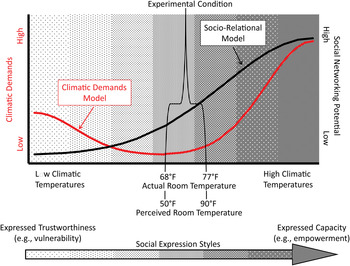
Social cognition is only measurable via expressive behaviors in the form of verbal and nonverbal gestures (see Ambady & Rosenthal Reference Ambady and Rosenthal1992), and Van de Vliert's representations of freedom can also be interpreted as demonstrations of capacity cues (e.g., signaling confidence and independence). Because climatic conditions affect the ability to acquire resources (e.g., networking opportunities) and influence the ability to aggrandize one's social network, climatic conditions alone should predict individual differences in the expression of basic capacity displays. As shown in Figure 1, climatic conditions are predicted to covary with networking potential and the expression of trustworthiness and capacity demonstrations of social cognition. Colder climates are comprised of conditions (e.g., snow and darkness) that physically restrict the ability to interact with more affiliates and should therefore covary with heightened expression of trustworthiness cues (e.g., modest and co-dependent self-descriptions) and the motivation to form fewer, more intimate peer networks. Warmer ambient temperatures are instead predicted to result in heightened capacity demonstrations (e.g., inflated and independent self-descriptions) and the motivation to form larger peer networks.
Figure 1.
Socio-relational framework of climatic variation, social networking potential, and the expression of capacity and trustworthiness cues.
We tested these hypotheses by exposing adults (n = 202, 25% male, mean age = 23.7) to ambient room temperatures that only varied between 68°F and 77°F. Using Blind Quantitative Likert (BQL) scales, which electronically record participant responses between two polar anchors via a 100-point interval scale that is concealed to the participants, we examined subtle differences in perceptions of ambient temperature, self-descriptions, distress reactions, and social motivations. Capacity cues were comprised of two items that consisted of self-rated attractiveness (relative to peers) as a job applicant and financial potential (α = .42); trustworthiness cues were comprised of three items that measured self-described selfishness (reverse scored), kindness, and responsibility, relative to peers (α = .43). Desired social responses from others in times of stress were measured with two items: when feeling angry and when feeling frustrated, would you rather be comforted (a trustworthiness gesture) or be left alone (a capacity gesture, α = .22). An item also asked about one's preferred social network (quality and quantity) along a continuum ranging from having few friends with a large amount of intimacy to having a large number of friends with a small amount of intimacy. Lastly, participants provided an estimate of the room temperature (from 50°F–90°F). These reports were correlated with the actual room temperatures (r = .34, p < .01) and were used as the main predictor variable.
Perceived room temperature was positively correlated with the omnibus capacity variable (r = .18, p = .01), negatively correlated with the omnibus trustworthiness variable (r = −.24, p < .01), and positively correlated with desiring more independence (rather than comfort) from others when experiencing distressful emotions (r = .14, p = .04). Examination of participants' subjective social preferences showed that higher perceived temperature was also associated with a greater desire to form larger, less intimate social networks (r = .14, p = .04).
These findings suggest that even slight variations in ambient room temperature are associated with variability in the expression of social cognition, which we argue can be explained by the social psychological adaptation to express heightened displays of capacity gestures in warmer climates as a result of the social networking opportunities that warmer temperatures enable (Vigil Reference Vigil2009). In theory, this model should incorporate self-reported endorsements of human “freedoms,” because they are associated with specific trait impressions of confidence and independence that signal the impression of dominance and ultimately capacity cues to others. This model is more parsimonious than the cognitive demands model, because the cognitive constructs at the core of the demands model (i.e., human needs and freedoms) are only measureable through expressive gestures, and because at a social-signaling level of analysis, even ambiguously defined cognitive constructs can still be systematically interpreted.





 You have
Access
Van de Vliert's ecological demands model makes a fresh contribution to the extant literature on climatic conditions and human behavior (Anderson Reference Anderson2001; Cohn Reference Cohn1993; Hancock Reference Hancock1986; Larrick et al. Reference Larrick, Timmerman, Carton and Abrevaya2011; Zhong & Leonardelli Reference Zhong and Leonardelli2008). We agree with Van de Vliert that social cognition is inherently influenced by climatic conditions and individual resource potential, but his model may be complicated by the fact that his key concepts, including human “needs,” “stresses,” and “freedoms” are cognitively defined. These constructs are only measurable through overt behaviors, they lack biological (e.g., phylogenetic) underpinnings, and they are atheoretical. We suggest that his omnibus findings can instead be explained as a much more basic and parsimonious extension of a social signaling model, the Socio-Relational Framework of Expressive Behaviors (SRFB; Vigil Reference Vigil2009). This framework predicts that personal capital and climatic setting each contribute to the types of social networking conditions that facilitate advertisements of either empowerment cues such as the case of expressing human freedom, or advertisements of vulnerability cues in the case of expressing repression-compliance. Temperature variation should therefore induce systematic changes in expressed cognition, including self-descriptions, distress behaviors, and motivations to invest in different types of relationships, irrespective of “cultural management of ambiguity” and similarly vague cognitive concepts. We examined these hypotheses using an experimental protocol and showed that even subtle variability in ambient room temperature influences how people describe their thoughts and feelings.
The SRFB subsumes the following premises: (1) that social signaling (communicative) systems underlie social cognition; (2) that expressive behaviors are composed of “capacity cues” (e.g., empowerment gestures that convey “dominance”) and “trustworthiness cues” (e.g., vulnerability gestures that convey “submissiveness”); (3) that changes in resource acquisition precipitate these gestures; (4) that capacity cues (e.g., expressed confidence) are expressed in conjunction with and used to attract novel relationship partners and maintain larger social networks, and trustworthiness cues (e.g., expressed vulnerability) are used to maintain fewer, more consolidated networks; (5) that climatic conditions influence the size of individuals' social networks by either restricting or facilitating interactions with more people; and (6) that climatic conditions prime the expression of trustworthiness-demonstrating dimensions of social cognition in colder climates, and the expression of capacity-demonstrating dimensions in warmer climates.
Social cognition is only measurable via expressive behaviors in the form of verbal and nonverbal gestures (see Ambady & Rosenthal Reference Ambady and Rosenthal1992), and Van de Vliert's representations of freedom can also be interpreted as demonstrations of capacity cues (e.g., signaling confidence and independence). Because climatic conditions affect the ability to acquire resources (e.g., networking opportunities) and influence the ability to aggrandize one's social network, climatic conditions alone should predict individual differences in the expression of basic capacity displays. As shown in Figure 1, climatic conditions are predicted to covary with networking potential and the expression of trustworthiness and capacity demonstrations of social cognition. Colder climates are comprised of conditions (e.g., snow and darkness) that physically restrict the ability to interact with more affiliates and should therefore covary with heightened expression of trustworthiness cues (e.g., modest and co-dependent self-descriptions) and the motivation to form fewer, more intimate peer networks. Warmer ambient temperatures are instead predicted to result in heightened capacity demonstrations (e.g., inflated and independent self-descriptions) and the motivation to form larger peer networks.
Socio-relational framework of climatic variation, social networking potential, and the expression of capacity and trustworthiness cues.
We tested these hypotheses by exposing adults (n = 202, 25% male, mean age = 23.7) to ambient room temperatures that only varied between 68°F and 77°F. Using Blind Quantitative Likert (BQL) scales, which electronically record participant responses between two polar anchors via a 100-point interval scale that is concealed to the participants, we examined subtle differences in perceptions of ambient temperature, self-descriptions, distress reactions, and social motivations. Capacity cues were comprised of two items that consisted of self-rated attractiveness (relative to peers) as a job applicant and financial potential (α = .42); trustworthiness cues were comprised of three items that measured self-described selfishness (reverse scored), kindness, and responsibility, relative to peers (α = .43). Desired social responses from others in times of stress were measured with two items: when feeling angry and when feeling frustrated, would you rather be comforted (a trustworthiness gesture) or be left alone (a capacity gesture, α = .22). An item also asked about one's preferred social network (quality and quantity) along a continuum ranging from having few friends with a large amount of intimacy to having a large number of friends with a small amount of intimacy. Lastly, participants provided an estimate of the room temperature (from 50°F–90°F). These reports were correlated with the actual room temperatures (r = .34, p < .01) and were used as the main predictor variable.
Perceived room temperature was positively correlated with the omnibus capacity variable (r = .18, p = .01), negatively correlated with the omnibus trustworthiness variable (r = −.24, p < .01), and positively correlated with desiring more independence (rather than comfort) from others when experiencing distressful emotions (r = .14, p = .04). Examination of participants' subjective social preferences showed that higher perceived temperature was also associated with a greater desire to form larger, less intimate social networks (r = .14, p = .04).
These findings suggest that even slight variations in ambient room temperature are associated with variability in the expression of social cognition, which we argue can be explained by the social psychological adaptation to express heightened displays of capacity gestures in warmer climates as a result of the social networking opportunities that warmer temperatures enable (Vigil Reference Vigil2009). In theory, this model should incorporate self-reported endorsements of human “freedoms,” because they are associated with specific trait impressions of confidence and independence that signal the impression of dominance and ultimately capacity cues to others. This model is more parsimonious than the cognitive demands model, because the cognitive constructs at the core of the demands model (i.e., human needs and freedoms) are only measureable through expressive gestures, and because at a social-signaling level of analysis, even ambiguously defined cognitive constructs can still be systematically interpreted.