




No CrossRef data available.
Article contents
Considering the role of ecology on individualdifferentiation
Published online by Cambridge University Press: 26 October 2016
Abstract
Our commentary articulates some of the commonalities between Baumeister etal.'s theory of socially differentiated roles and StrategicDifferentiation-Integration Effort. We expand upon the target article'sposition by arguing that differentiating social roles is contextual and drivenby varying ecological pressures, producing character displacement not only amongindividuals within complex societies, but also across social systems andmultiple levels of organization.
Information
- Type
- Open Peer Commentary
- Information
- Copyright
- Copyright © Cambridge University Press 2016
References
Alexander, R. D. (1974) The evolution of social
behavior. Annual Review of Ecology and
Systematics
5:325–83.Google Scholar
Armstrong, E. L., Fernandes, H. B. F. & Woodley, M. A. (2014) SD-IE and other differentiation
effects in Italy and Spain. Personality and
Individual Differences
68:189–94.CrossRefGoogle Scholar
Belsky, J., Steinberg, L. & Draper, P. (1991) Childhood experience, interpersonal
development, and reproductive strategy: An evolutionary theory of
socialization. Child Development
62:647–70.CrossRefGoogle ScholarPubMed
Cabeza de Baca, T. & Figueredo, A. J. (2014) The cognitive ecology of Mexico:
Climatic and socio-cultural effects on life history strategy and general
cognitive ability. Intelligence
47:63–71. doi: 10.1016/j.intell.2014.08.007.CrossRefGoogle Scholar
Cabeza de Baca, T., Figueredo, A. J. & Ellis, B. J. (2012) An evolutionary analysis of variation
in parental effort: Determinants and assessment.
Parenting: Science and Practice
12:94–104.CrossRefGoogle Scholar
Ellis, B. J., Figueredo, A. J., Brumbach, B. H. & Schlomer, G. L. (2009) Mechanisms of environmental risk: The
impact of harsh versus unpredictable environments on the evolution and
development of life history strategies. Human
Nature
20:204–68.Google Scholar
Fernandes, H. B. F. & Woodley, M. A. (2013) Strategic differentiation and
integration among the 50 states of the USA.
Personality and Individual Differences
55:1000–1002.CrossRefGoogle Scholar
Figueredo, A. J. & Jacobs, W. J. (2010) Aggression, risk-taking, and
alternative life history strategies: The behavioral ecology of social
deviance. In: Bio-psycho-social perspectives on
interpersonal violence, ed. Frias-Armenta, M. & Corral-Verdugo, V., pp.
3–28. Nova Science
Publishers.Google Scholar
Figueredo, A. J., Patch, E. A. & Gómez Ceballos, E. (2015) A life history approach to the
dynamics of social selection. In: Evolutionary
perspectives on social psychology, ed. Zeigler-Hill, V., Welling, L. & Shackelford, T. K., pp.
364–72. Springer International
Publishing.Google Scholar
Figueredo, A. J., Vásquez, G., Brumbach, B. H., Schneider, S. M. R., Sefcek, J. A., Tal, I. R., Hill, D., Wenner, C. J. & Jacobs, W. J. (2006) Consilience and life history theory:
From genes to brain to reproductive strategy.
Developmental Review
26:243–75.Google Scholar
Figueredo, A. J., Woodley, M. A., Brown, S. D. & Ross, K. C. (2013) Multiple successful test of the
strategic differentiation-integration effort (SD-IE)
hypothesis. Journal of Social, Evolutionary, and
Cultural Psychology
7:361–83.CrossRefGoogle Scholar
Kaplan, H., Hill, K., Hurtado, A. M. & Lancaster, J. (2001) The embodied capital theory of human
evolution. In: Reproductive ecology and human
evolution, ed. Ellison, P.
T., pp.
293–317. Aldine de
Gruyter.Google Scholar
Kaplan, H. S. & Gangestad, S. W. (2005) Life history theory and evolutionary
psychology. In: Handbook of evolutionary
psychology, ed. Buss, D.
M., pp.
68–95.
Wiley.Google Scholar
Lancaster, J. B. & Kaplan, H. S. (2009) The endocrinology of the human
adaptive complex. In: Endocrinology of social
relationships, ed. Ellison, P. T. & Gray, P. G. , pp.
95–119. Harvard
University Press.Google Scholar
Stearns, S. C., Allal, N. & Mace, R. (2008) Life history theory and human
development. In: Foundations of evolutionary
psychology, ed. Crawford, C. & Krebs, D., pp.
47–69.
Erlbaum.Google Scholar
Woodley, M. A. (2011) The cognitive
differentiation-integration effort hypothesis: A synthesis between the
fitness indicator and life history models of human
intelligence. Review of General Psychology
15:228–45.Google Scholar
Woodley, M. A. & Fernandes, H. B. F. (2014) Strategic and cognitive
differentiation-integration effort in a study of 76
countries. Personality and Individual
Differences
57:3–7.CrossRefGoogle Scholar
Woodley, M. A., Fernandes, H. B. F. & Madison, G. (2014) Strategic differentiation-integration
effort amongst the 47 prefectures of Japan.
Personality and Individual Differences
63:64–68.Google Scholar
Woodley, M. A., Figueredo, A. J., Brown, S. D. & Ross, K. C. (2013) Four successful tests of the
cognitive differentiation-integration effort hypothesis.
Intelligence
41:832–42.CrossRefGoogle Scholar
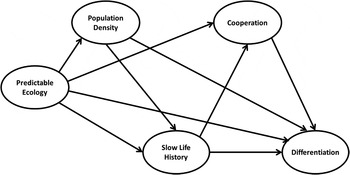
Figure 1. Life history model of differentiation. Individual differentiation results from a sequence of constraints at varying levels of organization. Increases in ecological stability and thus in environmental predictability result in increased population densities and slower life history strategies. This, in turn, promotes increased cooperation and thus strategic differentiation.
 You have
Access
Baumeister et al. present a provocative paper arguing that psychological theories of group and self can be more comprehensive if they include the concept of individual differentiation, which suggests that productivity and accountability will increase in groups where individuals are assigned distinct roles. Integrative, multilevel papers like this are rare in our field; thus, this endeavor is laudatory. The authors omitted one fundamental component, however: an outline of a mechanism for determining the degree to which groups differentiate among individuals. What causes some groups to highly specialize while others remain relatively socially stagnant and undifferentiated?
Although we agree with the core of the authors' position, we also present an evolutionary ecological perspective that complements and expands upon the authors' theory by specifying how and why certain ecological factors promote individual differentiation. Specifically, Baumeister et al.'s work on individual differentiation mirrors recent work investigating the Strategic Differentiation-Integration Effort (SD-IE) hypothesis, which posits that specialization and role differentiation within and among individuals and groups is an evolutionary adaptation to ecological pressures.
In essence, SD-IE articulates the ecological conditions under which individual differentiation should occur and ultimately why it does. According to SD-IE theory, slow life history strategies favor the evolution and development of individuals who are strategically differentiated in cognition and behavior, fueling the proliferation of individuals into varied micro-niches (Figueredo et al. Reference Figueredo, Woodley, Brown and Ross2013). Whereas high population densities typically promote higher levels of social competition among conspecifics, SD-IE permits niche-splitting through social specialization and role differentiation, and thus a certain degree of release from this competitive pressure. Once competitive release has been achieved, social cooperation among conspecifics, requiring more egalitarian distribution of resources, and niche specialization would increase labor productivity and extraction of resources. For example, the theory of embodied capital posits that division of labor between the sexes emerged as a strategy to maximize productivity and resource acquisition within the household, broadly defined (Kaplan et al. Reference Kaplan, Hill, Hurtado, Lancaster and Ellison2001).
Life history theory has informed evolutionary biology and ecology to explain human between-group differences and within-group differences (Ellis et al. Reference Ellis, Figueredo, Brumbach and Schlomer2009). These life history effects are typically found in biological traits such as birth spacing, age of maturity, life span, and so forth (Stearns et al. Reference Stearns, Allal, Mace, Crawford and Krebs2008) but have recently been shown to also involve psychological traits and certain aspects of social organization (Ellis et al. Reference Ellis, Figueredo, Brumbach and Schlomer2009; Figueredo et al. Reference Figueredo, Vásquez, Brumbach, Schneider, Sefcek, Tal, Hill, Wenner and Jacobs2006; Kaplan & Gangestad Reference Kaplan, Gangestad and Buss2005). Figure 1 displays a conceptual schematic of the pathways that are believed to be involved in how life history strategy affects individual differentiation within complex social groups.
Life history model of differentiation. Individual differentiation results from a sequence of constraints at varying levels of organization. Increases in ecological stability and thus in environmental predictability result in increased population densities and slower life history strategies. This, in turn, promotes increased cooperation and thus strategic differentiation.
Predictable and controllable ecological conditions produce environments characterized by low levels of stressors that facilitate the proliferation and habitation of individuals in the locale. Proliferation of individuals then saturates the environment with conspecifics and increases population density and stability. As a result, competition emerges between individuals as access to resources decreases relative to population increase. This source of resource scarcity is an ecological factor that influences life history strategies toward the slower end of the continuum. This is because the ecology can produce differences in life history strategies on the slow–fast continuum via development (Woodley Reference Woodley2011). Broadly, environments that are characterized as unpredictable and where sources of illness and death are extrinsic (i.e., uncontrollable by intrinsic forces) produce environments that foster fast life history strategies. Conversely, life history theory predicts that stable, predictable, and controllable ecological conditions favor the evolution and development of slow life history strategies (Ellis et al. Reference Ellis, Figueredo, Brumbach and Schlomer2009).
The ecology also has direct effects on the social dynamics of a collective (Figueredo et al. Reference Figueredo, Patch, Gómez Ceballos, Zeigler-Hill, Welling and Shackelford2015). Resource scarcity (discussed in Ellis et al. Reference Ellis, Figueredo, Brumbach and Schlomer2009) can result from depletion of resources such as drought as well as from population saturation of an area.
Thus, high population density environments containing low resources should favor cooperative social orientations and niche specialization. In contrast, harsh and unpredictable environments would produce strategically integrated individuals who generalize across niches, maximizing their plasticity to maneuver between social niches.
Thus, slow life history strategies favor strategic differentiation into social micro-niches. Evidence for cognitive and strategic differentiation-integration has been found between individuals (Figueredo et al. Reference Figueredo, Woodley, Brown and Ross2013; Woodley et al. Reference Woodley, Figueredo, Brown and Ross2013) and at population levels (Armstrong et al. Reference Armstrong, Fernandes and Woodley2014; Fernandes & Woodley Reference Fernandes and Woodley2013; Woodley et al. Reference Woodley, Fernandes and Madison2014).
One place where life history strategies can impact social dynamics is through social effort or the allocation of time and bioenergetic resources toward cooperative and/or competitive strategies (Figueredo et al. Reference Figueredo, Patch, Gómez Ceballos, Zeigler-Hill, Welling and Shackelford2015). Slow LH strategies promote prosocial, affinitive behaviors.
Socially, fast life history individuals would be oriented toward opportunistic or antagonistic social behavior such as insecure attachment, low-quality bonds, and conflict (Belsky et al. Reference Belsky, Steinberg and Draper1991; Figueredo & Jacobs Reference Figueredo, Jacobs, Frias-Armenta and Corral-Verdugo2010). Conversely, predictable environments should produce slow life history individuals who are oriented toward cooperative and affiliative social behavior.
Groups that socially cooperate will tend to differentiate because those groups with higher degrees of individual specialization are more efficient at extracting and utilizing resources from the environment (Cabeza de Baca & Figueredo Reference Cabeza de Baca and Figueredo2014). This phenomenon has been termed group-level character displacement, this being the group-level analogue to individual-level character displacement (Woodley & Fernandes Reference Woodley and Fernandes2014). Nevertheless, there are costs as well as benefits: Brain growth and social skill acquisition require large investment from parents and alloparents (Alexander Reference Alexander1974; Lancaster & Kaplan Reference Lancaster, Kaplan, Ellison and Gray2009), selecting higher levels of maternal and paternal effort (Cabeza de Baca et al. Reference Cabeza de Baca, Figueredo and Ellis2012).
In conclusion, we suggest that the authors consider the role of ecology when examining individual-societal social dynamics and specialization as we have previously discussed (Cabeza de Baca & Figueredo Reference Cabeza de Baca and Figueredo2014). We applaud Baumeister and colleagues' integration of the individual and the collective as a necessary step toward assimilating social-personality psychology with group and population studies. We do suggest, however, that the authors should clearly establish the ecological parameters that contribute toward group cohesion and system gain. We look forward to the authors' response and hope our comments enhance their theory.
ACKNOWLEDGMENT
TCdB was supported by National Institute of Mental Health grant T32MH019391.