


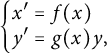

Let K be a differential field of characteristic zero. We fix a universal differential field extensionFootnote
1
U of K and assume that all differential field extensions of K considered in this article are contained in
 $U.$
For any differential field extension M of
 $K,$
the subfield of constants of M is denoted by
 $C_M.$
A generic solution over K of a system of first-order differential equations
 $$ \begin{align} \begin{cases} \begin{aligned} y^{\prime}_1 &= f_1(y_1,\dots, y_n)\\ \vdots\\ y' _n&= f_n(y_1,\dots,y_n),\\ \end{aligned}\end{cases} \end{align} $$
where
 $f_1,\dots ,f_n $
are rational functions in n variables over
 $K,$
is a tuple
 $(y_1, \dots ,y_n)\in U^n$
such that for each
 $i, 1\leq i\leq n, y^{\prime }_i=f_i(y_1, \dots ,y_n)$
and the field transcendence degree
 $\mathrm {tr.deg}(K(y_1,\dots , y_n)|K)=n.$
The system (S) is said to be almost internal to the constants (respectively, internal to the constants) if there are m generic solutions
 $(y_{i1},\dots ,y_{in}), 1\leq i\leq m,$
of (S) such that for every generic solution
 $(y_1,\dots , y_n)$
of (S), there exist constants
 $c_1,\dots , c_l\in C_U$
such that
 $y_1,\dots , y_n$
are algebraic over the field
 $K(\Omega )$
(respectively,
 $y_1,\dots , y_n$
belongs to the field
 $K(\Omega )$
), where
 $\Omega =\{y_{ij},c_p\ | \ 1\leq i\leq m, 1\leq j\leq n, 1\leq p\leq l\}.$
The model-theoretic concept of internality of a system of differential equations is known to be closely related to Kolchin’s strongly normal extensions (see [Reference Poizat12, Section 2.7]), and it has its origin in the works of Rosenlicht [Reference Rosenlicht13, Proposition] and Zilber [Reference Zil’ber14]. In [Reference Jin and Moosa5], Jin and Moosa prove two theorems, which appear as Theorems A and B in their paper, on almost internality of the system of differential equations
 $$ \begin{align} \begin{cases} \begin{aligned} x' &= f(x)\\ y' &= xy,\\ \end{aligned} \end{cases} \end{align} $$
where f is a rational function in one variable. In Theorems 4 and 5 of this article, we generalize and extend both these results of Jin and Moosa. In particular, Theorem 4 completely answers the question of when the system (L) is almost internal to the constants, given that
 $x'=f(x)$
is internal to the constants.
Proposition 1 Let
 $$ \begin{align*} \begin{cases} \begin{aligned} x' &= f(x,y)\\ y' &= g(x,y)\\ \end{aligned} \end{cases} \end{align*} $$
be a system almost internal to the constants. Then, there exists a finitely generated differential field extension M of K such that for any generic solution
 $(x,y)$
over M of the system,Footnote
2
the differential field
 $M(x,y)$
contains two M-algebraically independent constants. Furthermore, if N is a differential field intermediate to
 $M(x,y)$
and M with
 $\mathrm {tr. deg}(N|M)=1,$
then
 $\mathrm {tr. deg}(C_N|C_M)=1.$
Proof Since the system is almost internal to the constants, there are generic solutions
 $(x_1,y_1),\dots , (x_m,y_m)$
over K of the system such that for any generic solution
 $(x,y)$
of the system over
 $M:=K(x_1,y_1,\dots , x_m,y_m),$
there are constants
 $c_1,\dots ,c_l$
such that x and y are algebraic over
 $M(c_1,\dots , c_l).$
We now show that
 $M(x,y)$
contains two M-algebraically independent constants. Let
 $c_1,\dots , c_r$
be an M-transcendence basis of constants for
 $M(c_1,\dots , c_l).$
Since
 $\mathrm {tr.deg}(M(c_1,\dots , c_l,x,y)|M)=r,$
we must have
 $\mathrm {tr.deg}(M(c_1,\dots , c_l,x,y)| M(x,y))=r-2.$
Therefore, there is a nonzero polynomial
 $P\in M(x,y)[X_1,\dots ,X_r]$
such that
 $P(c_1,\dots , c_r)=0.$
Since
 $c_1,\dots ,c_r$
are constants, it follows that such a polynomial P must belong to
 $C_{M(x,y)}[X_1,\dots ,X_r]$
[Reference Kolchin6, Section 14, Theorem 2]. As
 $\mathrm {tr.deg}(M(c_1,\dots ,c_l)|M)=r,$
it also follows that one of the coefficients of P must be a constant nonalgebraic over
 $M.$
If we call this constant
 $u_1$
and replace M by
 $M(u_1),$
then a similar argument shows the existence of another constant
 $u_2\in M(x,y),$
which is nonalgebraic over
 $M(u_1).$
Observe that either
 $u_1$
or
 $u_2$
must belong to
 $M(x,y)\setminus M(x).$
Let N be a differential field intermediate to
 $M(x,y)$
and M. Since
 $\mathrm {tr. deg}(N|M)=1,$
there is a nonzero polynomial
 $P\in C_N[X_1,X_2]$
such that
 $P(u_1,u_2)=0.$
Again, by the same argument as above, there is a constant
 $v\in N$
which is not algebraic over
 $M.$
Theorem 2 Let f be a rational function in one variable over
 $K.$
The equation
 $x'=f(x)$
is internal to the constants if and only if
 $f(x)=a_2x^2+a_1x+a_0,$
where
 $a_0,a_1, a_2\in K.$
Proof Let
 $x'=f(x)$
be internal to the constants. Then, there are generic solutions
 $x_1,\dots ,x_m$
over K such that for any generic solution x over
 $M:=K(x_1,\dots ,x_m),$
there are constants
 $c_1,\dots , c_l$
such that
 $x\in M(c_1,\dots , c_l)$
. From [Reference Kolchin7, Chapter 2, Corollary 2], we know that
 $M(x)$
is generated over M as a field by a set of constants. Therefore, we may assume that
 $M(x)=M(c_1,\dots ,c_l).$
We first claim that there exists an algebraic extension
 $\tilde {M}$
of M such that
 $\tilde {M}(x)=\tilde {M}(c)$
for some constant c.
Note that
 $C_{M(x)}$
and M are linearly disjoint over
 $C_M$
[Reference Kolchin7, Chapter 2, Corollary 1]. Therefore,
 $C_M(c_1,\dots , c_l)$
and M are linearly disjoint over
 $C_M.$
Since
 $M(c_1,\dots ,c_l)=M(x),$
we have
 $\mathrm {tr.deg}(M(c_1,\dots ,c_l)|M)=1$
and from linear disjointness, we obtain
 $\mathrm {tr.deg}(C_M(c_1,\dots , c_l)|C_M)=1.$
Now since
 $M(c_1,\dots ,c_l)=M(x)$
is a rational function field, there is a finite algebraic extension
 $\tilde {C}_M$
of
 $C_M$
such that
 $\tilde {C}_M(c_1,\dots , c_l)=\tilde {C}_M(c)$
[Reference Chevalley1, Theorem 5]. Any extension of a zero derivation on a field to its algebraic closure is again a zero derivation. Therefore, c must also be a constant. Let
 $\tilde {M}:=M\tilde {C}_M$
and observe that
 $$ \begin{align*}\tilde{M}(x)=\tilde{M}(c_1,\dots,c_l)=\tilde{M}(c).\end{align*} $$
This proves the claim.
Since
 $\tilde {M}(x)=\tilde {M}(c),$
there exists
 $\alpha ,\beta ,\gamma , \delta \in \tilde {M}$
with
 $\alpha \delta -\beta \gamma \neq 0$
such that
 $$ \begin{align*}c=\frac{\alpha x+\beta}{\gamma x+\delta}.\end{align*} $$
A simple calculation shows that
 $f(x)=x'=a_2x^2+a_1x+a_0$
for some
 $a_0,a_1,a_2\in \tilde {M}.$
Now since
 $f\in K(x),$
we obtain that
 $a_0, a_1, a_2\in K.$
To prove the converse, let
 $x, x_1,x_2,x_3$
be distinct generic solutions of
 $x'=a_2x^2+a_1x+a_0$
over
 $K.$
It is observed in [Reference Nagloo11, p. 102] that
 $$ \begin{align*}c:=\frac{(x-x_2)(x_3-x_1)}{(x-x_1)(x_3-x_2)}\end{align*} $$
is a constant.Footnote 3 Since
 $$ \begin{align*}x=\frac{x_2(x_3 - x_1) + c x_1(x_2 - x_3)}{(x_3 - x_1) + c (x_2 - x_3)},\end{align*} $$
we now obtain
 $x\in K(x_1, x_2, x_3,c).$
This proves that the equation
 $x'=a_2x^2+a_1x+a_0$
is internal to the constants.
Remark 3 We note here that a particular case of Theorem 2 can be derived from certain recent results [Reference Jaoui and Moosa4, Reference Kumbhakar, Roy and Srinivasan8]. Suppose that K is an algebraically closed field and that the equation
 $x'=f(x)$
is both internal to the constants and weakly orthogonal to the constants.Footnote
4
Then, it is known that the binding group of the equation
 $x'=f(x)$
is a linear algebraic group. Therefore, one can apply [Reference Jaoui and Moosa4, Proposition 6.5] and conclude that
 $K(x)=K(y),$
where
 $y'=ay^2+by+c$
for some
 $a,b,c\in K.$
Writing
 $$ \begin{align*}x=\frac{\alpha y+\beta}{\gamma y+\delta},\end{align*} $$
where
 $ \alpha , \beta , \gamma , \delta \in K$
with
 $\alpha \delta -\beta \gamma \neq 0,$
and taking derivatives, we obtain the conclusion of Theorem 2 that f is a polynomial over K of degree at most
 $2.$
The conditions that
 $x'=f(x)$
is both internal to the constants and weakly orthogonal to the constants imply that the differential field
 $K(x)$
can be embedded in a strongly normal extension of
 $K.$
Now, applying [Reference Kumbhakar, Roy and Srinivasan8, Theorem 1.1(iii)], we obtain that f is a polynomial over K of degree at most
 $2.$
Thus, Theorem 2 provides a generalization of these results, as it requires neither that
 $x'=f(x)$
be weakly orthogonal to the constants nor that K be an algebraically closed field.
Under the assumption that
 $x'=f(x)$
is internal to the constants with the binding group not of dimension
 $3,$
it is shown in [Reference Jin and Moosa5, Theorem A] that the system (L) is almost internal to the constants if and only if it splits; which implies that the system can be transformed into a system of the form
 $$ \begin{align*}\begin{cases} \begin{aligned} x' &= f(x)\\ y' &= ay,\\ \end{aligned} \end{cases}\end{align*} $$
where
 $a\in K.$
In the next theorem, using Theorem 2 and Proposition 1 and without any assumption on the binding group of
 $x'=f(x)$
, we shall completely determine when the system (L) is almost internal to the constants.
Theorem 4 Let K be a differential field and f be a nonzero rational function in one variable over K. The system (L) is almost internal to the constants and
 $x'=f(x)$
is internal to the constants if and only if
 $f(x)=a_2x^2+a_1x+a_0,$
where
 $a_0,a_1\in K$
and
 $a_2$
is a nonzero rational number.
Proof We know from Theorem 2 that
 $f(x)=a_2x^2+a_1x+a_0,$
where
 $a_0, a_1, a_2\in K.$
Suppose that the system (L) is almost internal to the constants. By Proposition 1, there exists a differential field extension M of K such that for any generic solution
 $(x,y)$
over
 $M,$
the differential field
 $M(x,y)$
contains two M-algebraically independent constants. Then,
 $M(x,y)$
contains a constant which is not in
 $M(x)$
and therefore the latter must contain an element z such that
 $z'=nxz$
for some positive integer n [Reference Magid10, Example 1.11]. Let
 $z=P/Q,$
where
 $P, Q\in M[x].$
We can assume that P and Q are relatively prime and Q is monic. Write
 $P=\alpha _px^p+\alpha _{p-1}x^{p-1}+\cdots , Q=x^q+b_{q-1}x^{q-1}+\cdots \in M[x]$
with
 $\alpha _p\neq 0.$
Then,
 $$ \begin{align*}P'Q-Q'P=nxPQ\end{align*} $$
and we obtain
 $(p-q)a_2=n.$
Since
 $n\neq 0, a_2=n/(p-q)$
is a nonzero rational number.
For the converse, suppose that
 $f(x)=a_2x^2+a_1x+a_0,$
where
 $a_0, a_1\in K$
and
 $a_2=m_1/m_2, (m_1, m_2)\in \mathbb Z^2$
a nonzero rational number. Let
 $(x,y)$
be a generic solution of the system (L). We shall now find generic solutions
 $(x_1,y_1)$
and
 $(x_2, y_2)$
of the system and constants
 $c_1,c_2$
so that
 $x,y$
are algebraic over the field
 $K(y_1,x_1,y_2,x_2,c_1,c_2).$
This will then complete the proof of the theorem.
Let v be an element algebraic over the field
 $K(x,y)$
satisfying
 $v^{m_2}=y^{-m_1}.$
Then,
 $v'=-a_2x v, (a_2x)'=a_2x'=(a_2x)^2+a_1(a_2x)+a_2a_0$
and
 $v"=a_1v'-a_2a_0v.$
Consider the rational function field
 $K(v,v')(v_1,v^{\prime }_1,v_2,v^{\prime }_2)$
and extend the derivation on
 $K(v,v')$
to
 $K(v,v')(v_1,v_2,v^{\prime }_1,v^{\prime }_2)$
by declaring
 $v^{\prime \prime }_1=a_1v^{\prime }_1-a_2a_0v_1$
and
 $v^{\prime \prime }_2=a_1v^{\prime }_2-a_2a_0v_2$
. Let
 $N=K(v_1,v^{\prime }_1,v_2,v^{\prime }_2).$
Note that
 $v_1,v_2$
are
 $C_U$
-linearly independent and that the Wronskian of
 $v, v_1, v_2$
is zero. Therefore,
 $v=c_1v_1+c_2v_2,$
for some constants
 $c_1,c_2.$
This implies that
 $v\in N(c_1,c_2)$
and since
 $a_2x=-v'/v\in N(c_1,c_2),$
we obtain that
 $x\in N(c_1,c_2).$
Let
 $y_1$
and
 $y_2$
be elements algebraic over the field N such that
 $v^{m_2}_1=y^{-m_1}_1$
and
 $v^{m_2}_2=y^{-m_1}_2.$
Let
 $x_1:=-v^{\prime }_1/a_2v_1$
and
 $x_2:=-v^{\prime }_2/a_2v_2.$
Then, it is easy to see that
 $(x_1,y_1)$
and
 $(x_2,y_2)$
are generic solutions of the system (L). Now we consider the field
 $K(y_1,x_1,y_2,x_2,c_1,c_2).$
Clearly,
 $v_1$
and
 $v_2$
are algebraic over
 $K(y_1,x_1,y_2,x_2,c_1,c_2)$
and since
 $v=c_1v_1+c_2v_2,$
we obtain that v is also algebraic over
 $K(y_1,x_1,y_2,x_2,c_1,c_2).$
Since
 $x=-v'/a_2v,$
we obtain that x is algebraic over
 $K(y_1,x_1,y_2,x_2,c_1,c_2).$
Finally,
 $v^{m_2}=y^{-m_1}$
implies that y is algebraic over
 $K(y_1,x_1,y_2,x_2,c_1,c_2).$
Theorem 5 Let C be an algebraically closed differential field with zero derivation, and
 $f,g$
be two nonzero rational functions in one variable over
 $C.$
The system
 $$ \begin{align} \begin{cases} \begin{aligned} x' &= f(x)\\ y' &= g(x)y\\ \end{aligned} \end{cases} \end{align} $$
is almost internal to the constants if and only if the following two conditions hold:
-
(1)
 $\frac {1}{f(x)}=\frac {\partial u}{\partial x}$
or
$\frac {1}{f(x)}=\frac {c}{u}\frac {\partial u}{\partial x}$
for some
$c\in C\setminus 0$
and
$u\in C(x).$
-
(2)
$\frac {b+mg(x)}{f(x)}=\frac {1}{v}\frac {\partial v}{\partial x}$
for some integer
$m\in \mathbb Z, b\in C$
and
$v\in C(x).$


Proof Let
 $(x,y)$
be a generic solution of the system (A) and
 $F=C(x,y).$
We first make the following observations. Let
 $z\in F\setminus C$
such that
 $z'=0.$
Then,
 $z\notin C(x);$
otherwise,
 $f(x)\frac {\partial z}{\partial x}=0,$
which is a contradiction. Therefore,
 $z\in F\setminus C(x).$
As noted in the proof of Theorem 4, there exists a positive integer m and an element
 $v\in C(x)$
such that
 $v'=mg(x)v.$
Therefore,
 $f(x)\frac {\partial v}{\partial x}=mg(x)v$
and we obtain
 $$ \begin{align*}\frac{mg(x)}{f(x)}=\frac{1}{v}\frac{\partial v}{\partial x}.\end{align*} $$
Thus, if
 $z\in F\setminus C$
such that
 $z'=0$
then
 $z\in F\setminus C(x)$
, and in that case, the condition (2) holds with
 $b=0$
.
Along with these observations, we suppose that the system (A) is almost internal to the constants. Then, by Proposition 1, there exists a differential field extension M of C such that
 $M(x,y)$
contains two M-algebraically independent constants. Furthermore, since
 $M(x)$
is a differential subfield of
 $M(x,y)$
with
 $\mathrm {tr. deg}(M(x)|M)=1,$
it follows that
 $\mathrm {tr. deg}(C_{M(x)}|C_M)=1.$
By [Reference Rosenlicht13, Proposition],
 $C(x)$
contains an element u such that either
 $u'=1$
or
 $u'=cu$
for some nonzero
 $c\in C.$
Then,
 $\frac {1}{f(x)}$
is either
 $\frac {\partial u}{\partial x}$
or
 $\frac {1}{f(x)}=\frac {c}{u}\frac {\partial u}{\partial x}.$
This implies that condition (1) holds.
To prove that condition (2) also holds, we consider the following two cases. Suppose that
 $C_F\neq C$
. Then, by the observation made in the first paragraph, the condition (2) holds. Now suppose that
 $C_F=C.$
Since there exists a differential field M such that M and F are free over C and
 $MF$
contains two M-algebraically independent constants, by [Reference Kumbhakar and Srinivasan9, Proposition 4.2], there is a differential field L intermediate to C and F such that
 $\mathrm {tr. deg}(L|C)=2$
and L can be embedded in a strongly normal extension of
 $C.$
Since L is contained in the purely transcendental extension
 $C(x,y),$
by [Reference Kumbhakar and Srinivasan9, Theorem 1.2], L can be embedded in a Picard–Vessiot extension of
 $C.$
Footnote
5
The differential Galois group of any Picard–Vessiot extension of C is a connected commutative linear algebraic group over C. Therefore, by the fundamental theorem of differential Galois theory, L must also be a Picard–Vessiot extension of C with a differential Galois group isomorphic to
 $\mathbb {G}_a\times \mathbb {G}_m$
or
 $\mathbb {G}_m\times \mathbb {G}_m.$
This implies that
 $L=C(\alpha , \beta )$
where
 $\alpha , \beta $
are C-algebraically independent,
 $\beta '=c_2\beta $
for some nonzero
 $c_2\in C$
and either
 $\alpha '=1$
or
 $\alpha '=c_1\alpha $
for some nonzero
 $c_1\in C.$
Consequently, there exists an element
 $\zeta \in C(x,y)$
such that
 $\zeta '= a\zeta $
for some nonzero
 $a\in C.$
By the Kolchin–Ostrowski theorem, there exist integers
 $m,n$
such that
 $h:=y^m\zeta ^n\in C(x).$
Then,
 $$ \begin{align*}h'=f(x)\frac{\partial h}{\partial x}=my^m\zeta^ng(x)+nay^m\zeta^n.\end{align*} $$
From the above equation, we obtain
 $$ \begin{align*}\frac{mg(x)+b}{f(x)}=\frac{1}{h(x)}\frac{\partial h}{\partial x}, \quad na=:b\in C.\end{align*} $$
Thus, we have shown that the condition (2) holds in both cases.
To prove the converse, let
 $(x,y)$
be a generic solution of the system (A). From conditions (1) and (2), we obtain that
 $C(x)$
contains an element s such that
 $s'=1$
or
 $s'=cs$
for some nonzero
 $c\in C$
and that there is an element
 $t\in C(x,y)\setminus C(x)$
such that
 $t'=bt$
for some
 $d\in C.$
Note that
 $s=u$
and
 $t=y^m/v.$
Now let
 $(x_1,y_1)$
be another generic solution of the system (A). Consider the differential C-isomorphism
 $\phi :C(x,y)\rightarrow C(x_1,y_1),$
where
 $\phi (x)=x_1$
and
 $\phi (y)=y_1.$
Let
 $c_2:=t/\phi (t).$
If
 $s'=1,$
then let
 $c_1:=s-\phi (s)$
and if
 $s'=cs,$
then let
 $c_1:=s/\phi (s).$
In any event, note that
 $c_1, c_2$
are constants and that
 $s,t\in C(x_1,y_1,c_1,c_2).$
Since
 $x,y$
are algebraic over
 $C(s,t),$
they are also algebraic over
 $C(x_1,y_1,c_1,c_2)$
. This shows that the system (A) is almost internal to the constants.
We conclude this article with the following observations. When
 $g(x)=x,$
we recover Theorem B of [Reference Jin and Moosa5]. The nonorthogonality of the system (A), under the assumption that
 $x'=f(x)$
is orthogonal to the constants, has been examined in [Reference Jaoui, Jimenez and Pillay3, Corollary 5.5]. Interestingly, the condition (2) of Theorem 5 also appears in their result.
Acknowledgements
We thank the anonymous referee of this article for various helpful suggestions and references.



