








1 Introduction
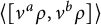
In this note, we present a further step in our investigation of induced representations of the form
$\langle [ \nu ^{a} \rho , \nu ^{b} \rho ] \rangle \rtimes \sigma $
 , where
$\langle [ \nu ^{a} \rho , \nu ^{b} \rho ] \rangle $
 stands for the Zelevinsky segment representation of the general linear group attached to the segment
$[\nu ^{a} \rho , \nu ^{b} \rho ]$
 , and
$\sigma $
 denotes a discrete series of either symplectic or special odd orthogonal group over a non-Archimedean field of characteristic zero. A key step in the determination of the composition factors of
$\langle [ \nu ^{a} \rho , \nu ^{b} \rho ] \rangle \rtimes \sigma $
 , obtained for half-integral a in [Reference Matić11], is to understand the irreducible tempered subquotients. This task appears to be more complicated in the integral case than in the half-integral one, and we show how this difficulty can be overcome under the assumption that
$\sigma $
 is strongly positive. This enables us to complete an explicit description of the composition factors of
$\langle [ \nu ^{a} \rho , \nu ^{b} \rho ] \rangle \rtimes \sigma $
 , for a strongly positive discrete series
$\sigma $
 . Note that the strongly positive discrete series serves as a cornerstone in discrete series classification [Reference Kim and Matić7, Reference Mœglin13, Reference Mœglin and Tadić15], while the Zelevinsky segment representation plays an important role in the classification of unitary representations [Reference Tadić17].
Reducibility criterion, provided in [Reference Matić10], reduces the determination of the composition factors for
$\langle [ \nu ^{a} \rho , \nu ^{b} \rho ] \rangle \rtimes \sigma $
 to the case
$2a \in \mathbb {Z}$
 and self-contragredient
$\rho $
 . The case of half-integral a is a particular instance of the results of [Reference Matić11], while the case
$a> 0$
 follows from [Reference Bošnjak2]. This reduces our determination to case
$a \in \mathbb {Z}$
 ,
$a < 0$
 ,
$a+b \geq 0$
 , and
$\rho \cong \widetilde {\rho }$
 .
We use several advantages of the strongly positive case. First is the knowledge of the Jacquet modules and embeddings of such representations [Reference Matić9, Reference Matić and Tadić12], which enables one to use the structural formula and reduce to the cuspidal case, in certain situations. Second one is a complete description of the composition factors for the generalized principal series in the strongly positive case [Reference Muić16], enabling one to obtain useful embeddings of potential subquotients.
In Section 2, we introduce the notations and summarize the required preliminaries. In Section 3, we provide a complete description of the composition factors for the induced representation of the studied type.
2 Preliminaries
Let F stand for a non-Archimedean local field of characteristic zero. By
$J_{n} = (\delta _{i, n+1-j})_{1 \leq i,j \leq n}$
 , we denote the
$n \times n$
 matrix, where
$\delta _{i, n+1-j}$
 stands for the Kronecker symbol. For a square matrix g, we denote by
$g^{t}$
 its transposed matrix, and by
$g^{\tau }$
 its transposed matrix with respect to the second diagonal. In what follows, we fix one of the series of classical groups

or

and denote by
$G_{n}$
 the rank n group belonging to the series which we fixed.
The set of standard parabolic subgroups will be fixed in a usual way, that is, we fix a minimal F-parabolic subgroup in
$G_{n}$
 consisting of upper triangular matrices in the usual matrix realization. Then, the Levi factors of standard parabolic subgroups have the form
$M \cong GL(m_{1}, F) \times \cdots \times GL(m_{k}, F) \times G_{m'}$
 , where
$GL(m, F)$
 stands for the general linear group of rank m over F. If
$\delta _{i}$
 is a representation of
$GL(m_{i}, F)$
 and
$\tau $
 is a representation of
$G_{m'}$
 , the normalized parabolically induced representation Ind
$_{M}^{G_{n}}(\delta _{1} \otimes \cdots \otimes \delta _{k} \otimes \tau )$
 will be denoted by
$\delta _{1} \times \cdots \times \delta _{k} \rtimes \tau $
 . We use a similar notation to denote a parabolically induced representation of
$GL(m, F)$
 .
By
$\mathop {\text {Irr}}(G_{n})$
 , we denote the set of all irreducible admissible representations of
$G_{n}$
 . Let
$R(G_{n})$
 denote the Grothendieck group of admissible representations of finite length of
$G_{n}$
 and define
$R(G) = \oplus _{n \geq 0} R(G_{n})$
 . In a similar way, we define
$\mathop {\text {Irr}}(GL(n, F))$
 ,
$R(GL(n, F))$
 , and
$R(GL) = \oplus _{n \geq 0} R(GL(n, F))$
 .
For
$\sigma \in \mathop {\text {Irr}}(G_{n})$
 and
$0 \leq k \leq n$
 , we denote by
$r_{(k)}(\sigma )$
 the normalized Jacquet module of
$\sigma $
 with respect to the parabolic subgroup
$P_{(k)}$
 having the Levi subgroup equal to
$GL(k, F) \times G_{n-k}$
 . We identify
$r_{(k)}(\sigma )$
 with its semisimplification in
$R(GL(k,F)) \otimes R(G_{n-k})$
 and consider

Let
$\nu $
 stand for a composition of the determinant mapping with the normalized absolute value on F. Let
$\rho \in R(GL)$
 denote an irreducible supercuspidal representation. By a segment, we mean a set of the form
$[\rho , \nu ^{k} \rho ] := \{ \rho , \nu \rho , \ldots , \nu ^{k} \rho \}$
 , where k is a nonnegative integer. The induced representation
$\nu ^{k} \rho \times \nu ^{k-1} \rho \times \cdots \times \rho $
 has a unique irreducible subrepresentation, denoted by
$\delta ([\rho , \nu ^{k} \rho ])$
 , which is essentially square-integrable. By [Reference Zelevinsky20], every irreducible essentially square-integrable representation in
$R(GL)$
 can be obtained in this way.
The induced representation
$\rho \times \nu \rho \times \cdots \times \nu ^k \rho $
 has a unique irreducible subrepresentation, which is denoted by
$\langle [\rho , \nu ^{k} \rho ] \rangle $
 , and called the Zelevinsky segment representation attached to segment
$[\rho , \nu ^{k} \rho ]$
 .
Let us recall the structural formulas, obtained in [Reference Hanzer and Muić5, Theorem 1.4] and in [Reference Tadić18, Theorems 5.4 and 6.5].
Theorem 2.1 Let
$\rho \in R(GL)$
 denote an irreducible cuspidal representation and
$k, l \in \mathbb {R}$
 such that
$k+l$
 is a nonnegative integer. Let
$\sigma \in R(G)$
 denote an irreducible admissible representation of finite length. Write
$\mu ^{\ast }(\sigma ) = \sum _{\pi , \sigma '} \pi \otimes \sigma '$
 . Then, we have

We omit
$\langle [\nu ^{x} \rho , \nu ^{y} \rho ] \rangle $
 and
$\delta ([\nu ^{x} \rho , \nu ^{y} \rho ])$
 if
$x> y$
 .
Let
$\delta \in \mathrm{Irr}(R(GL))$
 denote an irreducible essentially square-integrable representation. Then, there is a unique
$e(\delta ) \in \mathbb {R}$
 such that
$\nu ^{-e(\delta )} \delta $
 is unitarizable [Reference Zelevinsky20]. We use the subrepresentation version of the Langlands classification for classical groups and realize a non-tempered irreducible representation
$\pi $
 of
$G_{n}$
 as the unique irreducible (Langlands) subrepresentation of an induced representation of the form
$\delta _{1} \times \delta _{2} \times \cdots \times \delta _{k} \rtimes \tau $
 , where
$\tau $
 is an irreducible tempered representation of some
$G_{t}$
 , and
$\delta _1, \delta _2, \ldots , \delta _k \in R(GL)$
 are irreducible essentially square-integrable representations such that
$e(\delta _1) \leq e(\delta _2) \leq \cdots \leq e(\delta _k) < 0$
 . We write
$\pi = L(\delta _{1}, \delta _{2}, \ldots , \delta _{k}; \tau )$
 .
According to the Mœglin–Tadić classification of discrete series [Reference Mœglin13, Reference Mœglin and Tadić15] (which is now known to hold unconditionally, due to [Reference Arthur1], [Reference Gan and Lomelí3, Theorem 7.8], and [Reference Mœglin14, Théorème 3.1.1]), a discrete series
$\sigma \in G_n$
 corresponds to an admissible triple consisting of the Jordan block, the partial cuspidal support, and the
$\epsilon $
 -function. For more details on these invariants, we refer the reader to [Reference Mœglin and Tadić15], or to [Reference Kim and Matić7], where a slightly different approach has been used. For a discrete series
$\sigma $
 , we denote the corresponding admissible triple by
$(\mathop {\text {Jord}}(\sigma ), \sigma _{c}, \epsilon _{\sigma })$
 . For an irreducible self-contragredient cuspidal representation
$\rho _1$
 of
$GL(n_1, F)$
 , let
$\mathop {\text {Jord}}_{\rho _1}(\sigma ) = \{ x : (x, \rho _1) \in \mathop {\text {Jord}}(\sigma ) \}$
 . If
$\mathop {\text {Jord}}_{\rho _1}(\sigma ) \neq \emptyset $
 and
$x \in \mathop {\text {Jord}}_{\rho _1}(\sigma )$
 , denote
$x\_ = \max \{ y \in \mathop {\text {Jord}}_{\rho _1}(\sigma ): y < x \}$
 , if it exists.
Discrete series
$\sigma \in R(G)$
 is called strongly positive if for every embedding

where
$\rho _{i} \in R$
 ,
$i = 1, 2, \ldots , k$
 , are irreducible cuspidal unitary representations, we have
$s_{i}> 0$
 for
$i = 1, 2, \ldots , k$
 .
Strongly positive discrete series
$\sigma $
 corresponds to an alternated triple, that is, we have
$\epsilon _{\sigma }((x\_, \rho _1), (x, \rho _1)) = -1$
 , for every
$(x, \rho _1) \in \mathop {\text {Jord}}(\sigma )$
 such that
$x\_$
 is defined. We also provide an inductive description of strongly positive discrete series, which follows from [Reference Matić8, Theorem 1.2].
Proposition 2.2 Suppose that
$\sigma $
 is a strongly positive discrete series and let
$\rho $
 denote an irreducible cuspidal unitary representation such that some twist of
$\rho $
 appears in the cuspidal support of
$\sigma $
 . Then, there exist unique
$c, d \in \mathbb {R}$
 such that
$c> 0$
 ,
$d - c \in \mathbb {Z}_{\geq 0}$
 , and the unique strongly positive discrete series
$\sigma _1$
 without
$\nu ^{c} \rho $
 in the cuspidal support, with the property that
$\sigma $
 is the unique irreducible subrepresentation of
$\delta ([\nu ^{c} \rho , \nu ^{d} \rho ]) \rtimes \sigma _1$
 . Furthermore, there is a unique nonnegative integer l such that
$c + l = \alpha $
 , for
$\alpha> 0$
 such that
$\nu ^{\alpha } \rho \rtimes \sigma _{c}$
 reduces. If
$l = 0$
 , there are no twists of
$\rho $
 appearing in the cuspidal support of
$\sigma _1$
 , and if
$l> 0$
 , there exist unique
$d'> d$
 and a unique strongly positive discrete series
$\sigma _2$
 , which contains neither
$\nu ^{c} \rho $
 nor
$\nu ^{c+1} \rho $
 in its cuspidal support, such that
$\sigma _1$
 is a unique irreducible subrepresentation of
$\delta ([\nu ^{c+1} \rho , \nu ^{d'} \rho ]) \rtimes \sigma _2$
 .
Throughout the rest of the article, we fix a strongly positive discrete series
$\sigma $
 and an irreducible supercuspidal self-contragredient representation
$\rho $
 . Let
$\alpha \geq 0$
 be such that
$\nu ^\alpha \rho \rtimes \sigma _c$
 reduces. We assume that
$\alpha $
 is an integer and fix integers a and b such that
$a \leq 0$
 and
$a + b \geq 0$
 (note that, in
$R(G)$
 , we have
$\langle [ \nu ^{a} \rho , \nu ^{b} \rho ] \rangle \rtimes \sigma = \langle [ \nu ^{-b} \rho , \nu ^{-a} \rho ] \rangle \rtimes \sigma $
 ).
3 Composition factors
In this section, we describe the composition factors of
$\langle [\nu ^a \rho , \nu ^b \rho ] \rangle \rtimes \sigma $
 , after a certain amount of the preparation work.
Lemma 3.1 If
$a \leq -1$
 , then the induced representation
$\langle [ \nu ^{a} \rho , \nu ^{b} \rho ] \rangle \rtimes \sigma $
 does not contain an irreducible tempered subquotient.
Proof Suppose, on the contrary, that there is an irreducible tempered subquotient
$\tau $
 of
$\langle [ \nu ^{a} \rho , \nu ^{b} \rho ] \rangle \rtimes \sigma $
 . Inspecting its cuspidal support, we deduce that
$\tau $
 is not strongly positive, and it is easy to see that
$\tau $
 can be written as a subrepresentation of an induced representation of the form
$\delta ([\nu ^{x} \rho , \nu ^y \rho ]) \rtimes \tau '$
 , where
$x \leq 0, y \geq 0$
 ,
$x+y \geq 0$
 , and
$\tau '$
 is irreducible tempered. Using the Frobenius reciprocity, we obtain
$\mu ^{\ast }(\langle [ \nu ^{a} \rho , \nu ^{b} \rho ] \rangle \rtimes \sigma ) \geq \delta ([\nu ^{x} \rho , \nu ^y \rho ]) \otimes \tau '$
 , and Theorem 2.1 implies that there are
$0 \leq j \leq i \leq b-a+1$
 and an irreducible constituent
$\pi \otimes \sigma '$
 of
$\mu ^{\ast }(\sigma )$
 such that

Using the same reasoning as in the proof of [Reference Matić11, Theorem 3.9], we conclude that
$\rho $
 appears in the cuspidal support of
$\pi $
 , which contradicts [Reference Matić9, Theorem 5.3] (or [Reference Matić and Tadić12, Section 7]).
The following proposition can be proved in the same way as [Reference Matić11, Proposition 4.1].
Proposition 3.2 Suppose that
$L(\delta _1, \delta _2, \ldots , \delta _k; \tau )$
 is an irreducible non-tempered subquotient of
$\langle [ \nu ^{a} \rho , \nu ^{b} \rho ] \rangle \rtimes \sigma $
 , and let
$\delta _i \cong \delta ([ \nu ^{a_i} \rho _i, \nu ^{b_i} \rho _i ])$
 for
$i = 1, 2, \ldots , k$
 . Then, for all
$i = 1, 2, \ldots , k$
 , we have
$\rho _i \cong \rho $
 and
$b_i - a_i \in \{ 0, 1 \}$
 .
Proposition 3.3 Suppose that
$L(\delta _1, \delta _2, \ldots , \delta _k; \tau )$
 is an irreducible non-tempered subquotient of
$\langle [ \nu ^{a} \rho , \nu ^{b} \rho ] \rangle \rtimes \sigma $
 , and let
$\delta _i \cong \delta ([ \nu ^{a_i} \rho _i, \nu ^{b_i} \rho _i ])$
 for
$i = 1, 2, \ldots , k$
 . Suppose that there is a
$j \in \{ 1, 2, \ldots , k \}$
 such that
$b_j - a_j = 1$
 , and let
$l = a+b$
 . Then, the following holds:
-
(1) $-a < b$
 ,
$a_l = b_l -1$
and for
$i < l$
, we have
$a_i = b_i = -b+i-1$
;
-
(2) if there is a $j' \in \{ j+1, j+2, \ldots , k \}$
such that
$b_{j'} - a_{j'} = 1$
, then
$b_i - a_i = 1$
for all
$i \in \{ j+1, j+2, \ldots , j' - 1\}$
; -
(3) either $\tau \cong \sigma $
or there is an integer x,
$1 \leq x \leq -a$
, such that
$\langle [ \rho , \nu ^{x} \rho ] \rangle \rtimes \sigma $
contains an irreducible tempered subquotient; -
(4) if $\tau \cong \sigma $
, then
$a_k = -1$
,
$b_k = 0$
, and
$\langle [ \rho , \nu \rho ] \rangle \rtimes \sigma $
contains
$L(\delta ([\nu ^{-1} \rho , \rho ]); \sigma )$
.


Proof The proof closely follows that of [Reference Matić11, Proposition 4.2]. We restrict our attention to the main differences.
Let
$i \in \{ 1, 2, \ldots , k \}$
 be such that
$b_i - a_i = 1$
 . Following the same lines as in the proof of [Reference Matić11, Proposition 4.2], we deduce that there is a c such that
$1 \leq c \leq -a+1$
 ,
$a_i = -c$
 ,
$L(\delta _{i}, \ldots , \delta _k; \tau )$
 is an irreducible subquotient of
$\langle [ \nu ^{-c+1} \rho , \nu ^{c} \rho ] \rangle \rtimes \sigma $
 , and
$L(\delta _{i+1}, \ldots , \delta _k; \tau )$
 is an irreducible subquotient of
$\langle [ \nu ^{-c+2} \rho , \nu ^{c-1} \rho ] \rangle \rtimes \sigma $
 .
If for all
$j \in \{ i+1, \ldots , k \}$
 , we have
$b_j - a_j = 1$
 , a repeated application of [Reference Matić10, Lemma 2.6] shows that either
$\tau \cong \sigma $
 or there is a
$d \geq 1$
 such that
$\tau $
 is an irreducible subquotient of
$\langle [ \nu ^{-d+1} \rho , \nu ^{d} \rho ] \rangle \rtimes \sigma $
 . If
$\tau \cong \sigma $
 , it follows that
$a_k = -1, b_k = 0$
 , and
$L(\delta ([\nu ^{-1} \rho , \rho ]); \sigma )$
 is an irreducible subquotient of
$\langle [ \rho , \nu \rho ] \rangle \rtimes \sigma $
 . If
$\tau $
 is an irreducible subquotient of
$\langle [ \nu ^{-d+1} \rho , \nu ^{d} \rho ] \rangle \rtimes \sigma $
 , with
$d \geq 1$
 , Lemma 3.1 implies
$d = 1$
 .
Suppose that there is a
$j \in \{ i+1, \ldots , k \}$
 such that
$a_j = b_j$
 . In a completely analogous way as in the proof of [Reference Matić11, Proposition 4.2], we deduce that
$a_t = b_t$
 holds for all
$t \in \{ j, \ldots , k\}$
 , and there are x and y,
$0 \leq -y < x \leq -a$
 , such that
$\tau $
 is an irreducible subquotient of
$\langle [ \nu ^{y} \rho , \nu ^{x} \rho ] \rangle \rtimes \sigma $
 . Lemma 3.1 gives
$y = 0$
 and ends the proof.
Lemma 3.4 Suppose that
$\sigma $
 is a subrepresentation of an induced representation of the form
$\delta ([\nu ^c \rho ', \nu ^d \rho ']) \rtimes \sigma '$
 , where
$(c, \rho ') \neq (1, \rho )$
 and
$\sigma '$
 is irreducible. If
$L(\delta ([\nu ^{-1} \rho , \rho ]); \sigma )$
 is an irreducible subquotient of
$\langle [ \rho , \nu \rho ] \rangle \rtimes \sigma $
 , then
$L(\delta ([\nu ^{-1} \rho , \rho ]); \sigma ')$
 is an irreducible subquotient of
$\langle [ \rho , \nu \rho ] \rangle \rtimes \sigma '$
 .
Proof By [Reference Matić9, Theorem 5.3] or [Reference Matić and Tadić12, Section 7], we have
$c> 0$
 ,
$\sigma '$
 is strongly positive, and
$\delta ([\nu ^c \rho ', \nu ^d \rho ']) \otimes \sigma '$
 is a unique irreducible constituent of
$\mu ^{\ast }(\sigma )$
 of the form
$\delta ([\nu ^c \rho ', \nu ^d \rho ']) \otimes \pi $
 .
If
$\rho ' \cong \rho $
 , then
$c \geq 2$
 . This leads to

Thus,
$L(\delta ([\nu ^{-1} \rho , \rho ]); \sigma )$
 is a subrepresentation of

By [Reference Jantzen6, Lemma 5.5], there is an irreducible subquotient
$\pi $
 of
$\delta ([\nu ^{-1} \rho , \rho ]) \rtimes \sigma '$
 such that
$L(\delta ([\nu ^{-1} \rho , \rho ]); \sigma )$
 is a subrepresentation of
$\delta ([\nu ^c \rho ', \nu ^d \rho ']) \rtimes \pi $
 . By the Frobenius reciprocity,
$\mu ^{\ast }(L(\delta ([\nu ^{-1} \rho , \rho ]); \sigma ))$
 contains
$\delta ([\nu ^{-1} \rho , \rho ]) \otimes \sigma $
 , and it follows that
$\mu ^{\ast }(\delta ([\nu ^c \rho ', \nu ^d \rho ']) \rtimes \pi )$
 also contains
$\delta ([\nu ^{-1} \rho , \rho ]) \otimes \sigma $
 . Now, Theorem 2.1 implies that
$\mu ^{\ast }(\pi )$
 contains an irreducible constituent of the form
$\delta ([\nu ^{-1} \rho , \rho ]) \otimes \pi '$
 . Strong positivity of
$\sigma '$
 implies
$\pi \cong L(\delta ([\nu ^{-1} \rho , \rho ]); \sigma ')$
 , so

From

follows that
$\mu ^{\ast }(\langle [ \rho , \nu \rho ] \rangle \rtimes \sigma )$
 contains
$\delta ([\nu ^c \rho ', \nu ^d \rho ']) \otimes L(\delta ([\nu ^{-1} \rho , \rho ]); \sigma ')$
 .
It is now a direct consequence of Theorem 2.1 that
$L(\delta ([\nu ^{-1} \rho , \rho ]); \sigma ')$
 is an irreducible subquotient of
$\langle [ \rho , \nu \rho ] \rangle \rtimes \sigma '$
 .
Proposition 3.5 The induced representation
$\langle [ \rho , \nu \rho ] \rangle \rtimes \sigma $
 contains the irreducible representation
$L(\delta ([\nu ^{-1} \rho , \rho ]); \sigma )$
 if and only if
$1 \notin \mathop {\text {Jord}}_{\rho }(\sigma )$
 .
Proof We use a case-by-case consideration. Let us first consider the case
$1 \notin \mathop {\text {Jord}}_{\rho }(\sigma )$
 and
$3 \notin \mathop {\text {Jord}}_{\rho }(\sigma )$
 . By [Reference Muić16, Theorem 2.1], in
$R(G)$
 , we have

where
$\sigma ^{(1)}_{ds}$
 and
$\sigma ^{(2)}_{ds}$
 are discrete series subrepresentations of
$\delta [ \rho , \nu \rho ] \rangle \rtimes \sigma $
 .
Since
$\mu ^{\ast }(\sigma )$
 does not contain an irreducible constituent of the form
$\nu \rho \otimes \pi $
 , and
$\rho \rtimes \sigma $
 is a length-two representation, Theorem 2.1 can be used to show that
$\mu ^{\ast }(L(\delta ([\nu ^{-1} \rho , \rho ]); \sigma ))$
 does not contain an irreducible constituent of the form
$\nu \rho \otimes \pi $
 .
By [Reference Muić16, Proposition 3.1], the induced representation
$\nu \rho \rtimes \sigma $
 is irreducible, so we have

By [Reference Jantzen6, Lemma 5.5], there is an irreducible subquotient
$\pi $
 of
$\rho \times \nu \rho $
 such that
$L(\delta ([\nu ^{-1} \rho , \rho ]); \sigma )$
 is a subrepresentation of
$\pi \rtimes \sigma $
 . Since, in
$R(GL)$
 , we have

and
$L(\delta ([\nu ^{-1} \rho , \rho ]); \sigma )$
 is not a subrepresentation of
$\nu \rho \times \rho \rtimes \sigma $
 , we get
$\pi \cong \langle [ \rho , \nu \rho ] \rangle $
 .
Now, we consider the case
$1 \notin \mathop {\text {Jord}}_{\rho }(\sigma )$
 and
$3 \in \mathop {\text {Jord}}_{\rho }(\sigma )$
 . We denote by
$\sigma '$
 a strongly positive discrete series such that
$\sigma $
 is a subrepresentation of
$\nu \rho \rtimes \sigma '$
 . It follows from [Reference Muić16, Theorem 4.1(iii)] that, in
$R(G)$
 , we have

where
$\tau $
 is an irreducible tempered representation, which is a subrepresentation of both
$\delta ([\nu ^{-1} \rho , \nu \rho ]) \rtimes \sigma '$
 and
$\nu \rho \times \nu \rho \times \rho \rtimes \sigma '$
 . We note that
$\rho \rtimes \sigma '$
 is irreducible. It can be seen using Theorem 2.1 and the description of the Jacquet modules of strongly positive discrete series ([Reference Matić9, Theorem 5.3] or [Reference Matić and Tadić12, Section 7]) that
$\nu \rho \times \nu \rho \otimes \rho \rtimes \sigma '$
 is a unique irreducible constituent of the form
$\nu \rho \times \nu \rho \otimes \pi $
 appearing in
$\mu ^{\ast }(\delta [ \rho , \nu \rho ] \rangle \rtimes \sigma )$
 . Consequently,
$\mu ^{\ast }(L(\delta ([\nu ^{-1} \rho , \rho ]); \sigma ))$
 does not contain an irreducible constituent of the form
$\nu \rho \times \nu \rho \otimes \pi $
 .
Since
$\nu \rho \rtimes \sigma $
 is irreducible, we have

We denote by
$\pi $
 an irreducible subquotient of
$\rho \times \nu \rho $
 such that
$L(\delta ([\nu ^{-1} \rho , \rho ]); \sigma )$
 is a subrepresentation of
$\pi \rtimes \sigma $
 .
If
$\pi \cong \delta ([\rho , \nu \rho ])$
 , we have

which is impossible. Thus,
$\pi \cong \langle [ \rho , \nu \rho ] \rangle $
 .
Let us now assume
$1 \in \mathop {\text {Jord}}_{\rho }(\sigma )$
 and
$3 \in \mathop {\text {Jord}}_{\rho }(\sigma )$
 . Then,
$\mu ^{\ast }(\sigma )$
 does not contain an irreducible constituent of the form
$\nu \rho \otimes \pi $
 . Also, in this case,
$\delta ([ \rho , \nu \rho ] ) \rtimes \sigma $
 is irreducible, so

Thus,
$\mu ^{\ast }(L(\delta ([\nu ^{-1} \rho , \rho ]); \sigma ))$
 contains an irreducible constituent of the form
$\nu \rho \otimes \pi '$
 , and it follows that
$L(\delta ([\nu ^{-1} \rho , \rho ]); \sigma )$
 is not an irreducible subquotient of
$\langle [ \rho , \nu \rho ] \rangle \rtimes \sigma $
 .
It remains to consider the case
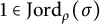
$1 \in \mathop {\text {Jord}}_{\rho }(\sigma )$
 and
$3 \notin \mathop {\text {Jord}}_{\rho }(\sigma )$
 . Note that, in this case,
$\nu \rho $
 does not appear in the cuspidal support of
$\sigma $
 , and there is a positive integer d,
$d \geq 2$
 , such that
$\sigma $
 is a subrepresentation of
$\delta ([\nu ^{2} \rho , \nu ^d \rho ]) \rtimes \sigma '$
 , for a strongly positive discrete series
$\sigma '$
 .
Suppose that
$L(\delta ([\nu ^{-1} \rho , \rho ]); \sigma )$
 is an irreducible subquotient of
$\langle [ \rho , \nu \rho ] \rangle \rtimes \sigma $
 . Using a repeated application of Proposition 2.2 and Lemma 3.4, we obtain that then
$L(\delta ([\nu ^{-1} \rho , \rho ]); \sigma _c)$
 is an irreducible subquotient of
$\langle [ \rho , \nu \rho ] \rangle \rtimes \sigma _c$
 . Thus, it is enough to prove that in this case
$\langle [ \rho , \nu \rho ] \rangle \rtimes \sigma _c$
 does not contain
$L(\delta ([\nu ^{-1} \rho , \rho ]); \sigma _c)$
 .
Note that
$\alpha \geq 1$
 . The case
$\alpha = 1$
 follows directly from [Reference Tadić19, Proposition 3.8], so we comment only case
$\alpha> 1$
 .
For
$\alpha> 1$
 ,
$\delta ([\rho , \nu \rho ]) \rtimes \sigma _c$
 is irreducible by [Reference Muić16, Theorem 4.1(i)], so we have
$L(\delta ([\nu ^{-1} \rho , \rho ]); \sigma _c) \cong \delta ([\rho , \nu \rho ]) \rtimes \sigma _c$
 and
$\mu ^{\ast }(L(\delta ([\nu ^{-1} \rho , \rho ]); \sigma _c)) \geq \nu \rho \otimes \rho \rtimes \sigma _c$
 . Since, by Theorem 2.1,
$\mu ^{\ast }(\langle [ \rho , \nu \rho ] \rangle \rtimes \sigma _c)$
 does not contain
$\nu \rho \otimes \rho \rtimes \sigma _c$
 , we obtain that
$\langle [ \rho , \nu \rho ] \rangle \rtimes \sigma _c$
 does not contain
$L(\delta ([\nu ^{-1} \rho , \rho ]); \sigma _c)$
 .
Now, we complete a determination of irreducible tempered subquotients.
Theorem 3.6 Suppose that
$d \geq 1$
 . The induced representation
$\langle [ \rho , \nu ^{d} \rho ] \rangle \rtimes \sigma $
 contains an irreducible tempered subquotient if and only if
$x \in \mathop {\text {Jord}}_{\rho }(\sigma )$
 for all
$x \in \{ 1, 3, \ldots , 2d-1 \}$
 and
$2d+1 \notin \mathop {\text {Jord}}_{\rho }(\sigma )$
 . If
$\langle [ \rho , \nu ^{d} \rho ] \rangle \rtimes \sigma $
 contains an irreducible tempered subquotient, then it contains a unique irreducible tempered subquotient, which is a subrepresentation.
Proof Let us first show that there are no irreducible tempered subquotients in the case
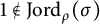
$1 \notin \mathop {\text {Jord}}_{\rho }(\sigma )$
 . Suppose, on the contrary, that
$1 \notin \mathop {\text {Jord}}_{\rho }(\sigma )$
 and there is an irreducible tempered subquotient
$\tau $
 of
$\langle [ \rho , \nu ^{d} \rho ] \rangle \rtimes \sigma $
 . If
$2d+1 \in \mathop {\text {Jord}}_{\rho }(\sigma )$
 , using cuspidal support considerations, similarly as in [Reference Hanzer4, Section 4.2.1], we deduce that
$\tau $
 is a subrepresentation of an induced representation of the form
$\delta ([\nu ^{-d} \rho , \nu ^d \rho ]) \rtimes \sigma _1$
 , where
$\sigma _1$
 is a strongly positive discrete series.
The Frobenius reciprocity implies
$\mu ^{\ast }(\langle [ \rho , \nu ^{d} \rho ] \rangle \rtimes \sigma ) \geq \delta ([\nu ^{-d} \rho , \nu ^d \rho ]) \otimes \sigma _1$
 . Using Theorem 2.1 and [Reference Matić9, Theorem 5.3], we easily get
$d = 1$
 and
$\mu ^{\ast }(\sigma ) \geq \nu \rho \otimes \sigma _1$
 . Consequently,
$1 \in \mathop {\text {Jord}}_{\rho }(\sigma _1)$
 .
Thus,

and [Reference Jantzen6, Lemma 5.5] implies that there is an irreducible subquotient
$\pi $
 of
$\delta ([\rho , \nu \rho ]) \rtimes \sigma _1 = \delta ([\nu ^{-1} \rho , \rho ]) \rtimes \sigma _1$
 such that
$\tau $
 is a subrepresentation of
$\nu \rho \rtimes \pi $
 .
By [Reference Muić16, Theorem 4.1(ii)], in
$R(G)$
 , we have

where
$\tau '$
 is an irreducible tempered subrepresentation of
$\delta ([\rho , \nu \rho ]) \rtimes \sigma _1$
 . If
$\pi \cong \tau '$
 , we have

which is impossible since
$\mu ^{\ast }(\langle [ \rho , \nu \rho ] \rangle \rtimes \sigma )$
 does not contain an irreducible constituent of the form
$\nu \rho \times \nu \rho \otimes \pi '$
 . Thus,
$\pi \cong L(\delta ([\nu ^{-1} \rho , \rho ]); \sigma _1)$
 , and
$\mu ^{\ast }(\langle [ \rho , \nu \rho ] \rangle \rtimes \sigma )$
 contains
$\nu \rho \otimes L(\delta ([\nu ^{-1} \rho , \rho ]); \sigma _1)$
 . Using Theorem 2.1 and [Reference Matić9, Theorem 5.3] again, we obtain
$L(\delta ([\nu ^{-1} \rho , \rho ]); \sigma _1) \leq \langle [ \rho , \nu \rho ] \rangle \rtimes \sigma _1$
 , contradicting Proposition 3.5.
If
$2d+1 \notin \mathop {\text {Jord}}_{\rho }(\sigma )$
 , using cuspidal support considerations, we obtain that
$\tau $
 is a discrete series representation, such that
$\mathop {\text {Jord}}_{\rho }(\tau ) = \mathop {\text {Jord}}_{\rho }(\sigma ) \cup \{ 1, 2d+1 \}$
 . Also,
$\tau $
 is a subrepresentation of an induced representation of the form
$\delta ([\nu ^x \rho , \nu ^y \rho ]) \rtimes \sigma _1$
 , where
$\sigma _1$
 is a strongly positive discrete series,
$x \leq 0$
 ,
$x + y> 0$
 , and in
$\mathop {\text {Jord}}_{\rho }(\tau )$
 , we have
$(2y+1)\_ = -2x+1$
 .
Using the Frobenius reciprocity, together with the transitivity of the Jacquet modules, we deduce
$\mu ^{\ast }(\langle [ \rho , \nu ^{d} \rho ] \rangle \rtimes \sigma ) \geq \delta ([\nu ^x \rho , \nu ^y \rho ]) \otimes \sigma _1$
 . The calculation of Jacquet modules gives
$x \in \{ 0, -1 \}$
 ,
$d = 1$
 if
$x = -1$
 , and
$\mu ^{\ast }(\sigma ) \geq \delta ([ \nu \rho , \nu ^y \rho ]) \otimes \sigma '$
 . Consequently,
$2y + 1 = \min (\mathop {\text {Jord}}_{\rho }(\sigma ))$
 , and
$\sigma '$
 is a strongly positive discrete series such that
$1 \in \mathop {\text {Jord}}_{\rho }(\sigma ')$
 and
$2y+1 \notin \mathop {\text {Jord}}_{\rho }(\sigma ')$
 .
If
$y < d$
 , we have
$x = 0$
 , and the calculation of Jacquet modules leads to
$\sigma _1 \leq \langle [ \nu \rho , \nu ^{d} \rho ] \rangle \rtimes \sigma '$
 . This contradicts [Reference Matić11, Proposition 3.3], the proof of which covers the integral case without any modification.
If
$d < y$
 , we have
$x = -d$
 , so
$d = 1$
 . From
$\mu ^{\ast }(\langle [ \rho , \nu \rho ] \rangle \rtimes \sigma ) \geq \delta ([\nu ^{-1} \rho , \nu ^y \rho ]) \otimes \sigma _1$
 , we directly get
$\sigma _1 \cong \sigma '$
 .
Note that

so there is an irreducible subquotient
$\pi $
 of
$\delta ([\nu ^{-1} \rho , \rho ]) \rtimes \sigma _1$
 such that
$\tau $
 is a subrepresentation of
$\delta ([\nu \rho , \nu ^y \rho ]) \rtimes \pi $
 .
By [Reference Muić16, Theorem 4.1(ii)], in
$R(G)$
 , we have

where
$\tau "$
 is an irreducible tempered subrepresentation of
$\delta ([\rho , \nu \rho ]) \rtimes \sigma _1$
 . If
$\pi \cong \tau "$
 , we have

Since
$y> 1$
 and
$2y + 1 = \min (\mathop {\text {Jord}}_{\rho }(\sigma ))$
 , it follows that
$\mu ^{\ast }(\langle [ \rho , \nu \rho ] \rangle \rtimes \sigma )$
 does not contain an irreducible constituent of the form
$\nu \rho \otimes \pi '$
 . Thus,
$\pi \cong L(\delta ([\nu ^{-1} \rho , \rho ]); \sigma _1)$
 so
$\mu ^{\ast }(\langle [ \rho , \nu \rho ] \rangle \rtimes \sigma )$
 contains
$\delta ([\nu \rho , \nu ^y \rho ]) \otimes L(\delta ([\nu ^{-1} \rho , \rho ]); \sigma _1)$
 . The calculation of the Jacquet modules implies
$\langle [ \rho , \nu \rho ] \rangle \rtimes \sigma _1 \geq L(\delta ([\nu ^{-1} \rho , \rho ]); \sigma _1)$
 , which contradicts Proposition 3.5, since
$\sigma _1 \cong \sigma '$
 and
$1 \in \mathop {\text {Jord}}_{\rho }(\sigma ')$
 .
Let us now assume
$1 \in \mathop {\text {Jord}}_{\rho }(\sigma )$
 . Using cuspidal support considerations, we obtain that an irreducible tempered subquotient
$\tau $
 of
$\langle [ \rho , \nu ^{d} \rho ] \rangle \rtimes \sigma $
 is a subrepresentation of an induced representation of the form
$\rho \rtimes \sigma '$
 , for a strongly positive discrete series
$\sigma '$
 . Thus,
$\mu ^{\ast }(\langle [ \rho , \nu ^{d} \rho ] \rangle \rtimes \sigma )$
 contains
$\rho \otimes \sigma '$
 . Theorem 2.1 and [Reference Matić9, Theorem 5.3] imply
$\sigma ' \leq \langle [ \nu \rho , \nu ^{d} \rho ] \rangle \rtimes \sigma $
 . It can now be seen, following the same lines as in the proof of [Reference Matić11, Proposition 3.3], that
$x \in \mathop {\text {Jord}}_{\rho }(\sigma )$
 for all
$x \in \{ 1, 3, \ldots , 2d-1 \}$
 and
$2d+1 \notin \mathop {\text {Jord}}_{\rho }(\sigma )$
 .
If
$x \in \mathop {\text {Jord}}_{\rho }(\sigma )$
 for all
$x \in \{ 1, 3, \ldots , 2d-1 \}$
 and
$2d+1 \notin \mathop {\text {Jord}}_{\rho }(\sigma )$
 , [Reference Matić10, Lemma 5.3] shows that the induced representation
$\langle [ \rho , \nu ^{d} \rho ] \rangle \rtimes \sigma $
 contains an irreducible tempered subrepresentation. Also, by [Reference Matić11, Proposition 3.3], the induced representation
$\langle [\nu \rho , \nu ^{d} \rho ] \rangle \rtimes \sigma $
 contains a unique discrete series subquotient, which we denote by
$\sigma _{ds}$
 . Using Theorem 2.1, together with [Reference Matić9, Theorem 5.3], we deduce that
$\rho \otimes \sigma _{ds}$
 is a unique irreducible constituent of
$\mu ^{\ast }(\langle [ \rho , \nu ^{d} \rho ] \rangle \rtimes \sigma )$
 of the form
$\rho \otimes \sigma '$
 , for a discrete series
$\sigma '$
 , and appears with multiplicity one.
Consequently, if
$\langle [ \rho , \nu ^{d} \rho ] \rangle \rtimes \sigma $
 contains an irreducible tempered subquotient, then it contains a unique irreducible tempered subquotient, which is a subrepresentation.
Propositions 3.3 and 3.5, together with Theorem 3.6, enable us to describe the composition factors of
$\langle [ \nu ^a \rho , \nu ^b \rho ] \rangle \rtimes \sigma $
 . Complete description is given by the following result, whose proof we omit, since it can be established by a very easy modification of the proof of [Reference Matić11, Theorem 4.6].
Theorem 3.7 Let us denote by
$x_1$
 the minimal positive odd integer such that
$x_1 \notin \mathop {\text {Jord}}_{\rho }(\sigma )$
 , and let
$x_{\min } = \frac {x_1 - 1}{2}$
 .
-
(1) If $x_{\min }> b$
, then the induced representation
$\langle [ \nu ^a \rho , \nu ^b \rho ] \rangle \rtimes \sigma $
is irreducible, and we have $$ \begin{align*} \langle [ \nu^a \rho, \nu^b \rho] \rangle \rtimes \sigma = L(\nu^{-b} \rho, \ldots, \nu^{a-1} \rho, \nu^{a} \rho, \nu^{a} \rho, \ldots, \nu^{-1} \rho, \nu^{-1} \rho; \rho \rtimes \sigma). \end{align*} $$
-
(2) Suppose that $x_{\min } = 0$
. We denote by
$\tau _1$
and
$\tau _2$
mutually non-isomorphic irreducible tempered subrepresentations of
$\rho \rtimes \sigma $
. If
$-a = b$
, in
$R(G)$
, we have $$ \begin{align*} \langle [ \nu^a \rho, \nu^b \rho] \rangle \rtimes \sigma &= L(\nu^{a} \rho, \nu^{a} \rho, \ldots, \nu^{-1} \rho, \nu^{-1} \rho; \tau_1) \\ &\quad + \ L(\nu^{a} \rho, \nu^{a} \rho, \ldots, \nu^{-1} \rho, \nu^{-1} \rho; \tau_2). \end{align*} $$
If $-a < b$
, in
$R(G)$
, we have $$ \begin{align*} \langle [ \nu^a \rho, \nu^b \rho] \rangle \rtimes \sigma &= L(\nu^{-b} \rho, \ldots, \nu^{a-1} \rho, \nu^{a} \rho, \nu^{a} \rho, \ldots, \nu^{-1} \rho, \nu^{-1} \rho; \tau_1) \\ &\quad + \ L(\nu^{-b} \rho, \ldots, \nu^{a-1} \rho, \nu^{a} \rho, \nu^{a} \rho, \ldots, \nu^{-1} \rho, \nu^{-1} \rho; \tau_2) \\ &\quad + \ L(\nu^{-b} \rho, \ldots, \nu^{a-2} \rho, \delta([\nu^{a-1} \rho, \nu^a \rho]), \ldots, \delta([\nu^{-1} \rho, \rho]); \sigma). \end{align*} $$
-
(3) Suppose that $0 < x_{\min } \leq b$
, and let us denote by
$\tau $
a unique irreducible tempered subquotient of
$\langle [ \rho , \nu ^{x_{\min }} \rho ] \rangle \rtimes \sigma $
. If
$-a < x_{\min }$
, in
$R(G)$
, we have $$ \begin{align*} \langle [ \nu^a \rho, \nu^b \rho] \rangle \rtimes \sigma &= L(\nu^{-b} \rho, \ldots, \nu^{a-1} \rho, \nu^{a} \rho, \nu^{a} \rho, \ldots, \nu^{-1} \rho, \nu^{-1} \rho; \rho \rtimes \sigma) \\ &\quad + \ L(\nu^{-b} \rho, \ldots, \nu^{-x_{\min} -1} \rho, \nu^{a} \rho, \ldots, \nu^{-1} \rho; \tau). \end{align*} $$
If $-a = b$
, in
$R(G)$
, we have $$ \begin{align*} \langle [ \nu^a \rho, \nu^b \rho] \rangle \rtimes \sigma &= L(\nu^{a} \rho, \nu^{a} \rho, \ldots, \nu^{-1} \rho, \nu^{-1} \rho; \rho \rtimes \sigma) \\ &\quad + \ L(\nu^{a} \rho, \nu^{a} \rho, \ldots, \nu^{-x_{\min} -1} \rho, \nu^{-x_{\min} -1} \rho, \nu^{-x_{\min}} \rho, \ldots, \nu^{-1} \rho; \tau). \end{align*} $$
If $x_{\min } \leq -a < b$
, in
$R(G)$
, we have $$ \begin{align*} &\langle [ \nu^a \rho, \nu^b \rho] \rangle \rtimes \sigma = L(\nu^{-b} \rho, \ldots, \nu^{a-1} \rho, \nu^{a} \rho, \nu^{a} \rho, \ldots, \nu^{-1} \rho, \nu^{-1} \rho; \rho \rtimes \sigma) \\ &\quad + \ L(\nu^{-b} \rho, \ldots, \nu^{a-1} \rho, \nu^{a} \rho, \nu^{a} \rho, \ldots, \nu^{-x_{\min} -1} \rho, \nu^{-x_{\min} -1} \rho, \nu^{-x_{\min}} \rho, \ldots, \nu^{-1} \rho; \tau) \\ &\quad + \ L(\nu^{-b} \rho, \ldots, \nu^{a-2} \rho, \delta([\nu^{a-1} \rho, \nu^a \rho]), \ldots, \delta([\nu^{- x_{\min}-1} \rho, \nu^{- x_{\min}} \rho]), \\ &\quad \nu^{-x_{\min}+1} \rho, \ldots, \nu^{-1} \rho; \tau). \end{align*} $$


Acknowledgments
The author would like to thank the referee for his or her careful reading, useful comments, and suggestions.



