



1. Introduction
1.1. The problem
Ownership is universal and ubiquitous in human societies. Surprisingly, there are very few attempts to provide a computational model of the underlying psychology. Here I propose a model based on the available psychological and anthropological evidence, and grounded in an evolutionary perspective. In this model, our common intuitions about ownership result from computational connections between two independent cognitive systems, specialized in the competitive acquisition of resources and in cooperation between non-kin, respectively, but ownership intuitions do not require a specific cognitive system geared to describing and explaining ownership as such.
1.2. The scope of the model: Intuitions
Ownership intuitions are mental representations such as “Agent A owns thing t.” If I recall that A bought t from B, I will probably (in the absence of any other information about the situation) draw the inference that, “A owns t.” If I recall that “A put t in her pocket when B wasn't looking,” I would probably infer that “A does not own t.” Such representations are not deliberate, we do not need to engage in explicit reasoning to achieve them, and we generally are unaware of the underlying cognitive processes. Ownership intuitions in this sense are distinct from explicit principles, representations such as “you do not own stuff that you stole from others,” “if it is yours, people cannot stop you using it,” and so forth.
2. Properties of ownership intuitions and possible origins
2.1. Salient features of ownership intuitions that should be explained
2.1.1. Why stable intuitions with vague explicit concepts?
Ownership intuitions, for example, “this car belongs to Melanie,” “that used to be my house,” seem stable across individuals, who generally have the same intuitions if they have access to the same information. In disputes, people rarely consider that they may disagree on principles of ownership – they argue for their case by mentioning particular facts that should trigger what they see as the correct intuition, which they expect an interlocutor to share if he/she also knows those facts.
In contrast, people's general statements about what ownership is and how it is established are often idiosyncratic and incoherent (Noles, Keil, Bloom, & Gelman, Reference Noles, Keil, Bloom and Gelman2012). People may for instance state that ownership is necessarily about things, having forgotten that it applies to ideas as well, or judge that people cannot be property before being reminded of the history of slavery.
This of course is not special to ownership. One can observe a similar discrepancy between fairly stable intuitions and vague or inconsistent explicit understandings of morality or causality (Haidt, Reference Haidt2001; Quillien, Reference Quillien2020), as the explicit concepts do not generate the intuitions, but rather constitutes an attempt to explicate, justify, or systematize them (Mercier & Sperber, Reference Mercier, Sperber, Evans and Frankish2009; Sperber, Reference Sperber1997).
2.1.2. Why is there an intuition of legitimate possession?
A crucial feature of ownership intuitions is that in some situations they diverge from representations of possession. For young children, what is taken by force for instance is not “really” owned (Blake & Harris, Reference Blake and Harris2009), because “ownership does not reduce to psychological, proximity, or outward perceptual cues” (Brandone & Gelman, Reference Brandone and Gelman2009, p. 1732). This might be specific to humans, as suggested by the title of a comparative study, “children, but not great apes, respect ownership” (Kanngiesser, Rossano, Frickel, Tomm, & Tomasello, Reference Kanngiesser, Rossano, Frickel, Tomm and Tomasello2019a). The distinction is clear to very young children, even on the basis of mere verbal cues, for example, “this one is yours” (Eisenberg-Berg, Haake, & Bartlett, Reference Eisenberg-Berg, Haake and Bartlett1981; see also Ross, Reference Ross1996). Given these cues, a child avoids appropriating a partner's resources even when the partner cannot defend them (Kanngiesser et al., Reference Kanngiesser, Rossano, Frickel, Tomm and Tomasello2019a). Even though young children see a territory and its contents as belonging to the occupiers (Verkuyten, Sierksma, & Thijs, Reference Verkuyten, Sierksma and Thijs2015b) or to the first-arrived (Verkuyten et al., Reference Verkuyten, Sierksma and Thijs2015b), they do not think you own an object that the wind blew into your territory (Goulding & Friedman, Reference Goulding and Friedman2018).
2.1.3. Why a prior possession heuristic?
In adjudicating between ownership claims, people generally consider the order in which the disputing parties gained access to the thing. Children spontaneously employ that principle in disputes (“I had it first!”) (Blake & Harris, Reference Blake and Harris2011; Friedman & Neary, Reference Friedman and Neary2008). The heuristic is found in very diverse cultures.Footnote 1 As Friedman and colleagues have demonstrated, a first possessor heuristic emerges early in cognitive development, and is more sophisticated than a mere record of the order in which people access the thing (Friedman & Neary, Reference Friedman and Neary2008; Friedman & Ross, Reference Friedman and Ross2011; Friedman, Neary, Defeyter, & Malcolm, Reference Friedman, Neary, Defeyter, Malcolm, Ross and Friedman2011). Children's and adults' intuitions take into account the nature of the connections between agent and thing (Gelman, Manczak, Was, & Noles, Reference Gelman, Manczak, Was and Noles2016).
2.1.4. Why is labor relevant to ownership?
People generally assume that labor is relevant to ownership claims, an intuition developed in Locke's theory of property (Locke, Reference Locke1988[1689]). Holding a piece of putty may provide you with a claim to ownership (from apparent first possession), but molding it into a particular shape seems to strengthen that claim (Davoodi, Nelson, & Blake, Reference Davoodi, Nelson and Blake2020; Hook, Reference Hook1993). Children readily use the labor heuristic, sometimes against cues of prior possession (Kanngiesser, Gjersoe, & Hood, Reference Kanngiesser, Gjersoe and Hood2010; Kanngiesser, Rossano, Zeidler, Haun, & Tomasello, Reference Kanngiesser, Rossano, Zeidler, Haun and Tomasello2019b; see also Rochat et al., Reference Rochat, Robbins, Passos-Ferreira, Oliva, Dias and Guo2014). There are nuances in the use of the heuristic, however, as people require the creative work to be intentional, and also (surprisingly) to be successful (Levene, Starmans, & Friedman, Reference Levene, Starmans and Friedman2015).
2.1.5. Why and how do contextual cues affect intuitions?
In many situations, subtle changes in the context of interaction are crucial to ownership intuitions. Consider, for example, the difference between these three scenarios:
[1] A tells B a joke that B repeats to C.
[2] A tells B a joke, on their way to a party that they will attend together. A confides that she is looking forward to dazzling the party with her wit. Once they arrive at the party, B tells everyone the joke.
[3] A is a professional comedian. She tells fellow-comedian B a new joke she's planning to use in her act. B uses that joke in his show.
These different scenarios seem to trigger very different intuitions, as to whether some violation of ownership occurred. We could be tempted to explain these differences by invoking principles like “you should not spoil other people's success at a party,” or “jokes are property for comedians,” but these simply state what we are supposed to explain.
2.1.6. How are intuitions readily applied to novel domains?
In prehistoric conditions, groups certainly claimed and defended territories as do all known human communities, and individuals probably owned tools and ornaments (Hoyt, Reference Hoyt1968). But humans can also own ideas, processes, stories, genetic material, access to particular places, a right to buy or sell something in the future at a particular price, etc. The scope of ownership is effortlessly extended to new domains of reality. For instance, we do not generally think that the place where we stand on a sidewalk is our property, but panhandlers readily construe that space as something they own and will defend (Leeson, Hardy, & Suarez, Reference Leeson, Hardy and Suarez2022; Scott, Reference Scott2003).
2.1.7. Ownership intuitions apply far beyond typical “property”
Ownership intuitions occur in many contexts of social interaction, beyond the typical domain of property:
-
Seats on the train or in a theater. If one leaves a train seat to use the restrooms, it is accepted (in most countries) that it would be improper to take “their” seat.
-
Places in a queue. People treat their place in a queue very much as something that is associated with one particular agent, can be stolen and must be guarded (Fagundes, Reference Fagundes2017; Mann, Reference Mann1969).
-
Slaves and spouses. Slavery occurs in multiple societies, and proprietary attitudes toward wives as a good are widespread in many cultures (Wilson & Daly, Reference Wilson, Daly, Barkow and Cosmides1992).
-
Cultural appropriation. When people adopt hairstyles, fashion, accents, cuisine, gestures, etc., previously typical of other groups, they are said “appropriate” something that is not theirs (Young & Brunk, Reference Young and Brunk2012).
One may be tempted to consider such situations as outside the scope of an ownership theory, as a matter of etiquette for instance in the case of seats and places in a queue, or of political rivalry in the case of cultural appropriation. But that would be arbitrary. If people buy or sell a place in a queue, does it mean that they are conceptually confused about property? We should consider all ownership intuitions as relevant and in need of a general explanation.
2.2. Origins of intuitions: Social norms or mental theories?
One may want to explain ownership intuitions, either as the result of shared social norms acquired by individuals through cultural transmission, or as the expression of common mental theories of ownership.
2.2.1. Social norms
The idea that ownership intuitions are influenced by locally accepted norms is in a sense self-evident, as the domain of what can be owned varies from place to place. But can we describe people's intuitions as a matter of “absorbing” arbitrary local cultural norms? That seems implausible, for two reasons. First, ownership intuitions cannot be the results of purely conventional norms, as that would entail that the rules are arbitrary (Lewis, Reference Lewis1969; Smead & Forber, Reference Smead and Forber2020). But it is clear that recurrent principles (described above, sect. 2.1.) underpin people's intuitions. Second, children's sophisticated intuitions emerge long before they know about, for example, local property rights. Also, their intuitions sometimes conflict with local social and legal norms, as when they judge that people who invest some work in a material can claim ownership against prior possessions (Kanngiesser et al., Reference Kanngiesser, Gjersoe and Hood2010; Rochat et al., Reference Rochat, Robbins, Passos-Ferreira, Oliva, Dias and Guo2014; see also Shaw, Li, & Olson, Reference Shaw, Li and Olson2012) for property in ideas. Also, in many domains, people faced with novel objects or situations (e.g., software, futures contracts) seem to develop appropriate ownership intuitions in the absence of previous norms (Kimbrough, Smith, & Wilson, Reference Kimbrough, Smith and Wilson2008).
Crucially, the notion of intuitions based on shared norms runs the risk of ad hoc stipulation. The example of jokes, from the previous section, is a case in point. One may argue that there is a social norm that you should not steal other people's thunder at parties – but then we will have to postulate the existence of a specific norm for every case in which people have particular intuitions, which makes the explanation entirely ad hoc.
2.2.2. Ownership intuitions derived from an implicit theory
Psychological accounts assume that specific psychological mechanisms underpin our spontaneous ownership intuitions (Furby, Reference Furby1991; Litwinski, Reference Litwinski1942; Pierce, Kostova, & Dirks, Reference Pierce, Kostova and Dirks2003, p. 84). This assumption informs most cognitive developmental research on children's behavior regarding property and allocations, but it is rarely discussed and defended on explicit theoretical grounds.
An exception is the “naive theory” account put forward by Nancekivell, Friedman, and Gelman (Reference Nancekivell, Friedman and Gelman2019). In analogy with domains such as intuitive psychology (Leslie, Friedman, & German, Reference Leslie, Friedman and German2004), natural language acquisition (Pinker & Bloom, Reference Pinker and Bloom1990), or other “core domains” of human competence (Spelke & Kinzler, Reference Spelke and Kinzler2007), this account proposes that ownership too could be described as the focus of a domain-specific, largely implicit, mentally represented theory that posits relations between agents and things and governs children's and adults' intuitions as regards possession, transfers, ownership disputes, etc. (Nancekivell et al., Reference Nancekivell, Friedman and Gelman2019).
Here I try to expand on that proposal. In particular, my goal is to describe the evolutionary and cognitive context that could explain why the stipulated mental theory is the way it is. For instance, why is there a first possession heuristic? Why does invested work matter? Why would possible benefits be relevant to ownership intuitions? I will argue that we can preserve the central points of the “naïve theory” model, namely that intuitions are principled, and do not reduce to the acquisition of external norms. But I will also argue that ownership intuitions may not require a specialized, dedicated set of principles. They may result from the interaction of cognitive systems that are not about ownership as such.
2.3. Outline of systems: Ultimate and proximate considerations
The central hypothesis here is that ownership intuitions result from the interaction of two sets of cognitive systems, to do with competitive acquisition (competition for resources) on the one hand, and cooperation (sharing, exchange, trade, collective action, etc.) on the other.
Following a “reverse engineering” strategy common in evolutionary biology (Pietraszewski & Wertz, Reference Pietraszewski and Wertz2011; Tooby & Cosmides, Reference Tooby and Cosmides2005), we should describe these two systems by answering both ultimate questions (What are the fitness-relevant challenges? What possible solutions?) and proximate questions (How do cognitive systems actually produce representations that support these fitness goals?), as summarized in Table 1.
Ultimate and proximate models relevant to ownership intuitions in humans, and pointers to sections in this article

The following sections (3 and 4) summarize those aspects of competitive acquisition and cooperation psychology that are both (a) well described in the literature and fairly uncontroversial, as well as (b) relevant to explaining ownership intuitions.
3. Ultimate aspects [I]: Competitive acquisition
Organisms extract fitness increments from various properties of their environments, for example, air, sunshine, food, shelter, mates, etc. Some of these fitness sources are localized in particular objects. Some are rivalrous goods with zero-sum enjoyment, such as shelter or food. Among the rivalrous sources of fitness, some constitute excludable goods such that one organism can limit another's enjoyment of the resource. Clearly, all these features are species-specific and are a matter of degree in nature, especially excludability.Footnote 2
The existence of localized, patchy, rivalrous, and partly excludable goods would provide a context for the emergence of fitness-enhancing behaviors geared to maximizing resource extraction, in the context of interaction with organisms that pursue the same goals. This applies not just to territories, but also to such possessions as mates, shelters, and even organisms from other species (Strassmann & Queller, Reference Strassmann and Queller2014, p. 306).
Fitness optimization results, not in constant fights for appropriation, but relatively stable situations best described in game-theoretic models like the Hawk–Dove game described by Maynard Smith and Price (Reference Maynard Smith and Price1973). Given scare resources, organisms have a choice between Hawk and Dove strategies, that is, engage in fights or leave the terrain. The model predicts a “Bourgeois” equilibrium, in which incumbents (prior possessors) behave like Hawks and outsiders (without a territory) as Doves, which corresponds to observed outcomes in most territorial species (Krier, Reference Krier2009, p. 149).Footnote 3 Such situations of pure conflict (with no other elements than cost of winning/losing fights) are somewhat idealized as Bourgeois is not always a stable strategy (Grafen, Reference Grafen1987), and strategies are influenced by players' preferences in the amount they invest in fights (Gintis, Reference Gintis2007). Also, strategic interactions other than Hawk–Dove could lead to stable territorial norms (Kokko, López-Sepulcre, & Morrell, Reference Kokko, López-Sepulcre and Morrell2006).
The crucial conclusion from evolutionary modeling and observation is that fitness maximization leads to behaviors that optimize the individual use of resources through privatized access to goods (Eswaran & Neary, Reference Eswaran and Neary2014; Gintis, Reference Gintis2007; Strassmann & Queller, Reference Strassmann and Queller2014). This applies to many species including humans – see for instance a demonstration of the emergence of territories when human participants extract scare resources from a virtual environment (DeScioli & Wilson, Reference DeScioli and Wilson2011). When asked to predict the winner in conflicts about resources, young children spontaneously deploy intuitive principles that closely approximate a war of attrition model (Pietraszewski & Shaw, Reference Pietraszewski and Shaw2015). Most important, these intuitions drive motivations in interpersonal aggression and warfare.
4. Ultimate aspects [II]: Cooperation
Within most human communities, people (to a large extent) “respect property,” so that interaction between agents around resources does not reduce to the Bourgeois equilibrium observed in competitive acquisition. In small-scale societies, for instance, people can set aside their tools or leave their plantations for a while, without others attempting to appropriate these goods. Keeping possessions, at least within communities, does not in general require that one physically threaten others. To better understand this, we need to turn to another domain of ultimate explanations, to do with the emergence of human cooperation.
Humans are clearly exceptional in the extent of cooperation between non-kin, which takes three typical forms. In communal sharing, all members of a group receive a share of resources extracted by some agents, for example, the catch from hunting or fishing expeditions (Kaplan & Gurven, Reference Kaplan, Gurven, Gintis, Bowles, Boyd and Fehr2005). In collective action, some agents pool effort and other resources to produce goods that are more likely to be obtained through joint effort, and whose benefits may spread to non-participants (Hardin, Reference Hardin1982). Finally, trade allows utility maximization for partners with different preferences (Dillian, Reference Dillian2010; Hoyt, Reference Hoyt1968). All these are mutually beneficial interactions for the partners involved, and all of these imply dynamics very different from a Bourgeois equilibrium.
Cooperation may be described as the outcome of partner choice between agents with different cooperation profiles. In this perspective, agents try to find partners who offer the best available terms of exchange. When such strategies are generalized, they tend to result in “fair” allocations of goods (Baumard, André, & Sperber, Reference Baumard, André and Sperber2013). An alternative explanation is that cooperation norms are stabilized by punishment and cultural group selection (Boyd & Richerson, Reference Boyd and Richerson2009). Here I will not discuss these theoretical proposals but focus on those proximate mechanisms involved in cooperation that support ownership intuitions.
5. Proximate psychology [I]: Competitive acquisition
5.1. Relevant cues
Organisms attend to, store, and combine various kinds of indices that are relevant to the competitive acquisition of resources. I call these P-cues. The psychological evidence would suggest that the following are among the relevant cues:
-
Contiguity. There is a higher than random number of situations in which the agent and the thing are observed simultaneously. Humans pay close attention to attentive to perceptual cues of contiguity, and this often shows in implicit measures.Footnote 4
-
Interaction. Common examples would be food that is consumed, shelter that is occupied, etc.
-
Defense. The organism thwarts other organisms' attempts to interact with the thing. In humans, a whole variety of behavioral reactions can be engaged against intruders or thieves, from verbal rebuke to direct attack or the mobilization of allies.
-
Modifications to the thing. In many species, organisms modify things in ways that indicate current possession (Strassmann & Queller, Reference Strassmann and Queller2014). For humans, many modifications are familiar to us, for example, mowed lawns versus wild yards, well-maintained versus derelict houses, etc.
Those cues are indices of relations between agent and thing. Many such cues are also signals, that is, they occur precisely because of their effect on the receiver. Indeed, any ostensive form of the behaviors listed so far can become such a signal, as when people write their names on objects like books, or on food in communal refrigerators, etc. Leaving one's coat on a train seat would convey similar information.Footnote 5
5.2. Summation of P-cues: The P-intuitions
Human minds can (a) store information about the different cues concerning the agent–thing relation, what we call P-cues, and (b) sum them in such a way as to produce an overall representation of that agent–thing relation.
This is the first premise of the model. I use the term “premise,” here and below, for statements that summarize the state of our knowledge about human behaviors and cognition. They are fairly uncontroversial, as well as unoriginal. Premises (and, further below, hypotheses) are summarized in a notation illustrated in Table 2. The notation serves the purpose of describing the various mental representations involved while avoiding the ambiguities of natural language glosses.
[P1] There is a representation P(A, t, s) that sums up P-indices
Examples of summary notation used in formulating the model

That is, information about some specific situation leads one to entertain the representation that a specific agent A, in one's environment, is in a specific kind of relation with an identified thing t, and that this relation carries a specific “strength,” a parameter that will be explained below.
We should not attempt to describe this P() representation in rich semantic terms, as denoting what the words possession or property or ownership convey to us. Rather, we can describe it in functional terms, as (a) the result of particular combinations of P-cues, and (b) the precursor to particular downstream representations and motivations, as summarized in Figure 1.
Input–output description of the P() conceptual tag.

The consequence of a P() tag attached to A and t, in this model, is that it triggers activation of representations and motivations that are relevant to competitions with the agent considered for the resource considered. Any relevant information will be activated in this process. For instance, even if no actual fight is engaged or even considered, cues such as the two partners' relative formidability would be among the items of information activated.
The P() tag includes a parameter s, that could be glossed as the perceived “strength” of the agent–thing relation. For instance, if the contiguity between agent and thing is more frequent, if defense efforts are more costly, if signaling is louder, etc., this parameter will be adjusted upwards. The term strength is of course just a convenient metaphor. In more precise terms, to the extent that an agent B perceives P(A, t, s) with a higher s, B will be for instance less likely to try to separate A from thing t.
6. Proximate psychology [II]: Cooperation
We now turn to the other aspect of proximate mechanisms relevant to ownership intuitions, those involved in creating and maintaining cooperative interactions.
6.1. The range of potential cooperation: Min() assumption
Some cognitive mechanism in the mind of B describes a particular agent A as either a potential cooperator or not:
[P2] There is a conceptual tag Min(A).
Agent B represents A in such a way that it would be possible for B to engage in one or other of the forms of interaction described above (sect. 4) with agent A, for example, sharing, collective action, trade, etc. This is noted as Brep [Min(A)].
Saying that B represents Min(A) does not entail any actual cooperation between A and B. It just means that if there was a situation in which such cooperation was possible, B could consider interacting with A in that manner, and evaluate the costs and benefits of such interaction. Conversely, if B represents ¬Min(A), that is, the negation of Min(A), this means that B would not consider cooperative interaction even if were available.
One might think that the scope of Min() expectations is in principle unlimited. After all, one may argue, if anyone offers us an advantageous trade or some beneficial collective action, we consider the offer and perhaps engage in cooperation. But that conclusion would result from an ethnocentric or time-centric perspective. For most of prehistoric and historic times, humans lived in fairly closed communities, within which intense cooperation, sharing, and trade might occur, but between which these interactions were fairly limited and often hostile (Boyd & Richerson, Reference Boyd and Richerson2005). Communal sharing is rarely extended to other groups among small-scale foragers and horticulturalist tribes (Kaplan & Gurven, Reference Kaplan, Gurven, Gintis, Bowles, Boyd and Fehr2005). When it is, the process is fraught with tension, and may actually conceal an ambush (van Creveld, Reference van Creveld2013). Collective action was generally limited to small communities (Gurven & Winking, Reference Gurven and Winking2008; Hardin, Reference Hardin1982). Although there was long-distance trade for many goods in prehistory (Renfrew, Reference Renfrew1969), that was generally the outcome of local, occasional barter, as well as highly codified ceremonial exchanges (Gell, Reference Gell, Humphrey and Hugh-Jones1992; Posner, Reference Posner1980). So the question, whether one can extend a Min(A) assumption to particular individuals or a group would have been a relevant question for most of human prehistory.
6.2. The value of cooperators
A person's social environment includes some agents that extend some cooperation expectations, called Min() here. The fact that there are such agents has direct effects on one's fitness, which explains remarkable features of human cooperation, in particular, the fact that it is both forgiving and generous.
Cooperation is forgiving in that lapses from expected cooperative behaviors are often left unpunished, in communal sharing (Bliege Bird & Bird, Reference Bliege Bird and Bird1997; Gurven, Reference Gurven2004), collective action (Gurven & Winking, Reference Gurven and Winking2008), and trade (McCabe & Smith, Reference McCabe, Smith, Gigerenzer and Selten2001). That is because the expectations Min(A) and Min(B) are not just descriptive, they carry a motivational weight:
[P3] Both Brep[Min(A)] and Arep [Min(B)] are positively valued by B.
That is, in an agent B's mind, there is a preference for states of affairs in which B extends cooperation to A, as opposed to situations in which that is not the case. There is also a preference for situations in which B is considered as potential cooperation partner by A, rather than not.
That is one of the reasons why humans in many situations also tend to start interaction by offering generous cooperation, assuming that gaining potential cooperation partners is a good in itself, and that missing out counts as a cost (Krasnow, Delton, Tooby, & Cosmides, Reference Krasnow, Delton, Tooby and Cosmides2013).
6.3. Cooperation extinguished by sustained defection
Naturally, cooperative interactions would not be fitness-enhancing if they resulted in decreased welfare:
[P4] Sustained loss of B's welfare from A's actions → Brep[¬Min(A)]
That is, if an agent B loses resources from interactions from A, and if that is a recurrent result of interactions with A, agent B may cancel cooperation expectations toward A.
This describes the fact that human cooperation with non-kin is forgiving but not unconditional. Although Min(A) is itself a good for B, that may be canceled when agent B receives a sucker's payoff. There is of course a great deal of variation in the particular conditions under which actual human agents interpret a loss as evidence for defection (Krasnow, Delton, Cosmides, & Tooby, Reference Krasnow, Delton, Cosmides and Tooby2016).
6.4. Reputation determines the extension of Min() expectations
Human cooperation requires some measure of partner evaluation, as there is no human group where people would indiscriminately extend cooperation to all other group members. Discriminating between partners obviously depends on the terms they offer. But the choice is also crucially influenced by information about the potential partner's prior behavior, their reputation.Footnote 6 That is why humans are strongly motivated to seek information about others' past interactions (Krasnow, Cosmides, Pedersen, & Tooby, Reference Krasnow, Cosmides, Pedersen and Tooby2012; Sperber & Baumard, Reference Sperber and Baumard2012). Verbal communication makes this use of the past as a guide to future interactions vastly easier among humans than any other species. Information about an agent's behavior can be broadcast to a large number of people at negligible cost.
As a consequence, agents have to calculate two different sets of costs and benefits from any course of action – direct consequences on their welfare, and further consequences on their status as cooperators in the eyes of other potential partners (André, Debove, Fitouchi, & Baumard, Reference André, Debove, Fitouchi and Baumard2022). A fitness-enhancing strategy consists of maximizing the number of potential interaction partners who represent one as a potential cooperation partner.
This reputation strategy creates a “sphere” of cooperation, a range of individuals who could be considered potential cooperation partners by default. As mentioned above, the extent of that “sphere” varies considerably between times and places. This is an additional premise:
[P5] There is a set of agents S, such that Brep[X ∈ S] → Brep[Min(X)]
In other words, there are cues in B's representation of an agent X that identify that agent as belonging to a set of potential cooperators. As mentioned above, the extension of Min() expectations varies a lot between modern societies. In many traditional communities, people by default identify S as co-extensive with their tribe, lineage or ethnic group. In some high-trust modern mass societies such as Denmark, people would include almost all their fellow citizens in the set S (Delhey & Newton, Reference Delhey and Newton2005; Kim, Helgesen, & Ahn, Reference Kim, Helgesen and Ahn2002). By contrast, some modern places are characterized by “amoral familialism” where there is virtually no cooperation beyond kin (Banfield, Reference Banfield1958; Umbres, Reference Umbres2022). Most human societies lie somewhere between these extremes.
7. The minimalist model of ownership intuitions
7.1. The notion of a distinct L() tag
The first hypothesis in the model is that a specific conceptual tag associates agent A and a thing t, but is distinct from the P() tag described above.
[H1] There is a conceptual tag L(A, t, s)
In the same way as P() tags, the L() tag can be defined as a mental representation characterized in terms of inputs and outputs, summarized in Figure 2 below.
Summary of inputs and outputs for the L() conceptual tag.

This process includes the inferences described so far, and includes additional elements. The P() representations take as input representations about contiguity, use, defense, etc., which are typically relevant to competitive allocation of resources (described in sect. 5). A distinct L() representation inherits information from the P() cues and take as additional input the cooperation expectations toward the agent(s) concerned, called Min() here.
The main hypothesis here, then, is that this combination of information from two distinct systems – the P() cues and Min() representations – explains many features of ownership intuitions.
7.2. How Min() tags may lead to infer L() tags
7.2.1. A simple dyadic interaction
Figure 2 above suggests that the activation of a representation Min(A) in combination with a P(A, t, s) representation triggers activation of an L(A, t, s) tag. That is hypothesis 2:
[H2] Brep[P(A, t, s) & Min(A)] → Brep[L(A, t, s)]
That is, an agent B entertains two representations:
1) That there are cues suggesting that A is in a P() relation with a thing t, with strength s;
2) that B extends cooperation expectations to A. That is, the representation of A triggers a representation Min(A), that identifies A as a possible cooperator for B, with the downstream inferences that become activated in actual situations of potential cooperation.
The arrow points to an inferred representation in B's mind:
3) That there is an L() relation between agent A and the thing t, again with a strength s.
The inferential path would follow these steps:
a) As described above, representations Min(A) and Arep[Min(B)], which describe A as a potential cooperator for B and vice-versa, have a positive valence for B (premise 3). That is, other things being equal, B prefers a situation of counting A as a potential cooperator over the opposite, and prefers to be considered as A's potential cooperator, Arep[Min(B)];
b) we also assume (premise 4) that a loss of resources for A may result in A switching from a representation Min(B) to ¬Min(B), meaning that A does not extend the minimal cooperation presumption to B anymore;
c) now the change from P(A, t, s) to ¬P(A, t, s), that is, eliminating the connection between agent and thing, is a loss for A, with the consequence that A would stop extending Min(B) cooperation expectations to any agent B whose behavior causes that loss (from premise 4);
d) so, given that Arep[Min(B)] has a positive valence for B, we would expect that B avoid courses of action that lead to Arep[¬Min(B)], the elimination of that cooperation expectation. This entails that B would avoid courses of action that lead from P(A, t, s) to ¬P(A, t, s), that is, to canceling A's relation to the thing t.
In other words, the representations included in the L() tag, together with the premises described above, concur to assign a positive valuation, in B's mind, to courses of action that maintain A's enjoyment of thing t, what we would ordinarily describe as B's “respect” for A's property.
This formulation of the hypothesis captures a simple, dyadic situation in which there are only two agents and one thing, and the agents entertain cooperation expectations about each other.
7.2.2. Possible third-party extension of L() tags
As stated in hypothesis 2, extending cooperation expectations Min() to an agent implies that their P() relations with things will also be represented as L(). That can also occur when the agent extends cooperation expectations to an agent who extends such expectations to a third party, with the same consequence of inferring from P() to an L() relation. In our notation:
[H3] Brep[P(A, t, s) & Min(C) & Crep[Min(A)]] → Brep: L(A, t, s)
In other words, B entertains three representations:
1) That A is in a P() relation with thing t;
2) that B can extend cooperation expectations to C;
3) that C extends cooperation expectations to A.
From these, B can infer that
4) the relation between A and t can be represented as L(A, t s).
This would describe a situation in which B has information about agent A (their use of t) and about agent C (namely, that C sees A as a potential cooperator) and transitively extends the label L() to the relation between A and thing t.
7.2.3. Default extension of L() tags
The most common situation is one in which an agent B has no specific information about A, but infers, from the fact that A enjoys a thing t, that B can represent that relation as an L(A, t, s). This form of default inference is a consequence of hypothesis 3 and premise 5, which stated that
[H3] Brep[P(A, t, s) & Min(C) & Crep[Min(A)]] → Brep: L(A, t, s)
[P5] Brep[X ∈ S] → Brep[Min(X)]
Hypothesis 4 simply makes explicit the fact that combing two statements creates a default assumption:
[H4] Brep[A ∈ S & P(A, t, s)] → Brep[L(A, t, s)]
In other words, if an agent B represents:
1) That some agent A (about whom B has no other information) belongs to a “sphere” of cooperation that includes B;
2) that there is a P() relation between A and t;
then B infers that
3) barring information to the contrary, B can represent the relation between A and t as an L() relation.
This would trigger the typical motivations described in Figure 2, for example, a suspension of any plans to appropriate the thing t, to cancel P(A, t, s). That may result in further motivations, for instance an intention to help A preserve access to t, or an intention to counter the actions of other agents who may try to thwart A's access to t, the same motivations that were triggered by the dyadic situation described above in section 7.2.1.
This describes a form of default assumption that governs most ownership situations in our everyday lives. For example, we generally assume by default that most occupants of houses around us are “legitimate” ones rather than squatters. One reason for thinking that is that there is no evidence that others in the relevant community seem to represent them as intruders.
In this model, the extent to which people “respect” others' property is a consequence of the extent to which they consider them as part of a community within which people extend Min() expectations to each other.
This description in terms of L() tags and Min() may seem an overly abstruse or complicated way of describing a situation in which, people simply “respect” each other's property. But that familiar and vague term simply assumes what needs to be described and explained, namely, the computations required to represent the relation between agent and thing, leading to those specific motivations that we gloss as “respect.”
7.3. Coordination effects of default assumptions
The fact that people can represent P() relations in terms of L() tags by default (at least within a sphere of cooperation) can also give rise to further, more complex inferences, based on meta-representations of other agents' representations.
Most importantly, within a sphere of cooperation, we can expect that others represent people's relations to things as L(), and we can expect that they expect us to do the same. These are two further combined hypotheses:
[H5a] Brep[L(A, t, s) & A,X ∈ S] → Brep[Xrep[L(A, t, s)]]
That is to say, by default, an agent B who represents:
1) The relation between agent A and thing t as an L() relation, and
2) the fact that both A and X belong to the Min() domain of cooperation (the set S),
may also infer by default that
3) agent X will represent that relation between A and t as L(A, t, s).
That inference may itself give rise to a further meta-representation:
[H5b] Brep [L(A, t, s) & A,X ∈ S] → Brep: [Xrep: [Brep: L(A, t, s)]]
An agent B who represents (1) and (2) as above may also infer by default that (3) agent X will represent that B represents the relation between A and t as L(A, t, s).
These two corollaries, taken together, constitute a minimal configuration for shared social norms, namely (a) I expect others to do x, (b) they expect me to do x, and (c) I expect them to expect me to do x (Bicchieri, Reference Bicchieri2006, p. 11ff).
These default assumptions deserve mention here because they create coordination points for a potentially large number of agents. If B represents L(A, t, s) and assumes that others represent L(A, t, s), B now has some information about these other agents' likely courses of action. For instance, B may now assume that, barring information to the contrary, an unspecified agent in the group (represented as X) will prefer to include that agent A in their circle of potential cooperators, in our notation, they will prefer Min(A) over ¬Min(A). As a consequence, B would also assume that an agent X will prefer that P(A, t, s) is maintained, that A preserves his/her connection to the thing t. From this, B may infer that a course of action that helps preserve the connection between agent A and thing t, what is called P(A, t, s) here, will probably be approved by most others in the relevant group. Obviously, other agents run similar inferences about each other.
Importantly, the fact that not just B, but others as well may be motivated to maintain A's access to t, that is, preserve P(A, t, s), has the consequence that it lowers the costs for B to help agent A keep a thing t. That is for two reasons. First, if most people around B share an L(A, t, s) representation of the link between A and t, the cost for each individual to help preserve P's connection to t is now reduced as a direct function of the number of individuals prepared to help preserve it. Second, the cost is also reduced because the general acceptance of L(A, t, s) lowers the probability that some others would side with an intruder trying to have access to the thing. This reduced cost should strengthen B's motivation to help preserve A's relation to the thing t.
These coordination cascades provide a simple description of the “general respect” for ownership that may seem self-evident to members of a community. People do not usually go around challenging each other's claim to the objects they happen to use. Such challenges, if they occur, are often met with some resistance and may be costly for the challenger.
7.4. L() tags inherit information from their precursor P() tags
As indicated in Figure 2, the contents of an L(A, t, s) representation include relevant information that triggered the creation of a P(A, t, s) tag for that particular agent–thing relation, which is a distinct hypothesis:
[H6] L(A, t, s) inherits the properties of P(A, t, s)
For instance, consider an agent C associated with a thing tc, and another agent D with a thing td. A third party who observe this situation creates representations P(C, tc, sc) and P(D, td, sd). Now suppose that C visibly modifies and defends thing tc, while D does not modify or defend the thing td. As a consequence, a third party represents the connections between agent and thing to be different in these cases, as the parameter s that measures the intuitive “strength” of connection (the inverse of separability between agent and thing) as different in these two cases – in other words sc > sd in these representations P(C, tc, sc) and P(D, td, sd). The (intuitively represented) “strength” of possession is greater for C than for D.
In a situation with no Min() assumptions, that is, no expectation of potential cooperation between the agents, this would trigger P-inferences, such that, for example, it would (all else being equal) be more costly to try to separate C from tc than D from td. That dynamic is indeed observed in competitive acquisition. Unsurprisingly, thieves prefer less well-defended targets.
But once Min() expectations are activated, so that, for a third party, C and D are potential cooperators, the very same pointers to information may be used to adjudicate, whether an agent “really” is the owner of a thing, or to what extent we should treat them as “the owner.”
For instance, if I want to defend Melanie's entitlement to a garden and persuade others that we should act against Karl's attempt to pick the flowers, I may mention that “Melanie worked hard on it,” “she built a fence around it,” etc. In cooperation situations with Min() expectations, these cues inherited from the P(Melanie, garden) tag strengthen the L tag and therefore increase our motivation to side with Melanie and frustrate Karl's attempt.
8. Explaining central intuitions and behavior
8.1. Explaining salient features of ownership intuitions
A central assumption of this model is that ownership intuitions are not derived from a central, consistent set of principles. Rather, as DeScioli and Karpoff put it, “people apply multiple criteria to determine ownership, and these different rules can come into conflict” (DeScioli & Karpoff, Reference DeScioli and Karpoff2015, p. 186). Our model aims to elucidate the origin of those multiple criteria in a way that explains the salient properties of ownership intuitions described in section 2.1.
8.1.1. Stable intuitions without a stable coherent theory
The processes that lead to attaching the L() tag to some agent–thing pair are largely implicit. That would explain why people's explicit attempts at providing general, theoretical descriptions of ownership can remain vague or inconsistent (Noles et al., Reference Noles, Keil, Bloom and Gelman2012). When people try to formulate some explicit principle of ownership (e.g., “someone really owns something if…”), they activate salient cases, “read out” their own intuitive reactions, and try to extrapolate a general principle, leaving out the specific cues that lead to the intuitions.
Our explicit theories may sometimes be inconsistent, as well as being inconsistent with intuitions. For instance, imagine that your neighbor is a vicious criminal. He bought a shirt, which his cousin then stole from the neighbor's closet. If we were asked to state, in principled terms, who owns the shirt, we might want to say that the neighbor was the legitimate owner, that his cousin's behavior was wrong, and that he should give back the garment. By contrast, consider intuitions and motivations rather than explicit principles. A plausible empirical prediction is that people in such cases would not be strongly motivated to incur any costs toward restoring the property rights of a repulsive criminal. So what is stated, reflectively, as a consequence of what ownership “really is” may not always drive behavior or indeed intuitions.Footnote 7
Ownership intuitions constitute the material on which people can construct their explicit, reflective representations of ownership. Intuitions are mental representations (e.g., “this is her car”) that do not come with an explanation of the mental processes that support them. Reflective representations provide commentary, explanation, explication, and justification of the intuitions or inferences from them (Mercier & Sperber, Reference Mercier, Sperber, Evans and Frankish2009). When people entertain and express thoughts such as “you don't really own what you took by force,” or “if you borrowed something, you do not own it,” and so forth, they are providing an explicit description of what seem to them to be recurrent features of their own intuitions. These reflective representations in turn may provide the main materials for the elaboration of explicit social norms and legal principles of ownership, as summarized in Figure 3 below.
Relations between intuitions, reflective representations, and explicit norms concerning ownership.

8.1.2. A notion of what is “legitimate” possession
Children and adults everywhere have definite intuitions about the distinction between actual use, contiguity, etc., and legitimate enjoyment of things. In the present model, this distinction between situations corresponds to the activation of P() or L() representations, respectively. That is, people's statements, for example, that the person who stole a horse “doesn't really own it,” that they “should not be allowed to keep it,” that it is “not right” for the person to keep it, and so forth, are so many ways to express the fact that there is a P(person, horse) but no L(person, horse). The motivation to act in such a way that the P() situation is maintained and the motivation to recruit others in defending that situation are readily expressed in deontic terms, for example, that the person “should” have unhindered access to the thing.
8.1.3. The prior possessor heuristic
In the model proposed here, prior possession matters to ownership because it belongs to those P() cues that trigger a P(A, t, s) representation. Indeed, it is a crucial factor in competitive acquisition of goods and resources. As stated in hypothesis 3, the P() cues are inherited by the L() representations that we usually gloss as “this belongs to her,” “it's really hers,” etc.
As Friedman and colleagues have demonstrated in careful empirical studies, prior possession heuristics are far more complex than the order of access to a thing (Friedman, Reference Friedman2010). First, the kind of contact between the successive agents and the thing does matter. Second, the actions that turn a thing into a rival good also matter.Footnote 8 As Friedman's studies demonstrate, people's reactions show that the “first possessor” is interpreted as the first agent that made the thing an object that can be used (Friedman, Reference Friedman2010).
8.1.4. The relevance of labor
Changes made to the thing possessed, that is, interaction with the thing, are one of the cues that contribute to the strength of s in the P(A, t, s) representation, associating agent A with a thing t that they use. The greater the changes, the more vigorously others can expect the agent to react to intruders. As stated in hypothesis 6, the L(A, t, s) representations inherit the parameters of P(A, t, s). The information that contributed to the strength s of association between the agent and the thing now also justifies claims about the strength of “ownership,” which people will express with comments like “he worked on it a lot, so he deserves to be the owner” or other verbal expressions of L(A, t, s) with a high value for s.
8.1.5. Relevant contextual cues sway intuitions
The minimal model provides a parsimonious account of the change of intuitions that results from extraneous facts, as in the joke scenarios described above (sect. 2.1.5):
[1] B tells A's joke.
[2] B ruins A's expected success at a party by telling A's joke first.
[3] Comedian B steals A's material.
In the first scenario, cues of first possession are available (one person knew the joke before the other) but the joke is not described as a rivalrous good, which blocks all further P() intuitions and therefore ownership intuitions. In scenario [2], we receive the same possession cues, but (a) we can now infer that the telling of the joke is a rivalrous good (the second teller of a joke gets no social benefit) so that P-cues are activated, and (b) we get a cue that the two characters are in each other's sphere of cooperation (at least minimally as they attend the same party), so that Min() would apply as well. That is sufficient to create an L() representation, with the associated motivation against ¬P(A, t, s), that is, against disrupting the connection between agent and thing. In scenario [3], we can activate additional background assumptions, to the effect that, inter alia, comedians are paid for providing original material, so that telling someone else's joke is a violation of the cooperative expectations of trade (Oliar & Sprigman, Reference Oliar and Sprigman2008).
8.1.6. What can be owned?
This may be a confusing question for many people (Noles et al., Reference Noles, Keil, Bloom and Gelman2012). The answer depends on time and place, and there are always exceptions to the postulated principles. By contrast, in the minimalist model, the domain of ownership extends to anything that is the object of P() intuitions and cooperation expectations. The potential ownership domain can therefore be extended in unpredictable ways. It is not, however, unbounded – the things concerned must be rival goods, such that the relevant P() cues about competitive acquisition are activated. So the model predicts that ownership intuitions will not be activated when goods are perceived as non-rival – that much is unsurprising – but also that they would be activated once non-rival resources become rival. That seems to be supported by the experimental evidence. People assume that creative work confers ownership, but only if the work is successful and turns the materials into something one may want (Levene et al., Reference Levene, Starmans and Friedman2015). Also, as mentioned above, the first possession heuristic can be reformulated as first contact that successfully makes the thing a potentially rival resource (Friedman, Reference Friedman2010).
The minimalist model explains why institutional innovation in this domain is both possible and easy for people to grasp. When some legal systems instituted copyright laws, ordinary people were not baffled by the notion of applying ownership tags to a melody or a novel, as they should have been, if their intuitions were guided by previous social norms or by a specific mental theory of ownership. They simply accepted that a tune or a story could be owned by a person, if there were (a) possession cues, and (b) cooperation intuitions, such as the motivation not to diminish other agents' welfare in situations of voluntary trade.Footnote 9 Future contracts are another example of ownership that is totally detached from tangible objects. Agent A's right to sell B a particular good at a particular price on a particular date, regardless of the market price at that date, is another example of something that can be owned, purchased, sold, etc.
8.1.7. Who can own things?
Human sociality includes many situations of joint ownership as well as public goods and commons. Foragers hold territories as the collective property of a group (but exclusive to that group) (Kelly, Reference Kelly1995) and communities often manage grazing fields, rivers, or fisheries as commons (Ostrom, Reference Ostrom1990). Young children also consider possible collective ownership (Verkuyten, Sierksma, & Martinovic, Reference Verkuyten, Sierksma and Martinovic2015a). Modern joint stock companies and state property are further examples of shared or combined ownership.
An implication of the present model is that agency is required for the mental representation of ownership, as ownership intuitions are grounded in the connection between an agent and a thing, noted here as P(A, t, s). This would imply that ownership intuitions would not be evoked if people do not represent an agent as part of the situation. Conversely, statements about ownership would trigger the inference that an agent must be involved in some manner (i.e., if told that “this belongs to x,” people will infer agent-like properties of x).
That seems to be the case. We know that people readily construe corporations as agents, attributing to them such mental states as beliefs, intentions, memory, and even some emotional reactions (Arico, Reference Arico2010). That is also the case in non-industrial societies, where people see lineages as corporate groups and also as quasi-persons (Fortes, Reference Fortes1953; Kuper, Reference Kuper1982). To the extent that collectives are represented as agents, people can represent that the collectives are the A in such tags as P(A, t, s) and L(A, t, s).
The model would also imply the converse inference, that if some entity is described as owning something, people will derive the representation that the entity is somehow an agent. There is no systematic study of that process, although anecdotal evidence would suggest as much. Being told that “the county” owns this piece of land, we may spontaneously entertain representations such as “Does the county want to sell it?,” “Why does the county need it?,” and so forth, which imply (an intuitive sense of) agency.
8.2. Explaining why people do, and don't, “respect property”
A proper model should specify how different representations may lead to these opposite motivations and behaviors.
8.2.1. People do not “respect” ownership
In our model, people's motivation to preserve a P(A, t, s) relation are the consequence of cooperation assumptions, Min() tags. That is clear from situations in which the assumptions are suspended. Looting is a good example. People engaged in a riot for instance suspend all expectations of cooperation with, for example, car or shop owners in the neighborhood. Note that a situation like that is not “total anarchy,” as people sometimes describe it, quite the opposite (Quarantelli & Dynes, Reference Quarantelli and Dynes1970). That is because P-inferences still regulate the looters' behavior.Footnote 10
Some people become professional thieves, an occupation that suggests some denial of ownership. Criminals do not seem to infer L(A, t, s) from the P(A, t, s) of their victims. One might conclude that thieves simply do not entertain L(A, t, s) notions at all. That is not really plausible, as an individual without L() representations would be governed only by P() intuitions, and would therefore steal whenever the expected benefit is greater than the expected cost. That may be true of psychopathic criminals who appropriate what they want when they can (Blair, Reference Blair1997; Yoder & Decety, Reference Yoder and Decety2018). But that is not the case for most career criminals, who have families, friends, and associates whose possessions they do not try to steal (Gambetta, Reference Gambetta1993; Sutherland, Reference Sutherland1937).
In the minimalist account proposed here, criminals are not at all confused or inconsistent in their ownership intuitions, but they impose definite limits on the application of Min() tags. They simply do not include the jeweler's store in the range of Min() cooperation intuitions. It is a familiar observation that most criminals think in terms of us versus them, explicitly differentiate their world from the “regular” world of their victims, and often use special signaling (clothes, accessories, language, tattoos) to convey that distinction (Gambetta, Reference Gambetta2011; Sutherland, Reference Sutherland1937).
Denial of ownership is most widespread in warfare, which for most of human prehistory consisted of surprise raids on other tribes' settlements, followed by looting and abductions (Gat, Reference Gat2006; McDonald, Navarrete, & Van Vugt, Reference McDonald, Navarrete and Van Vugt2012; Tooby & Cosmides, Reference Tooby and Cosmides1988). While people engaged in such a raid activate P-cues about enemy property, simply appropriating as much as possible, they also maintain Min() expectations of cooperation toward their fellow warriors. They would be incensed if some members of the raiding team tried to monopolize the loot. At the beginning of Iliad, Achilles is furious to be deprived by his leaders of the sex slave he abducted during the sack of an enemy camp.
8.2.2. People defend “legitimate” possession: a tentative account
People often seem motivated to defend, not just their own connection to a thing, but a third-party's connection. Consider the following situation. A thief manages to snatch an old lady's purse. A witness to that event would experience a strong disapproval of the thief's action, a motivation to stop him, a motivation to get others to help the victim, a motivation to decrease the welfare of the perpetrator, and so forth. The motivations result from deontic representations, that is, by an intuitive sense that the situation in which the thief can get away with his crime should not occur, that one should try to bring about the opposite state of affairs.
In the moral psychology literature, different frameworks account for the occurrence of such motivations (Baumard et al., Reference Baumard, André and Sperber2013; Cushman, Young, & Greene, Reference Cushman, Young and Greene2010; Greene & Haidt, Reference Greene and Haidt2002). The question considered here is orthogonal to these debates about the ultimate causes for moral understandings, as it concerns proximate mechanisms that would determine people's reactions.
In this situations, a witness represents the termination of a possession relation, ¬P(old lady, purse), that is, the link between the old lady and her purse is abolished. An intuition that the situation cannot be tolerated, and a motivation to interfere, may be prompted by any one of several relevant inferences, including the following:
a) That the old lady is a potential cooperator of the witness under Min() assumptions (from premises P3, P4, and hypothesis 2);
b) that some people the witness cooperates with may be among the old lady's cooperators (from premises P3, P4, and hypothesis 3);
c) that the old lady belongs to the witness's sphere of cooperators (from premise 5 and hypothesis 4);
d) that siding with the lady against the thief is a likely coordination point, the course of action most likely to be adopted and approved by other members of the group, and therefore the least costly option for the witness (from hypotheses 5a and 5b). Note, also, that a generalized “respect for property” may bring additional benefits for the witness – if it actually is a coordination point in the community concerned, the witness enjoys the advantage of living in a place where stealing is made less likely by such coordination points.
8.3. Explaining contested ownership
The minimalist model provides a straightforward account of situations in which ownership is contested, which should not occur if people shared common social norms or a theory of ownership.
Consider the case of squatters who appropriate some currently unoccupied land or dwelling. In terms of explicit principles of ownership, people would describe this as a case of illegitimate possession and conclude that the squatters have no “right” to the property. This seems to follow from fundamental principles of ownership.
But, confronted with actual cases, people's intuitions as to what to do are often more nuanced. In particular, people consider many aspects of the situation that do stem from principles or norms of ownership.
First, the time elapsed after the squatters' arrival does make a difference. If the squatters have occupied the property for a long time, many people have the intuition that they have increased their right to it. Second, investment matters too. When squatters rehabilitate some derelict property, many outsiders consider that the newcomers have some claim to stay in place. Indeed, both children and adults tend to find intrusion into a property “acceptable” if it makes the place better (Stonehouse & Friedman, Reference Stonehouse and Friedman2021). Third, squatters are seen as having a stronger claim if the previous owners did not protect the property, or seemed to tolerate the squatters for some time.Footnote 11 Fourth, many people consider that the intruders' “right” to the property is affected by the moral standing of both squatters and previous owners. For instance, many people will feel no great motivation to defend the rights of a “big,” rich corporation whose apartments are occupied by destitute people.
Note that these diverse considerations, which affect our intuitions about the proper way of dealing with the squatters, all derive from cues relevant to our competitive acquisition and cooperation psychology. The three first criteria all stem from P-cues. In competitive acquisition, the time elapsed since one started enjoying a thing, any modifications of the thing, and the previous occupier's defense of the thing, are all relevant in motivating behavior. The fourth consideration mentioned here, for example, to do with “greedy” landowners versus poor squatters, is a straightforward expression of Min() expectations.
So we can explain the uncertainties about who “really” owns the property, and what should be done, in a parsimonious manner by considering acquisition psychology and cooperation expectations, rather than ad hoc principles.
Indeed, most of the apparent uncertainty in such situations is driven by conflicting expectations about the extension of the Min() domain. History offers many examples. Colonizers for instance often claimed that they made a conquered country better (e.g., they brought roads, etc.), which in their view implied some form of ownership of the colony (Gilley, Reference Gilley2018; see discussion in Taylor, Reference Taylor2018). It is also possible to try to deny peoples' ownership by excluding them from the scope of Min() expectations. That was the case when colonizers insisted that the colonized population was outside the range of full humanity (Stoler, Reference Stoler2001), therefore outside Min() expectations. The same dynamic applies to the rights of conquered peoples in general, for example, to Native American land rights (Watson, Reference Watson2010).Footnote 12
9. Explaining (supposedly) peripheral cases
9.1. Informal property, seats, and queues
Someone who left a seat on the train, to go to the restrooms, still “owns” it in the sense that it would be a violation for others to “take” the seat. But if she leaves it unoccupied for a long time, intuitions may change. The same goes for seats at the theater or one's place in a queue.
The present model offers a simple interpretation. The contiguity cue is clear when we “occupy” a seat or a place in a queue. So P-intuitions are clearly activated here. When a person leaves her seat on the train or place in line, she removes the contiguity cues. But that does not guarantee that the “territory” is available. A currently unoccupied territory is an ambiguous state of affairs. Among many species, the time elapsed since the last observed possession is a crucial cue. Time elapsed affects the parameter s, the strength of perceived possession. Since L(A, t, s) inherits that parameter, time elapsed is naturally used as relevant to deciding whether it is fine to take the seat.
Note that cooperation motivations, by themselves, in the absence of P-intuitions, would not be sufficient to explain our intuitions regarding such situations. Cooperative motivations would require that we contribute to other people's utility. But our intuitions here go further, so that it would seem inappropriate for an agent B to take the seat A left vacant for a short time, even if by doing so B liberated a much better seat.
9.2. A special case: Cultural appropriation
The model may explain why “cultural appropriation” claims appear clearly legitimate to some, while others find them less compelling. In debates about this issue, people seem to be mostly interested in exclusivity and first possession. So claims of appropriation are justified by arguing that one group had the relevant norms or habits before others. Conversely, people who deride the claim of cultural appropriation often point out that the feature is not actually exclusive to or ancient among that group (Young & Brunk, Reference Young and Brunk2012). So it seems that P(A, t, s) cues are the most relevant information here.
But the minimalist model would suggest that cultural appropriation also implies another aspect of the cultural features, to do with cooperation and potential benefits. The model would predict that protests against cultural appropriation will seem legitimate to people who (a) expect others to maintain Min() expectations toward them, and (b) have an intuition that the cultural item “appropriated” conferred them a benefit and that it was a rival good. Actual cases seem to support this. For instance, protests against non-Black people in the US using Black haircuts, language, or other traits assume (a) that Whites and Blacks are in the same cooperation domain, so that Whites are expected to “respect” the interests of Blacks, but also (b) that there is some advantage in minority people having an exclusive use of specific practices. That is for instance the case if the cultural traits constitute ethnic signals. Outsiders who use them devalue their signaling function, and therefore decrease people's utility, leading to the intuition that people have been deprived of some benefit.
9.3. The case of slavery
Slavery was practiced throughout history in the most diverse societies, including empires (China, Rome), city–states (Greek poleis), agrarian societies (many African polities), and even foraging communities (some Native American tribes) (Eltis, Engerman, Bradley, Cartledge, & Drescher, Reference Eltis, Engerman, Bradley, Cartledge and Drescher2011). If we assumed that the domain of what can be owned resulted from accepted social norms or from a mental theory of ownership, it would seem that the abolitionist movement that started in 18th century England required a drastic change in conceptions of ownership. But that is not what happened. In the debates on slavery, abolitionists did not much bother with legalistic discussions about the concept of ownership in a person. Their highly successful propaganda emphasized the misery of the slaves' condition and the cruelty of slave drivers (Carey, Reference Carey2005; Taylor, Reference Taylor2004). Conversely, slave owners did not argue the case for a theoretical notion of ownership in persons, but tried to depict slaves as essentially different from full human beings (Smithers, Reference Smithers2012).
Indeed, in some cases, the people engaged in this trade clearly understood what it implied (humans could be property) while rejecting the application of that idea to their own sphere of cooperation. For instance, when Portuguese traders encountered Kongo kings on the Central African coast in the 1490s, their vast cultural differences did not stop them from understanding each other, as concerned the sale and purchase of slaves. Note, however, that on both sides the scope of potential cooperation (called Min() expectations here) was relevant to their activities – the Portuguese would not enslave their fellow countrymen, and the Kongo leaders only sold war captives, that is, tribal strangers (Heywood, Reference Heywood2009).
As many historians have noted (Carey, Reference Carey2005), the emergence of abolitionism did not result from the adoption of a different mental theory or social norm about the domain of ownership, but from a widening of the “moral circle” (Pinker, Reference Pinker2011; Singer, Reference Singer1981), that is, from the scope of what we called Min() expectations.
10. Ownership and social interaction
10.1. Downstream inferences: Giving, trading, liabilities
10.1.1. Giving and borrowing
Giving is very frequent in humans, in contrast with other species, from an early age (Cowell et al., Reference Cowell, Lee, Malcolm-Smith, Selcuk, Zhou and Decety2017; Herrmann, Engelmann, & Tomasello, Reference Herrmann, Engelmann and Tomasello2019; Paulus & Moore, Reference Paulus and Moore2017). It is crucial to informal and formal social interaction (Hann, Reference Hann2006; Mauss, Reference Mauss1954). If people represent a systematic theory of ownership, that theory should specify when and how people can give things to others. By contrast, in our minimalist model, ownership intuitions reduce to the attribution of L() tags to specific P(A, t) relations, which by itself carries no implications about giving or borrowing.
Two lines of evidence suggest that the minimalist account might be more plausible here.
First, infants seem to entertain rudimentary notions of giving long before they have detailed representations of legitimate use. Young infants can make a distinction, between transfers that occur as part of an agent's intention and accidental transfers or the result of fights for possession. This “giving” concept combines two features, (a) the transfer between A and B occurs because that is A's goal, and (b) the transfer produces an expectation of further social interaction between A and B (Tatone, Geraci, & Csibra, Reference Tatone, Geraci and Csibra2015). So “giving” seems to be an early-developed conceptual primitive.
Second, older children are sometimes confused about the consequences of giving. For instance, they seem to assume that there are residual rights over a given thing, that giver A could still use the thing, take it home, etc. (Hook, Reference Hook1993). This would seem paradoxical. But the solution is that the “giving” concept by itself may not carry any specific implications about residual rights, because it only includes the two features mentioned above. If that is the case, all downstream consequences of giving something to someone are a matter of cooperation parameters, which vary with place or time or context. In our model, the children's apparent confusion simply means that they have not acquired a full database for the consequences of giving in different contexts. Indeed, children have no difficulty understanding that transfers are final, when the situation includes cues that they know about, for example, the ribbons and balloons that signal birthday gifts (Friedman & Neary, Reference Friedman and Neary2008).
Note, also, that the children's assumption, that giving does not eliminate the giver's rights in the thing, is in fact very common in interactions between adults. Most people for instance expect a gift to be “respected” (re-gifting is seen as inappropriate even when it increases overall utility). Philanthropic donations generally come with specific conditions. Also, anthropologists have documented ritualized forms of gift-giving that occurs in many societies. People in these situations consider that some property of the giver adheres to the thing, and therefore constrains the recipient (Hann, Reference Hann1998, Reference Hann2006; Mauss, Reference Mauss1954). That would make sense, given the early developed intuition that giving creates an expectation of further interaction (Tatone et al., Reference Tatone, Geraci and Csibra2015) and the connection proposed here between ownership and cooperation.
10.1.2. Trading
Trading is both ubiquitous in humans and extremely limited in other species. Human trade can encompass any things that have utility for a trader and are currently possessed by a partner. Clearly, specific cognitive mechanisms are required to produce the required mental representations, including not just A's valuation of A's things, but also A's valuation of some other agent B's possessions, as well as a mental representation of B's goals.
One clear implication of the model proposed here, is that L() tags are a prerequisite for trade but do not entail exchanges, so that ownership intuitions are necessary though not sufficient for trade. In the absence of L() representations, B's possession of t would reduce to a P(A, t, s) tag, whose activation excludes the Min(A) assumption, and therefore the voluntary transfer of resources to the other agent. This may suggest that capacities for trade may have evolved as an addition to capacities for ownership intuitions.Footnote 13
10.1.3. Externalities and liability
Ranchers are liable for damage caused by their cattle under some ranching regimes (Ellickson, Reference Ellickson1991), and industrialists may have to compensate others for pollution (Baumol et al., Reference Baumol, Baumol, Oates, Bawa, Bawa, Bradford and Baumol1988). Are these obligations directly derived from ownership intuitions? True, people often phrase such duties in that way (“since you own that cow, you must pay for damage to our crops”) but simple statements of that kind are the outcome of tacit computations that we should be able to describe.
Ownership as described here contributes two crucial pieces of information to people's reasoning in such situations. The first one, which may seem self-evident to us, is that there is one particular agent with the closest relationship to the thing, and that this relationship is recognized by other members of the community. Second, in the same way as in the case of giving, the specific parameters of liability or externalities cannot be directly derived from ownership. That is why there are for instance opposite ranching regimes – either cattle are confined and agriculture is open, or vice versa (Ellickson, Reference Ellickson1991).
10.2. Generalized trust and informal property
Practices such as standing in line, keeping allocated seats, or even exiting airplanes are deployed in different ways in different places, or at different times in history (Lee, Reference Lee1984). Why those differences?
The minimalist model suggests that many cultural differences in ownership intuitions stem from differences in the scope of Min() expectations. The extension of people's Min() expectations may be correlated with generalized social trust, that is, people's intuitions about trustworthiness around them (Bauer & Freitag, Reference Bauer, Freitag and Uslaner2018). Surveys of trust evaluation reveal important differences between places, even between comparable European countries (Albanese & de Blasio, Reference Albanese and de Blasio2014). While people in Denmark would assume that most people are trustworthy, the situation is very different in Turkey or Southern Italy (Herrmann, Thöni, & Gächter, Reference Herrmann, Thöni and Gächter2008; Knack & Keefer, Reference Knack and Keefer1997; Welch et al., Reference Welch, Rivera, Conway, Yonkoski, Lupton and Giancola2005). Experimental studies too report large individual and national differences (Herrmann et al., Reference Herrmann, Thöni and Gächter2008).Footnote 14
So a clear prediction of the minimalist model is that cultural variation in “respect” for informal (and other kinds of) property will not be random, and that it will not depend on cultural models of what ownership “is” or “should be.” Rather, the places where people are most “considerate” in such situations would be the one where the sphere of cooperation is broadest, as manifest in trustworthiness expectations.
11. Cognitive implications
11.1. What do the P() and L() tags mean?
The model is described here in terms of abstract notions like P(), Min(), and L(). It would be natural to wonder what the tags “mean,” for example, whether the P() or L() tags correspond to what we usually name “possession” or “property” or “ownership” or “legitimate possession.” That would be misguided and misleading, as P() or L() are functional concepts that reduce to particular mappings of inputs to outputs, as described above, and summarized in Figures 1 and 2. The expression P(A, t, s) for instance is supposed to designate “the mental state that is triggered by P-cues (a, b, … n) with downstream consequences (1, 2, … n) concerning agent A and thing t.” The expression P(A, t, s) has no other meaning than these functional relations. That is not an exotic situation, as there are functionally defined concepts of this kind in other domains of cognition.Footnote 15
In this model, ownership intuitions here result from the particular inputs that activated to the P() and Min() representations, so they can be updated, as an effect of any change in those input cues. That is why ownership intuitions are both tentative and perspectival. That is, an L(A, t, s) is a revisable interpretation of the relation between person and thing, so it is tentative. When people around the possessor have a similar interpretation, we may want to say that they “recognize” the possessor as the owner, but in fact that ownership relation only obtains among the people who see each other as belonging to a Min() sphere of cooperation. In contrast to common explicit understandings, ownership is not an actual relation between a person and a thing, an objective state of affairs waiting to be discovered by people equipped with the right detection instruments.
11.2. Verbal forms under-determine the concepts
The complex ownership psychology described here may explain why there is no straightforward mapping from various ownership concepts and linguistic forms. All natural languages include ways of expressing ownership (Rudmin, Reference Rudmin1994). However, it would seem difficult to infer conceptual structures concerning ownership from these forms. In particular, grammatical forms like the English genitive describe a person's connection to her car and house, but also to her friends, her children, her face and even her shadow, her ideas or her position in space. Such possessive forms denote an abstract form of contiguity (Jackendoff, Reference Jackendoff1995) that is necessary but not sufficient to representations of possession, ownership, and property. Polysemous lexical forms like “have” in English are equally applicable to all manners of possession. More restrictively, linguistic forms in many languages mark the distinction between alienable and inalienable possession (Rudmin, Reference Rudmin1994). Finally, some lexical items indicate the much narrower field of ownership as “legitimate” possession (Aikhenvald, Reference Aikhenvald, Aikhenvald and Dixon2013; Rudmin, Reference Rudmin1994). So one can say that “Melanie and I stole cars yesterday – Melanie's is a red convertible” but not “Melanie and I stole cars yesterday – Melanie owns the red one” (or “the red one belongs to Melanie”).
So it would seem that many languages are content to express P-intuitions (Melanie has usage of the red convertible) in the same way as general contiguity (Melanie's eyes or parking spot). But special terms are reserved for L() relations between agents and things. As Goddard and Wierzbicka point out, terms like “own” and “belong” are “normative rather than factual” (Goddard & Wierzbicka, Reference Goddard and Wierzbicka2016, p. 97). These normative implications make sense in terms of the present model. L() relations require Min() cooperation expectations that are intrinsically normative, as they provide people with representations of the courses of action they should follow to maintain cooperation.
11.3. Is there a mental theory of ownership?
Should we assume that people entertain a mental theory of ownership? Leaving aside purely terminological disputes about what counts as a theory, the minimalist model would suggest that we do not need to think of ownership psychology as based on a set of principles that, for example, specify the domain to which ownership intuitions apply, the rules that allow one to determine whether A owns t or not, the consequences of specific ownership attributions, and so forth.
That is the main point on which this minimalist model diverges from the account proposed by Nancekivell et al. (Reference Nancekivell, Friedman and Gelman2019), the most important attempt to describe the cognitive underpinnings of ownership intuitions. The principles described in that proposal are all theoretically motivated and empirically validated. They are all taken as valid in the present account. But the minimalist model also implies that we can explain these general features of ownership intuitions as consequences of the activation of two cognitive systems dedicated to managing competitive acquisition and cooperation, respectively.
There are two main arguments for this minimalist understanding. First, it makes it possible to explain the parameters of the postulated mental theory (e.g., why labor matters, or why priority is relevant and when, why context would influence joke-ownership, etc.). Second, the minimalist perspective is parsimonious, as we do not have to postulate special systems beyond those involved in competitive acquisition capacities and human cooperation psychology, for which there is massive prior evidence, independent of matters of ownership (André & Baumard, Reference André and Baumard2011; Boyd & Richerson, Reference Boyd and Richerson2009; Gintis, Reference Gintis2007; Tooby, Cosmides, & Price, Reference Tooby, Cosmides and Price2006).
12. A cognitive adaptation: Summary and implications
12.1. The empirical bet of a minimalist explanation
The goal in proposing this model of ownership psychology is to provide the first steps to a computationally tractable description of the representations and inferences engaged, that accounts for the evidence in a parsimonious manner, without resorting to special, ad hoc stipulations. The central assumption is that the combination of human competitive acquisition psychology with our cooperation psychology is sufficient for the task. As a consequence, the proposal ought to be modified or abandoned, if it turns out that important aspects of ownership intuitions are entirely unrelated to these two cognitive systems.
12.2. Ownership psychology as an adaptation
We can describe the mechanisms governing ownership intuitions as a cognitive adaptation, consisting of computational connections established between two prior cognitive systems. These systems plausibly evolved separately as responses to different selective pressures, which is why they are computationally independent. Human cooperation extends far beyond ownership-based interactions, as, for example, when humans engage in helping others, or in collective action like hunting or warfare. Conversely, possession psychology can be activated outside cooperation, as in theft and conquest, and it is phylogenetically much older than cooperation behaviors.
So ownership psychology, the establishment of principled links between these two independent cognitive systems, is not a mechanical by-product of their existence. It constitutes a computational innovation, which may have been the target of positive selection because of its impact on the fitness of individuals with some version of this innovation, and is therefore an adaptation.
This establishment of computational links between systems seems to match general conditions for thinking of some trait as adaptive (Barrett, Reference Barrett2015; Pinker & Bloom, Reference Pinker and Bloom1990; Williams, Reference Williams1966), in that the computational machinery described here is both improbable – neither the features of cooperation, nor those of competitive interaction, require a connection to the other system – and plausibly fitness-enhancing, as interaction with agents who “respect ownership” enlarges considerably the domain of mutually beneficial interactions.
Acknowledgments
For their comments on previous versions, many thanks to Niklas Andersson, Jean-Baptiste André, Clark Barrett, Réka Blazsek, Leda Cosmides, Tamsin German, Christophe Heintz, Pierre Liénard, Hugo Mercier, David Pietraszewski, Tadeg Quillien, Daniel Sznycer, John Tooby, as well as the Editor and five anonymous reviewers.
Financial support
Work on this article was supported by a fellowship at the Institute d'Etudes Avancées, Paris (2021–2022) and a visitor's grant from the Maison des Sciences de l'Homme, Paris (program: “Directeurs d’études associés”).
Competing interest
None.

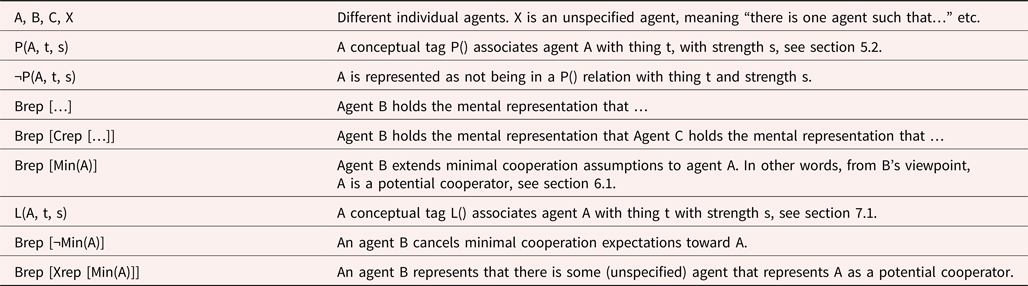
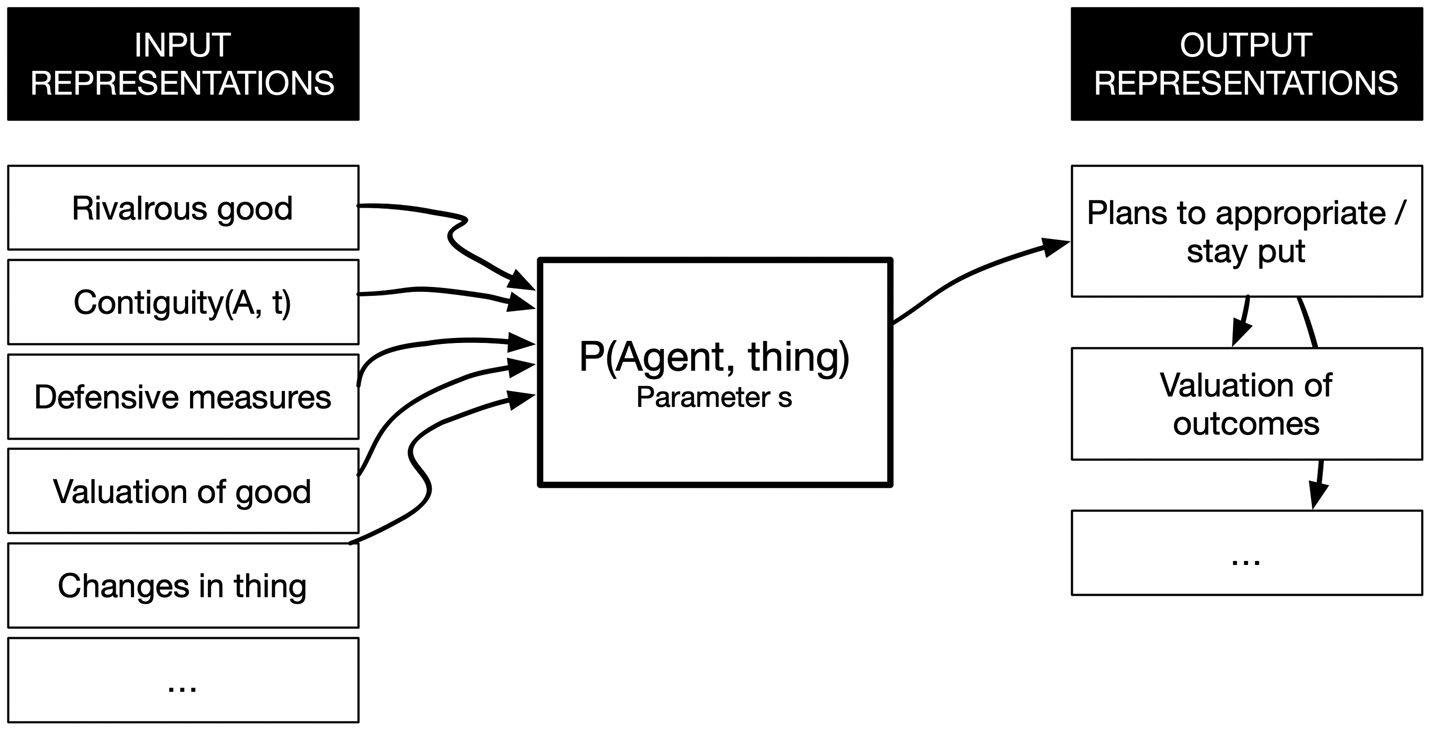
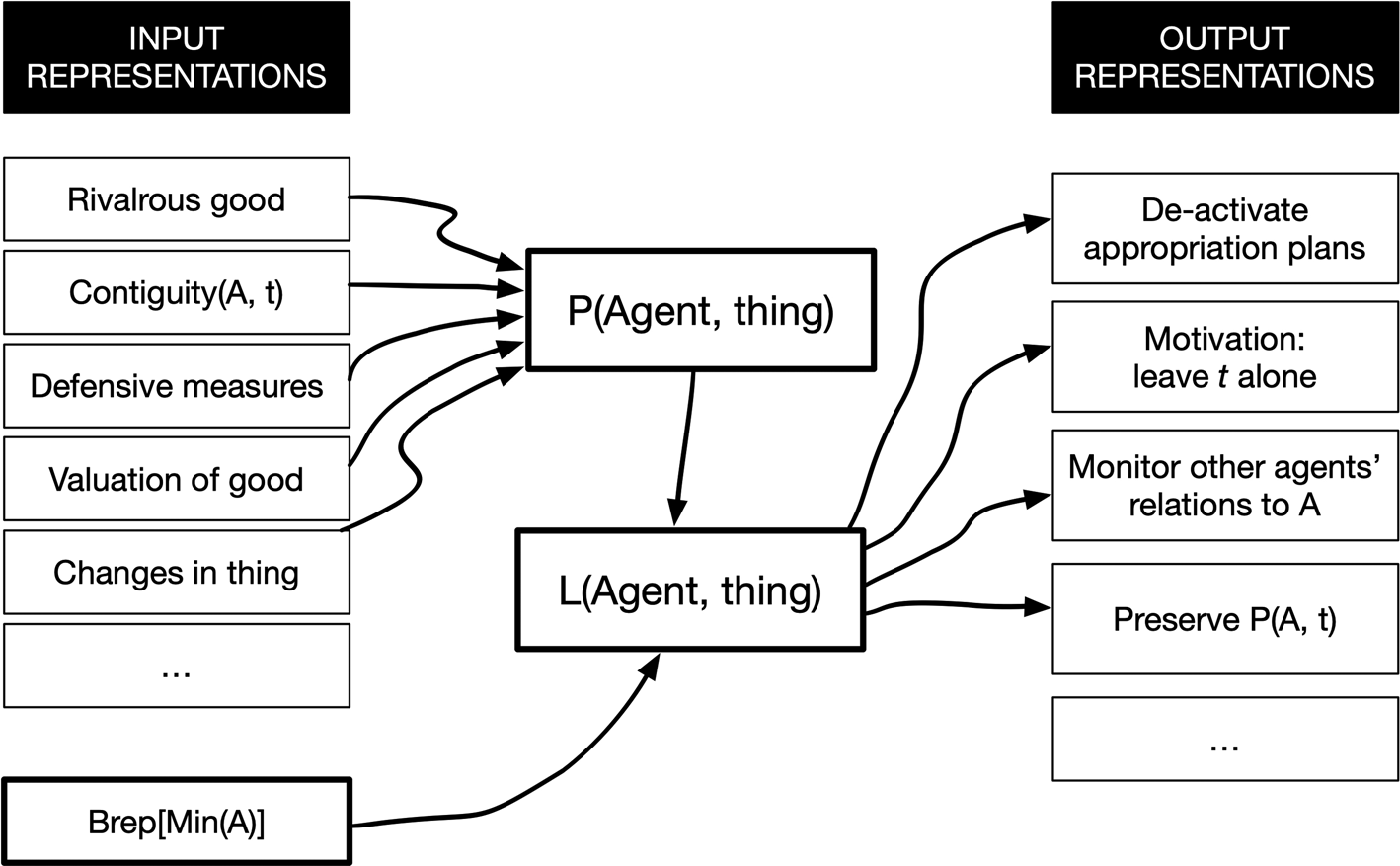
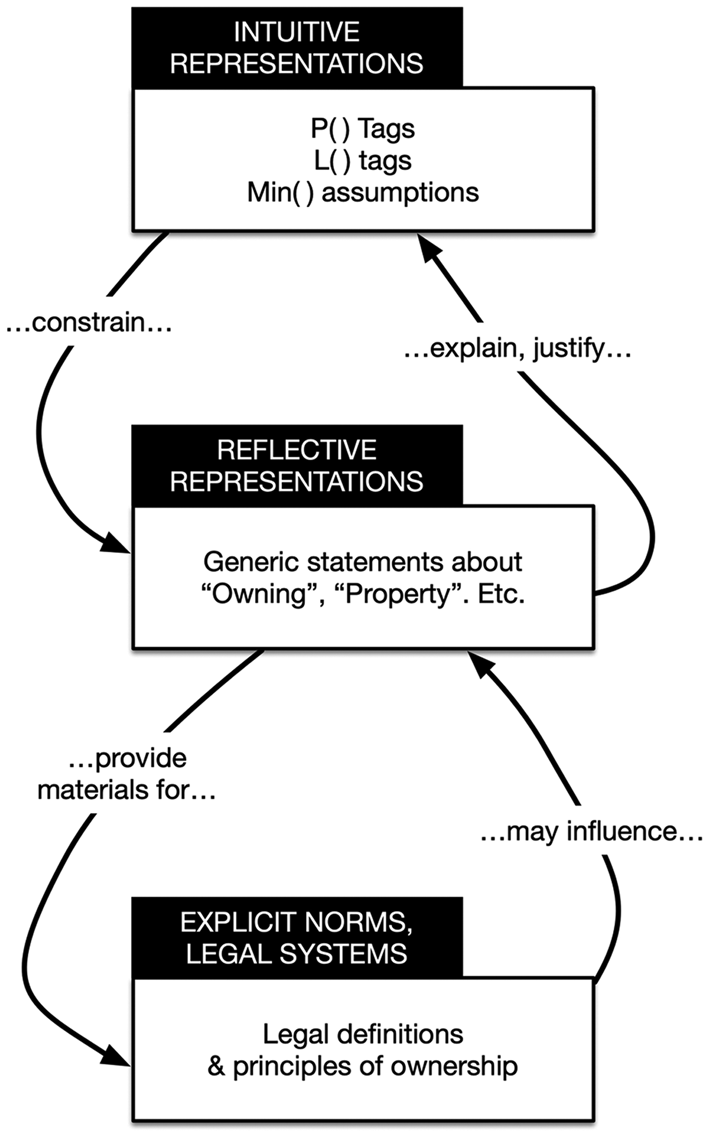



Target article
Ownership psychology as a cognitive adaptation: A minimalist model
Related commentaries (31)
A cooperative–competitive perspective of ownership necessitates an understanding of ownership disagreements
A developmental perspective on the minimalist model: The case of respect for ownership
Autonomy, the moral circle, and the limits of ownership
Beyond personal ownership: Examining the complexities of ownership in culture
Boyer's minimal model should also represent multiple ownership without collective agency
Computational theories should be made with natural language instead of meaningless code
Development, history, and a minimalist model of ownership psychology
Hold it! Where do we put the body?
How the minimalist model of ownership psychology can aid in explaining moral behaviors under resource constraints
Invested effort and our open-ended sense of ownership
No single notion of cooperation explains when we respect ownership
Not by intuitions alone: Institutions shape our ownership behaviour
On intuitive versus institutional accounts of ownership
Ownership and willingness to compete for resources
Ownership as a component of the extended self
Ownership as an extension of self: An alternative to a minimalist model
Ownership is (likely to be) a moral foundation
Ownership language informs ownership psychology
Ownership psychology and group size
Ownership psychology as a “cognitive cell” adaptation: A minimalist model of microbial goods theory
Primordial feeling of possession in development
Psychological ownership: Actors' and observers' perspectives
Reciprocal contracts – not competitive acquisition – explain the moral psychology of ownership
Similarity and the coordination of ownership
The curious origins of ownership
The evolutionary psychology of ownership is rooted in the Lockean liberal principle of self-ownership
The missing link? How do non-human primates fit in the minimalist model of ownership?
The origins of property law
The recursive nature of ownership intuitions
What do infants need an ownership concept for? Frugal possession concepts can adequately support early reasoning about distributive dilemmas
When it comes to taxes, ownership intuitions abide by the law
Author response
Ownership psychology, its antecedents and consequences