






No CrossRef data available.
Article contents
The false dichotomy of domain-specific versus domain-general cognition
Published online by Cambridge University Press: 15 August 2017
Abstract
The qualitative division between domain-general and domain-specific cognition is unsubstantiated. The distinction is instead better viewed as opposites on a gradual scale, which has more explanatory power and fits current empirical evidence better. We also argue that causal cognition may be more general than social learning, which it often involves.
Information
- Type
- Open Peer Commentary
- Information
- Copyright
- Copyright © Cambridge University Press 2017
References
Bateson, P. & Curley, J. (2013) Developmental approaches to behavioural biology. Nova Acta Leopoldina
111:89–110.Google Scholar
Blaisdell, A. P., Sawa, K., Leising, K. J. & Waldmann, M. R. (2006) Causal reasoning in rats. Science
311:1020–22.Google Scholar
Bolhuis, J. J. (1991) Mechanisms of avian imprinting: A review. Biological Reviews
66:303–45. doi: 10.1111/j.1469-185X.1991.tb01145.x.Google Scholar
Gärdenfors, P. (2003) How homo became sapiens: On the evolution of thinking. Oxford University Press.Google Scholar
Jacobs, I. F., von Bayern, A., Martin-Ordas, G., Rat-Fischer, L. & Osvath, M. (2015) Corvids create novel causal interventions after all. Proceedings of the Royal Society B: Biological Sciences
282:20142504. doi: 10.1098/rspb.2014.2504.CrossRefGoogle Scholar
Laland, K. N., Sterelny, K., Odling-Smee, J., Hoppitt, W. & Uller, T. (2011) Cause and effect in biology revisited: Is Mayr's proximate-ultimate dichotomy still useful?
Science
334:1512–16. doi: 10.1126/science.1210879.CrossRefGoogle ScholarPubMed
Martinho, A. & Kacelnik, A. (2016) Ducklings imprint on the relational concept of “same or different”. Science
353:286–88. doi: 10.1126/science.aaf4247.Google Scholar
Osvath, M., Kabadayi, C. & Jacobs, I. F. (2014) Independent evolution of similar complex cognitive skills: The importance of embodied degrees of freedom. Animal Behavior and Cognition
1:249–64. doi: 10.12966/abc.08.03.2014.Google Scholar
Ploeger, A. & Galis, F. (2011) Evo devo and cognitive science. Wiley Interdisciplinary Reviews: Cognitive Science
2:429–40. doi: 10.1002/wcs.137.Google Scholar
Vallortigara, G. (2012a) Core knowledge of object, number, and geometry: A comparative and neural approach. Cognitive Neuropsychology
29:213–36. doi: 10.1080/02643294.2012.654772.Google Scholar
Vallortigara, G. (2012b) The cognitive chicken: Visual and spatial cognition in a non–mammalian brain. In: The Oxford handbook of comparative cognition, ed. Zentall, T. R. & Wasserman, E. A., pp. 48–66. Oxford University Press.Google Scholar
West-Eberhard, M. J. (2003) Developmental plasticity and evolution. Oxford University Press.Google Scholar
Woodward, J. (2011) A philosopher looks at tool use and causal understanding. In: Tool use and causal cognition, ed. McCormack, T., Hoerl, C. & Butterfill, S., pp. 18–50. Oxford University Press. doi: 10.1093/acprof:oso/9780199571154.003.0002.Google Scholar
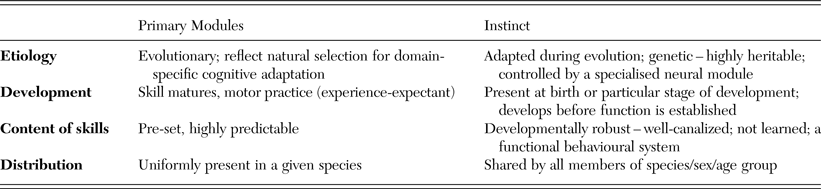
Table 1. The description of primary modules by Burkart et al. (Table 2 of target article) strongly resembles the nine different meanings of instinct by Bateson and Curley (2013) when rearranged.
Burkart et al. view domain-specific and domain-general intelligence as qualitatively different categories and then attempt to find plausible evolutionary scenarios. However, viewing intelligence as a scalar trait is more consistent with biological gradualism. Exclusive categories do not exist for the complex continuous interplay between genes and environment resulting in unique individual development and their evolutionary interactions (Laland et al. Reference Laland, Sterelny, Odling-Smee, Hoppitt and Uller2011; Osvath et al. Reference Osvath, Kabadayi and Jacobs2014; Ploeger & Galis Reference Ploeger and Galis2011; West-Eberhard Reference West-Eberhard2003). The authors also do not explain how any cognitive adaptation can be fully independent of brain size and executive functions, as they posit in Figure 3 of the target article. Although it is true that small brains can house many cognitive adaptations with poor executive functions, they must clearly be at least somewhat related. For instance, primary modules can be inhibited or stored in working memory. The tendency of kittens to respond to small moving objects with behaviours from the hunting repertoire is considered an example of a primary module (Table 2 of target article), yet they can wait for the right time to pounce (inhibitory control) and recall where they have last seen objects (working memory).
The problems of the dichotomy can also be illustrated by considering precocial birds such as ducks and chickens, which are born relatively well-developed; they walk, have open eyes, and forage. Their cognitive abilities can therefore be tested soon after hatching. Precocial animals are perfect for distinguishing between primary and secondary modularization because they can be tested with minimal experience. Filial imprinting occurs when a newly hatched precocial chick limits its social behaviour to a particular object. Under normal circumstances, this means that the chick will attend to and follow its mother. It is one of the most extensively described phenomena in ethology (Bolhuis Reference Bolhuis1991) and is traditionally considered to be the archetype of instinct, so categorizing it as domain specific and modular should be straightforward. Imprinting indeed appears to be a species-wide adaptive specialisation to a predictable situation that is stable across generations, with relatively quick learning in a specific domain following a characteristic ontogeny.
The concepts of primary modules and instinct resemble each other greatly (see Table 1), so we can criticize them on similar grounds – mainly, that they are not truly qualitatively distinct from their supposed polar opposites (Bateson & Curley Reference Bateson and Curley2013; Bolhuis Reference Bolhuis1991). Many aspects of imprinting go beyond instinct or primary modules. It can be considered domain general and may involve secondary modules because it is phylogenetically and ontogenetically canalized; it is learned until automated; and it can have variable contents with individual differences. Moreover, ducklings understand the relational concept of “same or different” based on imprinting (Martinho & Kacelnik Reference Martinho and Kacelnik2016), and chicks are born with advanced folk biology, psychology, and physics (Vallortigara Reference Vallortigara2012a; Reference Vallortigara, Zentall and Wasserman2012b). This suggests massive modularity, which according to Burkart et al. is “entirely compatible with the co-existence of domain-general processes and general intelligence” (sect. 1.2.1., para. 4). It is possible that imprinting is more of the one than the other, but according to their view it has to be either general or specific, which is incompatible with current empirical evidence.
The theoretical and empirical evidence for an absolute divide between domain-specific and domain-general intelligence is thus poor. One might argue that certain individuals have general intelligence in the sense that they consistently perform well on various tests across domains, but this hardly seems surprising or controversial. A gradual notion of intelligence means its evolution is more plausible – even repeatedly in different clades (Osvath et al. Reference Osvath, Kabadayi and Jacobs2014) – than the potential “hard step” of categorically unique general intelligence.
We are also sceptical of Burkart et al.'s focus on cultural intelligence. Social learning has undoubtedly played an important role in the cognitive evolution of many species, but perhaps it is not as central or exclusive as they claim. In fact, they are concerned that socio-cognitive abilities too often yield inconclusive results or are not even included in test batteries.
Causal cognition can arguably overcome the problems of Table 1 in the target article equally well or better than social learning, which in many cases can be considered to be causal. Woodward (Reference Woodward, McCormack, Hoerl and Butterfill2011) distinguished three levels of causal reasoning (see also Gärdenfors Reference Gärdenfors2003); one can learn to shake a branch to cause fruit to fall because of one's own experience shaking branches (egocentric causal learning), observing others shake branches (agent causal learning), or observing the wind shake branches (observation/action causal learning). It is reasonable that these three levels represent an evolutionary order of expansion of causal cognition. This would constitute another argument that the dichotomy between domain-specific and domain-general intelligence is not plausible.
The description of primary modules by Burkart et al. (Table 2 of target article) strongly resembles the nine different meanings of instinct by Bateson and Curley (Reference Bateson and Curley2013) when rearranged.
Rather than learning many one-to-one relations, representing a causal network based on individual and social learning can be highly advantageous and at the base of novel causal interventions (Tomasello & Call Reference Tomasello and Call1997; Woodward Reference Woodward, McCormack, Hoerl and Butterfill2011). This sort of causal cognition can be tested empirically in a variety of species (Blaisdell et al. Reference Blaisdell, Sawa, Leising and Waldmann2006; Jacobs et al. Reference Jacobs, von Bayern, Martin-Ordas, Rat-Fischer and Osvath2015), and may be of the general nature that Burkart et al. are seeking.