As Burkart et al. note in the target article, it is possible that the g factors that exist within species at the level of individual differences have somewhat different factorial characteristics for each species. For instance, certain cognitive elements that combine to give rise to g in chimpanzees may fall outside of the positive manifold in other species (e.g., humans). In other words, performance in certain abilities may be driven by g in some species but not in others. Lack of measurement invariance (i.e., discordance between species in terms of which cognitive abilities give rise to g) renders single batteries unable to identify a g factor common to individuals of different species (i.e., the mixed approach). One cause of these compositional differences may be the different ways in which ancestral selection pressures shaped the g factors across different species. Some species may have highly integrated abilities, dominated by a strong g factor, whereas others might have highly specialized and largely independent abilities, where the positive manifold of correlations underlying g is weaker.
Another potentially significant cause of the failure of measurement invariance across individuals of different species may be floor or ceiling effects upon performance. For example, a cognitive task that may be hard for one species may be trivially easy for another, more intelligent species. The latter condition is characterized by all or most individuals performing maximally well, revealing a ceiling effect. Hence, the g loading of the success rate at solving this task may be high for the less intelligent species, but will be low for the more intelligent one – this species having hit the test ceiling.
Operationally, both (1) species-specific specialization or modularization of cognitive abilities and (2) floor/ceiling effects can be identified empirically based on within-species statistical distributions in performance. The two conditions are likely to share a common observable feature: that is, low within-species variability in certain tasks. Highly specialized abilities are proposed to be species-typical and monomorphic, with little to no interindividual variation (Tooby & Cosmides Reference Tooby and Cosmides1990). Consistent with this, human and nonhuman primate data indicate that cognitive functions that are more specialized (and thus less g-loaded) exhibit lower phenotypic and genetic variability (Spitz Reference Spitz1988; Woodley of Menie et al. Reference Woodley of Menie, Fernandes and Hopkins2015). The presence of ceiling or floor effects in measurement when testing abilities in a given species also, by definition, limits variation. These alternative scenarios are therefore connected, as any apparent floor or ceiling effect in the performance of modularized abilities may not be due to a poor measurement approach but, rather, due to adaptive species-typical modularization.
We propose that the mixed design would support the presence of a g factor inclusive of individuals of different species if species differences in cognitive ability are larger on tasks that share more variance with others (larger part-whole correlations, representing g-loadings) but not if species differences are uniform across tasks. Here, we use combined data from two sources (Herrmann et al. Reference Herrmann, Hernandez-Lloreda, Call, Hare and Tomasello2010b; Woodley of Menie et al. Reference Woodley of Menie, Fernandes and Hopkins2015) on the Primate Cognitive Test Battery (PCTB; Herrmann et al. Reference Herrmann, Call, Hernández-Lloreda, Hare and Tomasello2007) performance in human children and chimpanzees to test this hypothesis and examine the importance of the confounding role of tasks on which individuals of at least one of the two species exhibit limited variability in scores.
Human children outperform chimpanzees to a greater degree on more g-loaded PCTB tasks – this can be demonstrated by correlating the vector of task g loadings with the vector of the between-species differences in performance (d) on those same tasks. To examine whether the true strength of this relationship was masked by the inclusion of tasks that yielded little within-species variation, we eliminated tasks from the analyses sequentially, starting with those that yielded the smallest coefficients of variance (CV) in human performance. The relationship between g loadings and the size of human-chimpanzee differences was thus examined in multiple stages, with each successive step having a more stringent cutoff for CV. Recall that the ceiling effects are a feature of the ease with which humans can execute certain basic cognitive tasks, suggesting that these abilities are modularized in human populations. CV was in fact smaller among humans on all tasks, suggesting that they solved all tasks more easily than chimpanzees.
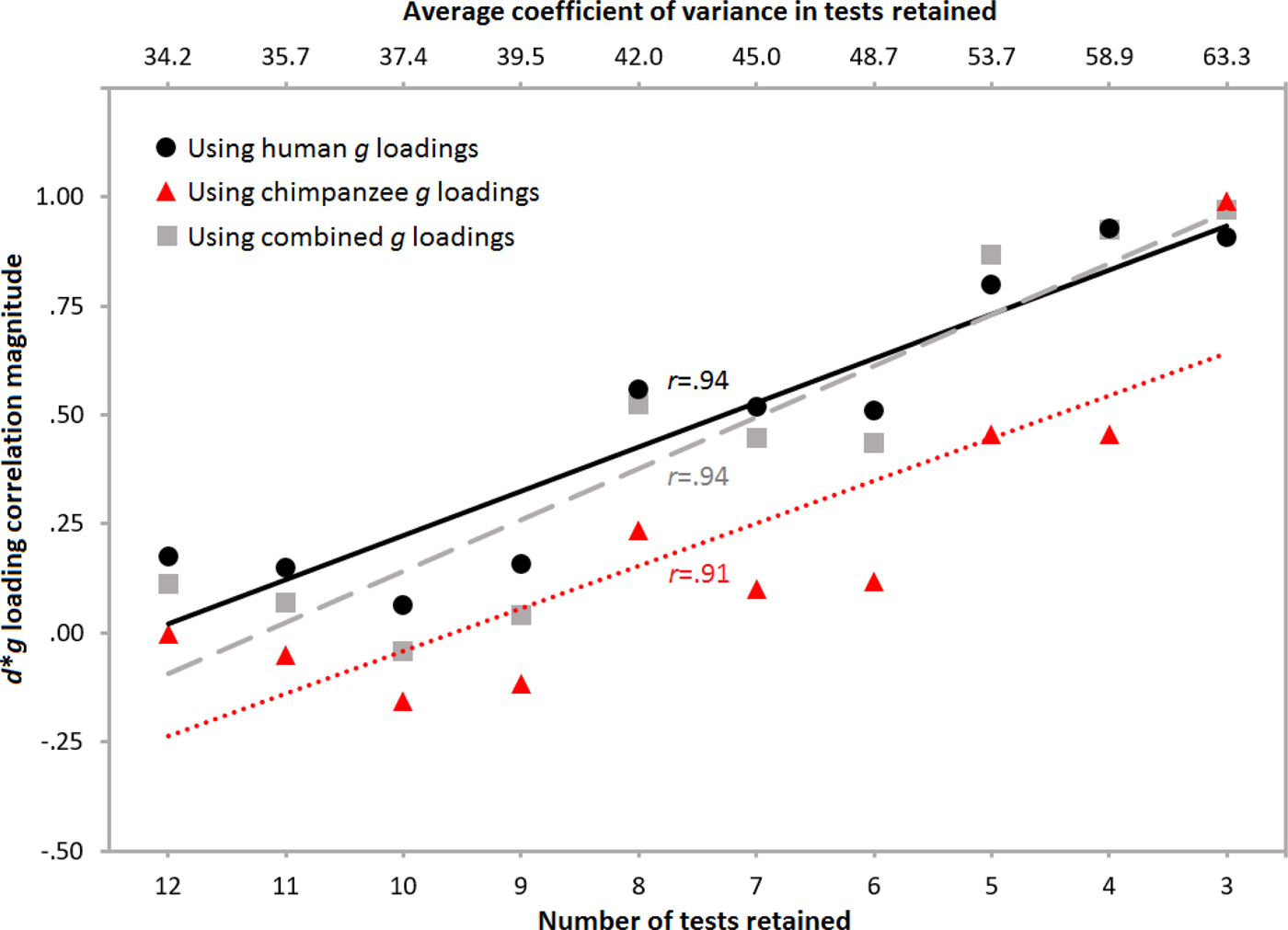
Figure 1 shows that the g*d vector correlation magnitude increased inversely to the number of tasks retained, with smaller numbers of tasks exhibiting larger variation among the human participants yielding bigger vector correlations. The vector correlation magnitude approached unity when only the three tests with the highest human CV values were used. The association was indifferent to the use of different g loadings (human, chimpanzee, and averaged) as the basis for computing the g*d vector correlations (the correlations between the vector correlation magnitudes and average CV across tasks ranged from .91 to .94, p < .05).
Figure 1.
Increasing magnitude of the vector correlations between task g loadings and the difference scores (d) between human children and chimpanzee performance, as a function of the average coefficient of variance of the tests kept in analyses.
Furthermore, as expected, tasks yielding smaller CV values were also less g-loaded in humans (r = .52; one-tailed p < .05), which replicates prior findings involving chimpanzees (Woodley of Menie et al. Reference Woodley of Menie, Fernandes and Hopkins2015).
This approach is currently being applied by our group to comparisons involving a larger number of species. The implication of our finding is that differences between individuals of different species may be consistently concentrated on g – this being especially apparent when focusing on experimental tasks whose design permits sufficient within-species variation. This finding furthermore indicates that the patterning of species differences in the g and G factors are concordant, meaning that they are likely one and the same, reinforcing the arguments put forward by Burkart et al.







As Burkart et al. note in the target article, it is possible that the g factors that exist within species at the level of individual differences have somewhat different factorial characteristics for each species. For instance, certain cognitive elements that combine to give rise to g in chimpanzees may fall outside of the positive manifold in other species (e.g., humans). In other words, performance in certain abilities may be driven by g in some species but not in others. Lack of measurement invariance (i.e., discordance between species in terms of which cognitive abilities give rise to g) renders single batteries unable to identify a g factor common to individuals of different species (i.e., the mixed approach). One cause of these compositional differences may be the different ways in which ancestral selection pressures shaped the g factors across different species. Some species may have highly integrated abilities, dominated by a strong g factor, whereas others might have highly specialized and largely independent abilities, where the positive manifold of correlations underlying g is weaker.
Another potentially significant cause of the failure of measurement invariance across individuals of different species may be floor or ceiling effects upon performance. For example, a cognitive task that may be hard for one species may be trivially easy for another, more intelligent species. The latter condition is characterized by all or most individuals performing maximally well, revealing a ceiling effect. Hence, the g loading of the success rate at solving this task may be high for the less intelligent species, but will be low for the more intelligent one – this species having hit the test ceiling.
Operationally, both (1) species-specific specialization or modularization of cognitive abilities and (2) floor/ceiling effects can be identified empirically based on within-species statistical distributions in performance. The two conditions are likely to share a common observable feature: that is, low within-species variability in certain tasks. Highly specialized abilities are proposed to be species-typical and monomorphic, with little to no interindividual variation (Tooby & Cosmides Reference Tooby and Cosmides1990). Consistent with this, human and nonhuman primate data indicate that cognitive functions that are more specialized (and thus less g-loaded) exhibit lower phenotypic and genetic variability (Spitz Reference Spitz1988; Woodley of Menie et al. Reference Woodley of Menie, Fernandes and Hopkins2015). The presence of ceiling or floor effects in measurement when testing abilities in a given species also, by definition, limits variation. These alternative scenarios are therefore connected, as any apparent floor or ceiling effect in the performance of modularized abilities may not be due to a poor measurement approach but, rather, due to adaptive species-typical modularization.
We propose that the mixed design would support the presence of a g factor inclusive of individuals of different species if species differences in cognitive ability are larger on tasks that share more variance with others (larger part-whole correlations, representing g-loadings) but not if species differences are uniform across tasks. Here, we use combined data from two sources (Herrmann et al. Reference Herrmann, Hernandez-Lloreda, Call, Hare and Tomasello2010b; Woodley of Menie et al. Reference Woodley of Menie, Fernandes and Hopkins2015) on the Primate Cognitive Test Battery (PCTB; Herrmann et al. Reference Herrmann, Call, Hernández-Lloreda, Hare and Tomasello2007) performance in human children and chimpanzees to test this hypothesis and examine the importance of the confounding role of tasks on which individuals of at least one of the two species exhibit limited variability in scores.
Human children outperform chimpanzees to a greater degree on more g-loaded PCTB tasks – this can be demonstrated by correlating the vector of task g loadings with the vector of the between-species differences in performance (d) on those same tasks. To examine whether the true strength of this relationship was masked by the inclusion of tasks that yielded little within-species variation, we eliminated tasks from the analyses sequentially, starting with those that yielded the smallest coefficients of variance (CV) in human performance. The relationship between g loadings and the size of human-chimpanzee differences was thus examined in multiple stages, with each successive step having a more stringent cutoff for CV. Recall that the ceiling effects are a feature of the ease with which humans can execute certain basic cognitive tasks, suggesting that these abilities are modularized in human populations. CV was in fact smaller among humans on all tasks, suggesting that they solved all tasks more easily than chimpanzees.
Figure 1 shows that the g*d vector correlation magnitude increased inversely to the number of tasks retained, with smaller numbers of tasks exhibiting larger variation among the human participants yielding bigger vector correlations. The vector correlation magnitude approached unity when only the three tests with the highest human CV values were used. The association was indifferent to the use of different g loadings (human, chimpanzee, and averaged) as the basis for computing the g*d vector correlations (the correlations between the vector correlation magnitudes and average CV across tasks ranged from .91 to .94, p < .05).
Increasing magnitude of the vector correlations between task g loadings and the difference scores (d) between human children and chimpanzee performance, as a function of the average coefficient of variance of the tests kept in analyses.
Furthermore, as expected, tasks yielding smaller CV values were also less g-loaded in humans (r = .52; one-tailed p < .05), which replicates prior findings involving chimpanzees (Woodley of Menie et al. Reference Woodley of Menie, Fernandes and Hopkins2015).
This approach is currently being applied by our group to comparisons involving a larger number of species. The implication of our finding is that differences between individuals of different species may be consistently concentrated on g – this being especially apparent when focusing on experimental tasks whose design permits sufficient within-species variation. This finding furthermore indicates that the patterning of species differences in the g and G factors are concordant, meaning that they are likely one and the same, reinforcing the arguments put forward by Burkart et al.