Bentley et al. present a significant, novel, and integrative approach to the understanding of collective decision-making, basing their analysis on two dimensions: the extent to which a decision is made independently versus socially; and the transparency versus opaqueness of payoffs and risks associated with the decision. Their analysis results in a fourfold map that, in their words, seeks to capture the essence of decision-making. Emotion is not mentioned in the target article, reflecting the long-standing dismissal of its effects on decision-making as relatively unimportant, largely disruptive, and contrary to rational thought. However, it is now widely understood that emotions can contribute positively to decision-making (Buck & Ferrer Reference Buck, Ferrer, Roeser, Hillerbrand, Sandin and Peterson2012), and it is important to understand the conditions under which emotions can be facilitative or disruptive. Unfortunately, the conceptualization of emotion in the decision literature tends to be oversimplified, involving only positive-negative valence. Thus, experiences of risk described in the “risk as feelings hypothesis” are framed simply in terms of anticipated positive or negative evaluative feelings (Loewenstein et al. Reference Loewenstein, Weber, Hsee and Welch2001).
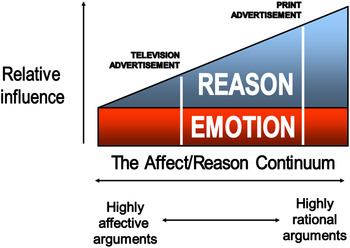
I suggest that a more comprehensive understanding of the role of emotion in decision-making is possible if the Bentley et al. target article's “transparency-opaqueness” dimension is modified from a purely cognitive dimension involving the judgment of risk and reward to a dimension involving the interaction of reason and emotion (see Figure 1). The extreme left end of this dimension would involve emotion to the exclusion of reason – pure irrational passion – and would correspond to extreme opaqueness of payoffs and risks in the Bentley et al. analysis. To the right, the relative influence of reason grows until it is overwhelmingly important relative to emotion. However, the influence of emotion never reaches zero: Emotion plays some role in all human decisions.
Figure 1.
The affect/reason involvement (ARI) model illustrating the interaction of reason and emotion. Behavior at the extreme left is entirely emotional and “irrational,” while the relative influence of reason increases progressively toward the right. At the extreme right, reason is predominant but emotion still exerts some, often hidden influence.
A number of phenomena can be represented by Figure 1. It can represent the evolution of the brain, with cortical mechanisms gradually increasing in size and influence but never completely replacing subcortical systems. It can also reflect the brain's growth in fetal and later development, as ontogeny recapitulates phylogeny. The figure can also represent the development of decision-making from infancy to adulthood, with the gradual learning of language and social rules, and expectations substituting for earlier, more reflexive, controls of behavior. It can also represent a range of social relationships, from formal relationships with relative strangers on the right, and intimate relationships on the left, where spontaneous emotional communication flows easily. Figure 1 can also represent a range of situations going from the most emotional on the left to the most rational on the right.
The emotional versus rational influences of online communication media can also be represented by Figure 1. Marshall McLuhan (Reference McLuhan1964) proposed that media are technological extensions of the body that can train perceptual habits and alter patterns of thought and feeling in fundamental ways. In particular, he suggested that changes in the habits afforded by electronic media have encouraged patterns of holistic perceptual/cognitive processing as opposed to linear sequential processing. Together with the direct worldwide pooling of information, this change in perception created a new collective identity: a “global village.” Buck and Powers (Reference Buck, Powers, Doveling, von Scheve and Konijn2011) suggested a reconceptualization of McLuhan's analysis in terms of print media affording rational symbolic communication and of electronic media affording non-voluntary, direct, spontaneous emotional communication.
Chaudhuri and Buck (Reference Chaudhuri and Buck1995) followed Tucker's (Reference Tucker1981) distinction between direct, holistic, and immediate syncretic cognition; and sequential, linear analytic cognition involving effortful information processing. They suggested that electronic media, often accompanied by emotional cues evoked by music and sound effects, encourage heuristic learning processes and may actually discourage analytic cognition. Based upon this analysis, they assessed analytic and syncretic-cognitive responses to 120 television and 120 print (magazine) advertisements. These involved 29 product categories, and a variety of characteristics were controlled, including advertising strategy and familiarity. Analytic responses (elicited from questions asking: did the ad make you think of fact, arguments, differences, etc.) were higher for advertisements in print media, while syncretic responses (elicited from questions asking: did the ad make you happy, feel good, excited, etc.) were higher for television advertisements (see Figure 1).
Adding emotion to the Bentley et al. analysis could arguably contribute to its usefulness. It is not incompatible with the cognitive explanation that this involves the relative presence or absence of rational consideration of payoffs and risks. Bentley et al. have noted that modern Western society is characterized by saturated markets in which there are thousands of extremely similar information sources and consumer products. Moreover, adding emotion to the model allows a way to consider the complex emotions – far beyond simple considerations of positive or negative valence – that can have nuanced effects on decision-making in a wide range of actual and consequential risky situations.
As an example, Buck et al. (Reference Buck, Anderson, Chaudhuri and Ray2004) queried college students in America and India about emotions experienced in risky sexual situations (e.g., using or not using condoms with strangers or long-term partners; discussing condom use with a potential partner). Results indicated a wide range of significant results: for example, condom use was associated with more caring but less intimacy in both female and male respondents, using condoms made men report more feelings of anger and less power while the opposite was found for women, and patterns of response in India and America were quite similar. These results informed the design of an intervention stressing emotional education involving a filmed conversation between two persons discussing having sex, whether to use condoms, and the emotions involved. This brief intervention was found to significantly increase reported condom use six months later (Ferrer et al. Reference Ferrer, Fisher, Buck and Amico2011).
I suggest that learning about the emotions likely experienced in a risky situation ahead of time can, in effect, inoculate the individual against being “carried away” by those emotions when the risky situation presents itself. In the Bentley et al. analysis, this could constitute a way in which payoffs and risks can be made more transparent, but it goes further in suggesting specific ways in which such transparency may be achieved.





Bentley et al. present a significant, novel, and integrative approach to the understanding of collective decision-making, basing their analysis on two dimensions: the extent to which a decision is made independently versus socially; and the transparency versus opaqueness of payoffs and risks associated with the decision. Their analysis results in a fourfold map that, in their words, seeks to capture the essence of decision-making. Emotion is not mentioned in the target article, reflecting the long-standing dismissal of its effects on decision-making as relatively unimportant, largely disruptive, and contrary to rational thought. However, it is now widely understood that emotions can contribute positively to decision-making (Buck & Ferrer Reference Buck, Ferrer, Roeser, Hillerbrand, Sandin and Peterson2012), and it is important to understand the conditions under which emotions can be facilitative or disruptive. Unfortunately, the conceptualization of emotion in the decision literature tends to be oversimplified, involving only positive-negative valence. Thus, experiences of risk described in the “risk as feelings hypothesis” are framed simply in terms of anticipated positive or negative evaluative feelings (Loewenstein et al. Reference Loewenstein, Weber, Hsee and Welch2001).
I suggest that a more comprehensive understanding of the role of emotion in decision-making is possible if the Bentley et al. target article's “transparency-opaqueness” dimension is modified from a purely cognitive dimension involving the judgment of risk and reward to a dimension involving the interaction of reason and emotion (see Figure 1). The extreme left end of this dimension would involve emotion to the exclusion of reason – pure irrational passion – and would correspond to extreme opaqueness of payoffs and risks in the Bentley et al. analysis. To the right, the relative influence of reason grows until it is overwhelmingly important relative to emotion. However, the influence of emotion never reaches zero: Emotion plays some role in all human decisions.
The affect/reason involvement (ARI) model illustrating the interaction of reason and emotion. Behavior at the extreme left is entirely emotional and “irrational,” while the relative influence of reason increases progressively toward the right. At the extreme right, reason is predominant but emotion still exerts some, often hidden influence.
A number of phenomena can be represented by Figure 1. It can represent the evolution of the brain, with cortical mechanisms gradually increasing in size and influence but never completely replacing subcortical systems. It can also reflect the brain's growth in fetal and later development, as ontogeny recapitulates phylogeny. The figure can also represent the development of decision-making from infancy to adulthood, with the gradual learning of language and social rules, and expectations substituting for earlier, more reflexive, controls of behavior. It can also represent a range of social relationships, from formal relationships with relative strangers on the right, and intimate relationships on the left, where spontaneous emotional communication flows easily. Figure 1 can also represent a range of situations going from the most emotional on the left to the most rational on the right.
The emotional versus rational influences of online communication media can also be represented by Figure 1. Marshall McLuhan (Reference McLuhan1964) proposed that media are technological extensions of the body that can train perceptual habits and alter patterns of thought and feeling in fundamental ways. In particular, he suggested that changes in the habits afforded by electronic media have encouraged patterns of holistic perceptual/cognitive processing as opposed to linear sequential processing. Together with the direct worldwide pooling of information, this change in perception created a new collective identity: a “global village.” Buck and Powers (Reference Buck, Powers, Doveling, von Scheve and Konijn2011) suggested a reconceptualization of McLuhan's analysis in terms of print media affording rational symbolic communication and of electronic media affording non-voluntary, direct, spontaneous emotional communication.
Chaudhuri and Buck (Reference Chaudhuri and Buck1995) followed Tucker's (Reference Tucker1981) distinction between direct, holistic, and immediate syncretic cognition; and sequential, linear analytic cognition involving effortful information processing. They suggested that electronic media, often accompanied by emotional cues evoked by music and sound effects, encourage heuristic learning processes and may actually discourage analytic cognition. Based upon this analysis, they assessed analytic and syncretic-cognitive responses to 120 television and 120 print (magazine) advertisements. These involved 29 product categories, and a variety of characteristics were controlled, including advertising strategy and familiarity. Analytic responses (elicited from questions asking: did the ad make you think of fact, arguments, differences, etc.) were higher for advertisements in print media, while syncretic responses (elicited from questions asking: did the ad make you happy, feel good, excited, etc.) were higher for television advertisements (see Figure 1).
Adding emotion to the Bentley et al. analysis could arguably contribute to its usefulness. It is not incompatible with the cognitive explanation that this involves the relative presence or absence of rational consideration of payoffs and risks. Bentley et al. have noted that modern Western society is characterized by saturated markets in which there are thousands of extremely similar information sources and consumer products. Moreover, adding emotion to the model allows a way to consider the complex emotions – far beyond simple considerations of positive or negative valence – that can have nuanced effects on decision-making in a wide range of actual and consequential risky situations.
As an example, Buck et al. (Reference Buck, Anderson, Chaudhuri and Ray2004) queried college students in America and India about emotions experienced in risky sexual situations (e.g., using or not using condoms with strangers or long-term partners; discussing condom use with a potential partner). Results indicated a wide range of significant results: for example, condom use was associated with more caring but less intimacy in both female and male respondents, using condoms made men report more feelings of anger and less power while the opposite was found for women, and patterns of response in India and America were quite similar. These results informed the design of an intervention stressing emotional education involving a filmed conversation between two persons discussing having sex, whether to use condoms, and the emotions involved. This brief intervention was found to significantly increase reported condom use six months later (Ferrer et al. Reference Ferrer, Fisher, Buck and Amico2011).
I suggest that learning about the emotions likely experienced in a risky situation ahead of time can, in effect, inoculate the individual against being “carried away” by those emotions when the risky situation presents itself. In the Bentley et al. analysis, this could constitute a way in which payoffs and risks can be made more transparent, but it goes further in suggesting specific ways in which such transparency may be achieved.