




No CrossRef data available.
Article contents
Infer yourself: Interoception and internal “action” in conscious selfhood
Published online by Cambridge University Press: 24 November 2016
Abstract
Can consciousness be understood through an association with voluntary skeletomotor action selection? Although flexible and integrated action selection is a plausible function for consciousness, a narrow focus on skeletomotor control neglects the contributions to conscious selfhood and subjectivity that rest on interoception and autonomic regulation (internal “action”). I consider these issues from the perspective of predictive processing.
Information
- Type
- Open Peer Commentary
- Information
- Copyright
- Copyright © Cambridge University Press 2016
References
Balcetis, E. & Dunning, D. (2010) Wishful seeing: More desired objects are seen as closer. Psychological Science
21(1):147–52. doi: 10.1177/0956797609356283.CrossRefGoogle ScholarPubMed
Clark, A. (2013) Whatever next? Predictive brains, situated agents, and the future of cognitive science. Behavioral and Brain Sciences
36(3):181–204. Available at: http://doi.org/10.1017/S0140525X12000477
Google Scholar
Conant, R. & Ashby, W. R. (1970) Every good regulator of a system must be a model of that system. International Journal of Systems Science
1(2):89–97.Google Scholar
Friston, K. J. (2009) The free-energy principle: A rough guide to the brain?
Trends in Cognitive Sciences
13(7): 293–301.Google Scholar
Friston, K. J., Daunizeau, J., Kilner, J. & Kiebel, S. J. (2010) Action and behavior: A free-energy formulation. Biological Cybernetics
102(3):227–60. doi: 10.1007/s00422-010-0364-z.Google Scholar
Haggard, P., Clark, S. & Kalogeras, J. (2002b) Voluntary action and conscious awareness. Nature Neuroscience
5(4):382–85. doi: 10.1038/nn827.Google Scholar
Merker, B. (2005) The liabilities of mobility: A selection pressure for the transition to consciousness in animal evolution. Consciousness and Cognition
14(1):89–114. doi: 10.1016/S1053-8100(03)00002-3.Google Scholar
Parkinson, J. & Haggard, P. (2014) Subliminal priming of intentional inhibition. Cognition
130(2):255–65. doi: 10.1016/j.cognition.2013.11.005.CrossRefGoogle ScholarPubMed
Schachter, S. & Singer, J. E. (1962) Cognitive, social, and physiological determinants of emotional state. Psychological Review. 69:379–99.CrossRefGoogle ScholarPubMed
Seth, A. K. (2013) Interoceptive inference, emotion, and the embodied self. Trends in Cognitive Sciences
17(11):565–73. doi: 10.1016/j.tics.2013.09.007.Google Scholar
Seth, A. K. (2015) The cybernetic bayesian brain: From interoceptive inference to sensorimotor contingencies. In: Open MIND, ed. Metzinger, T. K. & Windt, J. M., pp. 1–24. MIND Group.Google Scholar
Seth, A. K., Verschure, P., Blanke, O., Butz, M., Ford, J. M., Frith, C. D., Jacob, P., Kyselo, M., McGann, M., Menary, M., Morsella, E. & O'Regan, J. K. (2016) Action-oriented understanding of consciousness and the structure of experience. In: The pragmatic turn: Toward action-oriented views in cognitive science, ed. Engel, A. K., Friston, K. J., & Kragic, D., pp. 261–285. [Strüngmann Forum Reports, vol. 18; Lupp, J., series editor]. MIT Press.Google Scholar
Vishton, P. M., Stephens, N. J., Nelson, L. A., Morra, S. E., Brunick, K. L. & Stevens, J. A. (2007) Planning to reach for an object changes how the reacher perceives it. Psychological Science
18(8):713–19. doi: 10.1111/j.1467-9280.2007.01965.x.CrossRefGoogle Scholar
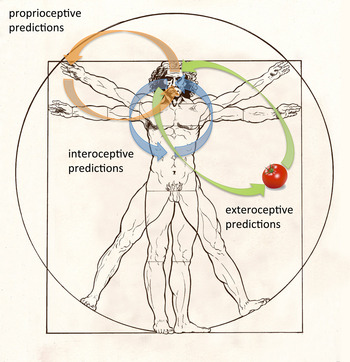
Figure 1. Inference and perception in different dimensions, supported by reciprocal flows of perceptual predictions and sensory prediction error signals. Reprinted with permission from Seth (2015).
Morsella et al. argue that consciousness serves as a frame that constrains and directs skeletal muscle output, by making encapsulated conscious contents available for adaptive voluntary control. Their argument builds in interesting ways on previous positions suggesting a role for consciousness in action selection (Merker Reference Merker2005). However, they in some ways go too far, and in other ways not far enough.
The authors go too far in overstating the association between volition and consciousness, asserting that “the conscious field wholly and exclusively determines what in everyday life is called voluntary behaviour. Conversely, for every voluntary action, the organism can report a conscious content responsible for that action” (sect. 2.5, para. 1). This excludes the possibility that volitional responses can be affected by subliminal (non-reportable) stimuli, which we now know is not the case; for instance, voluntary decisions to withhold prepotent actions can be influenced by subliminal primes (Parkinson & Haggard Reference Parkinson and Haggard2014). Also questionable are assertions that conscious perceptual content can be encapsulated from other factors like motivation (Balcetis & Dunning Reference Balcetis and Dunning2010) and even action itself (Vishton et al. Reference Vishton, Stephens, Nelson, Morra, Brunick and Stevens2007).
More interesting, however, is where Morsella et al. do not go far enough. Despite their emphasis on the body, they do not consider interoception or autonomic regulation (internal “action”), which may be highly relevant to basic instantiations of conscious selfhood and subjectivity. This idea makes most sense from the perspective of the “Bayesian brain” or “predictive processing” (Clark Reference Clark2013; Hohwy Reference Hohwy2013; Seth Reference Seth2013).
The basic idea of predictive processing is that perceptual content is determined by the brain's “best guess” of the (hidden) causes of its noisy and ambiguous sensory signals, computed according to Bayesian principles. Thus, visual perceptual content is determined by probabilistic inference of the causes of visual sensory signals, and so on for other modalities. Importantly, minimization of prediction error signals can be accomplished either by updating the prediction (corresponding to perceptual inference) or by performing actions to change sensory data – for example, by making eye movements to confirm sensory predictions. The latter process has been called active inference (Friston et al. Reference Friston, Daunizeau, Kilner and Kiebel2010).
This perspective generalizes easily to other domains of perception and action (see my Fig. 1). Perception of body configuration and motion can be understood as proprioceptive (and kinaesthetic) inference. Indeed, skeletomotor actions themselves can be understood and modelled as minimization of proprioceptive prediction error through active inference (Friston et al. Reference Friston, Daunizeau, Kilner and Kiebel2010). Active proprioceptive and kinaesthetic inference may also give rise to “action awareness,” which refers to consciousness of action, in contrast to awareness of the consequences of actions or of action options (Seth et al. Reference Seth, Verschure, Blanke, Butz, Ford, Frith, Jacob, Kyselo, McGann, Menary, Morsella, O'Regan, Engel, Friston, Kragic and Lupp2016). Classical examples here include experiences of intention and agency, which can be operationalized through paradigms like intentional binding (Haggard et al. Reference Haggard, Clark and Kalogeras2002b).
Inference and perception in different dimensions, supported by reciprocal flows of perceptual predictions and sensory prediction error signals. Reprinted with permission from Seth (Reference Seth, Metzinger and Windt2015).
In just the same way, perception of the internal state of the body – interoception – can be understood as inference on the (hidden) causes of interoceptive signals, with the resulting perceptual content emerging as conscious emotional or feeling states (Seth Reference Seth2013). This framework of “interoceptive inference” generalizes previous two-factor appraisal theories of emotion (Schachter & Singer Reference Schachter and Singer1962) to a rich multi-layered hierarchical model of the neural basis of emotion and physiological regulation.
Active inference in this context means suppression of interoceptive prediction errors through engagement of autonomic reflexes (internal actions). Interoceptive active inference is particularly significant for an organism because of the fundamental importance of maintenance of physiological homeostasis: It is more important for an organism to maintain its essential physiological variables within viable bounds, than it is to induce a detailed perceptual model of the internal milieu (Seth Reference Seth, Metzinger and Windt2015), though the one depends on the other. This perspective echoes Karl Friston's influential “free energy principle” (Friston Reference Friston2009) in saying that avoidance of atypical events (i.e., homeostatic regulation) necessitates a generative/predictive model of the causes of sensory inputs. It also recalls an older view from the largely neglected literature of cybernetics, where Ashby and Conant argued that “every good regulator of a system must be a model of that system” (Conant & Ashby Reference Conant and Ashby1970, p. 89; see also Seth Reference Seth, Metzinger and Windt2015).
From this perspective, internal actions make strong contributions to (affective) conscious contents through constraining interoceptive inference in the service of physiological homeostasis. These conscious feeling states may then further constrain adaptive skeletomotor responses when action options are evaluated with respect to their consequences for homeostatic integrity (see Damasio [Reference Damasio1994] for an early non-Bayesian expression of this idea). Taking things further, combined multimodal or amodal inference across exteroceptive, proprioceptive, and interoceptive domains – geared towards the active regulation of homeostatic integrity – may underlie basic non-conceptual experiences of embodied selfhood and subjectivity (Seth Reference Seth2013; Reference Seth, Metzinger and Windt2015); see my Figure 1. Notably, because the preservation of physiological integrity is the most basic duty of any nervous system, this view is arguably more basic and “low level” than passive frame theory.
In summary, conscious contents can be usefully understood from a functional perspective in shaping adaptive voluntary skeletomotor control, just as Morsella and colleagues suggest in their passive frame theory. But human (and likely nonhuman) consciousness has many phenomenological dimensions which may shape perception and behaviour in many different ways. To explain basic experiences of emotion and embodied selfhood, I believe it is necessary to account for the role of internal actions (autonomic regulation) in actively maintaining physiological homeostasis. A Bayesian perspective provides a powerful framework for integrating these different dimensions of prediction and control, and opens exciting experimental opportunities for exploring the biological mechanisms underlying consciousness and self.